All posts by pressva

Ask an Expert: Executive Producer Ed Egan provides insight and advice

I’m Executive Producer Ed Egan, and for over 15 years I have worked in the television industry, becoming recognized as one of the leading game show producers in the world. As Executive Producer, I am responsible for leading teams who produce great television shows, but I am also tasked with developing new ideas to create formats which have the potential to sell all around the world. I have worked on many leading gameshow formats around the world, in the US, UK and Australia, for networks such as NBC, ABC, BBC, ITV, Network Ten among others.

Gameshow formats are notoriously difficult to crack and small, seemingly insignificant tweaks can have profound repercussions if they are not discovered through intensive gameplay testing. The last thing you want is to discover a flaw whilst filming a show, as there can be millions of dollars at stake. This is why an experienced Executive Producer, who can put together a strong team, is vital in the production of any new format. I have become well known for working on pilots and first seasons for my ability to tweak gameplay and iron out any potential problems that could arise.

I believe the most important role of an Executive Producer is to lead a team in a way that ensures every member provides their best possible work on a production and feels valued in what they are making.

Here are my quick tips to leading a production team to produce the best shows possible:

Choose the right team

It all comes from having a great team. Not only does it make your life as an Exec easier, it also makes the best product. Meet lots of people and spend time interviewing them. Some people give great interviews, and some don’t, but it’s important to make a distinction between those that can talk well and those that can actually do the job! Make sure to always check as many references as possible. Personality is also important though, as the people you are employing are going to be a team and will need to work well together. Finding a good, balanced mix with strong abilities is the key.

Stay in contact with people you’ve worked with.

It’s important to know what the availability is of people you like that you’ve worked with previously so that you can plan for when productions begin. Sometimes it can take weeks to get a full team on board and the more aware you are of who is and isn’t available at all times, the better prepared you will be.

Note down ideas

Keep notes in your phone when you see something you like or that inspires you. A film, another television show or even the design of a restaurant you happen to be in – if there’s something visual you like it may be useful in a show at some point. Commercials are often very useful starting points when trying to explain your vision of a project to people for the first time. Also, keep notes on possible talent that you see, whether this be TV, film or theatre, as you might want to use them in the future.

Enjoy it

We’re very fortunate to work in a creative industry that often affords us the chance to go to exciting places, meet interesting people and we get to be creative. Enjoy it, encourage it in others and aim to inspire those who you are working with. They will be running teams in the not so distant future, so try to set a good example.

Believe in yourself

Like so many other Execs, we question ourselves and our abilities all the time and that’s not a bad thing. But, you are at the level you’re at for a reason, so make those decisions and stick to them. It’s important to remember that at times, especially when the going gets tough.

And finally…

Work hard and be nice to people!

Animator Sijia Huang brings joyful characters to life in new film ‘Breakfast’

As an only child, Sijia Huang was always looking for ways to entertain herself. She didn’t have any siblings to play with, and growing up in Chongqing, China, she immersed herself into movies from a young age, finding that it not only passed the time, but consumed her every thought. She knew she had to be a part of that world, and loving drawing from an early age, she became committed to knowing everything she could about animation. She studied her favorite films and scoured video stores to find new movies she could learn from. Now, she is an acclaimed animator, winning audiences around the world over with her unique style and commitment to her craft.

Her films Box Home, Quitting Brave Victory, Measures and Frames and Hear No Evil, Speak No Evil, See No Evil have allowed the world to see just what Huang is capable of. Her ability to generate smooth animation while still maintaining a good balance between tension and looseness generate the perfect rhythm for her films. She knows that in animated films, her work is the entirety of the visual aspect, making up 50 per cent of the movie goers experience, and she knows how to make that lasting impression.

“Just like having good actors or actresses in a film, a professional animator can create lively characters that will contribute lots to the story. A good story is one of the most important parts of a film. The power of a well animated character, a good story, and the aesthetic value behind an animated film is why I want to be a professional animator,” she said.

Huang’s most recent film is titled Breakfast, in which she was both the director and leading animator. She designed and crafted all the puppets and did all the stop-motion animation. Breakfast is a combination of 2D and stop-motion animation. The character design is what intrigued Huang to take part in the film, with a unique take on stop-motion puppets. She also found the script interesting, with funny and unique characters.

The story begins with two hands hitting two eggs. As the hitting goes on, the two eggs start to crack and finally explode into pieces. Two creatures come out of the eggs. One is a duck with hairy human legs. The other one is a muscular man with duck feet. The duck and the man both have a crush on each other and start to dance. In the middle of the dance, the two hands interrupt them by hitting them on their heads. A chase and fight commence. In the end, it turns out all the encounters and fights are happening in a child’s imaginary world when he plays with his toys – a rubber duck and an action figure, during his breakfast.

“The story is more about viewing the world with children’s perspective and the positive messages behind the story include love, support and equality,” said Huang.

Huang began working on the animation back in 2015, and it took over two years to perfect every image. After premiering at the New York Short Film Festival 2018 where it was an Official Selection, the film has already seen great acclaim. It was an Official Selection at the 2018 GUKIFF Animated Short, UK Monthly Film Festival, and the Oniros Film Awards. It also had an Official Screen at the Oregon Shorts section in the 41st Portland International Film Festival. At the Los Angeles Movie Awards, Huang was awarded with Best Animation for her work on the film, and at the Los Angeles Independent Film Festival she won Best Director. Needless to say, none of the film’s success could have been possible without her considerable contributions.

“Knowing the film has been so successful means a lot to me, as the director and the leading animator on this film, I had a lot of pressure. At the beginning, I didn’t know if the audiences would like the characters or not. This film is all about these interesting characters, which I personally love and had lots of fun on animating. It turns out that audiences really like it too, Every effort paid off at the end,” said Huang.

Huang was responsible for all the stop-motion animation in Breakfast, which was 90 per cent of the entire animation. Stop-motion requires working with puppets. While making the puppets, she was very careful when it came to the mold and cast process, one of the greatest challenges. When she began the process, she had no experience in casting them, and through trial and error, eventually created characters that were even better than the original design.

TeamPhoto
Sijia Huang, Stan Lee, and Yifu Zhou with the Digital Domain team

“I first met Sijia when we worked together on some digital content pieces for Stan Lee, and immediately recognized her exceptional talent and matchless vision. She is one of these rare talents, as she clearly demonstrated in Breakfast, and her reputation precedes her in the industry. Her stop-motion work is renowned for being refreshing in the animation world, as it is simultaneously mature, artistic, and avant-garde,” said Yifu Zhou, Vice President and Visual Effects Supervisor at Digital Domain.

Although they are not human actors, Huang says the puppets require a lot of care. For example, the Duck character has a pair of hairy legs that need special handling and care when animating. Therefore, she chose to only touch the joints that she needed to bend so that the leg hair would not fall off. She also used baby powder to help reduce the stickiness of the silicon surface.

“The ball and socket armatures were so fun to animate. I enjoyed the experience of animating on stage. It is hard to imagine without the ball and socket armatures, how to work on some of the shots. The most difficult part is to animate characters in the air. Two characters in the film are made of silicon and super sculpted. The materials and steal ball and socket armatures make the puppets heavy to animate. In order to stable them in the air, I used special designed rigs, so I can tie the puppets to the flying rigs to create movement in the air,” Huang described.

Music was also a big part of the film. Not only did Huang find the ideal composer in Lance Trevino, she also needed the choreography to be perfect. This required an ample amount of research on Tango dancing in order to perfectly execute the animation. To do so, Huang analyzed the patters of the dance steps and extracted the key movements to fit the animation style. Her dedicated resulted in the Tango being the highlight of the film.

“I loved the film, so animating it was really fun. When you see the characters on this film, you will know why I love them so much,” she concluded.

Be sure to check out Breakfast to know just what Huang is talking about.

Chinese Actor Yifan Luo talks upcoming film ‘Rift’

As a child, growing up in Shanghai, Yifan Luo did not see himself as an actor. In fact, he was very business oriented, and the arts were not a feasible career option for him at the time. However, as a teen, everything changed; when he stepped on the stage for the first time as the lead in his high school play, he experienced the unique sensation that only comes from doing something you truly love. His passion for acting was born at that time, and now, over ten years later, this passion only grows stronger each time he steps onto a new set.

As an in-demand actor in both China and abroad, Luo is constantly looking for different roles than those he has played previously. He aims to portray as many different personalities as possible, from a schizophrenic psychopath in the film SAM to a jokester college freshman in the feature Talentik. His versatility knows no bounds. With the four films he has coming out this year, each character explores a different side of humanity. In the upcoming movie Rift, Luo once again plays a different role than he ever has.

“The character of the psychologist is somewhat complex. Yifan is perfect for the role and his performance is excellent. He is a professional and dedicated actor. I definitely want to work with him again,” said Jing Ge, Producer.

Rift is a compelling science fiction film focusing on a series of characters. It begins with Sergeant Howard receiving a case that Professor Miles is missing. The main character, Yu, is considered as the prime suspect. However, Yu denies everything. According to his testimony, Yu killed Proffesor Miles ten years ago for the professor’s plagiarism of his thesis paper. Yu was sent back to China after he was released from the prison. Through investigation, Howard believes that he is lying about something regarding the case. However, the psychological consultant, Gu Shenming, holds a different opinion. Yu gives them an unbelievable explanation that he comes from a parallel universe. Howard doesn’t believe Yu, but he has no evidence, so he has to release Yu after 48 hours. Yu’s girlfriend Xin bails him out. Howard is shocked when he sees Xin, because this girl was murdered five years ago by a serial killer. When Yu sees Xin, he is also surprised that Xin is still alive. Two days later, different female bodies are found in suburban Los Angeles, related to a serial killer, all while travelling through parallel universes.

Rift 3
Yifan Luo in Rift

“Science fiction is always what people like to watch. Especially now in China, it is a very popular topic in film/TV shows. In this story, we see different kinds of people, good and bad. It is a real society that the film creates. It brings us a world where the hero is a real man who would never reach his goal without the help of people around him. Of course, the hero gets what he needs in the end, which also encourages the audience to go for what they want,” said Luo.

In Rift, Luo plays Gu Shenming. His character is the psychologist that works for the police. He talks to the suspects and makes the conclusion regarding whether they are lying or not. In the story, when the main character comes from a parallel universe, nobody believes what he says. Therefore, the sergeant sends Gu Shenming to talk with him and expects that he will be proved a liar. As the conversation progresses, Gu gradually believes in what the main character says and starts to suspect that the sergeant actually knows a secret about the case that he doesn’t want other people know. Finally, Gu makes the conclusion that the main character is not lying about anything, which infuriates the sergeant.

Gu Shenming is the only person that believes in what the main character, Yu, says about travelling from the parallel universe. Without the character, the main character would have been sent to prison at the very beginning. It is this character that keeps searching for evidence that proves Yu is not lying about anything, and the psychologist is the one who finally destroys the sergeant’s plan. During the process, Luo’s character is under the immense pressure but never gives give up. He does his duty as a psychologist and prevents the main character from being persecuted.

“I read the synopsis of the story before I went for the audition. I really liked the idea of a parallel universe. The character I auditioned for is a very smart psychologist who works for the police that diagnoses whether the leading guy is crazy or not, since he keeps talking about a parallel universe, which is totally what I’m good at. I believed that I could do a very good job in playing such a role,” said Luo.

As the story has the setting of a parallel universe, the actors were required to frequently move between the universes in the story, meaning the cast and crew had to constantly change the set, costumes, and makeup. Because of this, everyone had to be on top of their game. Luo made sure to be extremely familiar with the script and storyline, even for scenes he was not in. This also created a great sense of teamwork between everyone on set, as they were constantly working to make filming as smooth as possible. For Luo, it was working with everyone on the film that made working on Rift such a great experience.

“It was a great experience to work with Yifan. He is very professional and very passionate. As a partner, he is very considerable. He even helped me read the lines so patiently when I was doing my close-up shots. He always spends a lot of time working on the character before he goes to set. He is also creative at the same time. He has a sense of humor that makes his acting unique.  He is one of my favorite actors I have ever worked with,” said Yun Xie, Lead Actress.

Keep an eye out for Rift at a film festival near you.

Shaan Memon writes of the harms of bullying in new film

Article05-pdsdocu02Shaan Memon believes a film is made three times. At first, it is the writers; they are responsible for visualizing the tale in their mind and creating the characters, personalities and setting. Then comes the actual filming process, which is at the hands of the directors; they see the script and turn words into worlds that will transport audiences from their seats to another reality. Finally, the editors have the responsibility to turn shots into a story; they put everything together in a way that flatters the actors, compliments the set, and captivates audiences. As a true film lover, when Shaan was choosing which path to take in filmmaking, these roles all spoke to him, and he decided to pursue all three. As a celebrated writer, director, and editor, Shaan is showing not just his home country of India, but also the rest of the world, what he is capable of.

No matter the medium or genre, Shaan’s understanding of filmmaking is outstanding. Whether making a commercial, like the ones he recently did for Dickens Fair, a documentary, such as Purpose Driven Study for Dharoi Canal Command Area, or films like his new drama Fitting In and the acclaimed The Unreal, Shaan’s talents are on full display. He is a consummate professional, consistently impressing audiences and peers.

“Unlike so many, Shaan knows what is important to the production of film. He listens to advice, eagerly pursues the best, and delivers. He’s quite professional. He’s definitely a man of his word. When he says he will get the job done, he gets it done,” said Doug Campbell, Director.

Article02-bullied02Last year, Campbell consulted Shaan while writing his film Bullied, a story of a gay teenage boy who is being bullied by a gang of older boys in his high-school and living with his single mother. He decides to take revenge by killing the leader of the gang. On the verge of executing his plan, he remembers his mother’s words of wisdom.
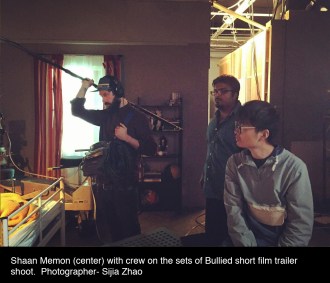
“Many that have been bullied commit suicide or go through a lot of mental stress and it affects their health and career hugely. This story teaches not to take revenge. It takes a lot of courage and many times we have to face huge losses. This movie teaches the path to redemption with being responsible, smart and courageous. I think this story is very important in today’s world,” said Shaan.

Shaan was inspired to write a story about bullying after experiencing it first hand in his first semester of University in India. He was brutally bullied by senior students who were politically very powerful. Under such circumstances, he had no one to turn to, as everyone was intimidated by such influential people. He struggled a lot, and experienced anxiety from the events for three more years. However, he did not let the experience break him, and he decided to write this script to encourage a positive outlook for victims, showing the value of life beyond bullying.

“It was a great experience sharing each other’s experiences and learning from this. I found out that the problem of bullying is much larger than we think, and a lot of people need help with this. Helping people and making positive changes in someone’s life gives me satisfaction, and that is what I liked about working on this project,” he said.

While writing the script, Shaan researched online, in books, and travelled to many schools to talk to students who had been bullied about their experiences. He also talked to teachers and staff to see what the repercussions and protocol were in such situations. He found that an overwhelming number of students in the LGBT community experienced bullying every day, and therefore wanted his protagonist to be homosexual to show the reality of what these students face. He wanted their stories to be heard and displayed as authentically as possible, so he rewrote his script dozens of times while consulting with various filmmakers and victims until it was perfect.

Article02-Bullied03“I wanted to convey my thoughts and tell these stories to the viewers as truthfully as possible, as I had imagined them in my mind. I never start a project until and unless I want to convey something through that. This script is near to my heart as I had struggled a lot for several years. I had a lot to show and say about my experience. I did a lot of research, writing and rewriting to create a powerful script with a good message. And I hope once this film is made, it will help a lot of people,” said Shaan.
Currently, Bullied is still just a script, but Shaan is looking at making it into a film in the near future. Despite this, however, the film has already received attention from many film festivals based on the story. It was an Official Selection at Oaxaca International Film Festival, Mexico, where it was nominated for Best Emerging Writers Award and Best Overall Script, an Official Selection at the Urban Mediamakers Film Festival, Atlanta, where it was nominated for Best Short Script Award, and a Semi-Finalist at the Oxford Film Festival where it has been nominated for Best Short Screenplay.

“It is incredibly satisfying that the script alone is receiving so much attention, because this is not just a film; it is my small effort to spread positivity in this world. I hope that once it is made, the film gets selected to more and more festivals and a huge number of people watch it, because my main goal in making it is to spread awareness. The medium of filmmaking itself is very powerful and it has magic to move people’s heart. If used properly, it can create wonders, and that is exactly what I am trying to do here,” he concluded.

British Actor Pezh Maan captivates in award-winning French series ‘The Bureau’

Pezh Maan in The Bureau (2016)
Pezh Maan as Houtan Vosoughi in The Bureau

Pezh Maan did not choose to become an actor. For the British native, it was instinctual, similar to waking up each day and going to bed every night. There was never anything else he imagined himself doing, and as a child, he never wondered what his future would hold, he knew. He has always listened to his heart and believes that when one lives by such a rule, success will always follow. It definitely has for Maan, who has become a sought-after actor in the United Kingdom’s film and television industry.

Audiences around the world quickly became enamoured with Maan when he played the Chief Analyst and right-hand man to Christoph Waltz’ Blofeld in the 2015 James Bond movie Spectre. He is also recognized for his outstanding work in the television shows Eastenders and Tyrant. His film Unattended Item went on to critical acclaim, and there is a lot of buzz around his upcoming television series, Deep State, starring Kingsmen’s Mark Strong and Game of Thrones’ Joe Dempsie, which premieres on FOX this Spring.

“I think what I do as an actor is interpret the words of the writer and turn them into all the facets of the living breathing human being that I am being asked to play. I get into the skin of the character whilst still being myself with all my own emotional responses. When the character is somewhat at odds with my own experiences, imagination can come to one’s aid in creating a way to relate to the character. Imagination is the lifeblood of actors’ work and interpreting the text is an imaginative endeavour, and an extremely rewarding one for me,” he said.

Maan’s versatility is endless, and as a multilingual actor, his work in other languages has led to success in countries outside of his home of the United Kingdom. In 2016, he starred in the French television series Le Bureau des Legendes, translated to The Bureau in English. The series went on to become a hit with not only audiences, but French critics as well. At the COLCOA French Film Festival, it took home the TV Series Jury Special Prize and the TV Series Audience Award. At the French TV Critics Association Awards (A.C.S.), it won Best Production. It also won Best French Series at Le Parisien, Best French Series at the Globes de Cristal Award, and was in the Top 10 Series at Télérama: Top 10 Series.

“I think knowing that the season was such a success gave everyone confidence that their ideas could only build on the quality that had already been established. I’m very proud of the work that we did, and it is a great feeling to be part of a universally lauded show. Despite what people say, good reviews and accolades are validation of a standard that you hope to achieve, the excellence that your hard work is aiming for. And it is satisfying that audiences and critics alike have responded to the elements that we worked to create for them. As an actor who is always learning, it gave me some very valuable feedback, especially as the performances were singled out for praise. It validated some of the bolder creative choices I made and that the Director had the bravery to include in the final cut,” said Maan.

The show, now in its third season, is a spy thriller directed by Eric Rochant for Studio Canal +. The Bureau is based upon real accounts by former spies and inspired by contemporary events, and centres on the daily life and missions of agents within France’s Directorate-General for External Security, its principal external security service. It focuses on the “Bureau of Legends”, responsible for training and handling deep-cover agents (operating ‘under legend’) on long-term missions in areas with French interests, especially in North Africa and the Middle East. Living under false identities for years, these agents’ missions are to identify and recruit good intelligence sources.

Maan played Houtan Vosoughi, an Intelligence officer charged with investigating and arresting foreign agents who have penetrated Iran. He has a wife and family who were oblivious to the danger and risk he was facing in his everyday role. As such, he was capable of leading multiple lives successfully without disturbing any of the delicate balances of each, all while still maintaining his sanity. He was a man capable of extreme violence, which was kept very deeply hidden behind an impassive exterior and a sense of decorum. He was a skilled communicator and could use words as weapons to disarm his opponents and reveal information without needing to resort to violence. He was also very self-confident in being able to handle people who were not trustworthy but had vital intelligence. Maan’s character was pivotal to the success of the second season of the show. He was the man who put all the pieces of the puzzle together that had been accumulating as the episodes progressed and discovered double agents that had infiltrated security. Through a series of cleverly crafted scenes and after interviewing a number of suspects he was able to make the arrests that lead to the series climax.

The arrest of Sara Giradeau’s character, Marina, was a pivotal moment in the story that created a climate of fear about the severe consequences that awaited her and her colleagues. Houtan’s arrival in the story as a dark horse and sinister figure was timed to escalate the tension that had been mounting and his quiet probing into the activities of the protagonists, aided by a wonderfully nuanced script, served as the catalyst for the exciting climax.

Maan has been a fan of French Cinema for quite a while, and when the opportunity to audition for the show came about, he eager to partake. After reading for multiple roles, Maan was chosen by the producer for the essential role of Houtan Vosoughi. The producers knew of the actor’s work in Spectre and they wanted to imbue the character of Houtan Vosoughi with a similar kind of cutting edge mentality.

“I watched the first season of The Bureau and was very impressed with the economy of style and the cinematic pace that gave the show a very unique atmosphere akin to some of the great cinematic thrillers. It was brilliantly acted, and I wanted this show to be my first French language production,” he said.

To prepare for his role on the series, Maan studied the first season, making sure to pick up on the details and nuances of the atmosphere, characters, and style of the show. From there, Maan created his character off the pages of the script. He decided Houtan’s actions would be expressed through stillness and facial expression as much as possible, keeping in line with the intelligence operatives holding multiple cards close to their chests. Maan also wanted to generate a lot of tension in the investigation and interrogation scenes, with the idea that he was leading the audience closer to the danger and intrigue of the plot. He executed this to perfection.

Maan also studied similar American shows, such as 24, stylizing his character similar to Jack Bauer. By doing this, he noted the subtlety of the acting and Keifer Sutherland’s ability to portray level-headedness in high stakes scenarios. Maan used this as a reference to find the right tone for his character. He also watched a lot of old crime thrillers in the French language and worked with a dialogue coach to bring out the nuances of the language.

One of the highlight of the experience for Maan was shooting in Morocco, where most of the scenes take place. Not only did it feel authentic, he says it is one of the most beautiful locations he has working in throughout his career. The other highlight, of course, was working with such a tremendous team.

“Working with so many experienced and talented artists was an exciting challenge that definitely motivated me to produce better work. It was such a collaborative experience on set with cast and crew which brought out the best in all of us and the atmosphere was a really lovely one to work in. The level of detail that concerned the Director, Camera team and fellow actors brought a high degree of excellence to the ambition of the project and one that was artistically very satisfying to be part of,” said Maan.

Be sure to watch the second season of The Bureau to witness Maan’s stellar performance as Houtan Vosoughi.

Pauler Lam talks dancing on ‘Steady Mobbin’ and pursuing what makes him happy

It doesn’t feel like that long ago for Pauler Lam that he was working a 9-to-5 in the corporate world. He found that each day sitting behind his desk ate away at his soul. He was working for a pay check, but it wasn’t what made him happy. Then, five years ago, he decided to take his hobby of dancing, which he spent 16 years training for, and transform it into his full-time career. Immediately, he felt a shift in his outlook on life. He was happy, doing what he truly loved. This joy he feels from dancing is contagious, and those who watch him perform, whether live or on television, feel it too.

With an impressive career working on television commercials, Buzzfeed videos, live performances, and various television shows, Lam has become a sought-after Breakdance and Hip-Hop dancer. Originally from Australia, he has taken the American dance industry by storm, and recently was the principle dancer in two national commercial campaigns: one for Hotel Indigo, and the other for American Crew. In both instances, his talents as a dancer and performer are enthralling, grabbing audiences’ attention around the country.

“I am a very driven person who only does what I know will ultimately make me happy and allow me to bring others joy and in turn, give back to the universe. This for me is dance,” said Lam.

One of Lam’s first breakout professional dance roles in the United States was on the television show Steady Mobbin. The series highlights diverse groups of dancers performing various flash mob styles in major cities, empowering the audience to bring out their inner dancer. The surprise element of the flash mob serves as a reminder that art, in this case dance, is all around us in everyday life.

“I loved that the show was about dance. The dancers were the star of the show, not just in the background. The producers understood how important and amazing dancers are and wanted to put us in the spotlight,” said Lam.

The production on the show began in September 2015. In that first season, Lam was featured in episodes 3, 4, 5 and 6. Each episode took a week to film, including rehearsals. Steady Mobbin premiered on The Dance Network both in the United States and worldwide in February of 2016.

As well as being a principle dancer, Lam was also given a feature in an episode where he was interviewed. He was able to explain his background in dance and provide his back story to the viewers. He also had a solo dance moment where he was able to showcase his breakdancing skills.

“It feels amazing to know that people everywhere are able to see me do what I love. It is great exposure for myself as a performer and entertainer in the dance industry. I truly feel blessed to be able to be a professional dancer and the fact that I can do it for a living and put my work out there for the whole world to see is indescribable,” he said.

When Lam first went to audition, he made an error that he now considers to be his saving grace. At the time, he had misread the audition details and went to the venue a day early. No one was there. and it made him very feel very inexperienced as he was new to the industry in those days. However, his mistake actually helped with his nerves, and when he returned the next day all of the initial fear he felt the day before had vanished; he had time to settle down and laugh at himself. When he came back the next day and auditioned, he impressed the Director, Aaron Mostow, as well as the well-known dancer/choreographer Suze Q (known for dancing with the celebrated pop group The Black Eyed Peas) who was running the auditions. While performing, Lam displayed his vast skill and versatility. It was only a week later when he was booked for lead role in the show.

Quickly noticed during the audition process for his unique ability to perform hip-hop choreography as well as bust out exceptional breakdance moves, Lam was essential in the creation process of each episode. In order for the choreography pieces to have a dynamic and recognizable moment, he was frequently featured doing a flip or a trick for the episode’s “wow moment”, keeping the audience captivated. Usually a Bboy would not do the choreography and stick simply to breakdancing, but Lam was able to do it all and help create flawless pieces and smooth transitions for the choreography, and ultimately, the show’s success.

“Pauler is one of the most skilled and versatile dancers I’ve ever come across. He can do Hip Hop choreography and breakdance. That’s a very rare thing for a Bboy to be able to do choreography too. So, I knew right away after seeing him at the audition that he would be perfect for my show. We featured him on an episode and he absolutely killed it in his solo with his crazy tricks and flips. He was so easy and fun to work with and I would love to work with him again,” said Director Aaron Mostow.

Because the show focused on dance, and everyone involved had dance experience, Lam was eager to be part of this experience as one of the first major projects of his career. While on set, he made sure to stay focused, adapt easily, and be professional. Despite the challenge of having to learn many pieces of choreography in a short time frame, with cameras pointed at him and producers watching, Lam shone in each number. Working on the show truly exposed him to working under pressure, something that is common in the industry, and he quickly learned how to excel under such conditions.

“I am, and will always be, very grateful for this opportunity. The other dancers on the show were really fun to work with. Everyone was happy to be in rehearsal and on shoot days. I made some of my first proper LA friends from this show and am proud to still be good friends with them today. I was able to showcase my skills and versatility as a dancer for the first time in the Los Angeles dance industry. I’ve come a long way since then and will continue to push and grow further as a performer. And a special shout-out to Suze Q, Aaron Mostow and all the other dancers from Steady Mobbin,” said Lam.

Being able to showcase his skill on television earlier on in his career opened many doors for Lam, and he is extremely humbled by the experience. Since being on the show, he has become an in-demand dancer in America, with no plans on slowing down. His journey reaffirms that pursuing his dreams full-time was the right choice, and he has never looked back.

I know that this is what I am meant to be doing and truly believe that I am in the right place. I will continue to push myself in this industry to achieve all of my dreams and be the best and happiest version of myself that I can be,” he concluded.

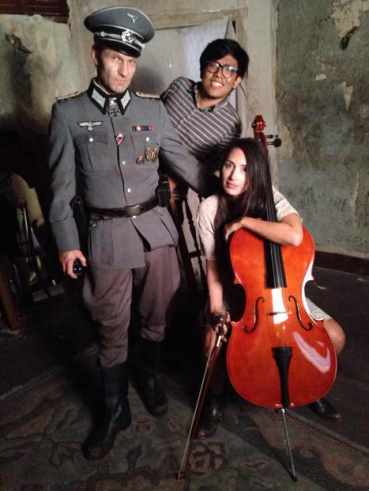
EXCAVATING THE EMOTION OF HISTORY WITH A CELLO

working photo for cello player

(By Luigi Paglia)

Dong Lei has many credits to his career as a production designer. As PD for award-winning films such as Emily, Cage, and Next Door, he has enabled films of varying genres to deliver their story with immense success. Sometimes one must step out of a comfortable role in order to stretch and learn. For Lei, taking the responsibilities of writer, director, producer, as well as production designer allowed him to challenge himself in creating a period piece. The Cello Player takes place in the mid 1940’s World War II era and is a remarkable in its recreation of the look of this time in addition to conveying a heart-wrenching experience. The story takes place in Poland as the Russian army is about to converge on German officers taking refuge in a brothel. A musician who plays for the entertainment of patrons is toyed with by a German officer who is facing inevitable surrender. Hoping to enact power and control over those in the brothel, in particular the Cellist, the officer conducts a game of mental/emotional cat & mouse. The constitution of both is tested as the sounds of war outside the walls of the building escalate.

Dong’s work on The Cello Player was recognized in 2017 with the “Best Production Design” award at both the Hollywood International Moving Pictures Film Festival and the Los Angeles Independent Film Festival. A responsible production designer always begins with immersion in research. A period piece such as The Cello Player requires more than the average amount of this if you want astute audience members to buy into the believability of the story. Lei spent considerable time researching in museums, libraries, and online to ensure that he created an environment which contained no cracks that could reveal the modern day in this World War II era drama. He spent time interviewing the older generation familiar with this bygone time as a final jury to vet the weaponry and technology displayed in the film was accurate. Actor Thure Riefenstien (known for his work in The Man in the High Castle, among others) played the German officer in The Cello Player and has had extensive experience appearing in films of this era. He comments, “Due to my own lengthy history of success in the international film industry I feel fully qualified to judge Dong’s exceptional achievements. I found his attention to detail impressive and insightful. In particular, we discussed the look of authentic German uniforms. As an actor, the costumes and the sets are a part of what allows you to become lost in the character and believe in yourself. The look that Dong achieved for this film was second to none. This greatly assisted myself and the other cast members to deliver a performance at the top of our abilities.”

Dong acquired props through prop houses and aged them to feel appropriate to the location in which the film takes place. The location was an actual hundred-year-old brothel. Always a stickler for details, Dong had the entire set wired for European electricity even though it was originally wired for US electricity. He hired a European electrical worker to rewire the set with the intent of giving complete accuracy to its appearance and design. With this completed, the set, specific wardrobe requirements (which Dong had created at Western Costume), and accoutrements like vintage typewriters, the entirety of the mid 20th century was complete. While these all play a prominent part of the film, a central piece is the Cello. The production designer acquired it via an unexpected circumstance. When Dong contacted a composer to create an original musical piece for The Cello Player, he met with him to discuss the story and this composition’s emotional contribution. The composer was so touched by the story that he offered up one of his beloved mid 1940’s Cellos as a prominent prop for the film. The action of the film vacillates between domination and détente in a compelling look at what we demand from ourselves and others when we have power, framed in a tale of a time when people were often at their worst.

Dong Lei openly admits that the work required from him to manifest the look of this film was immense. Over planning was the template which he used. The budget may not have been supportive of this goal but it’s a resourceful production designer who finds a way to achieve their own professional goals within these constraints. The look was so convincing that many of the actors profess that it inspired their performances. Thure Riefenstien himself was so moved by the story and setting that he gave an unplanned interview (while in his Nazi costume) about the lives of his own family’s personal experiences in Germany. The tale was so emotional and riveting that it was actually included in the final cut of the film. The work of Dong Lei cultivated a sense of believability that blurred the lines for both audience and cast of The Cello Player.

Dominic Kay terrifies as conflicted veteran in ‘White Settlers’

Photo by Ian Thraves 4
Dominic Kay, photo by Ian Thraves

When one asks Dominic Kay why he went into acting, his response is quite simple; he would not have been happy doing anything else. Every day he arrives on set, he is eager to get started. Acting never feels like work to Kay, and the long days and trailer time that some find disheartening just add to the experience for this British native. He humbly feels lucky to do what he loves every day, and audiences around the world feel lucky to watch this talent on both the big and small screens.

Kay’s work in film and television has made him instantly recognizable in the United Kingdom. He has appeared in shows such as Hollyoaks in the City as well as the renowned British soap Coronation Street. His work in film includes the acclaimed historical drama Allies, and many more. However, this actor does not limit himself to just one genre, and as the villain in the 2014 horror White Settlers, Kay’s versatility is evident in every scene.

“This project appealed to me initially due to the fact that it was an opportunity to work with a director and producer that I heard very good things about. Then once I was read the script I was hooked, I read the whole screenplay in an hour, then immediately phoned my agent and told her that I wanted to do it,” said Kay.

White Settlers tells the story of Ed and Sarah’s first night at their new home – an isolated farmhouse on the Scottish borders. This should be a new beginning away from their stressful London lives. And at first it is; come sunset they fall in love all over again on a wander in the woods. But as darkness falls, Sarah suspects they’re not alone, Ed goes to investigate and quickly, the evening becomes a nightmare. It suddenly dawns on them; they do not belong here, and they certainly aren’t welcome.

In White Settlers, Kay plays Local, the antihero. He is an ex-military psychopath, who stops at nothing to get what he wants. He is hard as nails, a bully, and a pack leader. He is definitely not one to be taken lightly. As you get further into the film, audiences see his desperation turn sadistic, forcing him to become more and more ruthless. He thinks nothing of terrorizing people to get what he wants. From when he first enters the feature until the very end, he causes nothing but chaos.

While playing such a menacing role, Kay made sure to maintain the constant barrage of peril and volatility. Particularly in the scenes without dialogue, he managed to be terrifying just with body language and facial expressions. To maintain being threatening and intimidating without being overdramatic can be a challenge, but Kay did so flawlessly. He exudes malice and instills fear into his c audience by doing as little as possible. He always made sure he brought an element of truth into his character. In one particular scene, he acted out of instinct and went off book. The director, Simeon Halligan, loved what the actor did and Kay’s instincts proved fruitful, as that scene made the final cut of the film.

White Settlers gave me the opportunity I had been waiting for a while – to play a real nasty piece of work. I love to play around with characters, and this character was going to be fun, despite being a challenge. I had to be very menacing, intimidating, and scare the life out of my co-stars. Decision making and being brave was key for this character. It was a difficult mindset to get into, so I found that if I wasn’t fully immersed into him it could come across a little forced,” Kay described.

Kay’s work as the leading bad guy helped White Settlers achieve international success at many prestigious film festivals. The film premiered at the 2014 Film4 FrightFest. It was the winner of the ScreamFest Festival Trophy – Best Cinematography 2014. It was then distributed by Falcon films, Grim up North. Many critics were impressed by Kay’s ability to terrify yet still be endearing. The Producer of the film, Rachel Richardson-Jones, credits Kay as being one of the driving forces of the horror film.

“I cast Dominic to play the lead bad guy in the film. He was an integral part of the cast and did a great job. We were hugely impressed by his acting skills and how he adapted to the role. He was a great addition to the cast and was good to work with. He was very professional and hardworking at all times,” said Richardson-Jones.

When casting for the film, Richardson-Jones immediately thought of Kay after seeing the actor in a television show. She invited him in for a meet and greet, and once Kay read the script, it was a perfect match. He was eager to explore a side of himself that he never had before, and working with a team that he knew would be ideal, he immediately said yes to the part.

“This project was great to be part of. Well, having to portray a character that is a complete psychopath was a joy and a challenge to be honest. It was great fun it gave me freedom to express my darker sides and go even further with them. The director was a credit to the production and got the best out of me with ease. The whole cast just performed really well and everyone bounced of each other adding the performances,” said Kay. “It’s not every day you get to be an axe wielding mad man and terrorize innocent people.”

This year, audiences can see Kay on the big screen once again in the feature Walk Like a Panther. The film tells the story of a group of 1980s wrestlers who are forced to don the lycra once last time when their beloved local pub is threatened with closure. Kay is incredibly eager to share this film with audiences around the world.

It is without a doubt that Dominic Kay is an inspiration to those looking to pursue acting not just in the United Kingdom, but around the world. He always knew acting was his passion, and never gave up on his dream, and he has wise words for those who would like to follow in his footsteps.

“Read as much as you can and expand your vocabulary. This understanding gives you so many more places to go with your performance. You can identify subtle changes in scenes and make better decisions based on the information in front of you. Secondly, I would advise that you study yourself and identify exactly who you are deep down – your core characteristics. This understanding of who you are lets you know what you bring to the table, what you are selling. There’s no point in trying to be something you’re not, because people can see through. Lastly, don’t be scared of letting yourself go or looking a fool, and be brave in your decision making. Unless you are very lucky, success won’t come easy, so work hard,” he concluded.


Photo by Ian Thraves

Actor Chris McNally’s Dramatic Trip to ‘Heaven’

Actor Chris McNally’s easy going, amiable demeanor is completely genuine, but the Canadian-born performer is capable of utterly transformative characterizations, fraught with subtle psychological nuance and stark, emotional depth,  It’s an attribute that’s served him well in a fast-moving career which  has taken him from aspiring supporting player to major lead roles, and his striking portrayal of Cal Dennison in Lifetime network’s forthcoming adaptation of the celebrated VC Andrews novel Heaven is a prime example. For McNally, landing the film’s second lead was the almost inevitable conclusion of a lifelong passion. “I just have always wanted to be an actor, ever since I can remember,” McNally said. “I’m not sure what initially prompted my interest, but there really was nothing else I ever thought to pursue.”

 Heaven, which sparked an entire series of best-selling novels, is a sort of glorious throwback to mid-century Peyton Place-era tearjerkers, loaded with melodramatic moral and social conflicts and fraught with scandal and hopelessly romantic entanglements. In the case of titular character Heaven Casteel, a comely teenager who finds herself sold off by her abusive father to a childless couple only to reluctantly submit to the male head of her new household’s seduction, the story line definitely pushes some boundaries.

 As McNally explains, “Heaven follows a teenage girl and her difficult journey through adolescence. The story begins in a dark place—Heaven lives with her alcoholic father, pregnant stepmother, grandmother and siblings in a small, dilapidated house in the mountains. When Heaven’s stepmother loses her baby, it triggers a tragic chain of events, ending with her father selling all his children and separating them. Heaven ends up with Cal and Kitty Dennison, who seem great at first, but life becomes even more complicated when Kitty begins having schizophrenic, abusive tendencies and Cal falls in love with Heaven.”

 To call the role of Cal a challenge would be a tremendous understatement, and McNally approached it with a characteristically canny mix of dramatic craft and emotional restraint.

 “Things become complicated when Kitty begins mentally and physically abusing Heaven, not letting her outside the house, forcing her to clean all day,” McNally said. “Cal finds himself trying to shelter and protect Heaven from Kitty’s actions. During this process though, Cal starts to develop romantic feelings for Heaven. This was the most difficult part to navigate, because we didn’t want Cal to come off as a predator.”

 McNally’s natural, persuasive approach to a role is so convincing that, in fact, he got the part despite the fact that he had to audition remotely, via a tape shot in a friend’s apartment—hardly an ideal circumstance. “I couldn’t attend the audition since I was out of town,’ McNally said. “So I asked a friend for help taping it. We got together in his tiny kitchen and made do with what we had. When I got back to Vancouver, I had a callback, so I went in for a session with the director and producers, and a week later was told that I’d gotten the job.”


chris-m-b

After landing the part, McNally got down the very serious business of making his character sympathetic.

 “I tried to prepare for this by using the relativity of the circumstances as structure,’ McNally said. “I doubt anything would ever have transpired between Cal and Heaven if they were in a normal situation. Their reality, though, is that they both find themselves as prisoners in this house arrest-like jail that Kitty has created. So within the walls of the house, we have this warped reality, separate from the real world. In that world, I looked at Heaven as my ally, and I protect her, we bond, and her earnestness and kindness begins to authentically fill a void in my heart that I hadn’t realized, until then, that Kitty never did. I’d say that was my main prep—understanding how and why these feelings came to be, and making it work for me.”

 This precisely reasoned motivation—calling back to Stanislavski’s famed dramatic admonition to “play the life”—is key to McNally’s appeal and success, artistically and professionally. In just over a decade, his continually rising profile has led to a formidable resume of on-screen achievements, with numerous roles, both on television series and small-screen movies and 2018 looks to be a banner year for the actor—he not only has Heaven coming out soon but also a recurring role in the highly anticipated Netflix original series Altered Carbon, already making a significant Hollywood buzz for being one of the most ambitious and highest budgeted series in television history.

 All of this was earned solely by McNally’s dedication. “Chris has a lot of talent and passion which he brings to his work,” co-star Julie Benz said. “He’s disciplined, reliable, passionate about his craft and he really delivers when the cameras are rolling. It was refreshing to work with a young actor who is more interested in the craft of what we do than how many Instagram followers he has.”

 It’s an exciting time for the perpetually driven McNally, who remains a down to earth, affable guy with a winning, attitude.

 “I believe you only have one chance at life, so if you really want something, you need to do everything in your power to make it happen,” McNally said. “I use that philosophy every day and it inspires me to keep going after my goals, to keep training, keep auditioning—and working.”

Cinematographer Guy Pooles’ Intuitive Visual Style

When it comes to movies, the audience always focuses on the actors and plot line, yet there’s one key behind the scenes player who not only captures the entire picture, he also conveys the mood and atmosphere in manner that really puts the entire plot and action across. This, of course, is the cinematographer, an essential contributor to any film and one of the top young guns working behind the camera in 2018 is the talented British-born cinematographer Guy Pooles.

Pooles came to the field through an unlikely conduit, one both poignant and liberating in its unusual nature.

“I’ve always suffered from quite severe dyslexia,” Pooles said. “Growing up, this would make it difficult to consume fiction via the reading of a book. So, films became my primary window into the world of fiction and storytelling. Paired with this fascination for cinema, I also adopted, at a young age, a great love for photography. As both of these interests grew and deepened throughout my life, they slowly evolved to form one entirely consuming fascination with the art and craft of cinematography. I was and continue to be, endlessly amazed at the human ability to tell stories through nothing more than the juxtaposition of images.”

The camera freed Poole from the constraints his condition often imposed and this unusual quality imbues his work with a clarity, vision and overall sense of artistry which really sets him apart. Moreover, Pooles’ approach to cinematography, both as an art and a science, relies on the emotional elements of his assignment, and his ability to blend the aesthetic and technical underscores a uniquely empathic brand of craftsmanship.

“My narrative interests seem to move through all genres, spanning many subject matters, artistic styles and tones,” Pooles said. “I think the one constant that a story I work upon has to possess, is an element of raw human truth. If the film never takes a moment to teach the viewer an emotional truth about his or herself, then I find it very hard to approach the cinematography from an emotional level, and I find it very hard to do my job well.”

Pooles’ always outstanding work is primarily achieved through his own regard for the story and, ultimately, forges an ideal vision of how to present it to the viewer: Case in point, his work on Marko Grujic’s extraordinary short film Unaligned. A tale of unconventional May – December romance between a college student and her one-time female babysitter, Grujic’s story came loaded with exactly the sort of raw psychological components Pooles thrives upon.

“Marko reached out to me after seeing my work on a low-budget web-series called The Ferryman,” Pooles said. “I believe this is because he knew he would require a cinematographer who could execute a complex production without sacrificing the emotive potency of the film’s visual language.”

The director’s instinct was spot-on. “Guy is much more than a common cinematographer,” Grujic said. “He goes deep into the characters psyche and translates it visually on screen with lighting and framing. Guy listens and adjusts to a situation. He understands a director, asks a lot of questions and tries to figure out things from more than one perspective. He is a tremendous talent.”


guy-pooles-1

Although a short, the project presented its fair share of challenges. “The budget of film was very small, as was the crew,” Pooles said. “In light of the scope of the screenplay, it is safe to say that the production was quite ambitious. Our schedule was often so tight that, to fall behind even by few minutes, could result in losing the opportunity to shoot key scenes at the end of each day. Marko and I had to work meticulously with the first Assistant Director to ensure that our plan for the schedule was as watertight as possible and that we were prepared for contingencies, should something go wrong.”

Pooles’ used a shrewd, holistic methodology that took into consideration both the film’s logistical and artistic needs. “My approach to lighting was quite different on this project,” he said. ”I worked hard to keep my lighting set ups as simple as possible, often trying to key a scene off a practical lighting unit already on location. I did this knowing that every minute saved from a lighting standpoint would free up more time for the cast to get the performances that they and Marko were striving for. I was very aware that with a story this intimate and character-driven, it would be very hard for an actor to relax into her or his performance if they were constantly under the gun schedule-wise.”

Thanks to the seamless Pooles-Grujic collaboration, the film was successfully completed and will begin screening along the busy festival circuit later in 2018. For Pooles, who won the American Society of Cinematographers Linwood Dunn Student Heritage Award in 2014 for his work on the short film Dirty Laundry, it’s another step forward in his fast moving journey of professional accomplishment. With a raft of credits both in the camera & electrical department and as a cinematographer (including 5 episodes of TV anthology series Two Sentence Horror Stories), Pooles is poised to emerge as one of the leaders in his field.

“My philosophy has always been, that a viewer should never be able feel the cinematographer’s hand upon a film,” Pooles said. “The visual style can be bold and assertive, but the minute this leads a viewer to dwell upon the strength of the cinematographer’s work, rather than the potency of the storytelling, the entire narrative experience will begin to fall apart. The cinematographers that I admire the most are those whose work remains largely unrecognizable from project to project and who guide a viewer, almost subliminally, along the emotional path of a film.”