Category Archives: Film

Production Designer Laura Santoyo talks new film ‘Falling’

Learning about various aspects of humanity is a passion of Colombia’s Laura Santoyo Dangond. Originally from Colombia, she has also lived in Peru and Canada, and loves to travel to experience different cultures and learn new languages, fluent in Spanish, English, French, German, and Portuguese. This desire to learn about the world and its people is part of what led her into filmmaking. With every new project she embarks on, she gets to tell a different story and learn something new about history, society, the human mind, and more. Beyond the stories, she works with people from all over the world that have different backgrounds and ways of seeing life, and together they share and experience their differences through their art. As a production designer, Santoyo takes everything she has seen and practiced and channels that into creating visually stunning and captivating sets and props that fully transport audiences into what they are watching.

“I make an effort to stay true to the story and what the characters are. I do a lot of research on the characters and the environment where they live. I also try to have many exchanges with the director where we discuss characters and share research and inspiration images, etc. to understand their vision and the direction they are taking the story to. I like to play with colors and used them to imply aspects of the story that are not explicitly spoken by the characters,” she said.

Santoyo is known for her work on award-winning films such as Lockdown and Tim of the Jungle, both of which made their way to several of the world’s most prestigious film festivals. Last year, her film The Plague premiered, reminding audiences of what she is capable of, as Santoyo created a dystopian world. Her most recent film premiered just last month at the Slamdance Festival, and once again Santoyo shows she is unrivaled as a production designer.

Falling set_2
Bill Bowles, Laura Santoyo Dangond and Ewen Wright on the set of Falling, photo by Sam Shaib

“As soon as I finished reading the script I felt like I had to be part of the project. It is one of the most original scripts I have read, very intelligent and I thought that it was a story that had to be told and that I wanted to tell it,” she said. “The script of this film describes a number of absurd situations and uses humor to address subjects that are affecting our society. It was very important that the design of the movie supported the comedic tone without ridiculing the situations.”

The film tells the story of a potentially psychosomatic white man, a woman stuck in a vortex of mansplaining, and a young black man confronted by the racial disconnect of society, each trying to make sense of their lives as their worlds are set on an inevitable collision course in this surrealist comedy.

It was important for Santoyo and the rest of the team to differentiate the three storylines that run parallel to each other and to show the absurdity of the situations without being too over the top. Therefore, they assigned one color to each character.

The first story, about a man who can’t walk, represents the feeling of impotence that someone watching the news at night can feel when they see injustices with no way to help. This character takes the “sickness” he feels to the extreme. Therefore, they decided to use the color blue with him, which is very clinical.

The second story, about a woman who’s caught in male-dominated conversations turmoil, was assigned the color red. She is often angry and frustrated, and all the men that she’s with see her and other women as objects. Santoyo felt red reflected these feelings.

The third story is about a black man, who in the most absurd situation, ends up being shot by the police. The filmmakers gave him the color green, because he’s young and innocent at the beginning and at the end it is his case that makes the man in the first story sick.

“As a society, we are still fighting against racism, social injustice and women’s equality and this film raises awareness on these subjects in a comedic tone. I believe that it is very important to have films like this one because we can start generating discussions that could eventually lead to change,” said Santoyo.

Working on Falling has been one of the most fun experiences Santoyo has had throughout her career. From the first time she read the script, she knew it was going to be challenging because there were many locations with three different stories that at the end become one. Each story had elements of magical realism that could also be difficult to achieve in production design. Santoyo wanted to enhance the experiences of the character through the set, but not overdo it to a point that the messages behind each scene were lost. She managed to find the perfect balance, always keeping in mind the color palette they had decided for each character early on in production.

“I think many things make Laura an excellent designer, collaborator, and professional. The first thing that comes to mind is passion. She’s clearly passionate about what she does – she made it clear that she seeks out work that she connects with on a personal and aesthetic level. Once she’s onboard, she’s obviously all-in. That shows at every phase of a project when you see her initial ideas, the hours she’s putting in, the attitude she brings to every meeting and production day, and the diligence with which she executes. Beyond that, she’s a professional with outstanding training, instincts, and experience. She knows how to present her ideas clearly – both verbally and visually, she has leadership skills, she remains calm under pressure, she knows how to prioritize, stay organized, and keep others motivated to work at a high standard,” said Ewen Wright, Director.

Wright was looking through portfolios and films for a costume designer when Santoyo’s work caught his eye. He asked the costume designer who the production designer was that possessed such talent. He immediately reached out to Santoyo, who was extremely responsive and receptive to the idea of the film. They immediately began a strong partnership and shared ideas about the film.
Falling Set
Ewen Wright, Laura Santoyo Dangond and Yonit Olsen, photo by Sam Shaib

“Laura has a creative voice, and in a key role on a collaboration that can’t be undervalued. She brings her lifelong sense of design, studied theory, and just pure instinct to her work in a way that gives her work a through-line. I really enjoyed developing a shorthand with her. Lastly, she has a phenomenal attitude and work ethic. She went above and beyond for our production – and even when things went wrong, or the hours ran long, Laura was a reliable source of positivity and joy. As a leader on the team, she set a tone for those around her that I know contributed to all of us doing better. When I was stressed or needed a moment, I always knew I could rely on Laura for a laugh – just as the rest of the time I relied on her for her eye on the image,” Wright continued.

Working with such a committed team was one of Santoyo’s favorite parts about filming Falling. She found everyone came together to tell such an intricate story, and she was constantly inspired by those she worked alongside. However, it was the message behind the film that truly made the experience for the production designer.

“I am so proud to have been a part of this film. I think it’s a story that captures the feeling that something is wrong in the world and the willingness to change it, but not knowing how to go about doing so. I think many people feel that now. I’m thrilled to know that it’s being watched by many people and it can maybe inspire some change in our society,” she said.

Now that Falling has begun its film festival run, Santoyo is looking forward to her next project. Undoubtedly, she has a very bright future ahead of her, and audiences can continue to look for her name rolling past their eyes in movie credits for years to come.

“I want to keep exploring and finding new stories to tell and more talented people to work with. I am looking forward to creating more worlds where magic is possible. I want my work to reach even larger audiences and present stories to the public that entertain them and that touches them. I have a couple of projects in line for this year that hopefully will help me accomplish this,” she concluded.


Top photo by Jesper Duelund

Chinese Actor Yifan Luo talks upcoming film ‘Rift’

As a child, growing up in Shanghai, Yifan Luo did not see himself as an actor. In fact, he was very business oriented, and the arts were not a feasible career option for him at the time. However, as a teen, everything changed; when he stepped on the stage for the first time as the lead in his high school play, he experienced the unique sensation that only comes from doing something you truly love. His passion for acting was born at that time, and now, over ten years later, this passion only grows stronger each time he steps onto a new set.

As an in-demand actor in both China and abroad, Luo is constantly looking for different roles than those he has played previously. He aims to portray as many different personalities as possible, from a schizophrenic psychopath in the film SAM to a jokester college freshman in the feature Talentik. His versatility knows no bounds. With the four films he has coming out this year, each character explores a different side of humanity. In the upcoming movie Rift, Luo once again plays a different role than he ever has.

“The character of the psychologist is somewhat complex. Yifan is perfect for the role and his performance is excellent. He is a professional and dedicated actor. I definitely want to work with him again,” said Jing Ge, Producer.

Rift is a compelling science fiction film focusing on a series of characters. It begins with Sergeant Howard receiving a case that Professor Miles is missing. The main character, Yu, is considered as the prime suspect. However, Yu denies everything. According to his testimony, Yu killed Proffesor Miles ten years ago for the professor’s plagiarism of his thesis paper. Yu was sent back to China after he was released from the prison. Through investigation, Howard believes that he is lying about something regarding the case. However, the psychological consultant, Gu Shenming, holds a different opinion. Yu gives them an unbelievable explanation that he comes from a parallel universe. Howard doesn’t believe Yu, but he has no evidence, so he has to release Yu after 48 hours. Yu’s girlfriend Xin bails him out. Howard is shocked when he sees Xin, because this girl was murdered five years ago by a serial killer. When Yu sees Xin, he is also surprised that Xin is still alive. Two days later, different female bodies are found in suburban Los Angeles, related to a serial killer, all while travelling through parallel universes.

Rift 3
Yifan Luo in Rift

“Science fiction is always what people like to watch. Especially now in China, it is a very popular topic in film/TV shows. In this story, we see different kinds of people, good and bad. It is a real society that the film creates. It brings us a world where the hero is a real man who would never reach his goal without the help of people around him. Of course, the hero gets what he needs in the end, which also encourages the audience to go for what they want,” said Luo.

In Rift, Luo plays Gu Shenming. His character is the psychologist that works for the police. He talks to the suspects and makes the conclusion regarding whether they are lying or not. In the story, when the main character comes from a parallel universe, nobody believes what he says. Therefore, the sergeant sends Gu Shenming to talk with him and expects that he will be proved a liar. As the conversation progresses, Gu gradually believes in what the main character says and starts to suspect that the sergeant actually knows a secret about the case that he doesn’t want other people know. Finally, Gu makes the conclusion that the main character is not lying about anything, which infuriates the sergeant.

Gu Shenming is the only person that believes in what the main character, Yu, says about travelling from the parallel universe. Without the character, the main character would have been sent to prison at the very beginning. It is this character that keeps searching for evidence that proves Yu is not lying about anything, and the psychologist is the one who finally destroys the sergeant’s plan. During the process, Luo’s character is under the immense pressure but never gives give up. He does his duty as a psychologist and prevents the main character from being persecuted.

“I read the synopsis of the story before I went for the audition. I really liked the idea of a parallel universe. The character I auditioned for is a very smart psychologist who works for the police that diagnoses whether the leading guy is crazy or not, since he keeps talking about a parallel universe, which is totally what I’m good at. I believed that I could do a very good job in playing such a role,” said Luo.

As the story has the setting of a parallel universe, the actors were required to frequently move between the universes in the story, meaning the cast and crew had to constantly change the set, costumes, and makeup. Because of this, everyone had to be on top of their game. Luo made sure to be extremely familiar with the script and storyline, even for scenes he was not in. This also created a great sense of teamwork between everyone on set, as they were constantly working to make filming as smooth as possible. For Luo, it was working with everyone on the film that made working on Rift such a great experience.

“It was a great experience to work with Yifan. He is very professional and very passionate. As a partner, he is very considerable. He even helped me read the lines so patiently when I was doing my close-up shots. He always spends a lot of time working on the character before he goes to set. He is also creative at the same time. He has a sense of humor that makes his acting unique.  He is one of my favorite actors I have ever worked with,” said Yun Xie, Lead Actress.

Keep an eye out for Rift at a film festival near you.

Shaan Memon writes of the harms of bullying in new film

Article05-pdsdocu02Shaan Memon believes a film is made three times. At first, it is the writers; they are responsible for visualizing the tale in their mind and creating the characters, personalities and setting. Then comes the actual filming process, which is at the hands of the directors; they see the script and turn words into worlds that will transport audiences from their seats to another reality. Finally, the editors have the responsibility to turn shots into a story; they put everything together in a way that flatters the actors, compliments the set, and captivates audiences. As a true film lover, when Shaan was choosing which path to take in filmmaking, these roles all spoke to him, and he decided to pursue all three. As a celebrated writer, director, and editor, Shaan is showing not just his home country of India, but also the rest of the world, what he is capable of.

No matter the medium or genre, Shaan’s understanding of filmmaking is outstanding. Whether making a commercial, like the ones he recently did for Dickens Fair, a documentary, such as Purpose Driven Study for Dharoi Canal Command Area, or films like his new drama Fitting In and the acclaimed The Unreal, Shaan’s talents are on full display. He is a consummate professional, consistently impressing audiences and peers.

“Unlike so many, Shaan knows what is important to the production of film. He listens to advice, eagerly pursues the best, and delivers. He’s quite professional. He’s definitely a man of his word. When he says he will get the job done, he gets it done,” said Doug Campbell, Director.

Article02-bullied02Last year, Campbell consulted Shaan while writing his film Bullied, a story of a gay teenage boy who is being bullied by a gang of older boys in his high-school and living with his single mother. He decides to take revenge by killing the leader of the gang. On the verge of executing his plan, he remembers his mother’s words of wisdom.
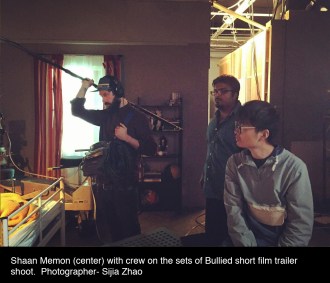
“Many that have been bullied commit suicide or go through a lot of mental stress and it affects their health and career hugely. This story teaches not to take revenge. It takes a lot of courage and many times we have to face huge losses. This movie teaches the path to redemption with being responsible, smart and courageous. I think this story is very important in today’s world,” said Shaan.

Shaan was inspired to write a story about bullying after experiencing it first hand in his first semester of University in India. He was brutally bullied by senior students who were politically very powerful. Under such circumstances, he had no one to turn to, as everyone was intimidated by such influential people. He struggled a lot, and experienced anxiety from the events for three more years. However, he did not let the experience break him, and he decided to write this script to encourage a positive outlook for victims, showing the value of life beyond bullying.

“It was a great experience sharing each other’s experiences and learning from this. I found out that the problem of bullying is much larger than we think, and a lot of people need help with this. Helping people and making positive changes in someone’s life gives me satisfaction, and that is what I liked about working on this project,” he said.

While writing the script, Shaan researched online, in books, and travelled to many schools to talk to students who had been bullied about their experiences. He also talked to teachers and staff to see what the repercussions and protocol were in such situations. He found that an overwhelming number of students in the LGBT community experienced bullying every day, and therefore wanted his protagonist to be homosexual to show the reality of what these students face. He wanted their stories to be heard and displayed as authentically as possible, so he rewrote his script dozens of times while consulting with various filmmakers and victims until it was perfect.

Article02-Bullied03“I wanted to convey my thoughts and tell these stories to the viewers as truthfully as possible, as I had imagined them in my mind. I never start a project until and unless I want to convey something through that. This script is near to my heart as I had struggled a lot for several years. I had a lot to show and say about my experience. I did a lot of research, writing and rewriting to create a powerful script with a good message. And I hope once this film is made, it will help a lot of people,” said Shaan.
Currently, Bullied is still just a script, but Shaan is looking at making it into a film in the near future. Despite this, however, the film has already received attention from many film festivals based on the story. It was an Official Selection at Oaxaca International Film Festival, Mexico, where it was nominated for Best Emerging Writers Award and Best Overall Script, an Official Selection at the Urban Mediamakers Film Festival, Atlanta, where it was nominated for Best Short Script Award, and a Semi-Finalist at the Oxford Film Festival where it has been nominated for Best Short Screenplay.

“It is incredibly satisfying that the script alone is receiving so much attention, because this is not just a film; it is my small effort to spread positivity in this world. I hope that once it is made, the film gets selected to more and more festivals and a huge number of people watch it, because my main goal in making it is to spread awareness. The medium of filmmaking itself is very powerful and it has magic to move people’s heart. If used properly, it can create wonders, and that is exactly what I am trying to do here,” he concluded.

EXCAVATING THE EMOTION OF HISTORY WITH A CELLO

working photo for cello player

(By Luigi Paglia)

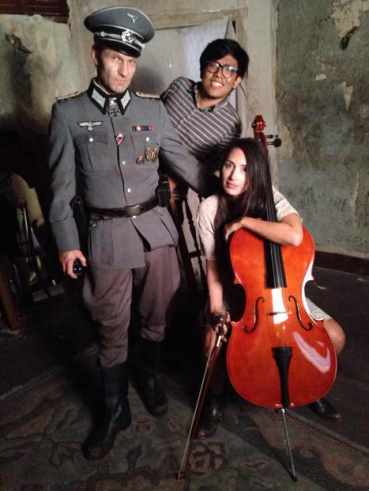
Dong Lei has many credits to his career as a production designer. As PD for award-winning films such as Emily, Cage, and Next Door, he has enabled films of varying genres to deliver their story with immense success. Sometimes one must step out of a comfortable role in order to stretch and learn. For Lei, taking the responsibilities of writer, director, producer, as well as production designer allowed him to challenge himself in creating a period piece. The Cello Player takes place in the mid 1940’s World War II era and is a remarkable in its recreation of the look of this time in addition to conveying a heart-wrenching experience. The story takes place in Poland as the Russian army is about to converge on German officers taking refuge in a brothel. A musician who plays for the entertainment of patrons is toyed with by a German officer who is facing inevitable surrender. Hoping to enact power and control over those in the brothel, in particular the Cellist, the officer conducts a game of mental/emotional cat & mouse. The constitution of both is tested as the sounds of war outside the walls of the building escalate.

Dong’s work on The Cello Player was recognized in 2017 with the “Best Production Design” award at both the Hollywood International Moving Pictures Film Festival and the Los Angeles Independent Film Festival. A responsible production designer always begins with immersion in research. A period piece such as The Cello Player requires more than the average amount of this if you want astute audience members to buy into the believability of the story. Lei spent considerable time researching in museums, libraries, and online to ensure that he created an environment which contained no cracks that could reveal the modern day in this World War II era drama. He spent time interviewing the older generation familiar with this bygone time as a final jury to vet the weaponry and technology displayed in the film was accurate. Actor Thure Riefenstien (known for his work in The Man in the High Castle, among others) played the German officer in The Cello Player and has had extensive experience appearing in films of this era. He comments, “Due to my own lengthy history of success in the international film industry I feel fully qualified to judge Dong’s exceptional achievements. I found his attention to detail impressive and insightful. In particular, we discussed the look of authentic German uniforms. As an actor, the costumes and the sets are a part of what allows you to become lost in the character and believe in yourself. The look that Dong achieved for this film was second to none. This greatly assisted myself and the other cast members to deliver a performance at the top of our abilities.”

Dong acquired props through prop houses and aged them to feel appropriate to the location in which the film takes place. The location was an actual hundred-year-old brothel. Always a stickler for details, Dong had the entire set wired for European electricity even though it was originally wired for US electricity. He hired a European electrical worker to rewire the set with the intent of giving complete accuracy to its appearance and design. With this completed, the set, specific wardrobe requirements (which Dong had created at Western Costume), and accoutrements like vintage typewriters, the entirety of the mid 20th century was complete. While these all play a prominent part of the film, a central piece is the Cello. The production designer acquired it via an unexpected circumstance. When Dong contacted a composer to create an original musical piece for The Cello Player, he met with him to discuss the story and this composition’s emotional contribution. The composer was so touched by the story that he offered up one of his beloved mid 1940’s Cellos as a prominent prop for the film. The action of the film vacillates between domination and détente in a compelling look at what we demand from ourselves and others when we have power, framed in a tale of a time when people were often at their worst.

Dong Lei openly admits that the work required from him to manifest the look of this film was immense. Over planning was the template which he used. The budget may not have been supportive of this goal but it’s a resourceful production designer who finds a way to achieve their own professional goals within these constraints. The look was so convincing that many of the actors profess that it inspired their performances. Thure Riefenstien himself was so moved by the story and setting that he gave an unplanned interview (while in his Nazi costume) about the lives of his own family’s personal experiences in Germany. The tale was so emotional and riveting that it was actually included in the final cut of the film. The work of Dong Lei cultivated a sense of believability that blurred the lines for both audience and cast of The Cello Player.

Dominic Kay terrifies as conflicted veteran in ‘White Settlers’

Photo by Ian Thraves 4
Dominic Kay, photo by Ian Thraves

When one asks Dominic Kay why he went into acting, his response is quite simple; he would not have been happy doing anything else. Every day he arrives on set, he is eager to get started. Acting never feels like work to Kay, and the long days and trailer time that some find disheartening just add to the experience for this British native. He humbly feels lucky to do what he loves every day, and audiences around the world feel lucky to watch this talent on both the big and small screens.

Kay’s work in film and television has made him instantly recognizable in the United Kingdom. He has appeared in shows such as Hollyoaks in the City as well as the renowned British soap Coronation Street. His work in film includes the acclaimed historical drama Allies, and many more. However, this actor does not limit himself to just one genre, and as the villain in the 2014 horror White Settlers, Kay’s versatility is evident in every scene.

“This project appealed to me initially due to the fact that it was an opportunity to work with a director and producer that I heard very good things about. Then once I was read the script I was hooked, I read the whole screenplay in an hour, then immediately phoned my agent and told her that I wanted to do it,” said Kay.

White Settlers tells the story of Ed and Sarah’s first night at their new home – an isolated farmhouse on the Scottish borders. This should be a new beginning away from their stressful London lives. And at first it is; come sunset they fall in love all over again on a wander in the woods. But as darkness falls, Sarah suspects they’re not alone, Ed goes to investigate and quickly, the evening becomes a nightmare. It suddenly dawns on them; they do not belong here, and they certainly aren’t welcome.

In White Settlers, Kay plays Local, the antihero. He is an ex-military psychopath, who stops at nothing to get what he wants. He is hard as nails, a bully, and a pack leader. He is definitely not one to be taken lightly. As you get further into the film, audiences see his desperation turn sadistic, forcing him to become more and more ruthless. He thinks nothing of terrorizing people to get what he wants. From when he first enters the feature until the very end, he causes nothing but chaos.

While playing such a menacing role, Kay made sure to maintain the constant barrage of peril and volatility. Particularly in the scenes without dialogue, he managed to be terrifying just with body language and facial expressions. To maintain being threatening and intimidating without being overdramatic can be a challenge, but Kay did so flawlessly. He exudes malice and instills fear into his c audience by doing as little as possible. He always made sure he brought an element of truth into his character. In one particular scene, he acted out of instinct and went off book. The director, Simeon Halligan, loved what the actor did and Kay’s instincts proved fruitful, as that scene made the final cut of the film.

White Settlers gave me the opportunity I had been waiting for a while – to play a real nasty piece of work. I love to play around with characters, and this character was going to be fun, despite being a challenge. I had to be very menacing, intimidating, and scare the life out of my co-stars. Decision making and being brave was key for this character. It was a difficult mindset to get into, so I found that if I wasn’t fully immersed into him it could come across a little forced,” Kay described.

Kay’s work as the leading bad guy helped White Settlers achieve international success at many prestigious film festivals. The film premiered at the 2014 Film4 FrightFest. It was the winner of the ScreamFest Festival Trophy – Best Cinematography 2014. It was then distributed by Falcon films, Grim up North. Many critics were impressed by Kay’s ability to terrify yet still be endearing. The Producer of the film, Rachel Richardson-Jones, credits Kay as being one of the driving forces of the horror film.

“I cast Dominic to play the lead bad guy in the film. He was an integral part of the cast and did a great job. We were hugely impressed by his acting skills and how he adapted to the role. He was a great addition to the cast and was good to work with. He was very professional and hardworking at all times,” said Richardson-Jones.

When casting for the film, Richardson-Jones immediately thought of Kay after seeing the actor in a television show. She invited him in for a meet and greet, and once Kay read the script, it was a perfect match. He was eager to explore a side of himself that he never had before, and working with a team that he knew would be ideal, he immediately said yes to the part.

“This project was great to be part of. Well, having to portray a character that is a complete psychopath was a joy and a challenge to be honest. It was great fun it gave me freedom to express my darker sides and go even further with them. The director was a credit to the production and got the best out of me with ease. The whole cast just performed really well and everyone bounced of each other adding the performances,” said Kay. “It’s not every day you get to be an axe wielding mad man and terrorize innocent people.”

This year, audiences can see Kay on the big screen once again in the feature Walk Like a Panther. The film tells the story of a group of 1980s wrestlers who are forced to don the lycra once last time when their beloved local pub is threatened with closure. Kay is incredibly eager to share this film with audiences around the world.

It is without a doubt that Dominic Kay is an inspiration to those looking to pursue acting not just in the United Kingdom, but around the world. He always knew acting was his passion, and never gave up on his dream, and he has wise words for those who would like to follow in his footsteps.

“Read as much as you can and expand your vocabulary. This understanding gives you so many more places to go with your performance. You can identify subtle changes in scenes and make better decisions based on the information in front of you. Secondly, I would advise that you study yourself and identify exactly who you are deep down – your core characteristics. This understanding of who you are lets you know what you bring to the table, what you are selling. There’s no point in trying to be something you’re not, because people can see through. Lastly, don’t be scared of letting yourself go or looking a fool, and be brave in your decision making. Unless you are very lucky, success won’t come easy, so work hard,” he concluded.


Photo by Ian Thraves

Renowned Writer Camilla Sauer Talks Top Projects

Camilla Sauer is one of Germany’s most successful head writers. Over the past 20 years of her career, she’s been accredited for her remarkable work on over a dozen different TV series, produced by some of the biggest German and European TV and Film production companies.

Getting her start as a creative writer at the young age of 19, Sauer proved early on that she was destined to spend her life creating and telling stories. Just three years after her first professional gig, she went from intern to full-time storyliner on Germany’s second highest rated TV series, Verbotene Liebe (Forbidden Love). With numerous awards won and over 4,5000 episodes aired, Verbotene Liebe circles around the lives of young men and women in Germany, their friends, and their families, and has become well known for its positive representation of LGBT characters and its presentation of controversial issues. The show is produced by UFA Serial Drama (Metropolis and The Blue Angel), one of Germany’s oldest and most distinguished entertainment brands

Sauer worked on Verbotene Liebe for two of its 20 seasons. From there, she climbed the ranks and earned what would be her first of many head writer titles for a season on the crime series Einsatz für Ellrich, of the award-winning production company, Constantin Entertainment.

“Two years later I started working for Alles Was Zählt, where I continued to work for three years,” Sauer said. “I was there from day one and was fortunate enough to be able to create this TV drama with some of the most talented writers. We were all so different, but each and every one of us was passionate about the show. We were encouraged to tell fresh, new, and compelling stories. We all put 100% of our effort into the stories – and it paid off.”

In February of 2008, while Sauer was the head writer on the show, Alles Was Zählt was awarded Blu Magazine’s Best National TV Format award for its portrayal of the relationship between two of its characters, Deniz and Roman. Additionally, Guido Reinhardt, Chief Creative Officer of UFA and producer of the groundbreaking series, provided Sauer with the opportunity to work as a creative producer together with the producer of the TV series Unter Uns, ultimately trusting her to relaunch this show and work with a different team of writers, with a different broadcast station in the process. “Camilla is truly a writer of extraordinary merit and ability,” Reinhardt recently commented of his professional colleague of over 10 years. “She possesses a talent that is rare, and it is her unique combination of talent and experience that has resulted in her becoming one of Germany’s most successful head writers.”

DSCF2801
Camilla Sauer

Having aired in 2006 to the present, Alles Was Zählt is one of the longest running TV dramas in Germany.

While it’s obvious that creative talent is a must-have when it comes to being a successful writer, one of Sauer’s greatest strengths that Reinhardt pointed out: life experience, along with empathy and a sense of structure, are also qualities that mustn’t be overlooked. Sauer is well versed when it comes to all of these, her expansive success as a head writer in the entertainment industry serving as proof. Expanding upon what she’s learned regarding the importance of these assets, Sauer explained, “It takes empathy to create characters and to be able to connect with how they feel and act. Not because you would do so, but because your character with his background, culture, and personality would do so. It takes some life experience because life gives you the best inspiration every day, everywhere. The best stories I’ve ever heard stem from real life experiences. Lastly, structure is needed to be able to take your story to the next level; To create a plot, a script, a scene. I know a lot of writers who are either very creative, but have issues with creating structure, and vice versa. If you have both – you are considered one of the lucky ones.”

In addition to head writer, Sauer has also worked diligently as a creative producer and story consultant on numerous distinguished projects broadcasted on some of the most established networks throughout Europe such as, Soko Familie, Herzflimmern, Unter Uns, the award winning Dahoam is Dahoam, and Lena – Liebe Meines Lebens, the latter which she first began working on a few years post her work on Alles Was Zählt.

“A story consultant in Germany is probably considered a creative producer, or a co-showrunner in the US. It’s someone who works closely with the producer and/or show runner. Together they create the story concept, characters, and the long running plots of the TV series,” Sauer said of her job title. “This particular work is not so much focused on the details like scenes or dialogue, but more so of the development of the whole concept of the TV series. The staff writers break our ideas down into episodes, scenes, and scripts.”

In 2010, Sauer was hired by the academy award winning production company, Wiedemann & Berg (The Lives of Others, WhoAmI, Welcome to Germany, and Dark), to create Lena – Liebe Meines Lebens with showrunner Günter Overman (Storm of Love, Verschollen, and Hinter Gittern – Der Frauenknast). The series title translates to Lena – Love of My Life in English, and is an adaptation of the Argentine series Don Juan y Su Bella Dama, created by Claudio Villarruel and Bernarda Llorente.

It was on Lena – Liebe meines Lebens where Sauer first worked with co-founder and CEO of Wiedemann & Berg, Quirin Berg. Berg, who thinks quite of the writer’s talents, shared, “I have had the pleasure of working with Camilla Sauer and can without a doubt certify that she is an exceptionally talented head writer, and furthermore, one of the best head writers in Germany. Camilla is extremely unique in many aspects. She is outstandingly creative, a very fast thinker, she has a wonderful ability to express her ideas clearly, create deep and three-dimensional characters, and eventually bring them to life. Additionally, she can immediately identify specific problems in a story and articulate a solution to them.”

Camilla Head7
Camilla Sauer

Since 2012, Sauer has been staffed as the head writer for Germany’s hit series Schicksale – und plötzlich ist alles anders (Fate – and suddenly everything is different). Produced by Constantin Entertainment, the TV series has been running for eight years, consists of twelve seasons, and was recently picked up for another (1 year).

In Camilla’s words, the idea behind Schicksale – und plötzlich ist alles anders is that, “Things are not happening to you, they are happening for you. Even if it looks like something bad is happening to you, it just creates a new opportunity for us to learn, to grow, and to eventually make better decisions that lead to a better life. ‘Fate’ is about that one single moment, that ‘accident’ that might look like some random situation, that completely changes your life.”

While working on such a long running show for an extended period of time has its challenges, Sauer has demonstrated that she is an expert when it comes to contributing fresh and exciting stories to an ongoing series, and in doing so has played a pivotal role in the success of Schicksale – und plötzlich ist alles anders. Former CEO of Constantin Entertainment Christoph Knechtel raved of the head writer, “Camilla is truly a head writer of extraordinary merit and ability. I was fortunate enough to witness her extraordinary talent in screenwriting when she served as writer, head writer, and showrunner on numerous television series like K-11-Kommissare im Einsatz, Einsatz für Ellrich, Schicksale, In Gefahr, Im Namen Der Gerechtigkeit, and Soko Familie for huge networks such as Sat. 1, RTL, VOX, and more. Her demonstrated skill and unparalleled creativity on these and other projects have earned Camilla widespread recognition and international acclaim as one of German television’s leading writers.”

Presently, Sauer is in development with the German TV production companies, UFA Serial Drama, Constantin Entertainment, and Bastei Media, on a few pilots and television series while continuing to write for Schicksale – und plötzlich ist alles anders.


For more information on Camilla Sauer, please visit: http://www.imdb.com/name/nm4646044/?ref_=nv_sr_1
 

Article Written By: Ashley Bower

Saif Al-Sobaihi: A Cinematographer with an Eye for Story and Success

Saif Al-Sobaihi
Cinematographer Saif Al-Sobaihi

Cinematographers are instrumental figures in the filmmaking process. In the past it was the actors, and occasionally their director, whose names were remembered by the public; but there is a growing list of creative cinematography auteurs who are are finally receiving their due praise for their contributions to the film industry.

Cinematographers need to possess the ability to blend technical practicality with specific artistry. They both employ and manipulate lighting, shot angles, close-ups, color and have to guide camera operators and gaffers to create moving pictures that present the visual story to an audience in such a way that goes beyond simply ‘looking impressive.’ Cinematographers create images that drive emotional responses from audiences and ensure a film takes a place in the cultural framework.

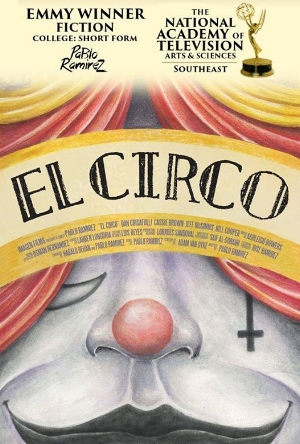
Saif Al-Sobaihi is one such example of a cinematographer whose crucial role in the construction of films like “El Circo” and “Pinwheel” has helped create striking visual sequences, and he’s built an excellent reputation amongst his peers as a consequence. Indeed, the foreign filmmaker received praise and an Emmy Southeast Award for his cinematography work with “El Circo,” while “Pinwheel” gave Saif an opportunity to showcase themes around true love.

El Circo
Film Poster for “El Circo”

When discussing “El Circo,” Saif recounts how it “was pitched to me by…the Salvadorian director Jose Pablo Ramirez. I really enjoyed reading the script and the values Pablo wanted to capture. It was certainly one of the most joyful sets I’ve worked on.”

“El Circo” director Jose Pablo Ramirez is a renowned filmmaker who’s also known for his work on “The Astronaut’s Son” which starred Megan Mazzoccone, who’s known for the TV series “The Buzz.”

“El Circo” concerns a circus clown, Charles, who invites three audience members on stage to assist him with his final act. Invoking the spirit of his predecessor, Charles tries to teach his audience a thing or two about one’s self, family and the power of laughter. Saif recounts how he used his expertise to showcase the character’s dual personalities – Charles, the good side, and Stupidus, the evil side.

An actor might do that with shifts in mannerisms, a costume designer might do that with different wardrobe pieces – but Saif discusses how he achieved this goal with “subtle changes in camera compositions.” He elaborates, “For Charles I chose angles that were predominantly eye level, and for Stupidus I chose to use slightly tighter shots. The emotional impact that I wanted to achieve with Charles is that his personality is still in the comfort zone of the audience.”

“For Stupidos, I chose to shoot some intimidating angles like I mentioned ‘in your face.’ I chose lower angles and close ups to ECU shots. Stupidos breaks the 4th wall in some of the shots and look straight into the viewer’s eyes. His personality is confusing and unclear, so I encouraged my focus puller to intentionally miss his focus marks on some of Stupidos shots. That way we were visually showing the audience that he is [abnormal] and doesn’t follow the rules.”

Such a detailed explanation proves Saif’s specific understanding of shot composition and his expert-level cinematographic skills being crucial to the development of the story in “El Circo.”

Saif’s expert level knowledge is also evident when discussing “Pinwheel” and how he shot the project. “We shot ‘Pinwheel’ with the Arri Alexa SXT (camera) [and] Cooke S4/i Primes (lenses)… There were a lot of camera and dolly movements; my camera operator Ryan Hance and the hardworking dolly grips were on the same page all of the time, and that made everything so much smoother.”

That project was directed by Francesca Crichton, well known for her project “Jamil Houston: Make it Last,” which starred Sebastian Condor (“When I was Younger”).

Saif’s down-to-earth attitude has clearly also been a crucial factor in developing his distinguished career. Unlike actors, who build their reputations through associating their face with big studios or other famous actors, a cinematographer like Saif has crafted his career through working with top-level companies like Sony, Viacom and PopSugar.

In addition, Saif also has enjoyed spending time on set with Dwayne “The Rock” Johnson and Zac Efron while working on blockbuster films like “Baywatch” for Paramount Pictures.

All of these accomplishments are not surprising, but Saif is very humble about the strong start he had in the industry. These auspicious beginnings were obviously a sign of a distinguished career to come.  

“My first ‘real’ gig as a cinematographer was for the Swedish singer Peg Parnevik for her music video ‘We Are,’ which we shot in Florida. It was later picked up by Sony Music. I was nervous, of course, and wanted to meet so many expectations. My crew and I made some mistakes, but we learned from them and had so much fun shooting this project.”


YUXIN BOON HEARS THE ART IN FILM

YuXinBoon_1

Sound editor Yuxin Boon works in the film industry but when she is asked exactly what a sound editor does, she often explains that it’s like being in a band. Boon does have a background in music so this isn’t simple conjecture…she knows what she is speaking about. Yuxin describes, “The general public has a view that the only job of a sound editor job is dealing with sound effects. The truth is that editors are divided into different categories of sound, like dialogue, Foley, and ambience. A sound editor is not usually in charge of remaking all the sound the audience hears. Editors are assigned to one particular category of sound but also applying their work to the overall sonic image of the film. It’s like a band; every member has one instrument and task. They need to play their own instrument while also working cohesively as a team to make the music and deliver the emotional intention of the song.”

As a professional female sound editor focusing on dialogue and Foley editing in the film post-production industry, YuXin has created a career path in the industry that includes working with Oscar-Award winners (as she did in “Heavy Rain” with Bill W. Benton) that display nature’s fury, romance films (“Christmas in Mississippi” & “Enchanted Christmas”), Westerns, and a myriad of other genres. A sound editor is required to be creative as well as detailed, which are the characteristics which drew her to this work. While many vocations in the TV and film industry steer professionals towards a certain genre, it’s the absence of this aspect for sound editors which allows professionals like Boon to test themselves to apply their talents a wide variety of story types. While the application of abilities may differ, the means by which they are applied is often universal.

A sound editor must possess a discerning eye, well…perhaps ear is the appropriate body part in this particular scenario. Talent is a requirement and the application of these are a given but Boon believes that this is only a baseline for contributing to a production. One needs only to watch your favorite movie with the sound down to gain an immediate appreciation for the work of a sound editor. Even this simple example does not properly communicate the affect a sound editor has on the entertainment. The work of Boon and her peers involves layers upon layers of sound that weave together a sub-story that most of don’t ever fully appreciate. In Yuxin’s opinion, a good editor not only inspires the other professionals on the production team to perform at the next level but also carries the emotion to the audience for a better understanding. A good sound editor can offer intriguing soundscapes which the director is looking for as well as combining it with creative designs and techniques. Skill is an element that can be used to evaluate editors’ work, but it’s far from the only one. Creativity may be the most important trait a sound editor can bring to those they work with.

It’s likely that Boon’s unique perspective came from her path to sound editing. As a child of parents who were not musicians but great lovers of music, her parents took her to piano lessons and encouraged (but did not push) YuXin towards making music a part of her life. While she thought that her aim would be in the music world, Boon took a film class and discovered that her natural inclination towards detail and her finely tuned ear (thank you piano) made her highly adept at timing and sound editing/design. The process of mixing different elements to create completely new sounds, such as the dinosaurs’ roar in “Jurassic Park” fascinated her and stimulated her creatively. As Boon discovered that a sound editor is given the opportunity to work with aspects like dialogue, Foley, and other sonic presentations of a film, she became increasingly drawn to it. Trail blazers like Singapore’s Ai-Ling Lee (Oscar-Award Nominee for La La Land) continue to reinforce the idea that an Asian woman/professional has a place in the film industry of Hollywood.

YuXinBoon_2

Any art form must grow. To achieve this requires individuals with fresh perspectives who understand and respect the process and individuals which created the template being used. Yuxin Boon has already created a community of peers and professionals who recognize this in her work and her view of her own application of her talent. The very fact that she sees her role in a manner that is simultaneously similar and differs from the traditional idea indicates the reasons why she has found herself so busy with an eclectic set of productions these days.

Lili Huang casts an honest lens on the life of “Xixi” in award-winning documentary

Alfred Hitchcock once said, “To make a great film, you need three things: a great script, a great script, and a great script.” For award-winning screenwriter and producer, Lili Huang, these words resonate deeply. If her career has taught her anything, in fact, it is that a well-written script is absolutely essential to the success of a film. For this reason, Huang pours her heart and soul into ensuring that when she writes a script, she fine-tunes each and every detail to perfection, regardless of its size. This dedication to scriptwriting, coupled with her business acumen and knowledge of film production, make her a rarity in the entertainment business and an asset to any project she works on.

“For me, screenwriting is about using my writing skills to take a simple idea and turn it into a gripping story for an audience. I enjoy the entire creative process of writing, from developing each character, to building the structure, planting every small or large detail, and ultimately, of course, presenting a final story that people will eventually fall in love with,” told Huang.

When Huang looks back on her career, however, she recognizes that originally, her passion for screenwriting and producing were not as clear cut as most. On the contrary, they have slowly and progressively built over the course of the last decade and as she continues to explore the film industry, her love for the two professions only grows stronger. To date, Huang has written upward of thirty film and web series scripts and makes no plans to stop any time soon. In addition, she has received a number of prestigious awards for her unique set of skills and techniques. For instance, in 2011, Huang tested her abilities as a screenwriter, director, producer, and editor when she created her film, The Flower of the Future, and earned herself a nomination for Best Screenplay at the Golden Panda Awards in China. For another of her films, Mei Mei, Huang won Best Film at the Golden Rooster and Hundred Flowers Film Festival, earned herself an Official Selection at the IndieFest USA International Film Festival, and more.

To little surprise, Huang is used to receiving a substantial amount of praise for her work from her peers and fellow film-lovers. For instance, well-known Chinese director, Xuehua Hu, acted as both a mentor and colleague to Huang over the years, considers her to be an asset in the industry. When asked about what makes Huang so good at her job, Hu had the following to say:

“Lili Huang has a rare professional dedication and passion for filmmaking. Throughout her career, she has gained a comprehensive understanding of the filmmaking industry, especially as it pertains to the differences between filmmaking in China and in other parts of the world. I can say confidently that she is an invaluable, professional filmmaker.”

After years of developing her skills in the genre of drama, Huang felt that she was ready to branch out of her comfort zone and explore the realm of creating a documentary-style film. Given that documentaries interest her greatly, Huang was confident that this was an area of filmmaking through which her talents could prosper. In 2012, she felt compelled to tell the story of Xixi, a girl who was born in China, immigrated to the United States as a child, and moved back to Shanghai, China, as a young adult. Huang spent the next eight months gathering raw footage of Xixi’s daily life, endeavoring to capture every moment of happiness, hardships, romance, friendship, and more. Ultimately, Huang wanted to shed a light on the Xixi’s unique life circumstances and allow audiences to draw their own conclusions about the intricacies of Xixi’s cultural transitions.

“I wanted to show my audience what her daily life is really like. For her, having had just moved back from the United States to China, she was definitely experiencing life in a very different way than local Chinese people were. I wanted to share her point of view on her new life in Shanghai, on how she was adopting new customs, etc. I also wanted to audience to draw their own conclusions after watching the film,” she said.

Once she had concluded her filming process, Huang edited her footage and eventually, in 2013, Xixi premiered at the Golden Panda Film Festival in China. Later, at that same festival, she received a nomination for Best Director of a Documentary Film, and was overwhelmed with pride. Director Haiying Wu, who acted as an advisor for the project, offered a great deal of praise for Huang and had only positive things to say about the film. Xixi, in conjunction with Huang’s other achievements in her field, have proven that there are very few limits to what she can achieve when she sets her mind to it and fortunately, she intends to continue dedicating her efforts to telling meaningful stories and continuing to help contribute the art of film for years to come.

An Exclusive Discussion of Award Winning Actor Christopher Capito’s Best Work

To be an actor is to be an expressive, fearless storyteller; Christopher Capito has been one of these since he was seven years old. Over the past fourteen years, it is a job he has fully embodied.

Originally from Quito, Ecuador, Capito initially got his start in a theater troupe before making the transition into film. Since then, his work has been viewed by a wide range of audiences and has been nominated for and won numerous awards at a variety of film festivals.

In the 2017 short film Rotten Grapes, directed by Marc-Ivan O’Gorman (The Black Magic, A Kiss and a Click, and Blood Coloured Moon), Capito plays Andres De La Vega, a grandchild of a Latino woman who is recently deceased. “The film won more than two festivals, and I won the award of best ensemble with the rest of the main cast,” Capito stated.

Rotten Grapes is a sitcom that follows the De La Vega family after the loss of their beloved grandmother. With the promise of leaving the entire fortune to only one of her grandchildren – the one who holds the most family values – the story delves deeper into the lives of each grandchild, revealing their individual troubles along the way.

The cast was lead under the guidance of experienced acting coach Michael Aspinwall, who’s known for his acting work as Dr. Shelby in the 2012-2013 TV series WWE Raw, and has also worked for companies such as Titan Sports Productions, USA Network, and World Wrestling Entertainment. Given the film’s comedic tone combined with Capito’s prior experience in both short and long form improv, the pair worked well together in training. Expanding upon this, Aspinwall said, “While the other actors had trouble bringing the characters alive, Capito didn’t have to make any effort. He has a natural timing for comedy, and that’s something you can’t learn. Capito was born with that.”

unnamed
Actor Christopher Capito

Also in 2017, Capito co-wrote and starred in the three-time award winning short film Milk Fang. “In Milk Fang, I played the main character named Andrew. The project is about a young vampire who lives in a conservative vampire family. In this world of vampires, there are two types: blood drinkers (who represent the societal norm), and the milker (who are vampires who drink milk instead of blood, and are an analogy to gay people),” Capito explained. “In the story, the young vampire Andrew comes out of the coffin with his parents, and has to face the prejudice of the rest of the vampire society.”

Ultimately exemplifying its success, Milk Fang was awarded with the titles of Best Screenplay, Best LGBTQ Film, and Best Sci-Fi Short Film at three different film festivals. It was directed by Nicholas Joseph Cunha (Red Souls, Outdated, and Daisy) and written in a collaborative effort. Two-time Daytime Emmy Award winner and Primetime Emmy Nominee George McGrath (Pee-Wee’s Playhouse, On the Television, and Tracey Takes On), who also worked as one of the three writers of the film, speaks highly of his writing partner and actor Capito, affirming, “Christopher has a special talent when it comes to writing and acting out real, human stories. He also has the ability to play multiple races, such as Latino, Italian, and Iberian, as well as a wide age range of 13 to 20 years old.”

Aside from his natural talent, this criterion played a crucial role in casting Capito as the main “Chambelan” named Santiago in one of his first U.S. based short films back in 2016, Terintañera. The story of Terintañera revolves around the Quinceañera party, a celebration that is a vital part of Capito’s culture. The film was based in Los Angeles, ultimately showing how the Latin culture is a growing minority. Additionally, the role of Sebastian provided Capito with the perfect opportunity to show his ability to connect with both the American and the Latin cultures.

Elaborating on this, Capito said, “For me, playing Santiago was an amazing experience. Not only was I challenged as an actor with having to revert back to thinking as a younger version of myself in order to pull inspiration from my Latin roots via experiences from a much earlier age, but I was also given the chance to rediscover my culture and ultimately revel in the nostalgia of growing up in it.”


For more information on Christopher Capito, please visit: http://www.imdb.com/name/nm7462667/?ref_=tt_ov_wr