Tag Archives: Filmmaking

Producer Mickey Liu brings music and drama together in acclaimed film ‘Nocturne in Black’

Growing up, Mickey Liu always found himself stuck between two different pathways as a child. He studied business, but he loved the arts. However, as a teenager, he realized he could combine both these passions and become a professional producer. A producer is a leader, a problem-solver, a caretaker, a doer, a negotiator, a storyteller and an artist. Liu aims to be all of them, and he has achieved his goal, becoming one of China’s leading producers.

“The lack of professional producers is one of the biggest problems in the film industry of my home country. I feel the responsibility and urgency to become one. It’s very challenging, but also very rewarding,” said Liu.

Liu’s work in Chinese film is renowned. His movies such as Sail the Summer Wind, An Ill-Fitting Coat and Tear of the Peony exemplify Liu’s determination to transform the Chinese film industry and allow for more professional producers to take lead. However, one of the highlights of his career comes from his work on the 2016 film Nocturne in Black, which is actually in Arabic.

“I wanted to work on this project because of its powerful script with a musical element of the story. It was one of those rare cases where I immediately knew I would regret not being part of this. It was definitely a very ambitious and challenging project, but if we could pull that off, we would send a powerful message,” he said.

Nocturne in Black takes place in a war-ravaged Middle Eastern neighborhood, where a musician struggles to rebuild his piano after it is destroyed by terrorists. The film premiered and was an Official Selection at the 2016 Telluride Film Festival in Colorado along with Liu’s film Tear of the Peony. From there it was an Official Selection at the Los Angeles Shorts International Film Festival, won Best Director at NDU International Film Festival, The Marion Carter Green Award at the 2016 National Board of Review, Gold Circle Award Grant Winner at the 2016 Caucus Foundation, and Best Short Film Narrative at the Long Beach International Film Festival. What was the most exciting for Liu, however, was when he received the news that Nocturne in Black was shortlisted for Best Live Action Short for the 89th Academy Awards.

“It was definitely the highlight of my career. I remember receiving an email from Producer Felecia Hunter with the subject line “JESUS CHRIST” and a link to the Hollywood Reporter article in it. I was literally shaking while scrolling down the list and found out that we were shortlisted. I had no idea it could go that far, and I still feel very honored and blessed to be a part of it” said Liu.

When putting together a team for the film, Producer Felecia Hunter approached Liu, knowing what an asset he could be as a co-producer. The two had worked together in the past, and she knew he had great experience putting together and designing posters. Once he was approached, Liu read the script and immediately decided to jump on board. He then created the pitch book and designed posters when the film was just a script, which ended up being essential in the success of their Kickstarter campaign, and he also designed the look of the Kickstarter page. Half of the film was financed by the crowdfunding campaign. Liu also contributed editing notes in post-production.

NIB at LA Shorts Fest with producer Felecia Hunter
Mickey Liu and Felecia Hunter at the LA Shorts Fest

Hunter and Liu attended several film festivals and awards to help promote the film. During the film’s festival run, he helped with coordinating the transportation of the film’s DCP copy and created promotional postcards for Nocturne in Black. Liu played a critical role in financing and marketing of Nocturne in Black, and that is exactly why Hunter approached him to begin with.

Mickey is organized, thorough, and possesses a very keen eye for details. He knows how to communicate with department heads quickly and effectively, ensuring a productive working environment on set and throughout post-production. Mickey is an asset on any project or event he works on. He always goes the extra mile by working long hours; triple checking details; and doing much more than is required of his job description. Through our work together, I had the delight of experiencing his extraordinary talent shine from pre-production to having films he produced screen at the Telluride Film Festival and other notable festivals worldwide. Mickey Liu is a gifted artist, but also a skilled professional and invaluable collaborator. His writing, producer’s vision, and narrative insights have always been revelatory – the sign of a mature and talented film producer – and add an unforgettable quality to any project he takes on,” said Hunter.

The story is set in Syria, but for safety reasons due to the civil war in the country, the production took place in the director’s home country Lebanon. Liu was working long hours just to put together a good pitch book; he did a lot of the research and exchanged notes with the Director, Jimmy Keyrouz, to ensure the look of the pitch book matched Keyrouz’s artistic vision. He then worked on the typography and details of the book for days, and this was only the first step.

“Everyone on the team pushed themselves to a whole new level because we wanted to have the best possible version of the film. It was really a labor of love and I could feel it when I was working on it,” Liu described.

The team was one of the best parts about working on Nocturne in Black for Liu. He was extremely impressed with everyone’s commitment to the story and with the professionalism on set. Everyone was at the top of their game, and they were having fun. More than anything, however, Liu was most inspired by the story they were telling. He knows the importance it has and encourages audiences to see it.

“It’s imperative to remind people about what is happening in the forgotten parts of the world – murderously effective, half-ton barrel bombs are constantly dropped on innocent civilians. It’s a story about human spirit standing up to oppression, evil, and terrorism. In the story, playing music is the protagonist’s ultimate act of defiance in a world where music is banned. I think it sends out a powerful message. Our director once said, “Art is a mighty tool that helps us fight extremism and terrorism.” In some way, making this film is our way to join the fight,” he said.

Be sure to check out Nocturne in Black so you too can join the fight.


Top photo by Lingyun Zheng


By Sean Desouza

Production Designer Laura Santoyo talks new film ‘Falling’

Learning about various aspects of humanity is a passion of Colombia’s Laura Santoyo Dangond. Originally from Colombia, she has also lived in Peru and Canada, and loves to travel to experience different cultures and learn new languages, fluent in Spanish, English, French, German, and Portuguese. This desire to learn about the world and its people is part of what led her into filmmaking. With every new project she embarks on, she gets to tell a different story and learn something new about history, society, the human mind, and more. Beyond the stories, she works with people from all over the world that have different backgrounds and ways of seeing life, and together they share and experience their differences through their art. As a production designer, Santoyo takes everything she has seen and practiced and channels that into creating visually stunning and captivating sets and props that fully transport audiences into what they are watching.

“I make an effort to stay true to the story and what the characters are. I do a lot of research on the characters and the environment where they live. I also try to have many exchanges with the director where we discuss characters and share research and inspiration images, etc. to understand their vision and the direction they are taking the story to. I like to play with colors and used them to imply aspects of the story that are not explicitly spoken by the characters,” she said.

Santoyo is known for her work on award-winning films such as Lockdown and Tim of the Jungle, both of which made their way to several of the world’s most prestigious film festivals. Last year, her film The Plague premiered, reminding audiences of what she is capable of, as Santoyo created a dystopian world. Her most recent film premiered just last month at the Slamdance Festival, and once again Santoyo shows she is unrivaled as a production designer.

Falling set_2
Bill Bowles, Laura Santoyo Dangond and Ewen Wright on the set of Falling, photo by Sam Shaib

“As soon as I finished reading the script I felt like I had to be part of the project. It is one of the most original scripts I have read, very intelligent and I thought that it was a story that had to be told and that I wanted to tell it,” she said. “The script of this film describes a number of absurd situations and uses humor to address subjects that are affecting our society. It was very important that the design of the movie supported the comedic tone without ridiculing the situations.”

The film tells the story of a potentially psychosomatic white man, a woman stuck in a vortex of mansplaining, and a young black man confronted by the racial disconnect of society, each trying to make sense of their lives as their worlds are set on an inevitable collision course in this surrealist comedy.

It was important for Santoyo and the rest of the team to differentiate the three storylines that run parallel to each other and to show the absurdity of the situations without being too over the top. Therefore, they assigned one color to each character.

The first story, about a man who can’t walk, represents the feeling of impotence that someone watching the news at night can feel when they see injustices with no way to help. This character takes the “sickness” he feels to the extreme. Therefore, they decided to use the color blue with him, which is very clinical.

The second story, about a woman who’s caught in male-dominated conversations turmoil, was assigned the color red. She is often angry and frustrated, and all the men that she’s with see her and other women as objects. Santoyo felt red reflected these feelings.

The third story is about a black man, who in the most absurd situation, ends up being shot by the police. The filmmakers gave him the color green, because he’s young and innocent at the beginning and at the end it is his case that makes the man in the first story sick.

“As a society, we are still fighting against racism, social injustice and women’s equality and this film raises awareness on these subjects in a comedic tone. I believe that it is very important to have films like this one because we can start generating discussions that could eventually lead to change,” said Santoyo.

Working on Falling has been one of the most fun experiences Santoyo has had throughout her career. From the first time she read the script, she knew it was going to be challenging because there were many locations with three different stories that at the end become one. Each story had elements of magical realism that could also be difficult to achieve in production design. Santoyo wanted to enhance the experiences of the character through the set, but not overdo it to a point that the messages behind each scene were lost. She managed to find the perfect balance, always keeping in mind the color palette they had decided for each character early on in production.

“I think many things make Laura an excellent designer, collaborator, and professional. The first thing that comes to mind is passion. She’s clearly passionate about what she does – she made it clear that she seeks out work that she connects with on a personal and aesthetic level. Once she’s onboard, she’s obviously all-in. That shows at every phase of a project when you see her initial ideas, the hours she’s putting in, the attitude she brings to every meeting and production day, and the diligence with which she executes. Beyond that, she’s a professional with outstanding training, instincts, and experience. She knows how to present her ideas clearly – both verbally and visually, she has leadership skills, she remains calm under pressure, she knows how to prioritize, stay organized, and keep others motivated to work at a high standard,” said Ewen Wright, Director.

Wright was looking through portfolios and films for a costume designer when Santoyo’s work caught his eye. He asked the costume designer who the production designer was that possessed such talent. He immediately reached out to Santoyo, who was extremely responsive and receptive to the idea of the film. They immediately began a strong partnership and shared ideas about the film.

Falling Set
Ewen Wright, Laura Santoyo Dangond and Yonit Olsen, photo by Sam Shaib

“Laura has a creative voice, and in a key role on a collaboration that can’t be undervalued. She brings her lifelong sense of design, studied theory, and just pure instinct to her work in a way that gives her work a through-line. I really enjoyed developing a shorthand with her. Lastly, she has a phenomenal attitude and work ethic. She went above and beyond for our production – and even when things went wrong, or the hours ran long, Laura was a reliable source of positivity and joy. As a leader on the team, she set a tone for those around her that I know contributed to all of us doing better. When I was stressed or needed a moment, I always knew I could rely on Laura for a laugh – just as the rest of the time I relied on her for her eye on the image,” Wright continued.

Working with such a committed team was one of Santoyo’s favorite parts about filming Falling. She found everyone came together to tell such an intricate story, and she was constantly inspired by those she worked alongside. However, it was the message behind the film that truly made the experience for the production designer.

“I am so proud to have been a part of this film. I think it’s a story that captures the feeling that something is wrong in the world and the willingness to change it, but not knowing how to go about doing so. I think many people feel that now. I’m thrilled to know that it’s being watched by many people and it can maybe inspire some change in our society,” she said.

Now that Falling has begun its film festival run, Santoyo is looking forward to her next project. Undoubtedly, she has a very bright future ahead of her, and audiences can continue to look for her name rolling past their eyes in movie credits for years to come.

“I want to keep exploring and finding new stories to tell and more talented people to work with. I am looking forward to creating more worlds where magic is possible. I want my work to reach even larger audiences and present stories to the public that entertain them and that touches them. I have a couple of projects in line for this year that hopefully will help me accomplish this,” she concluded.


Top photo by Jesper Duelund

Animator Sijia Huang brings joyful characters to life in new film ‘Breakfast’

As an only child, Sijia Huang was always looking for ways to entertain herself. She didn’t have any siblings to play with, and growing up in Chongqing, China, she immersed herself into movies from a young age, finding that it not only passed the time, but consumed her every thought. She knew she had to be a part of that world, and loving drawing from an early age, she became committed to knowing everything she could about animation. She studied her favorite films and scoured video stores to find new movies she could learn from. Now, she is an acclaimed animator, winning audiences around the world over with her unique style and commitment to her craft.

Her films Box Home, Quitting Brave Victory, Measures and Frames and Hear No Evil, Speak No Evil, See No Evil have allowed the world to see just what Huang is capable of. Her ability to generate smooth animation while still maintaining a good balance between tension and looseness generate the perfect rhythm for her films. She knows that in animated films, her work is the entirety of the visual aspect, making up 50 per cent of the movie goers experience, and she knows how to make that lasting impression.

“Just like having good actors or actresses in a film, a professional animator can create lively characters that will contribute lots to the story. A good story is one of the most important parts of a film. The power of a well animated character, a good story, and the aesthetic value behind an animated film is why I want to be a professional animator,” she said.

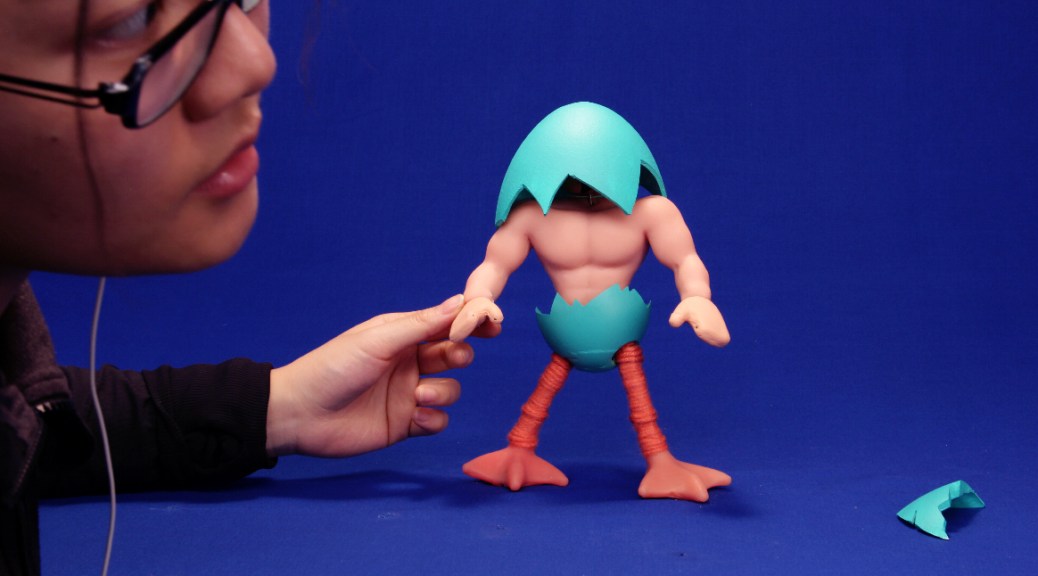
Huang’s most recent film is titled Breakfast, in which she was both the director and leading animator. She designed and crafted all the puppets and did all the stop-motion animation. Breakfast is a combination of 2D and stop-motion animation. The character design is what intrigued Huang to take part in the film, with a unique take on stop-motion puppets. She also found the script interesting, with funny and unique characters.

The story begins with two hands hitting two eggs. As the hitting goes on, the two eggs start to crack and finally explode into pieces. Two creatures come out of the eggs. One is a duck with hairy human legs. The other one is a muscular man with duck feet. The duck and the man both have a crush on each other and start to dance. In the middle of the dance, the two hands interrupt them by hitting them on their heads. A chase and fight commence. In the end, it turns out all the encounters and fights are happening in a child’s imaginary world when he plays with his toys – a rubber duck and an action figure, during his breakfast.

“The story is more about viewing the world with children’s perspective and the positive messages behind the story include love, support and equality,” said Huang.

Huang began working on the animation back in 2015, and it took over two years to perfect every image. After premiering at the New York Short Film Festival 2018 where it was an Official Selection, the film has already seen great acclaim. It was an Official Selection at the 2018 GUKIFF Animated Short, UK Monthly Film Festival, and the Oniros Film Awards. It also had an Official Screen at the Oregon Shorts section in the 41st Portland International Film Festival. At the Los Angeles Movie Awards, Huang was awarded with Best Animation for her work on the film, and at the Los Angeles Independent Film Festival she won Best Director. Needless to say, none of the film’s success could have been possible without her considerable contributions.

“Knowing the film has been so successful means a lot to me, as the director and the leading animator on this film, I had a lot of pressure. At the beginning, I didn’t know if the audiences would like the characters or not. This film is all about these interesting characters, which I personally love and had lots of fun on animating. It turns out that audiences really like it too, Every effort paid off at the end,” said Huang.

Huang was responsible for all the stop-motion animation in Breakfast, which was 90 per cent of the entire animation. Stop-motion requires working with puppets. While making the puppets, she was very careful when it came to the mold and cast process, one of the greatest challenges. When she began the process, she had no experience in casting them, and through trial and error, eventually created characters that were even better than the original design.

TeamPhoto
Sijia Huang, Stan Lee, and Yifu Zhou with the Digital Domain team

“I first met Sijia when we worked together on some digital content pieces for Stan Lee, and immediately recognized her exceptional talent and matchless vision. She is one of these rare talents, as she clearly demonstrated in Breakfast, and her reputation precedes her in the industry. Her stop-motion work is renowned for being refreshing in the animation world, as it is simultaneously mature, artistic, and avant-garde,” said Yifu Zhou, Vice President and Visual Effects Supervisor at Digital Domain.

Although they are not human actors, Huang says the puppets require a lot of care. For example, the Duck character has a pair of hairy legs that need special handling and care when animating. Therefore, she chose to only touch the joints that she needed to bend so that the leg hair would not fall off. She also used baby powder to help reduce the stickiness of the silicon surface.

“The ball and socket armatures were so fun to animate. I enjoyed the experience of animating on stage. It is hard to imagine without the ball and socket armatures, how to work on some of the shots. The most difficult part is to animate characters in the air. Two characters in the film are made of silicon and super sculpted. The materials and steal ball and socket armatures make the puppets heavy to animate. In order to stable them in the air, I used special designed rigs, so I can tie the puppets to the flying rigs to create movement in the air,” Huang described.

Music was also a big part of the film. Not only did Huang find the ideal composer in Lance Trevino, she also needed the choreography to be perfect. This required an ample amount of research on Tango dancing in order to perfectly execute the animation. To do so, Huang analyzed the patters of the dance steps and extracted the key movements to fit the animation style. Her dedicated resulted in the Tango being the highlight of the film.

“I loved the film, so animating it was really fun. When you see the characters on this film, you will know why I love them so much,” she concluded.

Be sure to check out Breakfast to know just what Huang is talking about.

Chinese Actor Yifan Luo talks upcoming film ‘Rift’

As a child, growing up in Shanghai, Yifan Luo did not see himself as an actor. In fact, he was very business oriented, and the arts were not a feasible career option for him at the time. However, as a teen, everything changed; when he stepped on the stage for the first time as the lead in his high school play, he experienced the unique sensation that only comes from doing something you truly love. His passion for acting was born at that time, and now, over ten years later, this passion only grows stronger each time he steps onto a new set.

As an in-demand actor in both China and abroad, Luo is constantly looking for different roles than those he has played previously. He aims to portray as many different personalities as possible, from a schizophrenic psychopath in the film SAM to a jokester college freshman in the feature Talentik. His versatility knows no bounds. With the four films he has coming out this year, each character explores a different side of humanity. In the upcoming movie Rift, Luo once again plays a different role than he ever has.

“The character of the psychologist is somewhat complex. Yifan is perfect for the role and his performance is excellent. He is a professional and dedicated actor. I definitely want to work with him again,” said Jing Ge, Producer.

Rift is a compelling science fiction film focusing on a series of characters. It begins with Sergeant Howard receiving a case that Professor Miles is missing. The main character, Yu, is considered as the prime suspect. However, Yu denies everything. According to his testimony, Yu killed Proffesor Miles ten years ago for the professor’s plagiarism of his thesis paper. Yu was sent back to China after he was released from the prison. Through investigation, Howard believes that he is lying about something regarding the case. However, the psychological consultant, Gu Shenming, holds a different opinion. Yu gives them an unbelievable explanation that he comes from a parallel universe. Howard doesn’t believe Yu, but he has no evidence, so he has to release Yu after 48 hours. Yu’s girlfriend Xin bails him out. Howard is shocked when he sees Xin, because this girl was murdered five years ago by a serial killer. When Yu sees Xin, he is also surprised that Xin is still alive. Two days later, different female bodies are found in suburban Los Angeles, related to a serial killer, all while travelling through parallel universes.

Rift 3
Yifan Luo in Rift

“Science fiction is always what people like to watch. Especially now in China, it is a very popular topic in film/TV shows. In this story, we see different kinds of people, good and bad. It is a real society that the film creates. It brings us a world where the hero is a real man who would never reach his goal without the help of people around him. Of course, the hero gets what he needs in the end, which also encourages the audience to go for what they want,” said Luo.

In Rift, Luo plays Gu Shenming. His character is the psychologist that works for the police. He talks to the suspects and makes the conclusion regarding whether they are lying or not. In the story, when the main character comes from a parallel universe, nobody believes what he says. Therefore, the sergeant sends Gu Shenming to talk with him and expects that he will be proved a liar. As the conversation progresses, Gu gradually believes in what the main character says and starts to suspect that the sergeant actually knows a secret about the case that he doesn’t want other people know. Finally, Gu makes the conclusion that the main character is not lying about anything, which infuriates the sergeant.

Gu Shenming is the only person that believes in what the main character, Yu, says about travelling from the parallel universe. Without the character, the main character would have been sent to prison at the very beginning. It is this character that keeps searching for evidence that proves Yu is not lying about anything, and the psychologist is the one who finally destroys the sergeant’s plan. During the process, Luo’s character is under the immense pressure but never gives give up. He does his duty as a psychologist and prevents the main character from being persecuted.

“I read the synopsis of the story before I went for the audition. I really liked the idea of a parallel universe. The character I auditioned for is a very smart psychologist who works for the police that diagnoses whether the leading guy is crazy or not, since he keeps talking about a parallel universe, which is totally what I’m good at. I believed that I could do a very good job in playing such a role,” said Luo.

As the story has the setting of a parallel universe, the actors were required to frequently move between the universes in the story, meaning the cast and crew had to constantly change the set, costumes, and makeup. Because of this, everyone had to be on top of their game. Luo made sure to be extremely familiar with the script and storyline, even for scenes he was not in. This also created a great sense of teamwork between everyone on set, as they were constantly working to make filming as smooth as possible. For Luo, it was working with everyone on the film that made working on Rift such a great experience.

“It was a great experience to work with Yifan. He is very professional and very passionate. As a partner, he is very considerable. He even helped me read the lines so patiently when I was doing my close-up shots. He always spends a lot of time working on the character before he goes to set. He is also creative at the same time. He has a sense of humor that makes his acting unique.  He is one of my favorite actors I have ever worked with,” said Yun Xie, Lead Actress.

Keep an eye out for Rift at a film festival near you.

Shaan Memon writes of the harms of bullying in new film

Article05-pdsdocu02Shaan Memon believes a film is made three times. At first, it is the writers; they are responsible for visualizing the tale in their mind and creating the characters, personalities and setting. Then comes the actual filming process, which is at the hands of the directors; they see the script and turn words into worlds that will transport audiences from their seats to another reality. Finally, the editors have the responsibility to turn shots into a story; they put everything together in a way that flatters the actors, compliments the set, and captivates audiences. As a true film lover, when Shaan was choosing which path to take in filmmaking, these roles all spoke to him, and he decided to pursue all three. As a celebrated writer, director, and editor, Shaan is showing not just his home country of India, but also the rest of the world, what he is capable of.

No matter the medium or genre, Shaan’s understanding of filmmaking is outstanding. Whether making a commercial, like the ones he recently did for Dickens Fair, a documentary, such as Purpose Driven Study for Dharoi Canal Command Area, or films like his new drama Fitting In and the acclaimed The Unreal, Shaan’s talents are on full display. He is a consummate professional, consistently impressing audiences and peers.

“Unlike so many, Shaan knows what is important to the production of film. He listens to advice, eagerly pursues the best, and delivers. He’s quite professional. He’s definitely a man of his word. When he says he will get the job done, he gets it done,” said Doug Campbell, Director.

Article02-bullied02Last year, Campbell consulted Shaan while writing his film Bullied, a story of a gay teenage boy who is being bullied by a gang of older boys in his high-school and living with his single mother. He decides to take revenge by killing the leader of the gang. On the verge of executing his plan, he remembers his mother’s words of wisdom.
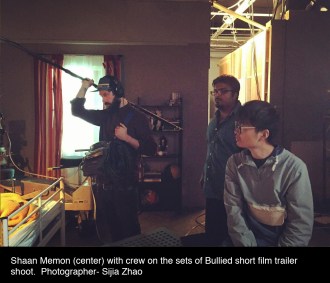
“Many that have been bullied commit suicide or go through a lot of mental stress and it affects their health and career hugely. This story teaches not to take revenge. It takes a lot of courage and many times we have to face huge losses. This movie teaches the path to redemption with being responsible, smart and courageous. I think this story is very important in today’s world,” said Shaan.

Shaan was inspired to write a story about bullying after experiencing it first hand in his first semester of University in India. He was brutally bullied by senior students who were politically very powerful. Under such circumstances, he had no one to turn to, as everyone was intimidated by such influential people. He struggled a lot, and experienced anxiety from the events for three more years. However, he did not let the experience break him, and he decided to write this script to encourage a positive outlook for victims, showing the value of life beyond bullying.

“It was a great experience sharing each other’s experiences and learning from this. I found out that the problem of bullying is much larger than we think, and a lot of people need help with this. Helping people and making positive changes in someone’s life gives me satisfaction, and that is what I liked about working on this project,” he said.

While writing the script, Shaan researched online, in books, and travelled to many schools to talk to students who had been bullied about their experiences. He also talked to teachers and staff to see what the repercussions and protocol were in such situations. He found that an overwhelming number of students in the LGBT community experienced bullying every day, and therefore wanted his protagonist to be homosexual to show the reality of what these students face. He wanted their stories to be heard and displayed as authentically as possible, so he rewrote his script dozens of times while consulting with various filmmakers and victims until it was perfect.

Article02-Bullied03“I wanted to convey my thoughts and tell these stories to the viewers as truthfully as possible, as I had imagined them in my mind. I never start a project until and unless I want to convey something through that. This script is near to my heart as I had struggled a lot for several years. I had a lot to show and say about my experience. I did a lot of research, writing and rewriting to create a powerful script with a good message. And I hope once this film is made, it will help a lot of people,” said Shaan.
Currently, Bullied is still just a script, but Shaan is looking at making it into a film in the near future. Despite this, however, the film has already received attention from many film festivals based on the story. It was an Official Selection at Oaxaca International Film Festival, Mexico, where it was nominated for Best Emerging Writers Award and Best Overall Script, an Official Selection at the Urban Mediamakers Film Festival, Atlanta, where it was nominated for Best Short Script Award, and a Semi-Finalist at the Oxford Film Festival where it has been nominated for Best Short Screenplay.

“It is incredibly satisfying that the script alone is receiving so much attention, because this is not just a film; it is my small effort to spread positivity in this world. I hope that once it is made, the film gets selected to more and more festivals and a huge number of people watch it, because my main goal in making it is to spread awareness. The medium of filmmaking itself is very powerful and it has magic to move people’s heart. If used properly, it can create wonders, and that is exactly what I am trying to do here,” he concluded.

Dominic Kay terrifies as conflicted veteran in ‘White Settlers’

Photo by Ian Thraves 4
Dominic Kay, photo by Ian Thraves

When one asks Dominic Kay why he went into acting, his response is quite simple; he would not have been happy doing anything else. Every day he arrives on set, he is eager to get started. Acting never feels like work to Kay, and the long days and trailer time that some find disheartening just add to the experience for this British native. He humbly feels lucky to do what he loves every day, and audiences around the world feel lucky to watch this talent on both the big and small screens.

Kay’s work in film and television has made him instantly recognizable in the United Kingdom. He has appeared in shows such as Hollyoaks in the City as well as the renowned British soap Coronation Street. His work in film includes the acclaimed historical drama Allies, and many more. However, this actor does not limit himself to just one genre, and as the villain in the 2014 horror White Settlers, Kay’s versatility is evident in every scene.

“This project appealed to me initially due to the fact that it was an opportunity to work with a director and producer that I heard very good things about. Then once I was read the script I was hooked, I read the whole screenplay in an hour, then immediately phoned my agent and told her that I wanted to do it,” said Kay.

White Settlers tells the story of Ed and Sarah’s first night at their new home – an isolated farmhouse on the Scottish borders. This should be a new beginning away from their stressful London lives. And at first it is; come sunset they fall in love all over again on a wander in the woods. But as darkness falls, Sarah suspects they’re not alone, Ed goes to investigate and quickly, the evening becomes a nightmare. It suddenly dawns on them; they do not belong here, and they certainly aren’t welcome.

In White Settlers, Kay plays Local, the antihero. He is an ex-military psychopath, who stops at nothing to get what he wants. He is hard as nails, a bully, and a pack leader. He is definitely not one to be taken lightly. As you get further into the film, audiences see his desperation turn sadistic, forcing him to become more and more ruthless. He thinks nothing of terrorizing people to get what he wants. From when he first enters the feature until the very end, he causes nothing but chaos.

While playing such a menacing role, Kay made sure to maintain the constant barrage of peril and volatility. Particularly in the scenes without dialogue, he managed to be terrifying just with body language and facial expressions. To maintain being threatening and intimidating without being overdramatic can be a challenge, but Kay did so flawlessly. He exudes malice and instills fear into his c audience by doing as little as possible. He always made sure he brought an element of truth into his character. In one particular scene, he acted out of instinct and went off book. The director, Simeon Halligan, loved what the actor did and Kay’s instincts proved fruitful, as that scene made the final cut of the film.

White Settlers gave me the opportunity I had been waiting for a while – to play a real nasty piece of work. I love to play around with characters, and this character was going to be fun, despite being a challenge. I had to be very menacing, intimidating, and scare the life out of my co-stars. Decision making and being brave was key for this character. It was a difficult mindset to get into, so I found that if I wasn’t fully immersed into him it could come across a little forced,” Kay described.

Kay’s work as the leading bad guy helped White Settlers achieve international success at many prestigious film festivals. The film premiered at the 2014 Film4 FrightFest. It was the winner of the ScreamFest Festival Trophy – Best Cinematography 2014. It was then distributed by Falcon films, Grim up North. Many critics were impressed by Kay’s ability to terrify yet still be endearing. The Producer of the film, Rachel Richardson-Jones, credits Kay as being one of the driving forces of the horror film.

“I cast Dominic to play the lead bad guy in the film. He was an integral part of the cast and did a great job. We were hugely impressed by his acting skills and how he adapted to the role. He was a great addition to the cast and was good to work with. He was very professional and hardworking at all times,” said Richardson-Jones.

When casting for the film, Richardson-Jones immediately thought of Kay after seeing the actor in a television show. She invited him in for a meet and greet, and once Kay read the script, it was a perfect match. He was eager to explore a side of himself that he never had before, and working with a team that he knew would be ideal, he immediately said yes to the part.

“This project was great to be part of. Well, having to portray a character that is a complete psychopath was a joy and a challenge to be honest. It was great fun it gave me freedom to express my darker sides and go even further with them. The director was a credit to the production and got the best out of me with ease. The whole cast just performed really well and everyone bounced of each other adding the performances,” said Kay. “It’s not every day you get to be an axe wielding mad man and terrorize innocent people.”

This year, audiences can see Kay on the big screen once again in the feature Walk Like a Panther. The film tells the story of a group of 1980s wrestlers who are forced to don the lycra once last time when their beloved local pub is threatened with closure. Kay is incredibly eager to share this film with audiences around the world.

It is without a doubt that Dominic Kay is an inspiration to those looking to pursue acting not just in the United Kingdom, but around the world. He always knew acting was his passion, and never gave up on his dream, and he has wise words for those who would like to follow in his footsteps.

“Read as much as you can and expand your vocabulary. This understanding gives you so many more places to go with your performance. You can identify subtle changes in scenes and make better decisions based on the information in front of you. Secondly, I would advise that you study yourself and identify exactly who you are deep down – your core characteristics. This understanding of who you are lets you know what you bring to the table, what you are selling. There’s no point in trying to be something you’re not, because people can see through. Lastly, don’t be scared of letting yourself go or looking a fool, and be brave in your decision making. Unless you are very lucky, success won’t come easy, so work hard,” he concluded.


Photo by Ian Thraves

Dixie Chan talks honor of producing China’s most viewed documentary of 2015

For as long as she can remember, Dixie Chan recalls having a deep passion for the art of filmmaking. When she was a child, she would actively search for the “behind-the-scenes” footage of her favorite films and study the styles and techniques through which they were created. Particularly, Chan found herself interested in the making of documentaries. There was something so intriguing about how the lives of the individuals or concepts presented in narrative documentary style films would tell themselves. As she got older, Chan began exposing herself to film festivals around the world and her fascination with the visual and narrative power of documentary films grew stronger the more that she watched. She could often be found in the back of a film screening, jotting and scribbling notes about the techniques and ideas that interested her most. Flash forward to today, and Chan has developed a remarkable career as a film producer, exploring her love for documentary style films and forming a livelihood around it.

“What I love is that every documentary project has a certain theme, message, or vision. My role as a producer, then, is to flesh that out by searching for the right people and the right places to tell those compelling stories. In the field of documentary storytelling, you look for these compelling characters and you let their lives tell their stories. With that, preproduction work often involves extensive research, most of which is done in the field with locals. As a producer, I am always the first one to access the location and characters, so a big part of my job is to gather as much intelligence for the shoot as possible. Subsequently, I cast characters and scout out the best filming spots and angles. I also brainstorm with the field director about how we can bring our narrative ideas to life, from the types of scenes that can be shot to the kind of questions that we can raise during interviews,” shared Chan.

During her career as a producer, Chan has worked on some of National Geographic and The Discovery Channels most prestigious documentaries. Her work on documentaries such as Frontier Borneo, The Bridge, Warriors of Wood and Stone, and Expedition X — Silk Road Rising, are the reason that she has earned such a strong reputation amongst her peers. She is well known for her ability to see a project through from conception to post-production and her unique style makes her a force topple reckoned with in the producing community. In fact, the caliber of work that Chan is capable of producing typically earns her a significant amount of praise and award buzz in her field. For instance, it is no coincidence that after Chan produced Frontier Borneo, it went on to receive a nomination for Best Documentary Series at the 2017 Asian Television Awards, as well as an Official Selection for the 2017 Eco Film Festival in Singapore. These awards were little, however, in comparison to the recognition she received for her work on National Geographic’s hit series, China From Above.

China From Above is a 2-part documentary commissioned by the National Geographic Channel which takes an aerial perspective showcasing how China has transformed its cities and infrastructure over the last three decades, whilst still retaining its strong traditions. From the monumental engineering feats of the Great Wall, to innovative and unique farming techniques, and a massive water splashing festival, the show illustrates how these strong traditions have shaped China’s landscape to make it uniquely recognizable around the world and truly magnificent, especially from the air.

Chan began working on China From Above in 2014, partway through the show’s production. Given that aerial cinematography was still a relatively new style of filming, she was eager to explore her own personal production style along with it. At the time that Chan was asked to join China From Above’s production team, management had identified a gap in communication between the show’s Chinese and Australian partners. Fortunately, Chan had experience working on Chinese documentaries and being bilingual, she was able to communicate extensively in both Mandarin and English on all logistical and editorial matters. She was thrilled that she was able to bridge the gab between Chinese and Australian work cultures. Though it was challenging at times, she was rewarded by the opportunity to expand her experience within the field of documentary style film production, as well as to explore her potential as a bilingual producer.

As the show’s lead producer, Chan had a very large task on her hands. Given the fact that aerial documentaries were so new and unexplored, she had few points of reference to go by when researching and planning the film’s production. For this reason, she motivated herself to utilize the skills she had already established throughout her career and adapt them for this new and unfamiliar style of filming. In addition, she had her work cut out for her when it came to scouting characters and locations to feature in the show. She was in constant battle with climate and terrain conditions, travelling through extreme winter and desert conditions at even the best of times. Beyond that, she carefully and considerately searched for characters who would bring a certain degree of unpolished authenticity to the footage. For this reason, she spent countless hours grooming candidates and refused to stop searching until she found the best possible individuals for the job.

“There was one instance where I arrived on location to work on a story about Kazakh Eagle Hunters and realized that the characters that were introduced to us were not ideal for our project, and had to spend another 5 hours traveling in the snow to find a more authentic candidate. I am a perfectionist in that regard. I never take the easy way out especially when it comes to characters and stories,” told Chan.

Though daunting at times, her hard work eventually paid off in the end and Chan considers her work on China From Above to be one of the greatest highlights of her career. For anyone who worked with her on the project, it is no secret why. She placed a great level of dedication and effort into ensuring that each second of film was edited and refined to shed China in the most compelling light possible. Felix Feng, Vice President of Operations: China, Natural History New Zealand, worked very closely with Chan when researching and scouting locations for the show and knows how particular she was about capturing high quality content throughout the duration of the filming process. He credits her as having been the reason that the project was executed so smoothly and considers himself fortunate to have been able to collaborate with such a high performing producer.

“It was a great experience working with Dixie on this award-winning and breakthrough project about China. Her patience, hard-work, smart and creative thinking, persistence, and proper communication skills were very valuable in the production of China From Above. This helped us in an extremely smooth execution in both the research and ground shooting of the production. Today, the show has a viewership of over 200 million people and is one of the best rated documentaries in China. Dixie was a hero behind the scenes and is one of the biggest reasons why it was so successful,” added Feng.

After it premiered, China From Above went on to earn a slew of awards and praise at film festivals across the globe. For instance, the film won the award for Best Camerawork and Best Cultural Issues at the New York Festival Gold Awards in 2016, as well as a Gold Panda Award at the 2016 Sichuan TV Festival, and more. In addition, it received over 130,000,000 views within the first two weeks of premiering in China and was later named China’s most viewed documentary TV series in 2015 by China Mainland Media Research Co., Ltd. Its widespread success and praise was above and beyond what Chan had dreamed of for the series and she feels fortunate to be able to have played such a prominent role in creating it.

Producer Yayun Hsu talks new film ‘Next Door’

Taiwan’s Yayun Hsu sees her role as a producer similar to that of a magician; she is often required to make things appear out of nowhere, with the end goal of enthralling audiences and providing a temporary escape, and a source of entertainment. With each new project, this revered producer analyzes what she can do with the resources she has, looking to see how to make things happen no matter the budget. Whenever she wraps a project, she reviews what steps were taken to ensure everything is the best it can possibly be. Despite constant success, she always feels a slight sense of surprise and delight by such good results, giving her the positive power to make more movies and tell better stories, and audiences around the world are thankful for such a commitment to her craft.

Throughout her esteemed career, Hsu has worked on many films and various projects that exemplify what she is capable of. This year alone, Hsu worked on a series of successful endeavors. She created a video for the Westfield Century City Mall Grand Opening Event, made a national commercial for the Whisk Wiper, produced the inaugural American Influencer Awards, and worked on several successful films.

“I give myself the rule of ‘practice what you preach.’ For example, if I expect my actors and crew to be to set on time, then I need to be there even earlier; if I hold a vendor responsible for delivering a quality product, then I need to make sure I’m delivering the same quality both in my word and work ethic. I find this strategy pays off for everyone involved,” said Hsu.

This strategy has indeed paid off for Hsu’s most recent film, Next Door. It is a horror film that conveys the message to not always trust what you see. Next Door follows Lily and Earl, who have just moved into a new home and become Morgan’s neighbor. Lily makes Morgan think her father, Earl, is an abuser, but it turns out Lily has dark secrets of her own The script is what caught Hsu’s interest in the film, and she knows the importance of a good story.

“A good storyline and a plot twist will always make a film memorable. Leaving a lasting impression on an audience is of course the ultimate goal of a filmmaker. I prefer thought provoking storylines and I hope that this one inspires change after viewing,” she said. 

The film had its premiere at the Asian World Film Festival at the beginning of November, and impressed both audiences and critics. It is expected to make its way to several other film festivals over the next year.

“It was amazing to see all the footage we made come together into a real film. It feels nice that it is now doing well at festivals. Receiving recognition from the professional filmmakers is a compliment especially from people I admire. We worked hard on this project for almost half a year, so to see it on the big screen was definitely is a pleasure,” said Hsu.

In her role as Unit Production Manager on Next Door, Hsu was involved in casting, location scouting, applying for permits, arranging catering, controlling the budget, and working on set to solve unexpected problems. In one instance, the Director of Photography realized he forgot to rent camera batteries for the shoot. Hsu knew exactly who to contact at the last minute to help the shoot continue without delay. Additionally, before Hsu joined to the team, the director already had completed casting, but he couldn’t get the right actors for the performance. Hsu then was invited to take part in the casting process, and she posted casting information on different platforms, which led to the right actors being cast for the film. There is no doubt that the film would not have achieved what it already has without her extraordinary talents.

“Yayun is very well-rounded and able to help out the team in numerous different roles. As a producer, Yayun has a strong leadership ability to solve problems. As a partner, she is dependable and reliable when I need support. As a worker, she always does her best to find the best solutions in a time efficient manner. These are all very desirable qualities in a team member. Yayun gives every working partner a relaxed and happy environment, while also supervising the filming process. We have worked on many projects, and I foresee Yayun’s support as an advantage for any team she is on in the film industry,” said Mimi Masters, Producer of Next Door and CEO of IMC Production.

Masters specifically sought out Hsu to work as her partner, as she was working on several films at the same time, and she knew she needed someone like Hsu as an on-set producer to make Next Door a success. Hsu’s commitment to every project she works on was invaluable to not only Masters, but everyone she worked with.

Despite working on many acclaimed films, Hsu had never before produced a horror film. She says it was an adventure everyday on set. They planned many things ahead, but the plans could never keep up with the changes, which is where her ability to work under pressure and problem solve proved vital. After a long 12 hour a day on set, the cast and crew’s energy began to dip, and a happy crew is of course a first priority for Hsu. It was 7 p.m., and she knew the next break wasn’t until 1 a.m. Most of the restaurants were closed by then, and she thought, “How am I going to feed my crew?” Putting her strategic thinking abilities to use, Hsu contacted the catering person she worked with earlier that day, and they made a special hot and fresh meal at midnight and delivered it to set.

“A story about food may not seem too exciting, but I learned that as a producer, the key to any projects success begins with resourcefulness and a full stomach,” she said.

Be sure to check out Next Door and keep an eye out for Producer Yayun Hsu’s future work. It is evident with everything she does that she is a “magician” when it comes to filmmaking.

Lili Huang casts an honest lens on the life of “Xixi” in award-winning documentary

Alfred Hitchcock once said, “To make a great film, you need three things: a great script, a great script, and a great script.” For award-winning screenwriter and producer, Lili Huang, these words resonate deeply. If her career has taught her anything, in fact, it is that a well-written script is absolutely essential to the success of a film. For this reason, Huang pours her heart and soul into ensuring that when she writes a script, she fine-tunes each and every detail to perfection, regardless of its size. This dedication to scriptwriting, coupled with her business acumen and knowledge of film production, make her a rarity in the entertainment business and an asset to any project she works on.

“For me, screenwriting is about using my writing skills to take a simple idea and turn it into a gripping story for an audience. I enjoy the entire creative process of writing, from developing each character, to building the structure, planting every small or large detail, and ultimately, of course, presenting a final story that people will eventually fall in love with,” told Huang.

When Huang looks back on her career, however, she recognizes that originally, her passion for screenwriting and producing were not as clear cut as most. On the contrary, they have slowly and progressively built over the course of the last decade and as she continues to explore the film industry, her love for the two professions only grows stronger. To date, Huang has written upward of thirty film and web series scripts and makes no plans to stop any time soon. In addition, she has received a number of prestigious awards for her unique set of skills and techniques. For instance, in 2011, Huang tested her abilities as a screenwriter, director, producer, and editor when she created her film, The Flower of the Future, and earned herself a nomination for Best Screenplay at the Golden Panda Awards in China. For another of her films, Mei Mei, Huang won Best Film at the Golden Rooster and Hundred Flowers Film Festival, earned herself an Official Selection at the IndieFest USA International Film Festival, and more.

To little surprise, Huang is used to receiving a substantial amount of praise for her work from her peers and fellow film-lovers. For instance, well-known Chinese director, Xuehua Hu, acted as both a mentor and colleague to Huang over the years, considers her to be an asset in the industry. When asked about what makes Huang so good at her job, Hu had the following to say:

“Lili Huang has a rare professional dedication and passion for filmmaking. Throughout her career, she has gained a comprehensive understanding of the filmmaking industry, especially as it pertains to the differences between filmmaking in China and in other parts of the world. I can say confidently that she is an invaluable, professional filmmaker.”

After years of developing her skills in the genre of drama, Huang felt that she was ready to branch out of her comfort zone and explore the realm of creating a documentary-style film. Given that documentaries interest her greatly, Huang was confident that this was an area of filmmaking through which her talents could prosper. In 2012, she felt compelled to tell the story of Xixi, a girl who was born in China, immigrated to the United States as a child, and moved back to Shanghai, China, as a young adult. Huang spent the next eight months gathering raw footage of Xixi’s daily life, endeavoring to capture every moment of happiness, hardships, romance, friendship, and more. Ultimately, Huang wanted to shed a light on the Xixi’s unique life circumstances and allow audiences to draw their own conclusions about the intricacies of Xixi’s cultural transitions.

“I wanted to show my audience what her daily life is really like. For her, having had just moved back from the United States to China, she was definitely experiencing life in a very different way than local Chinese people were. I wanted to share her point of view on her new life in Shanghai, on how she was adopting new customs, etc. I also wanted to audience to draw their own conclusions after watching the film,” she said.

Once she had concluded her filming process, Huang edited her footage and eventually, in 2013, Xixi premiered at the Golden Panda Film Festival in China. Later, at that same festival, she received a nomination for Best Director of a Documentary Film, and was overwhelmed with pride. Director Haiying Wu, who acted as an advisor for the project, offered a great deal of praise for Huang and had only positive things to say about the film. Xixi, in conjunction with Huang’s other achievements in her field, have proven that there are very few limits to what she can achieve when she sets her mind to it and fortunately, she intends to continue dedicating her efforts to telling meaningful stories and continuing to help contribute the art of film for years to come.

Producer Annick Jaëgy sheds light on anorexia in award-winning film “Mackenzie”

A child’s imagination is what makes them so special. The ability to envision all new worlds while in sitting alone in a bedroom is something that tends to dissipate as we age. However, artists still possess such imagination for their entire lives, and filmmakers not only have the capability to imagine new worlds, they create them. Annick Jaëgy knows this well. As a producer, her creativity knows no bounds, and it is because of this that she has quickly become one of Europe’s most sought-after in her field.

Throughout her career, Jaëgy has worked on a variety of high-achieving projects, showing the world what she is capable of. She has worked alongside Oscar winners such as Mahershala Ali in the critically-acclaimed film Gubagude Ko, and her work on the musical That Frank garnered international attention.

Another highlight of the producer’s career came from making the film Mackenzie. The film tells the story of a teenage girl who is dealing with the emotional distress of moving to college and leaving behind her severely anorexic sister. On the day of her departure for college, teenage Alison wants it to be about her for a change and not her sister Mackenzie, who she thinks is extremely self-centered. But, as the day progresses, Alison’s true feelings about her sister come to surface. She worries about how Mackenzie will battle her anorexia without her around. And when the time comes to say goodbye, an honest confrontation between the two could jeopardize the future of their relationship. It’s a teen drama with a lot of heart and also some humor. Such a story required a producer who was not only dedicated to their work, but also the message the film was trying to convey, and Jaëgy was the ideal woman for the job. 

Because this script was about a woman struggling with anorexia, Annick was very concerned that we go about the task of casting this actress very carefully, making sure we found not only a good performer but one who would not herself become anorexic in order to do the role. ​I was very impressed with how protective Annick was with her director’s process, making sure she was not rushed to make any decisions, making sure I allotted plenty of time for callbacks and work sessions with the actresses. This is very rare in a producer, most want casting to happen as quickly as possible without a thought to the nuances that a director needs to see in order to make a decision. I’ve worked on many AFI films, but Annick stands out as particularly talented at her job. I had such a positive experience doing Mackenzie with Annick that I jumped at the chance to work with her again on her next project.  I hope to continue to work together,” said Lisa Zambetti, Casting Director.

The idea for Mackenzie came from Sofia Åström, the Writer and Director. Initially, Åström had an idea for a feature about two sisters going on a road trip, which eventually transitioned to a film about two sisters separated by anorexia. She wanted to explore anorexia from the point of view of a family member, in this case the younger sister Alison (Jessica Wingenbach). Such a stance is uncommon in films tackling the disease, which are more often than not told from the point of view of the anorexic person.

Åström struggled with anorexia as a teenager, and now having long recovered, she wanted to use her tools available as a Director, educating audiences on the impact of the disease. However, when Jaëgy came on board, she wanted Åström to work with another writer to give Åström some distance to her script and allow her to direct more clearly. The decision, although sometimes challenging to work with multiple writers on one project, proved to be the right one, as the story is told with the protectiveness of Åström’s connection but also her artistry as Director.

“A lot of people wrongfully think anorexia is a vanity thing when it’s actually a deeply psychological struggle,” said Annick.

Åström and Jaëgy had previously worked on the film Soledad Canyon together prior to Mackenzie, a beautiful short about mourning and grieving. The two had a perfect collaboration, calling it “professional love at first sight”. Therefore, when Åström wrote a film that was as dear to heart as Mackenzie, she knew she needed Jaëgy as her producer to bring her idea to life. Åström was always impressed with Jaëgy, and had faith in her as a producer, trusting her taste and the fact that she could rely on the producer for every step of the filmmaking process. Jaëgy is known for her ability to create an environment where the talents of the cast and crew can flourish. In addition, she raised almost 75 per cent of the funds for the project. Each and every one of her decisions was backed by Åström, knowing that the producer’s instincts would prove fruitful and beneficial for her film.

“This is a story where women have a tendency to recognize themselves or at least their relationship with their siblings. Our main team is almost entirely female apart from William, the cinematographer. Sofia wanted an entirely female main crew. I am glad that William stepped as I think it is important to have the balance of the two genders. I am not in favor of an entire female crew to be honest. On set, we had a good balance men and women,” Annick described.

Jaëgy spent almost two years working on Mackenzie, from start to finish. Finding the correct location took some time, as they were in search of a house with a “jack and Jill bathroom”, a bathroom shared between two bedrooms, with doors entering from each room. This was extremely pivotal to the film, as it is where the sisters have most of their issues, such as Alison making fun of Mackenzie, and Mackenzie struggling with her image in the mirror, and also where they reunite. It was essential to find the right home with such a bathroom. After finding a fit, one of the rooms was too small to shoot, but Jaëgy and her team used a green screen to manipulate the footage. Both bedrooms were entirely repainted and redecorated to make it look like two teenage girls’ rooms and show the two different worlds the two girls are evolving; Alison’s being a messy teenage world and a tom boy with Mackenzie very neat, meticulous, and very girly.

The only leading roles in the film were that of Alison (Jessica Wingenbach) and Mackenzie (Reid Cox). Because of the nature of the project, Jaëgy and her crew also had to cast models to be able to replicate magazines covers. These models animated themselves when Alison was facing them and the mirror, a representation of what Mackenzie wants to be. Although these models had a few lines that made them cast, the film is essentially supported by two female leads. Engaging an audience with such a small cast can sometimes be difficult, but everyone’s commitment to the story translates to the screen.

“It was a very long process but the result is there. We have a beautiful film entirely financed through fundraising, that has gained recognition in renowned festivals around the world,” said Annick.

After its premiere, the film was an Official Selection at prestigious festivals like the Cannes Film Festival Short Film Corner, HollyShort Film Fest, Newport Beach Film Festival, Madrid International Film Festival, and Palm Springs International ShortFest – The ShortFest Film Market. It received a Silver Palm Award for Narrative Short at the Mexico International Film Festival, a Platinum Remi Award Winning for Short Subject Film Award/Dramatic Original and a Remi Winner at WorldFest Houston, and it was nominated for Best Short Film at the California International Film Festival and Davis Chinese Film Festival. Mackenzie has also just been selected to the Academy Award-qualifying Bahamas International Film Festival and we are thrilled as it is a very important film festival. It also pleased the investors. Once the film premiered, one of them told Annick that she would invest in her next film, and is now helping finance her next project. As a filmmaker, such validation is invaluable.

“To see months of work unfold in front my eyes when I was looking at the monitor watching the scenes while on set, these short moments made me think that when you are passionate about narrative visual storytelling, never give up. The road is bumpy and sinuous. It’s hard, don’t get me wrong, but there is nothing more magical to see months, years of work to unfold in front of your eyes while you’re on set,” said Jaëgy.

Annick is immensely proud of Mackenzie, not just with what the film accomplished amongst festivals, but how it resonated with audiences. Each and every member of the cast and crew felt what they were trying to convey in the film, and one of the most rewarding moments for Jaëgy was when one of her leads, Reid Cox, sent her a note.

“I am so grateful for the opportunity you gave me to work on such an incredible project with amazing people. Thank you for creating a safe environment for me to go to an extremely vulnerable place within me. You are such a bright light and I can’t wait to work with you again,” the note read.

Cox was one of many that was impressed with Annick Jaëgy.

“Annick is one of the most qualified people I’ve ever worked with. Her job requires a rare personality, involving management and creativity. There are no models to make a good artistic project. The ability to adapt to each unique configuration is therefore required. Economic and artistic understanding, time management, identification and resolution of often unprecedented problems, social skill, knowledge of the different jobs specific to the movie industry, ability to act for the project and not that of the ego, huge work capacity , especially in rush phases, which often exceed expectations, reliability, intelligence, project appropriation, passion and great humor, are all qualities that allow me to consider Annick as the best collaborator that anyone may wish to have to carry out on a film project,” said Marc Chouarain, a celebrated Composer who worked on Mackenzie.

Be sure to keep an eye out for more of Annick’s work in the future.