THE SOUND OF THE GRANDMASTER: JIFU LI

The human experience is diverse and complicated. There are layers upon layers of emotions that make up the life of every individual on the planet regardless of their experiences and their point of origin. This complexity can sometimes go unnoticed in the din of so many people. The beauty that makes up each person’s life is a story in itself. This concept goes overlooked by many but is always present in the mind of Jifu Li. As a Sound Editor, Jifu spends his time ensuring that the voices and sounds present in a film weave in and out of presence in the story as the filmmakers see fit. One might not think of sound in terms of color but it is precisely this perspective that allows a contouring of the experience by the audience. Jifu uses his talents in a wide variety of films ranging from Oscar nominated to independent productions, proving that those of great talent seeks to collaborate with great storytellers regardless of the price tag…because that’s what they must do as committed artists.

Creating any film is a massive endeavor. The Oscar-nominated feature film The Grandmaster was almost hyperbolically so. The footage was extensive, twelve reels by the time that Jifu began his work. The production’s shooting cycle had lasted four years. Li’s previous work on five films had convinced Wu Ling (general manager of the China film post Company) that Jifu’s talent and propensity to work long hours without complaint made him ideal for the position. The Grandmaster is the story of the martial-arts master Ip Man, the man who trained Bruce Lee. While it’s a gripping drama, the film is an obvious action story as well. The picture editing and audio editing of the film were done synchronously, which meant that getting the final frame version in perfect sync was an intimidating proposition. Altogether there were fifteen versions of the film. If an action scene changed, all of the effects and Group ADR required recutting by hand, sometimes even redesigning or rerecording.  Describing what he does in a very literal sense, Jifu states, “If you cut from a punch to a slow motion reaction, the sound pacing should be fast to slow. I might add in some ‘Bass Drops.’ The hit should appear to the audience as it ‘feels’ to the characters, like you can hear the fist beat from the skin to the bones, all the texture and details. What happened a lot in The Grandmaster is that they would then change it on the other side; cut to the fighter’s slow-motion movement first, and suddenly speed up, hitting the others person’s face. The sound design will then change a lot. Sometimes there were voices and sometimes just music and sound effects. There are so many of these sonic aspects in modern films and in particular action films. My job is to make sure these subtleties are executed perfectly and to the desire of the director. It can be arduous but it’s always gratifying.”

A consummate professional like Jifu was necessary for The Grandmaster due to one technique which was employed during filming for the benefit of the action sequences. In this film (as in many action films) the director used music to aid in the fight sequences. This type of choreography is always about timing and music greatly aids in this. Quite often, the music used during filming is not the same that is used in the final edit (sometimes the music is altogether discarded). This results in extensive ADR (automated dialogue replacement). Even beyond the main characters, Li worked extensively on Walla Editing (the background character voices), Wild Tracks (sound effects which are recorded on location by the production sound mixer and then later edited for use), and Foley.

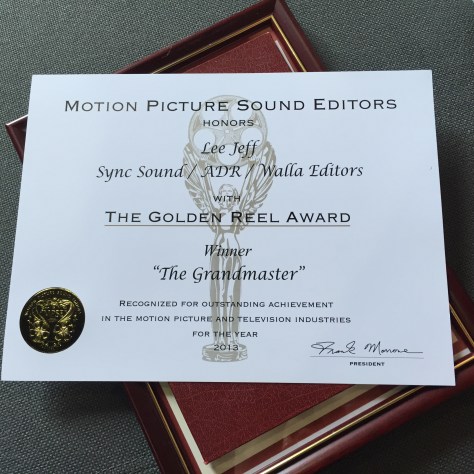
The Grandmaster is a beautiful film, visually and audibly. In addition to its 2014 Academy Award-nomination, it also received the Best film at the (2014) Asian Film Awards, Best Film at the (2014) Hong Kong Film Awards, as well as a Golden Horse Film Festival Audience Choice Award & Best Feature Film nomination. Most meaningful to Jifu was the Golden Reel Award for Best Sound Editing in Foreign Feature Film that acknowledged his skill on The Grandmaster and which he credits for inspiring him to continue to excel in the profession.

Though he enjoys the challenge of a huge budget feature film, Li also welcomes the opportunity of smaller films and the methodology they require. His work in Editing for the film “Love is Color Blind” helped to create the mood for a very different type of adversity and combat between the film’s main characters. The film, which won a host of awards at the London IFF 2017 and the Los Angeles Cinema Festival of Hollywood, is the story of an American woman who adopts an orphan from China and has brought it back to the United States. With adolescent rebellion, the child begins to gradually question the authority of her mother. Teen angst ensues and a rift is created between child and parent. As life educates the daughter, she prepares to sincerely apologize to her mother at her 18-year-old birthday party but the mother faints from weakness due to late stages of cancer. At the last moment of life, the mother and daughter finally understand each other.

Jifu had extensive conversation with director Liu Jiaqi about the emotional shading of the tone she wanted in the film. In creating the sound design for “Love is Color Blind” he used Avid Media Composer  and Protools HD. The program creates sound Design effects and allows them to be categorized and moved around as per the director’s desire for subtle differences. These type of modern tools are equally applicable in major studio films or smaller indie productions. It’s a fact of the modern filmmaking era that both the tools and the skilled professional like Jifu who use them often work in both situations. The key factors in either are talent and hard work, something which Li is always mindful of. He reveals, “I remember when I worked for Kar Wai Wong the director and he told me an idiom which inspires me to this day. Everyone knows that the most valuable part of a toad is the toad oil but do you know how the toad oil is produced? The toad is placed under a light and is scorched by the light. It produces this oil, a process which takes about twenty hours. When I heard this, I thought ‘sometimes inspiration comes from dogged pursuit.’ The best thing/essence occurs at the moment when you feel you reach your limit and want to give up. If you persist, you might be surprised by your achievement. This is what keeps me working as hard as I possibly can.”The Grandmaster -MPSE best sound editing
Ismaël Lotz on the honor of working alongside his childhood idols

IL05
Ismaël Lotz

When Ismaël Lotz looks back on his inspiration to pursue a career as a Director of Photography, Lotz recounts a unique combination of motivators. He recalls watching television and films with his father as a child. In fact, at the mere age of 7, Lotz saw E.T., and it was his first time seeing a film on the big screen. He was left in complete and utter awe, eager to see many more films just like it. After E.T., came films like Indiana Jones and Back to the Future. Eventually, he began experimenting with photographs and with shooting film on an 8mm camera. Even at a young age, he was confident that he could build a future out of his passion. His fascination with telling these gripping stories through different lighting techniques, filming methods, and sound styles opened an endless amount of possibilities and creative outlets for him to channel his artistry. He promised himself that one day, he would produce films that audiences would love the way he loved films like Back to the Future. Little did he know, he would one day work with the actors who crafted these stories before his eyes; however, today, instead of being his idols, these actors are also his equals.

Over the course of his career, Lotz has built himself into a highly sought-after Director of Photography in the arts and entertainment industry. His creative process typically begins when he assesses the story of a script and determines which style of film would best suit its inherent messages, moods, emotions, and atmospheres. Once he develops a vision for the script, he works tirelessly to ensure that he brings it to life in such a way that honors every element of the writer’s vision. Lotz distinguishes himself by his ability to capture every detail of a storyline, no matter how large or small. In his free time, he researches and experiments different filming techniques used by other directors of photography to master new techniques and broaden his range of abilities in order to enhance his skill set for the better of his future projects. In fact, in 2016, he had the unique opportunity to test his hand at filming a documentary called I Am Famous, featuring the life of Tom Wilson.

After he developed the idea of I Am Famous, Lotz was extremely excited about the opportunity to work with an actor that he had admired and idolized ever since he was a child. Wilson, who played the infamous role of Biff in Back to the Future, built an entertaining comedy reel out of his experiences after Back to the Future stormed the film industry. His role was so well known and vehemently disliked by audiences across the globe that he became accustomed to strangers approaching him and saying, “I hate you!” For I Am Famous, Lotz was not only the Director of Photography, but also the film’s sole director and editor. His personal approach to shooting the documentary allowed him to unveil Wilson’s true self. Being able to get to know one of the actors who inspired Lotz to become a Director of Photography was an opportunity unlike anything else he had ever encountered. He worked tirelessly to ensure that the final product of the project was nothing short of perfect.

“The way I create documentaries is very close and personal. I think the closer you can get to your subject, the more honest and real you can present them in your film. I like getting close to my subject on an intellectual level, but also with my camera. The result of I Am Famous was more than I could have ever dreamt. It turned out to be very successful,” told Lotz.

On the other side of the camera, Wilson was extremely humbled by the project. He doesn’t often allow for filmmakers to tap into his personal journeys; however, he felt that he could trust Lotz to portray him in an honest, organic light. He developed a confidence in Lotz that allowed him to feel at ease on camera and that allowed Lotz to challenge him to open himself up before his audience. When Wilson agreed to the project, he had no idea that he would be so moved by the final product and he felt that it was a distinct pleasure to be able to experience working with such a well-established Director of Photography.

“Working with Ismaël was a pleasure, as he is kind, easy to collaborate with, and keeps his humanity of the utmost importance – which is sometimes a rarity in filmmaking. His friendly demeanor makes a fine foundation for his skills as a cinematographer and director who gets things done. His knowledge of the technical demands that underlie the complex technologies of filmmaking are at the highest professional level and he has proven that with a long list of impressive professional work. In my almost forty years of filmmaking, I must say that Ismaël combines the essential ingredients for a successful filmmaker; a high level of technical skill, a deep commitment to the art of cinematography, and the personal character that makes for a solid and lasting success,” noted Wilson.

I Am Famous premiered in 2017 on ShortCutz Festival in Amsterdam. It went on to screen successfully at a number of subsequent film festivals such as the Miami Independent Film Festival, the Los Angeles Film Awards, New York Film Awards, Hollywood International Independent Documentary Awards, and many more. Knowing the film has done this well so early on in its screening life is a testament to Lotz’ prowess as a Director of Photography. He is motivated to explore the possibility of creating a follow up film.

For anyone aspiring to follow in Lotz’ footsteps, he cautions them to remain honest to themselves and to their environment. He understands that in his field, it is imperative to create as much as possible. With that, will come mistakes and ultimately, learning opportunities. By watching the work of other cinematographers, you can learn new techniques and gain an appreciation for all of the different styles present in the industry. The learning never stops and maybe one day, up-and-coming cinematographers will get to work with their idols and perfect their craft as Lotz has done in his remarkable career.

From High Tension Thrillers to Cutting Edge Emotional Dramas, Actress Daniela Junko’s Range Continues to Impress

13679894_578545459386_4253432136214602630_o
Actress Daniela Junko

When an actor brings a character to life on screen with such seamless believability, we’re sometimes led to wonder– is this character really just a natural extension of the actor’s off screen self? It’s when we see actors take on characters that are the polar opposite from one another and still deliver that same flawless authenticity (those such as Charlize Theron in “Monster” compared to “The Legend of Bagger Vance,” Jennifer Lawrence in “The Hunger Games” series compared to “Silver Linings Playbook” and Denzel Washington in “Training Day” compared to “The Magnificent Seven,” to name a few), that is when we know the true strength of an actor’s craft. One such actor who boasts an undeniably impressive range that places her in the upper echelon of the world’s most skilled actors is Daniela Junko.

Tall, exotic and beautiful, Daniela Junko’s look gives her the coveted ability to easily portray leading ladies on screen ranging from the femme fatale to the damsel in distress and everything in between. Her physical attributes aside, it is what she brings to the table in terms of talent that has really made her a powerhouse in the industry.

Over the years Junko, who is originally from Brazil, has become known for her starring roles in films such as Frank Lopez’s (“Tangerine Sky”) award-winning crime drama “Three Kings Down,” the twisted thriller films “I Am Tommy Talbot” and “The Incision” with Delpaneaux Wills from the two-time Golden Globe Award winning series “American Crime Story,” the hit feature film “Rough Mix” with Asian Television Award winners Kay Tong Lim and Rebecca Lim, and most recently the emotional drama “Alone,” which screened at the Cannes Film Festival earlier this year.

When asked what drives her as an actress, Junko explained, “As funny as it may sound, humans. We are such beautiful and complex creatures, even if we were capable of living for hundreds of years we would still not go through all the emotions and experiences that life has to present us with. To be able to study, understand and portray those different emotions, perhaps even help someone open their mind is a gift.”

From her body of work it is easy to see Junko’s interest, aptitude and dedication to discovering and experiencing the wide spectrum of emotional responses available and the many ways each individual character’s past experiences frame those responses.   

Two of Junko’s projects that really shine a light on her inimitable capacity to bring two completely different characters in two totally different genres to life are the films “Alone” and “The Incision.”

In Tekin Girgin’s thrilling crime drama “The Incision,” which centers on an organ trafficking ring led by an unscrupulous entrepreneur looking to expand his business, Junko gave a chilling  performance as Jessica, the point person who leads potential victims (or ‘organ donors’ as her character might refer to them) into situations where they are drugged and operated on. The leading lady of the film, Junko carefully imbues Jessica with multiple layers that make her intriguing and scathing simultaneously. The way she initially comes across, mesmerizing victims with her beauty and appearing affable and trustworthy, to her true essence as an evil power hungry woman with no identifiable value for human life, Junko’s performance on screen is difficult to peel our eyes away from as we wonder what her character is going to do next.

Whereas “The Incision” proved Junko’s flare for playing the villain, her role in the 2017 drama “Alone” directed by Angelo Perrino (“Dirty Spaghetti,” “The Lost Samurai”) revealed the actress in a very different light.

Riddled with vulnerability and emotional turmoil, her performance as Emma, a beautiful woman struggling to cope with debilitating depression, earned Junko a prestigious Best Actress Award nomination at the Madrid International Film Festival– and to anyone who’s seen the film, it comes as no surprise.

Starring opposite Swell Soubra, who is known for his work on the multi-award winning film “Lost Angels” and plays Emma’s boyfriend in “Alone,” Daniella powerfully depicts the paralyzing struggles those diagnosed with clinical depression face on an everyday basis. The on screen chemistry between Soubra and Junko is evident throughout the film, which is understandable considering their a couple off screen as well.

I love working with [Daniela], she is a tireless worker who demands the most from herself and everyone around her and she’s always great to be around. She is an incredible actress and storyteller,” explained “Alone” director Angelo Perrino. “The whole film would not exist without her… She is the film.”

Incapable of being typecast, Daniela Junko is one actress who has managed to defy all genre limitations and pre-existing expectations concerning the kinds of characters she takes on. Up next for Junko is the film “Killer Issues,” which will be directed by Jonathan Cocco (“Abduction,” “Twice Blessed”) and is expected to begin filming in 2018.

Saudi Arabia’s Talha Bin Abdulrahman is director extraordinaire

As a child, growing up in Riyadh, Saudi Arabia, Talha Bin Abdulrahman’s father used to rent movies and watch them with his family. This quality time together meant even more for the oldest brother, as he was enthralled by the films in a different way than the rest of his family. Bin Abdulrahman knew then that he was meant to be a filmmaker, and has spent his life making that dream a reality.

Now, as a director, Bin Abdulrahman does exactly what he always dreamed of. He creates all new worlds, and sees his job as gathering all the pieces of a puzzle and putting them together just right. This viewpoint is that of a perfectionist, which is exactly what Bin Abdulrahman is when it comes to filmmaking. His newest film, The Scapegoat, is a telling tale of a writer going through a rough spot, and is expected to be a strong contender at many of the world’s most prestigious film festivals. This is no different than his previous work. His comedic musical Film School Musical is an award-winning look at the difficulties a young filmmaker can go through, and his feature Viral Night, although still in pre-production, is a thriller that audiences can already look forward to.

“The rush of being on set, there’s nothing quite like it. You get to see performances of talented people giving you their best with what they were given, even when things go south there’s always some kind of silver lining or a lesson to be learned so you avoid it in future situations,” said Bin Abdulrahman.

One of the director’s favorite films to work on was the 2015 dramatic thriller Served Cold. Honoring television shows like Breaking Bad and Better Call Saul, Bin Abdulrahman wanted to tell a story about the drug world, showing that there is no clear-cut black and white in this world. Therefore, Served Cold is about a former drug lord who is sentenced to life in prison after killing an undercover cop. With the help of his shady attorney, he has to take desperate measures in order to be with his teenage daughter.

“There is a lot of interesting grey areas to discover and I wanted this project to shed some light on that theme. It’s essentially a cold revenge story about a criminal lawyer who poisons one of his clients who was sentenced to do a life sentence for illegal drug trafficking and killing the undercover DEA agent, who is also the lawyer’s father by adoption. This scheme doesn’t go as planned,” said Bin Abdulrahman. “Revenge stories can be very emotionally engaging and it’s a good way to see the characters faced with their worst nightmare, the rage behind the revenge fuels the whole story and it’s satisfying for the audience to go through this emotional journey.”

Bin Abdulrahman’s vision for the film was achieved when it won the “Audience Choice” at the SFA awards in January 2015, which was being held at the same time and place as the Sundance Film Festival. The film’s rights were then sold to ShortsHD, an international cable channel, where it was such a hit with audiences that it has aired twelve times during 2015.

“It feels very rewarding to be validated by awards and audience reactions. I think to myself that I must be headed on the right direction. It feels reassuring after five months of work to know that it wasn’t for nothing and it boosts you to move on to your next project,” said Bin Abdulrahman.

After writing the script himself and self-financing the production with his producer, Bin Abdulrahman made the decision to also direct the film. After finding the right cinematographer, the project took off. Immediately, Bin Abdulrahman became committed to telling the story of Served Cold with a specific vision in mind. He knew the look and feel that was appropriate for the genre and worked hard to bring the script to life. The story is very moody and has layers of dark tones, so maintaining that feeling depended a lot on the actors and how realistic their performances were, so as the director, Bin Abdulrahman strived to get the best out of his cast, and his efforts paid off. It gave him quite a lesson on finding the best way to get his actors in the mood and to get them be very serious, as all of the scenes were extremely intense. Throughout filming, the director strived to be fully harmonious with his crew, and he succeeded.

“Working with Talha is a blessing. He comes to set extremely prepared, knows what he wants and is very easy to work with. I enjoy working with directors like Talha who makes a producer’s life easier,” said Maan B., the Producer of Served Cold. “Talha is a very talented, creative, and visionary director. I experienced it on set with him; we came to set one day with something we have long prepared for, but something did not work, so Talha came up with a better idea on the spot and we continued with our day without losing money. That’s the kind of directors I like. He’s not married to his ideas. He’s open to suggestions and anything else that will help the project for the better.”

Bin Abdulrahman knows just how to bring the best out of those he works with, and the best out of himself. It is what makes him such an in-demand director, and why he will continue to have such a prosperous career.

Producer Sherry Yang scares and educates audiences in new thriller ‘Under the Pieces’

The moment Sherry Yang steps onto a film set, she falls in love with what she does all over again. She is an extraordinary producer, and her passion for her work translates into each and every film she has done. She loves the feeling of working tirelessly night and day, as it allows her to see the magic of the filmmaking process in its entirety. She loves that as a producer, she nourishes a project from beginning to end; she works with every department; she is the go-to person for any problem that may arise and always has a way of solving it. For Yang, her work is more than satisfying, it is addicting, and that is why she is in demand all over the world.

Yang has produced many high-achieving films, and the success of each comes down to her talent and work ethic. Her versatility is superlative, and whether working on a historical story, such as the award-winning film The Letter, a telling comedy, exemplified by her films Jiaozi and Cash Back, or meaningful dramas like Te Echo de Menos, Yang’s producing is continuously top-notch. She has now also extended her resume to the thriller genre with her work on the new film Under the Pieces, and she has once again showed the world what she is capable of.

“I had always been very interested in the human psyche, which sparked my interest in Under the Pieces. I have been especially fascinated by the notion of dual personalities. This film decided to take a step further and make it multiple personal identities, and that made me excited. It was going to be another challenge to see how a mysterious murder would play out. I wanted to be one of the key elements that help in bringing this story to its successful,” said Yang.

Under the Pieces - Yuki Yoshimatsu, Brittany Fisheli, Sherry Yang - photo by Vera Zhang
Yuki Yoshimatsu, Brittany Fisheli, and Sherry Yang – photo by Vera Zhang

Under the Pieces follows a detective as she tries to put the puzzle pieces together of a horrendous murder that occurs inside a loving couple’s home. Yang was responsible for gathering the team, setting up meetings and rehearsals, and running daily productions. She also had to hire a writer and director. When she found Yuki Yoshimatsu, Yang then was involved in the creative aspect of the film. She would go over each draft and work with her team to ensure they were telling the right story. This made her extremely attached to the script, and she had to make sure she found the right actors for each part. Finding someone who can convincingly portray multiple personalities is not easy, as they had to be someone who could change their entire disposition just from the look in their eyes, but eventually she found just that in Mikael Mattsson. Her work was not done after that; once filming was completed, the team then looked for the ideal editor, one who would display the story in a manner that the audience would understand what happened whilst keeping the mystery of it until the very end, which they found in Monge. Undoubtedly, the film could not have achieved what it did without Yang, and these thoughts are echoed by her team.

“Sherry demonstrated exceptional problem-solving skills and communication abilities within and outside the production crew. In particular, when working with her, I don’t remember having a single problem with other departments or locations. When a producer is talented and particularly adept at their job it often goes unnoticed, because everyone else can tend to their own responsibilities without unexpected distractions. In this respect, Sherry was always an unsung hero on set by solving every ongoing problem that we were unaware of at the time. She is the best kind of producer, one who provides an environment where everyone on the crew can excel up to and beyond their individual abilities to collaboratively make the best possible product. I don’t even know much about her past work and accomplishments because when I’ve worked with her she has always been focused entirely on the job at hand rather than talking about herself. The filmmaking business is often correctly characterized for its narcissism. It is an industry where many people prop themselves up by tearing others down. It is notable that I have never heard a negative comment about Sherry from anyone else or a diminishing remark from her about anyone else. This might seem like a small thing, but it is a significant asset to the film industry because she has the type of work ethic and personality that sets a cultural and social example for an industry that is too often lacking,” said Edwin Beckenbach, a gaffer on Under the Pieces.

After premiering at the Los Angeles Cinema Festival of Hollywood in February where it won Best Student Film, Under the Pieces has had quite the film festival run. It was a selection at the celebrated Cannes Short Film Corner, as well as the L.A. Shorts Awards 2017 where it won Best Short Film Silver Award and the NYC Indie Film Awards 2017, where it took home Best Short Film Platinum Award.

“It is exciting that the film did so well. I am happy that many audiences and festival juries were able to understand the story and enjoy it. It assures us that the film was understandable and that we were able to tell the story correctly. We hope that this film has not only surprised audiences with the ending, but that it allowed them to connect with its message. We wanted the audience to understand that although perhaps not to the extreme of murder, but any individual in a stressful situation can snap with one simple push,” said Yang.

The film started out as Cinematographer Royce Gao’s passion project. Gao approached Yang knowing she was the best producer possible for her cherished film. Yang was not only eager to tell the story, but also to take on a more creative producing role, finding the correct writer and director, and being a part of the writing process. This made communication critical for the project’s success.

“I truly liked how I got to be involved creatively. The fact that I was able to put a few inputs to the story made this project a lot more personal to me. It made me more passionate to make sure the story was told right. I enjoyed being valued not only for my skills as a producer, but also for my creativity,” she said.

Above all else, however, Yang wanted to tell the story not just as a thriller that would excite and terrify audiences, but as a teaching tool. She wanted to educate viewers on multiple personality disorder, and put in a lot of research to make the story as authentic as possible.

Be sure to check out Under the Pieces and get a glimpse into Sherry Yang’s outstanding producing talents.


Top photo Victoria Geske, Sherry Yang – by Yuki Yoshimatsu

Tooba Rezaei experiences the magic of touching hearts through ‘A Sweet Dream’

A-sweet-dream-poster-small
A Sweet Dream film poster

One of the most unique joys of being an artist is knowing that your work evokes raw, human emotions within those around you. Visual arts have the ability to transcend the mundane aspects of human life and to push people to explore themselves and the world around them. Over time, art has created change. It has inspired and influenced. It has created chaos and disruption, and it has birthed a community of dreamers, and creators. It has produced renowned artists like Tooba Rezaei, whose passion has allowed her to touch the lives of several different people throughout her career. For Rezaei, the true joy of her craft comes from the platform it gives her to make people feel things that they may not otherwise have the chance to feel. She gets to tell stories and to motivate her audiences to dream without limits.

When Rezaei was a child, she would immerse herself in cartoon television shows. When each show ended, she would take her pen and paper and challenge herself to draw all of her favorite characters. She was energized by the feeling of her pencils exploring the paper and loved the creating things that hadn’t otherwise existed. As she grew up, she continued to test her skills against various mediums and art forms within the field of visual arts. This led her to discover the wonderful world of animation, a world in which she feels that she belongs. She has a natural affinity for bringing her drawings to life via animation and loves the dynamics that the motion brings to her artwork. As an animator, Rezaei has created a number of well-known animations, such as her original animation, A Sweet Dream. Prior to creating A Sweet Dream, however, Rezaei experienced her first sense of impacting the lives of others through her artwork with her animations for the game SilverFit.

SilverFit was a game designed specifically for use by an older demographic. Essentially, it is a virtual therapy system to be used to train gross motor skills and ADL tasks during rehabilitation sessions. The game presents the necessary exercises for elderly individuals to follow along with and keep their muscles working accordingly. Since its inception, the game received great success and is now used by over 20,000 individuals a week. As SilverFit’s first designer, Rezaei acted as the background designer, background painter, character designer, and character animator. She designed a wide variety of different games, each based on the use of different motor skills to suit the game’s intended audience. In working for SilverFit, Rezaei got a taste of what it felt like to know that her work would directly aid in helping improve the health of its target audience. It gave Rezaei’s art a meaningful sense of purpose and she was addicted to the high of helping those around her. SilverFit’s founder and managing director, Maaike Dekkers-Duijts, was blessed to have Rezaei on board for the project. Her talents exceeded far beyond simply animating.

“Her animations really seem to come alive. They really ‘touch’ you. She is a great artist, creating extraordinarily beautiful animations. She is so artistic and has exceptional talent,” regarded Dekkers-Duijts.

After the success of Silverfit, Rezaei then extended her talents to the children’s show Parparook for Persian Gulf TV. Parparook (meaning ‘Pinwheel’ in the South of Iran) is a special program that is produced and distributed in Kahlije Fars IRIB (Islamis Repablic of Iran Broadcasting, also known as Persian Gulf). Rezaei wrote, directed, designed, painted and animated all the characters and all the objects on the background of Parparook, creating everything from scratch and differentiating her shorts from everything on the show. The producer and manager of the program were so happy with results that years later they used some of Rezaei’s work for other kid’s television programs as well.

Knowing that she had always wanted to create her own animated story, she knew that in order for it to be truly worth her while, she would need to give it an element of social influence. She wanted to do more than just entertain, and out of this determination, A Sweet Dream was born. A Sweet Dream can be described as a bittersweet, allegorical look at the desires of a little girl who wants the world to see her talents shine through her difficult life circumstances. Not only did Rezaei animate this project from start to finish, she also wrote and directed the storyline. To fit with the animated short’s premise, Rezaei felt it fitting to use a simple, two dimensional, flat design. In fact, she felt that the simplicity of the drawings was imperative to the overall mood she was attempting to portray. She wanted it to seem as if the little girl could’ve drawn the lines and shapes herself, making her world easier to relate to for her audience. Rezaei then added a second element to her design concept by showcasing the little girl’s reality through dark blue tones and contrasting it with her dream state, which Rezaei colored in golden tones.

“In her dream world, forms are curvaceous and delicate. There is dance and movement and inspiration. However, in reality, she is in an orphanage and the forms of the beds and the room are sharp and straight with harsh angles, alluding to her real-life struggles and difficulties,” said Rezaei.

Rezaei hoped that A Sweet Dream would challenge her audience to question their own harsh realities and evaluate them against their own hopes and dreams. She wanted them to think about how they would react if they were in the little girl’s shoes. Would their dreams be squandered by their reality? According to Rezaei, if we don’t push ourselves to understand the lives of others, we can never truly improve our society as a whole and make our collective world a better place. She felt as though A Sweet Dream helped to remind her why she does the work that she does. Seeing her audiences shed tears over her story solidified the reality that this is exactly what she wants to be doing and that she had succeeded in her efforts to make them stop and think about the consequences of their actions.

After screening at a number of different film festivals, A Sweet Dream even went on to win Best Animation at the Los Angeles CineFest, as well as Finalist in Animation Short at both the International Film Awards in Berlin, Germany, as well as at Constatine’s Gold Coin Festival in Serbia. If you wish to experience the magic, watch A Sweet Dream for yourself and you won’t be disappointed.


Image by Tooba Rezaei, captured from ‘A Sweet Dream’

Actor Profile: Australia’s Madalein Jackson

Madalein Jackson
Australian actress Madalein Jackson

Hailing from Newcastle, Australia actress Madalein Jackson first took to the stages at the age of 7. Performing in multiple theatre productions over the course of her childhood and teenage years, Jackson realized early on that acting was a passion she had to follow.

“I find acting to be extremely cathartic; it’s such a great outlet for expressing yourself.  Acting has always been a weird obsession for me that has sometimes been difficult to make sense of… There is also nothing like the rush of performing, I cannot think of anything else that compares to the feeling,” explains Jackson.

One of the aspects of Jackson’s talent that has made her such a dynamic asset to the theatre productions she’s starred in to date is her remarkable singing voice. Early on in her career Jackson’s voice landed her a coveted spot in Newcastle’s Hunter Singers choir, with which she travelled and performed across both Australia and Europe.

“Being a member of Hunter Singers improved my singing technique immensely… we were constantly learning and performing new repertoire, helping me to develop fast learning and excellent sight-reading skills, both of which are extremely beneficial in the musical theatre world.” explains Jackson about being selected to sing for one Australia’s premiere vocal groups.

“I was lucky enough to be part of the European tour to Austria, England and Wales, as well as competing at the Llangollen International Eisteddfod and being part of premiere performances of commissioned works by renowned Australian composers Stephen Leek, Paul Jarman and Gordon Hamilton.”

Jackson’s seasoned skill as an actress coupled with her powerful singing voice has made here a natural choice for leading roles in an impressive list of esteemed productions in Australia, such as “Urinetown,” “Seussical,” “Pride & Prejudice,” “Les Miserables,” “Animal Farm,” “Bugsy Malone,” “Charlie and the Chocolate Factory” and “Our Day Out.”

One of her most memorable performances, and one that definitely struck a chord with audiences, was her performance in the hit musical “Seussical” where she took on the starring role of Gertrude McFuzz.

“My favourite part of ‘Seussical’ is absolutely the music. It has such well-written, catchy songs, and we had an amazing cast and band who did such an incredible job bringing the music to life,” admits Jackson.

The play pulls together characters from Dr. Seuss’s most famous books, mainly those from “Horton Hears a Who!,” “Horton Hatches the Egg” and “Miss Gertrude McFuzz.” When Horton the Elephant hears a sound coming from a speck of dust he is convinced that there must be someone in it– so he places it on a clover and guards it; meanwhile the surrounding community led by the villain Sour Kangaroo go to town mocking Horton without mercy, all but Gertrude McFuzz. A shy and insecure ‘bird-girl,’ Jackson’s character Gertrude McFuzz is overwhelmingly in love with Horton, but fearing he won’t notice her because of her puny tail, she goes to the doctor who prescribes her pills to take to make her tail grow. Thrilled by the immediate results, Gertrude quickly overdoses on the pills, which lead her tail to grow to an enormous length.

Jackson’s ability to bring to life such an awkward and fantastical character on stage while singing all of the dialogue was tantamount to the success of “Seussical” in Australia.

When asked how she feels on stage, Jackson said, “It’s a combination of overwhelming euphoria and varying degrees of nervousness. It is exciting, nerve-wracking and exhilarating. It’s like jumping out of a plane without a parachute! A great audience will feed you energy and contribute to the highest high there is.”

Over the years Jackson wowed countless audiences with her capacity as an actress on stage, and in 2012 she made the cross over to the film and television. Her first role on screen was on none other than four-time Golden Globe Award winning series “Glee,” which she followed up with a featured role on the Golden Globe Award winning series “Enlightened” with Laura Dern (“Jurassic Park,” “The Fault in Our Stars”). In 2013 Jackson took on a key role as Miss Merryweather’s Assistant in the film “Wiener Dog Nationals” where she acted alongside Golden Globe nominee Morgan Fairchild (“Life’s a Beach,” “The Bold and the Beautiful”) and Jason London (“The Man in the Moon,” “Jason and the Argonauts”).

From the stage to the screen actress Madalein Jackson has created a dazzling repertoire of work that reveals the dynamic nature of her craft and we’re sure we’ll be seeing a whole lot more from her as time goes on.


“IF” HONESTY IS BEAUTY

Director Nikki Ormerod wanted to use her background in still photography as an inspiration for the film “If” which celebrated the differences in human beings. She wanted the most basic of presentations in order to focus all attention upon the individuals presented onscreen. She had long desired to work with cinematographer Stuart Campbell and was pleased when he consented. The resulting film was an official selection of the Ottawa Film Festival (2016) and earned Campbell a nomination for Best Dramatic Cinematography from the Canadian Society of Cinematographers. The most fitting description for the film would be classic. “If” is streamlined and yet possesses a massive emotional impact. If (no pun intended) the desire of Ormerod and Campbell was to exhibit the corporal form and communicate the essence of our connective substance, goal soundly achieved!

Most directors hope to capture a performance that is believable. In her film “If” Ormerod wanted to simply capture the beauty and complexity of what is already in existence. The desire was to manifest a “filmic version” of the type of photography that interested her most. The soul of the individuals onscreen should be visible and instantly relatable to the audience. Nikki knew Stuart’s work and knew that he understood how to capture the correct moments to exhibit this. She confirms, “Stuart elevated the film to levels of quality I had never thought possible. ‘If’ is a very simple film that centers purely on showing the faces of a variety of individuals from different walks of life. Considering the static nature of the shots, it was necessary to have a cinematographer that could think beyond just shooting beautiful photography and instead capture thoughtful, conceptual, and cinematic imagery that delved much deeper, which is exactly why Stuart was the only man for the job. Based on my initial idea, Stuart brilliantly introduced the idea of incorporating slow motion shots and poetic narration to the film to help support the idea and visuals, which I must say was a stroke of pure genius. The slow motion shots and use of black and white photography created strong rhythmic and timeless imagery.”

bts_3

Working together, director and cinematographer created a visual statement which communicates a unifying vision of community; one which literally shows how we are all the same regardless of age, sex, race, religion, and other factors…because we all feel the same emotions. The Rudyard Kipling poem supplies the verbiage which tells this but the imagery packs the punch of this idea. Within mere seconds of viewing those onscreen, one can see the same desires, hopes, and motivation in an outwardly eclectic yet inwardly cohesive group.

The sincerity and simple beauty of Nikki’s idea for the film spoke so loudly to Campbell that he offered up a streamlined and simple approach to the camera’s view. In its singular manner, the cinematography of “If” established the ability of the audience to focus on the individuals seen on the screen rather than a variety of framing, lenses, and other technical processes that Stuart could have used. There’s no shortage of technology available to use on a film these days. Drones, Go Pros, and other technological gadgets enable a cinematographer to create a myriad of different looks for their work. Stuart explains, “Some prefer to have a lot of toys at their disposal so they have options while they’re shooting. I prefer to figure out what needs to be done and focus in on that and get the gear that is needed. Different jobs have different needs. Some jobs you really do need to have two, three, four cameras around because that’s what’s appropriate for the job and what you need to cover. Personally, I love one camera jobs because it allows me to shoot everything the way that I think it needs to be shot. Controlling? Maybe, but everyone is different and everyone sees the world differently. Someone else may not shoot something the same way I would. And sometimes things come up where you need to adjust and roll with what’s happening. There’s no guarantee that someone else will react the same way.”

bts_7

There’s something to the idea that a great cinematographer gets inside the brain of the director they are working with. If the cinematographer is the eyes of the project, the director is most certainly the mind and heart of it. Campbell contributed more than just the images seen in “If” because he “got” Ormerod. Nikki’s original idea was to have music, vague & droning instrumental tracks to accompany the people seen onscreen but after prompting from Stuart and some research, the Kipling poem was added and gave a whole new dimension to the film. That poem was written for Kipling’s son as a piece of paternal advice. It gives general conditions to succeed in achieving a happy & beautiful life. If everyone lived by similar “rules” the world would be a much different place, and potentially a much happier one.

One very obvious and complementary part of Campbell’s contributions to “If” is the use of slow motion. The gravitas of the imagery in the film, coupled with the poem by Rudyard Kipling, are enhanced by the calculated lethargy of the movements seen in the film as a result of this. This grants the viewer the ability to hang on every person, every frame, every emotion, fully supporting the idea and experiment of a “moving photograph”, as was the director’s original desire. Stuart confirms, “The slow motion was a very clear way to allow the viewer to really take in the emotion that the subject was giving out. Like a photograph, the longer you have to sit with something, the more story comes out of it. It was an opportunity to let the viewer take their time and experience the visuals along with what was being said in the poem. The film is an emotional piece and sometimes it’s best to just take your time with things. Using slow motion also gave us an opportunity to make some emotions mean more by speeding them up or picking a speed somewhere in between. Shooting in slow motion just gives you options and lets you bring some more drama to what you’re shooting (sometimes).”

bts_2

Stuart Campbell is known for getting amazing results with an often very basic camera set up. While he is quite comfortable with the updates that technology’s cutting edge offers up, it’s because this cinematographer is so committed to story and connecting with the essence of a production that he often uses a very limited set of tools for himself. It’s via this “primary” approach that Campbell feels he is able to more sincerely communicate the essential ideas that the storyteller wishes to impart. It’s Stuart Campbell’s contention that more tools do not make one more skilled, rather it’s by using the tools you have when they are called upon that empowers one to honestly communicate the essential idea of any story.

Australian actress Natasha St. Clair-Johnson stars in new film ‘Incall’

NatashaStClairJohnson-2006
Natasha St. Clair-Johnson, photo by KAT TUOHY PHOTOGRAPHY

“Acting is the one way that I feel free to be myself,” said Natasha St. Clair Johnson. The Australian native has an innate talent, and has loved performing for almost her entire life. As a child, she wanted to be like the people she saw on-screen, but as she grew, this desire became much fiercer. She wanted to tell stories; she wanted to show the wonderful and painful aspects of what it means to be human; she wanted to make a difference with the best way she knew how. Acting became her focus, and performing her way of life. Now, she is one of Australia’s leading actresses, and the passion she feels for what she does is the same as it was when she began her career.

While working her way to the top, St. Clair-Johnson worked on several extremely successful projects, showing her home country and the world why she is so formidable. In the feature film Birthday, the actress has the critical role of a social-worker. Her work led the film to be selected for the highly-prestigious Cannes Film Festival, where it took home the top award for Best Actress in a Foreign Film. Similar success followed with her film Prized, where she co-stars with ‘Twitch’ aka Stephan Boss from So You Think You Can Dance and currently the popular DJ on The Ellen Degeneres Show, as well as the movie Shang, playing a seductive vampire and showing audiences how versatile of an actress she truly is.

“The thrill of performing is like nothing else for me. With film and theatre being such different mediums, they both still give me joy. Being on set has an intimacy, a rawness, and a realism to it,” said St. Clair-Johnson.

Audiences can also look forward to St. Clair-Johnson’s performance in the highly-anticipated film Incall. The film tells the story of a wealthy house wife who gets more than she bargained for when a call girl changes the course of her day into something completely unexpected. It explores ideas of sexuality, power, feminism, and manipulation, with three women all appearing as different facets of what is it to be the modern woman.

“Not many films like to show women that are sexual and strong. It’s considered taboo, and commonly mistaken to be either an excuse for woman to behave in an explicit nature or to get attention. Our film is more about the mind games between people. It’s not about seeing anything happen but the suggestion,” St. Clair-Johnson described.

The film is centered around St. Clair-Johnson’s character and what happens to her over the course of one day. It is a window into the perverse intimacy she enjoys. She is an elegant, well-dressed, poised woman with a dark side. Although she appears to be one way to others, her inner desires are quite different from the persona she displays. She has a certain way about her that can be disarming, which is what the directors were looking for in St. Clair-Johnson’s performance. She perfectly personifies the complicated character, with a hint of possible danger, as you can’t always be sure where the character might take the conversation or situation she is in.

While many films explore a male and female dynamic, Incall involves two strong female characters. These characters are not necessarily attracted to each other, but rather show how they manipulate, judge, and control each other. It is about ego and power. St. Clair-Johnson’s character is the instigator of the events. Therefore, when the director was looking for someone for such an important and complicated role, she knew she had to find someone with immense talent.

“Natasha is gifted and hard working. She always gives 100 per cent to every take and patience beyond what would be required of her. It is a pleasure working with her on and off set. She is very personable. Her unique choices make her an outstanding actress. She has a subtle but compelling ability to seek the nuances in her characters’ behavior, with an unlimited range and keen understanding of the complexities of the characters’ relationships,” said Rachael Murphy, Writer and Director of Incall.

Murphy approached St. Clair-Johnson when she began casting. She knew that she wanted the actress as her leading character to make her film a success. St. Clair-Johnson was happy to take on a role in an all-female film. During the shoot, she found herself being taken away with what was happening. She knew exactly where to go with her character, completely embodying her. She would utilize subtle and exciting exchanges between her co-star and herself, opening up her creative juices. With every script she works on, the actress takes the time to analyze it. She figures out the exact motives behind each of her characters’ choices. For Incall, she worked those choices into her performance flawlessly, displaying intimacy, and passive-aggressive behavior simultaneously.

In addition to acting, St. Clair-Johnson also took on an executive producer role for the film. Although she had never done this before, she was excited to learn about the job, knowing the experience behind-the-scenes would help make her an even better actress. She was able to find the perfect balance between her role as an actress and her executive producing responsibilities, and found herself watching every take and staying engaged in all areas of the film production.

“This project gave me artistic freedom to play with whatever choices I wanted. I was to carry the film and I loved the responsibility of that. Especially showcasing myself in a film that is strongly focused on women. My team and I knew that it would be topical and the LGBT community would also be interested. We were recently approached by a film festival exclusively showcasing films produced and starring woman. It’s an honor,” said St. Clair-Johnson.

Incall is currently in post-production with a release date set for 2018 into the film festival circuit, and then onwards to national release in the United States and Australia. It is also expected to make its way to several Australian television networks, and streaming services such as Amazon Prime, Netflix, YouTube, and Hulu in the short film category. If you get a chance, make sure to check out St. Clair-Johnson’s stellar performance.

Ana Lossada inspires children to live healthy lives with work at Disney

Despite having an interest in the arts from an early age, Ana Lossada never really thought she would have a future in the field. As a child, she enjoyed drawing and painting as most children do, but she also enjoyed sports, dance, and playing with friends. Creativity was an instinct for her, she was never conscious of it. As she began to grow, her other interests slowly started fading away, but art was her constant. She started to realize that she could pursue a career in the arts and do what she loved every day. It was this realization that changed her life, and now, as an internationally sought-after motion graphics designer, she has never looked back.

“As a kid, I never really saw it as a ‘this is what I want to do when I grow up’ type of thing. Doing creative things simply came to me very easily and effortless an. Besides being the artsy kid in school, I have always loved watching cartoons and also movies filled with action, sci-fi and a whole lot of visual effects. These tendencies worked out, as my art interests led me to pursue a career in the digital media world,” said Lossada.

Throughout her esteemed career, Lossada has worked with some of the world’s most well-known production companies and television shows. She recently collaborated with Disney to create the opening theme for the new show Raven’s Home, a spin-off of their older classic That’s So Raven. Premiering earlier this summer, the opening garnered a lot of media attention, and Lossada’s work is a large part of that. A similar experience occurred with Lossada’s work on the opening of Netflix’s hit show Atypical, where Lossada perfectly captured the autistic main character’s tendencies and feelings in her work. All that work alongside the designer are impressed with what she can do.

“Throughout my career I have worked with many talented designers and no one comes across like Ana has. Not only does she have amazing technical skills when it comes to handling computer software, she has a natural ability as an artist and illustrator. She is incredibly dedicated and gives her best in every single project. Her hard work will lead her to an incredible career,” said KA Batcha, who worked with Lossada on The Walking Dead: The Journey So Far, a thrilling recap of the first six seasons of AMC’s iconic series The Walking Dead.

Despite such success, one of the highlights of Lossada’s career is her work with Disney Jr. on their “Be Inspired” spot. The concept of the project was to encourage children to live healthy active lifestyles with promotional videos showing easy exercises that kids can follow along with, designed in the setting of the Disney classic The Lion King. The project was an immense success, and at only 23, Lossada showed one of the largest and most renowned production companies in the world, Disney, that she was extraordinarily talented.

After the success of Be Inspired with the Lion Guard, Disney wanted to team up with Lossada once again, this time with the spot Be Your Best with Miles, featuring the character Miles from Miles from Tomorrowland, a popular children’s show for the network. This segment is a 2-minute spot in which cartoon Miles and “real” Miles are compared side to side, teaching us how to live a healthy lifestyle by following a healthy diet and exercising frequently.

“The way children eat from a very young age impacts their growth and health throughout their childhood, and for the rest of their lives. A healthy diet and good nutrition are critical in preventing some of the issues and illnesses that are caused by bad nutrition, such as nutrient deficiencies, poor bone health, increased risk of injuries, poor academic performance and increased risk of eating disorders. Teaching children how important a healthy nutrition is and also the importance of a vigorous fitness routine throughout their childhood years will lay a base for a healthier and fulfilling life,” said Lossada.

The music video with exercises are currently being aired on Disney Junior worldwide. Each exercise video has over 60,000 views on YouTube alone, and the music video “Teke Ruka Teleza” has over 250,000. Such success could not have been possible without Lossada’s contributions.

Working with her team at Big Machine, Lossada helped design and animate the main title for the spot. Additionally, she needed to create modern and stylized split-screen graphics for the spot and also a UI/UX interface graphic that explained what audiences were seeing on screen. She did all this using her own unique style, as she is known for her distinctive artistry. Her artwork speaks strongly to people, and with Be Your Best with Miles, it has resonated with children around the globe.

While creating the video spots, all of Lossada’s skills were put to use, from designing to illustrating and even animating. Not only was she leading the team, but she was also working on the live action set as well, ensuring her graphics would perfectly transition with the live footage.

To generate ideas and inspiration for the project, Lossada watched an episode of Miles from Tomorrowland. Upon doing so, she noticed there were many simple shape designs in the show, primarily hexagons. This is therefore the primary element seen throughout the whole Lossada’s work on Be Your Best with Miles. She used it for overlay shots, for example the scene where Miles analyzes a breakfast kitchen, for transitional designs between live-action Miles and character Miles, and lastly for the split screens where they are seen together. Such attention to detail is what makes Lossada one of the best, and while working on Be Your Best with Miles, her co-workers were able to see all of talents really shine. Not only does she have the technical skills when it comes to mastering any software, but she also possesses the innate natural ability to design and illustrate.

“Working on Be Your Best with Miles was very fun. Mainly, because we had to find activities and exercises performed by the live-action Miles and compared it to the 3D character Miles,” said Lossada.

No matter what she takes on, Lossada puts everything she has into her work. This is not for the accolades or awards, but for a passion for what she does. She is a perfectionist in the best way. When people enjoy what she has produced, she knows she is doing what she was meant to do.

“I take a great deal of pride in my work and do everything I can to ensure every aspect of each project I touch is perfect, so it truly means a lot when people acknowledge the quality of my projects.  Seeing the look of astonishment on their faces as they wonder how exactly I animated and designed these various projects makes all of the hard work worthwhile. I have always believed that the entertainment industry, particularly the creative side of the business, can convey powerful emotions and messages. It is my goal to use my knowledge and skillset to bring these feelings and experiences to the general public and leave an everlasting mark on the industry,” said Lossada.

She is already well on her way. Watch Lossada’s tremendous work in Be Your Best with Miles here.

International Entertainment, and the Talents that Leave us Buzzing….