Category Archives: Reviews, Interviews & Features!

THE MODERN PATH TO ALL THINGS ENTERTAINMENT

Screen Shot 2017-12-04 at 9.58.40 PM

Information moves more quickly than ever before. Included in this nowadays is entertainment. While it used to be music downloads, we presently see the entire season of a TV program released in a day, and films come out more and more expeditiously whether new productions or classic time capsule fare. All of this results in a closer relationship between the artists who create these works and those who are able to deliver them to the public. Red Touch Media (RTM) is a company which licenses and distributes entertainment content. It has created a world class content management and distribution system. The conduit between RTM, the artist/companies who have content to distribute, and the public is event producer Ian Pickup. As the professional who plans and manifests the situations/venues between those who “have” and those who “want”, Ian is the M.C. if you will of the modern entertainment mogul parties. Helping RTM to present their product at global prestigious events like MIP TV and MIPCOM, Pickup facilitates the meetings and conversations that lead to the rest of us being able to watch our favorite productions (and listening or reading them, depending on the situation). Whether it’s events in Cannes, Liverpool, Sydney, or others, Ian Pickup has found himself in the enviable position of being on the cusp of modern entertainment technology, while not actually being a filmmaker himself. If there is such a thing as a professional entertainment wingman, this event producer is at the top of the heap.

Held in Cannes, MIP TV and MIPCOM are where a significant portion of the worlds TV and film content is sold and purchased. These massive events facilitate and determine what a great deal of the world watches. RTM provides software for many studios at these markets who use RTM software to manage all their digital assets as well as to sell this content. It is a critical part of the sales process. If you think of MIP and MIP TV as a marketplace of digital and entertainment content, you have the right idea.  RTM’s job is to help studios use their software to display, manage, distribute, and ultimately sell that TV & film content. At MIP TV (which focuses on television content) Pickup finds himself on site from the very first set up of RTM’s venue to the final stages. During MIPCOM (which focuses more on film), Ian is responsible for the overall Operations and works closely with Reed Midem (the event organizers). With an attendance of around 14,000, MIPCOM may be the somewhat larger event but current trends show that more and more of the viewing public skews to the comfortability and accessibility of TV programing (though film as well is becoming more available). Pickup states, “RTM is very aware of how things are evolving in the entertainment industry and it is passionate about being a leader. I appreciate the proactive nature of this. These two events are a requirement for anyone who is part of the industry. Company executives are often asked to be on panels to talk about the latest technology and trends.  Given our position as a prime distributor of digital content to underserved markets, we really do see where things are headed and what might shape the market.”

Screen Shot 2017-12-04 at 9.59.04 PM

As an event producer for RTM Ian takes part in a wide variety of tasks. One minute might find him renting a yacht and hosting a dinner, then next might be throwing one of those parties that he is famous for; not in the sense of lavishness but rather in terms of providing an atmosphere of fun. In fact, Ian takes great pride in the fact that the events he creates are not solely focused on the spectacle but rather in creating a relaxed form of respite from what may have been a chaotic whirlwind of meetings and discussion that are a necessity of the situation. It’s somewhat surprising to hear that the person in charge of gathering great groups of individuals is adamant that his role is one of facilitating personal connection. The show itself is more about relationships than logistics.  Coordinating with unions, installation teams, and multiple companies doing different things on the installation is a really big part of the job, to say nothing of the multiple languages often involved in these events. As Ian puts it, “Most of the deals are made outside the ‘formal’ parts of the show.  Parties, dinners, off line meetings, anywhere where you can get to know someone on a deeper level rather than simply as ‘Steve from Sony with a quota.’ Our reputation in the business is one of deep relationships with not just our clients but people in general, we know how to develop relationships and we are good at it. Yes, I’m a professional who produces and coordinates events but I honestly think of my role as someone who creates an environment where people can relax, have fun, and be themselves. I think this is what allows people to understand if they want to do business with someone…when they feel as if they’ve truly met them rather than simply that person as a representative. It takes a lot of work and preparation to create that environment though.”

Meeting like MIPCOM and MIP TV are examples of the continuing evolution of entertainment in the world. RTM’s pervasiveness is in a positively correlated path to this and Ian Pickup is keenly aware of this relationship’s benevolent effect on all involved parties. His incredible aptitude for organization makes him skillful in his career but what makes him the recipient of such immense accolades is his focus on the personal touch. He communicates, “Whether it’s the people I work with or the people I see at our events, it’s all about getting to know each other better. Working side by side with someone gives a window into their character that is not usually apparent from casual conversation. It’s important to work with everyone both internally and externally to make each event smooth and great!” This sentiment is echoed by Wayne Scholes (Chairman and Chief Executive Officer of Red Touch Media) who states, “Ian Pickup is an invaluable member of our management team and has always proven to be particularly capable of adapting to any manner of challenging situations during live events. The fact that people are always willing to ‘muck in’ when required is an absolutely crucial factor in the success of any business.”

 

SHREEKRISHNA DOESN’T MIND IF YOU CALL HIM “LONGSHOT”

(By Kelly James)

1.jpg

One of the most important lessons in dealing with life’s fortune and misfortune is that we can choose to laugh or cry, most often at the absurdity of it all. A malevolent storm destroys a neighborhood with the exception of one house, one of two twins receives fame and fortune while the other suffers constant defeat and humiliation, even a well-placed gambling debt can make or destroy a person. Life is fascinating when one considers the minute variations that lead to (seeming) happiness or tragedy. Writer Shreekrishna Padhye has always been fascinated by these situations. His self-declared love of dark comedy has led him to create a number of disturbing and yet laughable productions. Rather than showing us the real hero that each of us has the potential to become, Padhye finds amusement in showing us all how potentially sinister we can become…or possibly how wary we should be that those around us might become. His stories of the baser aspects of human nature exhibit proof that he has made peace with the self-centered facet of the members of society.

The pervasive sentiment in a large number of the stories which Shreekrishna writes is not judgmental, although the viewer might impose their own sense of right and wrong onto what they witness in them. It is Padhye’s contention that human motivation and action is a delicate precipice on which circumstance and emotions teeter. He concedes that while many of us wear the visage of ethics, we all are suspect until placed in situations that test our resolve. Padhye explains, “Humans are generally peaceful until they’re not and I’m fascinated by how little it can take to push someone over that line. It’s not easy to acknowledge the darkness that resides in every one of us and I feel that through humor you can ask these tough questions without making the audience defensive. I think people are inherently selfish. That isn’t a pessimistic statement, because we are all motivated by the same desire to survive. This also doesn’t mean people are bad. Being altruistic or bad is the result of our selfish motivations and the situation.

Shreekrishna’s “Longshot” is more a character study than simply a story. In the film, a mailman drops a package off at a residence as a man and wife are in their middle of their weekly ritual of watching the lottery drawing. During the delivery, the wife squints at the TV and erupts in excitement as she sees that they have won the lottery. They break open a special bottle of champagne and offer a drink to the mailman. The postman recognizes opportunity and before the couple can call the Lottery Board with their winning numbers, the mailman procures a knife from the kitchen and stabs them to death. With the couple dead and no obstacle between him and the fortune, the mailman picks up the ticket. It’s at this point that he notices the numbers all match…with the exception of one. He discovers the wife’s reading glasses…which were unused when she saw the winning numbers, he killed for nothing.

What is so interesting and such an important part of Padhye’s writing is that he lays some of the blame (thought not evenly) on both victim and perpetrator. In the film, the mailman tries to change what he feels is his miserable existence by stealing the lottery ticket and ends up killing the couple. The husband invites the mailman in to celebrate because sharing his happiness amplifies it. Both sides of this story are motivated by selfish reasons. The intersection that both sides of this equation share is greed. One may be more socially acceptable but the outcome for all involved parties is destruction. Shreekrishna reveals that he has always been suspicious of lotteries because they seem to amplify greed and selfishness, thereby creating a perfect setting for him to construct a tale of humanity’s shortcomings.

The plot itself is fairly simple, but this isn’t the source of what makes so many filmmakers and audience members fans of Padhye’s writing. The sense of knowing and relatability that he brings to his characters is palpable. They seem familiar in a way that is sometimes too close for comfort. The Mailman feels that life has not given him the proper opportunities and he must correct it through his own actions. The wife focuses her energy on this “get rich quick with luck” idea that she feels will ultimately allow her to have the things she desires. The husband feels that he serves at the behest of his wife and under the surface may resent this. He “goes along to get along.” It’s the source of the characters and their true motivations that make the story work. Padhye had discussions with each of the actors playing these three main roles about what their characters felt and truly thought versus what they exhibited on the surface. He relates, “One of the pitfalls a writer needs to avoid is molding the characters to fit a particular story. This will make them seem unrealistic, instead the better approach is to create conflicting characters in a tense situation and let them tell you how a something would play out.

In this case the comedy arises not necessarily from the quirky characters but from the situation that they find themselves in. It’s naturally funny to see people fall and make a fool of themselves. The mistakes the husband and wife make in this film are relatively benign (being overly friendly with their mailman) but because the circumstance is so unusual and there’s a lot at stake, this mistake ends up costing them their lives. The mailman’s character is funny and relatable because he is a rookie… at crime. We can laugh at his failure without him having to act in an exaggerated manner.”

Audiences were thrilled by the film but even more exuberant were the actors of “Longshot” who were given the chance to play such layered characters. Asdis Thorlaksdotti, the Icelandic actress who played the wife in the film describes, “Great writing like the kind Shreekrishna creates gives an actor the opportunity to think and discover. There are a number of ways to communicate this character and discussing them with him was an exercise in creativity…which doesn’t always happen for actors. He brilliantly explored the sinister impulses that lurk just beneath the surface of normal everyday life, and ended up creating something truly unique and refreshing. It was an immense pleasure to find the humor, the malevolent situations, and actions in this film.”

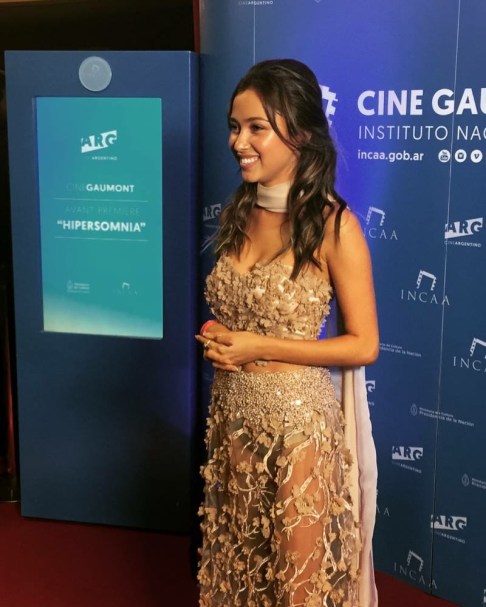
Argentinian Actress Yamila Saud Wows Audiences with the Film “Hypersomnia”

Yamila Saud
Argentinian actress Yamila Saud

As the only South American country to win not just one, but two Academy Awards, it’s no surprise that some of Latin America’s most talented film industry professionals hail from Argentina. Born in the bustling city of Cordoba, actress Yamila Saud is a shining symbol of Argentine contributions to cinema.

In her most recent role, Saud grabs audiences and pulls them down into a dark and unsettling place where human depravity has no limits. That film is “Hypersomnia”– a powerful 2017 thriller about human trafficking and the tragic toll it takes, both physically and psychologically, on the trapped women who are literally living in slavery.

Saud delivers a captivatingly meta performance as Milena, an actress who is playing a character named Laly in a theater production that takes place within the film’s storyline. Laly is a prisoner in a brothel, a victim of the human slave trade, and she lives in constant fear of the men who treat her worse than livestock. Milena, like Saud, is intensely serious about her craft. Determined to fully capture the essence of Laly, Milena begins falling deeper and deeper into character.

“[Milena’s] character [Laly] is a sex slave who falls in love with one of her captors. During rehearsals Milena begins to experience trances, in which she seems to live the life of her character,” Saud described. “What begins as an acting exercise ends up becoming a dark reality.”

Because of its layered narratives, the film’s impact is felt on several levels. Beyond the subjects of sex slavery and Stockholm syndrome, “Hypersomnia” also deftly tackles a social issue that has dominated the news of late — sexual harassment and assault by powerful men in the industry. As an actress, Saud’s character Milena endures advances and threats of retribution from the play’s director.

“[The story is also about] the abuse of power by men, where women are manipulated to do what is asked of them in exchange for getting work,” Saud said. “In this case, the director subjects [Milena] to a number of rare requests.”

It is no small task for an actress to believably capture the trauma of Laly, the worsening psychosis of Milena, and the effect it has on Milena to be exploited by powerful men. But Saud was able to expertly take on both characters, a testament to her versatility.

“My most challenging roles were Milena and Laly in ‘Hypersomnia,’” Saud recalled. “The character of Milena is a girl who has a dream, but to achieve it she has to submit to the director’s ‘requests.’ … It’s something that really happens every day, not only in the artistic fields but in all industries.”

Disturbing, enthralling and extremely relevant, “Hypersomnia” is a brilliant social critique presented as a haunting psychological thriller. “Hypersomnia” is available to stream for free for Netflix subscribers.

Saud’s upcoming film “Solo el Amor” is slated to begin shooting in 2018, and is about as different from “Hypersomnia” as a film can be. Lighthearted by comparison, “Solo el Amor” is the timeless story of two mismatched young people discovering an unlikely romance.

“I am very happy to be a part of this film,” Saud said. “I think every actress dreams of making a love movie, and I’m not the exception.”

At its core, “Solo el Amor” is a classic tale of the heart wanting what the heart wants. Saud plays Ana, a straight-laced and serious woman who begins falling in love with a young man named Bruno.

“Ana is a young lawyer who lives in a world that is as structured as it is unexciting. Bruno is a bohemian and an irresponsible singer-songwriter who dreams of reaching success with his rock band,” Saud explained. “Despite their differences they fall in love, leading them to understand who they are — and to go for what they really want at whatever cost.”

The heartwarming story of love conquering all, “Solo el Amor” will begin filming next year and will likely begin screening to audiences in late 2018 or the following year.

Yamila Saud’s versatility and empathy form the foundation for the career she has built. Whether playing an unstable stage actress, a victim of human trafficking, or a lawyer on a collision course with true love, Saud is capable of understanding her characters on a truly deep level. That intimate connection to her characters that Saud naturally possesses is a rare gift that no amount of training can teach.

Filmmaking is All About the Beauty of Collaboration for DP Olesia Saveleva

Cinematographer Olesia Saveleva
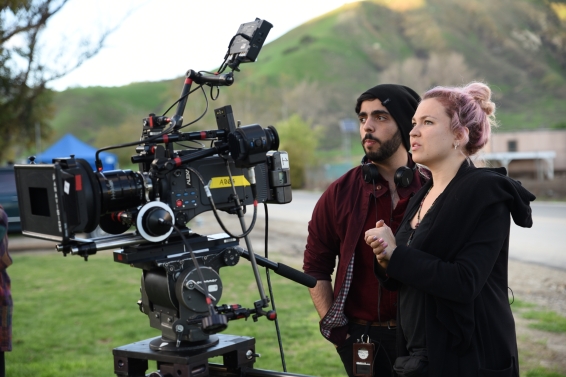
Director Joshua Amar and DP Olesia Saveleva on set of “Steady Eddie”

The filmmaking process is arguably one of the best examples of a group of people collaborating across multiple departments in order to bring a single vision to life. Turning the initially ‘invisible’ vision of the director into a visible story that viewers around the world can experience is a massive undertaking, and though the role of every department is integral to the finished work, the relationship between a director and their cinematographer is one of the most vital.

Esteemed cinematographer Olesia Saveleva says that, for her, “the collaboration part of filmmaking is one of the most interesting and attractive parts of filmmaking.” She adds, “You never know how the dialogue with the director and other principal team members will go. I love when there is trust and honesty. I love when everybody is sharing ideas and I love when a director hears all the suggestion and takes a lead in making decisions.”

As the proverbial ‘eyes of the director,’ the cinematographer has to first understand the director’s vision, and then use their creativity and technical skill to translate that vision into what we ultimately see on screen. One of the things that has made Olesia Saveleva such a successful and sought after cinematographer in the film world is her ability to understand what the directors she works with envision for their project.

Earlier this year Saveleva wrapped production on Joshua Amar’s (“Velvet Waterfalls,” “Billy the Kid”) dramatic film “Steady Eddie,” which was chosen as an Official Selection of the SCAD Savannah Film Festival where it premiered in November.

Starring Robert Daniel Sloan (“How I Met Your Mother,” “Bad Teacher,” “Sinister 2”), Gabriel Sousa (“Mad Men,” “Growing Up Immigrants”) and Shawn Lockie (“Criminal Minds”) “Steady Eddie” tells the story of Jesse (Robert Daniel Sloan), a young boy who, fearing his autistic older brother Ed (Gabriel Sousa) will die in battle, takes Ed to their father’s cabin in the wilderness in hopes of getting him to avoid the Vietnam War draft.

“In this project we wanted to stay in the perspective of the young brother, so we are much closer to him,” explains Saveleva.

In order to bring the audience closer to Jesse, Saveleva made sure that each scene in the film included both a shot from his point of view and one of him and his reactions, which helps viewers to identify with what he is feeling. From the lighting, which helped to transport the audience to the 1960s when the film takes place, to the decision to initially keep a portion of the frame out of focus in some shots, which directs the viewer’s attention to a specific area, Saveleva’s extraordinary work as the cinematographer of the film was key in making “Steady Eddie” a highly cinematic and visually gripping story.

Out of all of her productions to date Saveleva marks “Steady Eddie” as one of her top favorites. She explains, “It was the smoothest and the most pleasant set. And we had a very creative, responsible and collaborative team. The production of this film was the best in terms of organization, and I had the best director and producer. Everybody was on top of their jobs so we got everything we needed.”

As a cinematographer Saveleva is also known for her work on films such as Jorge S. Pallas’ “In Girum Imus Nocte,” which earned the Award of Recognition from the 2016 IndieFEST Film Awards, the comedy film “The Worst People at the Party,” the crime film “Brothers,” “X & Y” and the recently released drama “Immigrant Brothers.”

About working with Saveleva, Olga Solodukhina, the director of the film  “X & Y,” says, “It is a very fruitful collaboration. She bring a lot of ideas to the table. Olesia pays a lot of attention to the details. As a cinematographer she is very good with composition and designing camera movements. But also she collaborates closely with the production designer and costume designer.”

While she has undoubtedly made a powerful mark through her work as the cinematographer on a diverse range of narrative films, she’s also lent her unparalleled skill to countless music videos. Most recently she worked with artists Julia Proskuryakova, Elena Esenina and Maxim Galkin as the cinematographer on their music video for the hit Russian song “I’m a Mother,” which was released in October and has garnered extensive attention from media outlets across Russia. The music video, which already has over 377,000 views on YouTube, follows two fed up housewives who get tired of doing everything for their family and getting no appreciation from their husbands so they decide to break free and have some fun.

From the way she zeros in on the intricately arranged food and shows only the housewife’s hands, which gives the sense that she is more of a servant than a person, to the following framing, which makes it feel as though she is trapped within four walls, Saveleva’s composition in the opening scenes perfectly supports the story. Through her camera movements, such as slowing down over a stack of plates as they shatter on the ground, signaling that the housewife is ready to break free, to the way she speeds up the shots and keeps the camera traveling once the women have reclaimed their freedom, Saveleva used her seasoned skill to set the pace of the video.

Thanks to her extensive experience in the field, Saveleva’s technical skill is so on point that she has the capacity to get creative with her director when it comes time to shoot instead of being fixated on sticking to one plan.

She explains, “When I plan a shoot thoroughly with a director we kind of get on the same wavelength. So that when we come on set we are both flexible to change shots and be creative because we are still on the same wavelength.”

At the end of the day filmmaking is all about collaboration; and a strong collaborative relationship between a director and cinematographer is one that often continues over the course of each of their career, with the two joining forces again and again to make magic on screen. And for Olesia Saveleva, that is precisely the kind of relationship she looks for in the people she works with.

“I want to find one or several directors who I collaborate well with and make many projects together. The collaboration part excites me the most because I believe in synergy. The better I know the director, the faster the decision making is happening. We trust each other in making creative decisions and we can challenge each other with ambitious plans. I believe that in those collaboration processes the strongest movies are being made.”

“2Survive” Star Ingrid Haubert is Instagram’s Nutella Girl

IMG_6633

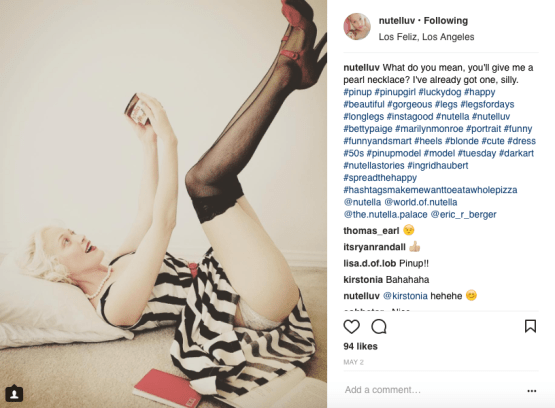
You’re scrolling through Instagram when you come across a photo of a striking blonde. She’s standing in her Buddy Holly glasses and a baby blue bowtie in front of an open cabinet filled to capacity with…um, 50 jars of Nutella? Captivated and instantly in love, you navigate to her profile, @Nutelluv, and it’s everything you’ve ever hoped for.

You quickly realize that your dream girl is off the rails beautiful, unabashedly hilarious, captivating, and seemingly in a serious relationship with this delicious hazelnut spread. She has thousands of followers and an arsenal of couple-like photos where she sits lovingly beside Nutella jars on beaches, in beds, in hospitals, and on dates downtown. But who is this passionately quirky, seemingly shameless Nutella girl?

The bombshell and brains behind @Nutelluv is none other than the unforgettable Australian-born actress Ingrid Haubert, and we had the pleasure of sitting down with her to talk art, success, movies, television, and, of course, Nutella.

Ingrid Haubert shot by Vanie Poyey
Actress Ingrid Haubert shot by Vanie Poyey

An alumni of both the Australian Academy of Performing Arts and the Australian Institute of Music, Haubert is the perfect balance of charisma, natural talent, and formal education. With a skillset ranging from horror to comedy to drama and science fiction, Haubert engages audiences globally with her authentic deliveries, impeccable timing, and her harnessed, raw emotion. From her recent appearances on MTV to films streaming on AmazonPrime, and everything in between, Haubert is undoubtedly an unstoppable force in the industry.

In “2Survive,” one of the many films she’s starred in to date, Haubert shares the screen with Golden Globe Award nominee Erik Estrada (“Finding Faith,” “CHiPs” ), Jonathan Camp ( “Agents of S.H.I.E.L.D.,” “S.W.A.T.”) and Michael Laurie (“Nuclear,” “CollegeHumor Originals”) as she embodies the lead role of Amber, a tall drink of water in the middle of a scorching, death-riddled desert. A film about a reality television show that goes terribly wrong, “2Survive” follows six contestants as they face unforeseen obstacles and pull from deep within themselves as they attempt to get home alive.

The way Haubert transforms Amber from a seemingly basic beauty (with little going on in the intelligence department) and helps her grow into a woman of strength by revealing that her intelligence exists in her ability to think outside of the box, and the invaluable importance of her kindness and compassion, makes her a major highlight of the film. Haubert’s dedication to breathing life into the character with authenticity whilst adding layers to her personality were tantamount to making Amber the kind of character audiences could easily get behind.

Haubert says she was determined “not to let [Amber] just be an airhead. I wanted her to have substance, vulnerability, something to make the audience care about her and root for her.”  

2surviveposter

It is Haubert’s poignant instincts as an actor that make the film as compelling and relevant as it is. She excels at highlighting strong, capable women while encouraging much needed dialogue about female empowerment and heroism. Haubert finds ways to strengthen the characters she plays in every role she steps into, making her a critical staple in Hollywood today.

Not limited to just film, Haubert appears frequently in episodic television as well, engaging fans nationally with her spark and brilliance. Most recently, Haubert played a key role in MTV’s “Awkward.,” the story of a 15-year-old-nobody who is pushed into the limelight when the school mistakes a legitimate accident for a suicide attempt.Last year we got a chance to see Haubert on MTV when she guest starred on the network’s hit series “Awkward.,” which stars award-winning actress Ashley Rickards (“One Tree Hill,” “Behaving Badly”), Beau Mirchoff (“I Am Number 4,” “Scary Movie 4”) and Jillian Rose Reed (“Foursome,” “Weeds”). The Teen Choice and People’s Choice Award winning series “Awkward.” follows Rickards’ character Jenna Hamilton, an awkward teen whose high school popularity skyrockets after rumors spread that her accidental fall was really a suicide attempt.

Haubert comes into the series in season 5 episode 14 titled ‘WTF Happened Last Year?,’ which follows Jenna into college and centers largely on her crumbling relationship with her long-distance boyfriend Matty (Beau Mirchoff). Haubert plays a key role as a pompous retail stylist at a high-end clothing store who embarasses series’ lead Tamara (Jillian Rose Reed) who can’t afford the clothes she wants.

“My character was very snooty and nasty, which is the opposite of me. So it was kinda fun to let that out,” says Haubert.

However, the tables quickly turn on Haubert when Sadie (Molly Tarlov) shows up out of nowhere, slaps her credit card on the table and says to Haubert with palpable attitude, “Ring ‘em up shop bitch. Chop chop Tilda Skankton, you work retail so work it.” Haubert is immediately cut down from her pedestal with her mortified facial expressions making for great comedy. The scene is also key in the developing friendship between Sadie and Tamara, former high school rivals, as the encounter gives Sadie an opportunity to show Tamara a little kindness.

Haubert has a deep love for her craft, which gives her work a certain genuinity and passion impossible to duplicate. Haubert explains, “I love creating a new person, how they walk, talk, dress, and think, but I I’d have to say that the biggest thing for me always comes back to the story.”

So, speaking of story. What is the deal with this exceptionally ingenious, uniquely awesome Instagram page?

Screen Shot 2017-11-14 at 1.51.33 pm

Haubert is quick to answer. “@nutelluv started out as a laugh. I was joking with my friends about how I didn’t need a boyfriend because I had Nutella, and making fun of all the ridiculously sappy Instagram posts and captions that are out there. But then I started to think about it, and I thought…oh, it’s actually true. Nutella is always there when I need it, I’m always left satisfied, and plus, who doesn’t love a sweet Italian?”

“Everybody does love a sweet Italian,” I joke, but then Haubert comes back and hits me with some poetic truth. “I realised this could be a really interesting way to tell a story everyday within the confines of a photograph and short caption,” Haubert explains. “Many actors think that the work starts when you get the job, or when you get an audition. But I believe in doing something everyday towards an ultimate goal, even if it is small. I saw this Instagram idea as a potential storytelling platform where I could create my own character and stories. Plus, at the very least, it keeps my brain in the habit of refining an idea to its simplest form, which is a skill that helps in all my creative pursuits.”

Whimsical, brave, talented, motivated and committed, actress Ingrid Haubert is a shining example of everything a performer should be. With a presence undeniable, Haubert practices relentless determination and engages audiences across the globe, taking the bull by the horns, the jobs by the minute, and the Nutella by the pallet.

Screen Shot 2017-11-14 at 1.53.46 pm


Canadian star Dewshane Williams recalls ‘Dogpound’ and why he went into acting

From the time Dewshane Williams was a child, he always had one passion: film. He spent his earliest years watching movies and television shows as much as possible. As he grew, he started to see himself as an actor. After his first performance, when he was just a schoolboy, he was hooked. He began to immerse himself in musical theatre, writing, choreographing, and acting in productions. He never envisioned himself doing anything else, and today, he is one of the best actors to recently come from Canada.

Williams has spent most of his life in Canada, and has taken the country’s film industry by storm. He has starred in hit television shows, such as The Expanse and Defiance, as well as critically-acclaimed films like The Story of Luke and Home Again.

Williams’ first true taste of international success came in 2010 from his work on the film Dogpound. Georges Bermann, the Executive Producer of the film, credits Dogpound of launching a number of careers, including Williams’. His convincing portrayal of Frank the inmate was spot on and accurate, and Berrmann was incredibly impressed with the, at the time, not well-known actor.

“I noticed that Dewshane is the type of actor that focuses entirely on creating the best work. Watching him channel the teenage angst associated with juvenile distress made our director’s job easy. He’s a joy to work with. Dewshane’s generosity and focus are admirable qualities. I think his performance in our film speaks for itself; hard work goes a long way,” said Bermann.

 Dogpound tells the story of 17-year-old Butch, who is sent to the Enola Vale Youth Correctional Center in Montana for blinding an abusive correctional officer. He brings with him a deep-seated intolerance for injustices and a penchant for meting out retributions on his own. He becomes friends with two other inmates at the correctional facility, where they encounter gang violence, death, and harassment from staff and other inmates.

“This film is important because it’s a cautionary tale. It’s social commentary. If you look closely enough, it’s an opportunity to show anyone who’s going down the wrong path where they’ll end up. Particularly young people who might not have any idea what that kind of world is like,” said Williams.

In Dogpound, Williams played Frank. He was a juvenile inmate who worked as an enforcer. Frank starts a riot that involves everyone in the jail. His character has an important arc, as Frank appears to be an immoral character, but ultimately has a heart. Due to an injustice perpetrated against another inmate, he takes it upon himself to act, which was surprisingly selfless for the character. Williams is now known for taking on roles that will impact audiences, and at the time, this is exactly what he did.

Dogpound premiered in June 2010 in Paris, France, and later was an Official Selection at the Tribeca Film Festival. The director, Kim Chapiron, won the coveted “Best New Narrative Director” at the Tribeca Film Festival. The film impacted audiences and impressed critics all over the world, and skyrocketed Williams’ name in the Canadian film industry.

“The thought that anyone would pay me to do what I loved was a dream come true, it really was,” Williams recalled.

Dogpound was Williams’ first feature film. At the time, the entire concept of being on set and shooting a movie seemed unreal to the young actor. He auditioned for the role just dreaming he would get the part, but his raw talent eclipsed any lack of experience he may have had at the time. He greatly impressed the casting director, and won the role.

“It’s a standard thing to hear, but actors almost always have to audition for a part. Before getting to revel in whom you might be working with, you’ve got to compete. You’ve got to show everyone why you’d be able to bring something to the character. I studied for hours, trained with my acting coach, and left school early that day. I can remember being in Character the whole day, maybe that helped,” said Williams.

Once earning the role, a lot of research was required for Williams to truly understand his character. He read articles, watched films, and a number of documentaries. He credits a docuseries titled Scared Straight as being great source material for him to understand the juvenile delinquent correctional system.

“The film was a co-production between Canada, USA, and France. Most of our film crew had flown in from Paris, so I had to be a great listener on that set. English wasn’t our director’s first language, so I picked up a bit of French while shooting. I loved our crew; they really wanted to create a good film – I could tell, and that was infectious,” said Williams.

Now that Williams has become such a successful actor, it may be easy to forget that feeling of what it was like to be young and struggling, just dreaming of becoming what he now is. However, Williams remains humble, and Dogpound still holds a special place in his heart.

“You never forget your first film, and this one was mine. To this day, complete strangers come up to me and say ‘that film was so realistic, I would never want to end up in there.’ That’s the point, you don’t want to end up in Juvie,” Williams concluded.


Victor Gilbert reminds the world that a kiss should just be a kiss

victor
Victor Gilbert

From the time he was a baby, Victor Gilbert has been immersed into a world of full of films, acting, and make believe. Given the fact that his mother is a cinematographer, Gilbert has played child roles in several of her films and he has had the unique opportunity to test his acting skills against a number of different storylines and plots. Like most children, Gilbert loves to play pretend and he finds himself energized by the ability to play pretend for more than just enjoyment, but as a career. Playing a wide range of emotions interests him, and he thrives on the chance to explore playing different versions of “happy,” “sad,” or “mad.” For Gilbert, acting is all he’s ever known. It is a part of his family. He has grown with it and he wishes to continue to let acting grow with him for the rest of his life.

As he has aged, Gilbert has slowly branched away from filming with his mother and has begun working with esteemed production companies, directors, actors, and more. At the mere age of 10, Gilbert is taking the entertainment industry by storm and having earned such great success so early on in his life, it is intriguing to wonder where his talents will carry him next. One of his most notable works was for Netflix’s Hell on Wheels, where Gilbert played the son of a railroad worker called Jeff Strobridge, played by Reg Rogers. In this role, Gilbert had the chance to act alongside Rogers, Anson Mount, the series’ lead actor, as well as several other experienced professionals. It was a great way to expose himself to various acting styles and techniques, and since he was a recurring character, he had the opportunity to develop his character throughout each episode he acted in. Gilbert thoroughly enjoyed learning from the individuals he acted with, and submerged himself into the film’s extravagant, western-themed set. To this day, he considers it one of the highlights of his career.

Another of Gilbert’s more enjoyable projects evolved over the summer of 2016 when he aced the audition for, and won the role of Peter in the influential film, The Kiss. The Kiss tells the emotional story of a young boy, played by Gilbert, kisses another young boy at school. It is set in the 1950’s and unpacks a controversial dilemma for a mother who tries to understand what her child is going through. With the tag line, “a kiss should just be a kiss,” the film explores deep themes of love and homosexuality, and is gaining a substantial amount of praise from film festivals around the world. Being only 8 years old at the time of filming, Gilbert was unfamiliar with the emotional nature of the plot line and didn’t realize the importance of the topic in today’s society. Upon learning of meaning behind the film’s premise, Gilbert was eager to play such an impactful role. In fact, Gilbert’s character was pivotal to the The Kiss’ storyline and he set the tone for the entire film.

Gilbert credits his role in The Kiss as being the toughest he had ever played. Having to travel back in time to the 1950’s through the film’s costumes and set design was unlike anything Gilbert had ever done before. When filming, he had to act out emotionally charged scenes involving kissing another boy, being scolded by his mother, and portray feelings of fear, sorrow, and intimidation. Fortunately, Gilbert excels in any environment where he has to sell different emotions for the better of his character’s storyline. He has a remarkable ability to play multi-dimensional emotions and despite his age, he never struggled to explore a new emotion when asked. David Emmanuel, who both produced and acted in The Kiss, has nothing but respect for Gilbert’s natural affinity to play his characters as realistically and organically as possible. He was astonished to see an actor as young as Gilbert displaying qualities that even some of the most established professionals have not yet mastered.

“Victor had a very, – I cannot stress it enough – very difficult scene to act at such a young age. He had to pretend to have kissed a boy in school, to dress up, to wear lipstick, and more. Still, he did an amazing job and was so right for the role. He was extremely patient and open-minded for this movie. Not to mention, he was very professional on set for such a young age. He listened to the director very well and was open to giving his input whenever he didn’t feel comfortable,” noted Emmanuel.

If you ask Gilbert, however, the film simply helped him tell an important story to the world and he was happy to have had the opportunity. Even he himself was moved by his character’s strength and determination. To play such an integral character at such a young age is a rare feat for any child actor and he hopes to be able to do so again in future.

“I think the story of this film is important because there are tons of people who are still too shy to love another person of the same gender. I think these kinds of films help these people come forward. It is so important to respect people for who they are. Films have a big impact on people and they can influence generations,” told Gilbert.

Upon wrapping The Kiss, it made its way to several prestigious film festivals in Orlando, Los Angeles, Brazil, Cannes, Germany, Sweden, and many more. Gilbert, along with everyone else involved in the film, are excited to see where else The Kiss will go and how many more lives they can touch with this incredible story.

THE SWEET DREAMS OF RICARDO CAMPOS

Artists suffer for their craft. For every self-important/self-indulgent creative type there are a thousand who are working in conditions that most of us would prefer to avoid. All of this is done for the sake of the creation of art. Cinematographer Ricardo Campos took this idea a bit too literally when working on the film “Sweet Dreams.” Because the story and the film’s cast and crew were so intriguing to him, he agreed to take on the DP position which was filmed in the North East of the US…overnight in the dead of Winter. A weekend shoot at the Beverly Hills Hotel this was not. While he admits that the experience was quite uncomfortable in terms of climate, the end product is what keeps him remembering more of the good than the bad. “Sweet Dreams” is dark and unsettling, which is an apt description of the physical sensation of making it.

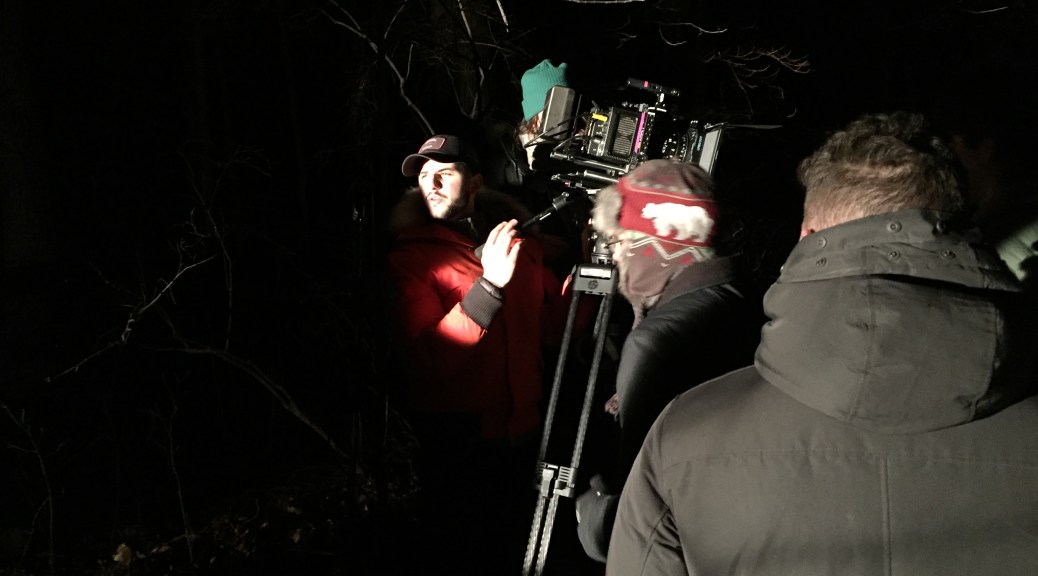
The process of creating art can sometimes find itself positively correlated to the message it’s delivering. For a film such as “Sweet Dreams” this may not be a comfortable experience but channeling their emotions into their work is the positive manner by which artists deal with these occurrences. Like the postal service motto of old; neither rain, snow, freezing cold, or dark of night (all of which frequently occurred on this shoot) would deter Ricardo and the crew/cast of this film from their work. When the camera wasn’t rolling, it was quite common to find twenty or more people huddled together in a pop up tent with a heater. This energy and sense of desperation is palpable in the film. Eduardo Alcivar (director of “Sweet Dreams”) notes, “From the beginning of this project I knew it was going to be a difficult one to make but very rewarding. For starters, we began production on this show in the middle of winter in the North East which is as cold as it sounds. In addition to that, we were shooting overnight exteriors in the middle of the snowy woods so as you can imagine, things were a little more complicated than usual. I reached out to Ricky to shoot this project because he and I had been wanting to shoot a narrative piece together for a while and I thought that Sweet Dreams would be the perfect opportunity for that. He is a very driven professional. Once he understands what is needed there is no stopping him. He brought a high level of abilities and professionalism to the shoot that spoke to many of us.”

IMG_4607

The story of “Sweet Dreams” takes place over the course of one freezing night in the outskirts of New York. Two women, Carmen and Janie, are trying to discard a body. They are both call girls who work for a boss in the organ smuggling black market. Later that night when they find a suitable location and open the trunk to take the body out, they realize that the man inside is still alive. It becomes immediately clear to Janie that this man [Henry] and Carmen know each other and have been having a relationship. After a long argument in the snowy woods, and a message is sent to both of them by their boss with instructions to kill each other, both girls end up dead alongside Henry.

While everyone in the cast and crew had their hands full dealing with how the environmental conditions on set made them feel, Campos had to contend with how these factors affected what he was able to witness with the camera. Being aware of the possible outdoor conditions, Ricardo kept his lighting design decidedly simple but effective. A china ball on a boom was used as a floating key for the interiors. For the exteriors at the gas station scene, vapor lighting was used to match the practicals. Overall the lighting has a great deal of contrast and is punchy, as soft lighting would not be congruent with the feel of the film. Ricardo’s preference for natural organic imagery was the Alexa camera.

Fans clamored over this cutting and dark tale, which Campos confirms is always the goal. He concedes that he was quite happily surprised when the film was accepted to the 2017 Festival International de Cannes and was shown in the Short Film Corner. Cannes is perhaps the most prestigious festival on the planet and having your work accepted there communicates inclusion into a very noteworthy club. Ricardo states, “It was a huge honor to have the film show at the short film corner there. It was also amazing because it led to so much more work afterwards.”

Michael Whalley steals the heart of ‘Jean’ and audiences in new film

There is a camaraderie that comes from playing sports. Everyone has the same goal, they wear the uniform, they experience the same victories and failures as a team. For New Zealand’s Michael Whalley, he experiences that same solidarity from acting. He represents the team while still shining on his own. He works with that team spirit to achieve the best result possible. He loves to play, and considers acting a serious game, as each new project brings a new match and a different opponent. To use such a metaphor shows how much Whalley appreciates the intricacies of his craft, and this understanding translates to raw talent for this celebrated actor.

With an esteemed resume and unparalleled versatility, Whalley is an internationally in-demand actor. While working on many acclaimed films, such as the 2015 award-winning feature Psychoanalysis, he has shown the world what he is capable of. His work on Slow West, alongside Michael Fassbender and Ben Mendelsohn, received praise from audiences and critics, and this trend occurs with almost everything Whalley takes on.

“To think I could be paid for doing the very thing I wanted to do every day was such an incredible thought, so I sought to make that my reality,” said Whalley.

Earlier this year, one of Whalley’s newest films was once again a large success.  The actor played the leading character of Beverly Shepherd in the historical romance Jean. The film tells the story of Jean Batten, New Zealand’s greatest pilot, heroine, celebrity, and mystery. Beverly Shepherd is the romantic lead in the film. Beverly is a man with a strong moral backbone, a sense of fun for life and a determination to challenge for the things he wants in both affairs of his career and heart. Despite being the only son of wealthy Sydneysiders, he lacks the pretension of wealth. He can read people and knows instinctively if they are being untruthful. Independent and modern, he is attracted by Jean’s adventurous spirit and mystery. His greatest struggle is attempting to protect Jean from decisions that would put her in danger, only to have to accept that she isn’t someone who wants or needs protection. He knows he has to play a long game of love to not scare her away. Jean had lovers in her life, but Beverly is the one man who truly captures her heart. In the story, audiences see how headstrong Jean is with her life and career, and when Beverley sweeps in and shows her glimpses of recreation, fun and love, he innocently threatens her focus, creating Jean’s ultimate emotional conflict. Therefore, the filmmakers required a seasoned actor to play such a pivotal role in such an important story, and Whalley was the obvious choice, with the talent and passion to go with it.

JEAN 1 with Kate Eliot pic Ginnie Loane
Michael Whalley and Kate Elliot in Jean, photo by Ginnie Loane

“Especially in the past few years, it has been of growing importance to remind ourselves of the power women had in shaping the world. Too many films are one-sided in their portrayal of male heroes, and Jean was a heroine that defied the constraints of a male-driven world. The film, the first about Jean Batten, is a piece of entertainment, education and inspiration for New Zealand and the world to see. I had known of Jean Batten in the past, but this was a chance to see behind the tabloids and popular public image into the life of such a mysterious firebrand,” Whalley described.

After premiering earlier this year, the film has seen vast critical success. At the Film Awards New York 2017, Jean won an unprecedented nine awards, including “Best TV Movie” and “Best Drama Special”. These are immensely prestigious honors, as New York Festivals recognize only the best content from over 50 countries around the world. In addition, the film was successful commercially, airing on TVNZ, which reaches over 2 million people and has recently been acquired by distributor Banijay International for the ROW market. Such success could not have been possible without Whalley’s portrayal of Beverly.

“He brought a charm, wit and strength to the character of Beverly Shepherd that we could only imagine.” said the Producer and Writer of the film, Donna Malane.

Taking part in this period piece was enticing for Whalley, and as an actor he is always looking for new challenges and experiences to refine his talent. This story is set in the thirties, and Whalley researched the decade extensively to ensure he would completely transport audiences. Parts of this process were more fun than others, such as driving around an open top 1930s Model A Ford, and getting to know about the planes they were working with, which by a happy coincidence, were taught to Whalley by an old friend of his grandfather, Dennis. However, some parts of the preparation process were more grueling. Whalley had to take on the language, manner of speech and the classic nature of the period drama, and work to make that all ring true for his mouth, body and mind to create a genuine portrayal. To do this, Whalley infused his character with the parts of himself that fit best, which he tries to do for every role he can. This helps create an authenticity that captivates audiences, and what the actor is so well-known for.

Jean Ginnie Loane 2
Michael Whalley in Jean, photo by Ginnie Loane

Whalley says getting into the mindset of the time was made easier by the incredible costumes designed by Kirsty Cameron. As soon as he put on his gear, he felt clean, classic and upright. “Putting on my costume became a very important part of my morning ritual to get into Beverly’s shoes, literally,” he joked.

Improvisation also was a great tool for the actor when preparing for filming. During rehearsals with his co-star, Kate Elliott, they would have a series of improvisations around the scripted dialogue, which he says was a sure-fire way to find out what they knew or didn’t know about their characters and the world of the film. These exercises were helpful as the role of Beverly was a refreshing change for the actor, who often plays “punks and public nuisances”, and the character of Beverly is very dependable and ethical.

The actor also uses music frequently to prepare for roles. For Jean, Whalley made a playlist specific to what Beverly may have been listening to at the time, mixed with songs from Postmodern Jukebox to “get in the zone to play”, once again, similar to an athlete.

Undoubtedly, Jean is a must-see, and Whalley is enchanting in it, as he is so well-known to be. His passion for the story is evident, and his passion for what he does is even more so.

“This was a chance to act in an historical and important story in both New Zealand and International history. The true love of Jean Batten, at one point the world’s most famous and respected women. To play a character who had the charm, wit, intelligence and pilot skills to win the heart of the Lady that kept it locked away,” concluded Whalley.


Top photo by Ginnie Loane

HOW THREE RIVERS ACQUIRED ITS SUSPENSE

Screen Shot 2018-03-17 at 8.17.46 PM.png

Advertisers have become much more aware of the fact that interesting presentations equal more attention for their products as well as a longer life in terms of their production budget. To that end, shrewd and astute companies have given greater latitude to the artists they use in creating these promotions. Italian fashion company Golden Goose has utilized the duo of editor Aaron Bencid and director Marco Prestini in a trio of fashion films which are highly unusual, deeply narrative, and always compelling. It seems that the company subscribes to the idea that when you hire a professional, it’s with the understanding that you allow them to do what they know how to do best rather than telling them how you’d like it done. The director of Three Rivers for Golden Goose agrees with this as well as he states, “I was given a lot of creative freedom on this project and the only request made was to have three female characters. I used the opportunity to step out of my comfort zone and work on a narrative to portray the collection. I usually edit my own films but since I was piercing into new territory, I wanted to divide the labor with someone I knew I could trust so I asked my long-time collaborator and great editor Aaron Bencid. He definitely demonstrated a different sensibility and approach towards the project, which ultimately made it better. Working with him was a professional, intuitive, and overall well- rounded experience. A great thing about Aaron is that he’s not just someone who knows the ins and outs of the program, but he comes up with opinions and solutions of his own. He’s as good of a listener as he is an active participant during the editorial process.”

Screen Shot 2018-03-17 at 8.17.27 PM

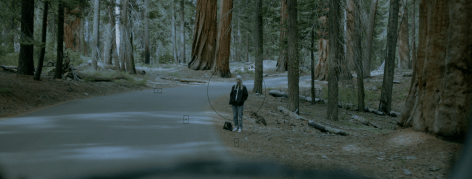
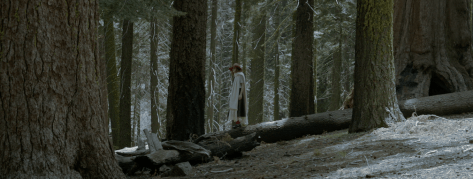
Bencid approaches every project whether it be film, television, web-based, promotional, etc., with the purpose of affecting the emotional impact of the production’s message. Three Rivers is a subtle drama with elements of suspense. An eerie and cryptic voiceover at the beginning hints to an uncertain world. The imagery is subtle yet powerful; its composition imposes a certain amount of anxiety. The character’s actions are purposely mysterious, inducing the audience into a sense of dread and confusion. The first visuals are that of the ancient sequoias; silent giants that for centuries have extended their presence towards the sky and the infinite. Birds sing amidst the foliage and forest community, where a road extends hiding in the trees. A black SUV approaches in the distance, dominated in every direction by the grandeur of the trees which overlook the black asphalt. Two women (Anna and Heather) have been traveling for hours towards the heart of the forest where, hidden among rocks and conifers, a small glass house is seen in the distance. This secret place far from the noise and the city is where as usual the two love to take refuge during the first days of autumn. Accompanying the duo is a mysterious hitchhiker they picked up on their drive to this remote location in the woods. The following morning, one of the girls is discovered missing.

Screen Shot 2018-03-17 at 8.18.16 PM

The setting for this story implies the same contrast that Golden Goose and their distressed fashion line is known for. The mystery and intrigue are compliments of the editor and director. The plot sets an obvious somber and eerie tone to which Aaron wanted to be faithful and magnify. His use of use of unnaturally long moments to induce a sense of awkwardness and uneasiness is reminiscent of Yorgo Lanthimos’ work (famed Greek director known for his creative vision in films like The Lobster, Dogtooth, Alps, and others). Bencid describes, “I never wanted the film to feel cutty. The mood of it was purposely slow and I wanted the film to flow like that in the edit. Involving too many cuts in a specific scene would overload it and disrupt its tone. This ended up being a main template; having the shots drag out instead of cutting it short. Remaining on certain shots for longer periods of time than normal helped me enhance the desired effect. I didn’t want the audience to realize when the cut came in, as if you were trapped in this loop; a loop that narratively parallels the ending of the film.”

Screen Shot 2018-03-17 at 8.18.33 PM

  Three Rivers was the recipient of copious accolades for its highly creative approach. Vimeo Staff Pick, winner of “Best New Creative Advertising Piece” (Interference Festival 2015), and Official Nominee “Best New Italian Fashion Film” (Fashion Film Festival Milano) were just a few of the many recognitions it received. What makes this all the more impressive is the fact that director and editor were on completely separate continents during the production of Three Rivers. Times zones and physical distance made it nearly impossible to communicate in real time, which led to email being a primary source of communication. It’s a very modern way of making films and the results of Three Rivers makes the very idea of this seem counterintuitive…almost impossible but yet it is very much accurate. Lending to the argument that Three Rivers is literally a piece of art rather than just a promotion was its screening at the Italian Museum Triennale under the exhibition “Il Nuovo Vocabolario Della Moda Italiana” 2015-2016. This is proof that Three Rivers and editor Aaron Bencid can proudly and literally be referred to as art and artist.

Screen Shot 2018-03-17 at 8.18.51 PM