Category Archives: international Talent

Animator Sijia Huang brings joyful characters to life in new film ‘Breakfast’

As an only child, Sijia Huang was always looking for ways to entertain herself. She didn’t have any siblings to play with, and growing up in Chongqing, China, she immersed herself into movies from a young age, finding that it not only passed the time, but consumed her every thought. She knew she had to be a part of that world, and loving drawing from an early age, she became committed to knowing everything she could about animation. She studied her favorite films and scoured video stores to find new movies she could learn from. Now, she is an acclaimed animator, winning audiences around the world over with her unique style and commitment to her craft.

Her films Box Home, Quitting Brave Victory, Measures and Frames and Hear No Evil, Speak No Evil, See No Evil have allowed the world to see just what Huang is capable of. Her ability to generate smooth animation while still maintaining a good balance between tension and looseness generate the perfect rhythm for her films. She knows that in animated films, her work is the entirety of the visual aspect, making up 50 per cent of the movie goers experience, and she knows how to make that lasting impression.

“Just like having good actors or actresses in a film, a professional animator can create lively characters that will contribute lots to the story. A good story is one of the most important parts of a film. The power of a well animated character, a good story, and the aesthetic value behind an animated film is why I want to be a professional animator,” she said.

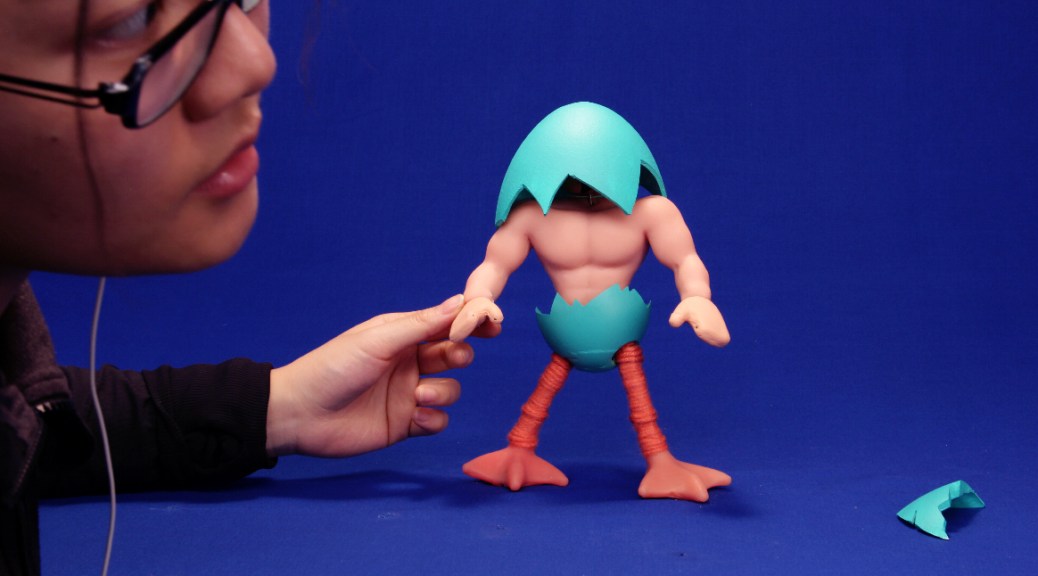
Huang’s most recent film is titled Breakfast, in which she was both the director and leading animator. She designed and crafted all the puppets and did all the stop-motion animation. Breakfast is a combination of 2D and stop-motion animation. The character design is what intrigued Huang to take part in the film, with a unique take on stop-motion puppets. She also found the script interesting, with funny and unique characters.

The story begins with two hands hitting two eggs. As the hitting goes on, the two eggs start to crack and finally explode into pieces. Two creatures come out of the eggs. One is a duck with hairy human legs. The other one is a muscular man with duck feet. The duck and the man both have a crush on each other and start to dance. In the middle of the dance, the two hands interrupt them by hitting them on their heads. A chase and fight commence. In the end, it turns out all the encounters and fights are happening in a child’s imaginary world when he plays with his toys – a rubber duck and an action figure, during his breakfast.

“The story is more about viewing the world with children’s perspective and the positive messages behind the story include love, support and equality,” said Huang.

Huang began working on the animation back in 2015, and it took over two years to perfect every image. After premiering at the New York Short Film Festival 2018 where it was an Official Selection, the film has already seen great acclaim. It was an Official Selection at the 2018 GUKIFF Animated Short, UK Monthly Film Festival, and the Oniros Film Awards. It also had an Official Screen at the Oregon Shorts section in the 41st Portland International Film Festival. At the Los Angeles Movie Awards, Huang was awarded with Best Animation for her work on the film, and at the Los Angeles Independent Film Festival she won Best Director. Needless to say, none of the film’s success could have been possible without her considerable contributions.

“Knowing the film has been so successful means a lot to me, as the director and the leading animator on this film, I had a lot of pressure. At the beginning, I didn’t know if the audiences would like the characters or not. This film is all about these interesting characters, which I personally love and had lots of fun on animating. It turns out that audiences really like it too, Every effort paid off at the end,” said Huang.

Huang was responsible for all the stop-motion animation in Breakfast, which was 90 per cent of the entire animation. Stop-motion requires working with puppets. While making the puppets, she was very careful when it came to the mold and cast process, one of the greatest challenges. When she began the process, she had no experience in casting them, and through trial and error, eventually created characters that were even better than the original design.

TeamPhoto
Sijia Huang, Stan Lee, and Yifu Zhou with the Digital Domain team

“I first met Sijia when we worked together on some digital content pieces for Stan Lee, and immediately recognized her exceptional talent and matchless vision. She is one of these rare talents, as she clearly demonstrated in Breakfast, and her reputation precedes her in the industry. Her stop-motion work is renowned for being refreshing in the animation world, as it is simultaneously mature, artistic, and avant-garde,” said Yifu Zhou, Vice President and Visual Effects Supervisor at Digital Domain.

Although they are not human actors, Huang says the puppets require a lot of care. For example, the Duck character has a pair of hairy legs that need special handling and care when animating. Therefore, she chose to only touch the joints that she needed to bend so that the leg hair would not fall off. She also used baby powder to help reduce the stickiness of the silicon surface.

“The ball and socket armatures were so fun to animate. I enjoyed the experience of animating on stage. It is hard to imagine without the ball and socket armatures, how to work on some of the shots. The most difficult part is to animate characters in the air. Two characters in the film are made of silicon and super sculpted. The materials and steal ball and socket armatures make the puppets heavy to animate. In order to stable them in the air, I used special designed rigs, so I can tie the puppets to the flying rigs to create movement in the air,” Huang described.

Music was also a big part of the film. Not only did Huang find the ideal composer in Lance Trevino, she also needed the choreography to be perfect. This required an ample amount of research on Tango dancing in order to perfectly execute the animation. To do so, Huang analyzed the patters of the dance steps and extracted the key movements to fit the animation style. Her dedicated resulted in the Tango being the highlight of the film.

“I loved the film, so animating it was really fun. When you see the characters on this film, you will know why I love them so much,” she concluded.

Be sure to check out Breakfast to know just what Huang is talking about.
EXCAVATING THE EMOTION OF HISTORY WITH A CELLO

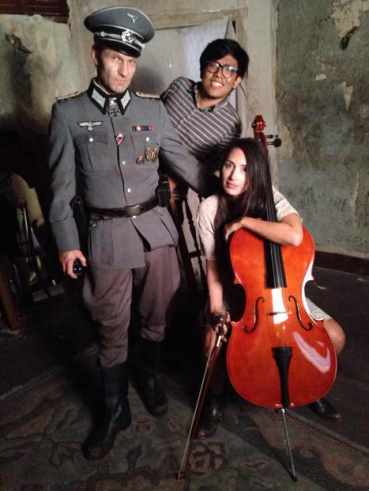
working photo for cello player

(By Luigi Paglia)

Dong Lei has many credits to his career as a production designer. As PD for award-winning films such as Emily, Cage, and Next Door, he has enabled films of varying genres to deliver their story with immense success. Sometimes one must step out of a comfortable role in order to stretch and learn. For Lei, taking the responsibilities of writer, director, producer, as well as production designer allowed him to challenge himself in creating a period piece. The Cello Player takes place in the mid 1940’s World War II era and is a remarkable in its recreation of the look of this time in addition to conveying a heart-wrenching experience. The story takes place in Poland as the Russian army is about to converge on German officers taking refuge in a brothel. A musician who plays for the entertainment of patrons is toyed with by a German officer who is facing inevitable surrender. Hoping to enact power and control over those in the brothel, in particular the Cellist, the officer conducts a game of mental/emotional cat & mouse. The constitution of both is tested as the sounds of war outside the walls of the building escalate.

Dong’s work on The Cello Player was recognized in 2017 with the “Best Production Design” award at both the Hollywood International Moving Pictures Film Festival and the Los Angeles Independent Film Festival. A responsible production designer always begins with immersion in research. A period piece such as The Cello Player requires more than the average amount of this if you want astute audience members to buy into the believability of the story. Lei spent considerable time researching in museums, libraries, and online to ensure that he created an environment which contained no cracks that could reveal the modern day in this World War II era drama. He spent time interviewing the older generation familiar with this bygone time as a final jury to vet the weaponry and technology displayed in the film was accurate. Actor Thure Riefenstien (known for his work in The Man in the High Castle, among others) played the German officer in The Cello Player and has had extensive experience appearing in films of this era. He comments, “Due to my own lengthy history of success in the international film industry I feel fully qualified to judge Dong’s exceptional achievements. I found his attention to detail impressive and insightful. In particular, we discussed the look of authentic German uniforms. As an actor, the costumes and the sets are a part of what allows you to become lost in the character and believe in yourself. The look that Dong achieved for this film was second to none. This greatly assisted myself and the other cast members to deliver a performance at the top of our abilities.”

Dong acquired props through prop houses and aged them to feel appropriate to the location in which the film takes place. The location was an actual hundred-year-old brothel. Always a stickler for details, Dong had the entire set wired for European electricity even though it was originally wired for US electricity. He hired a European electrical worker to rewire the set with the intent of giving complete accuracy to its appearance and design. With this completed, the set, specific wardrobe requirements (which Dong had created at Western Costume), and accoutrements like vintage typewriters, the entirety of the mid 20th century was complete. While these all play a prominent part of the film, a central piece is the Cello. The production designer acquired it via an unexpected circumstance. When Dong contacted a composer to create an original musical piece for The Cello Player, he met with him to discuss the story and this composition’s emotional contribution. The composer was so touched by the story that he offered up one of his beloved mid 1940’s Cellos as a prominent prop for the film. The action of the film vacillates between domination and détente in a compelling look at what we demand from ourselves and others when we have power, framed in a tale of a time when people were often at their worst.

Dong Lei openly admits that the work required from him to manifest the look of this film was immense. Over planning was the template which he used. The budget may not have been supportive of this goal but it’s a resourceful production designer who finds a way to achieve their own professional goals within these constraints. The look was so convincing that many of the actors profess that it inspired their performances. Thure Riefenstien himself was so moved by the story and setting that he gave an unplanned interview (while in his Nazi costume) about the lives of his own family’s personal experiences in Germany. The tale was so emotional and riveting that it was actually included in the final cut of the film. The work of Dong Lei cultivated a sense of believability that blurred the lines for both audience and cast of The Cello Player.

Renowned Writer Camilla Sauer Talks Top Projects

Camilla Sauer is one of Germany’s most successful head writers. Over the past 20 years of her career, she’s been accredited for her remarkable work on over a dozen different TV series, produced by some of the biggest German and European TV and Film production companies.

Getting her start as a creative writer at the young age of 19, Sauer proved early on that she was destined to spend her life creating and telling stories. Just three years after her first professional gig, she went from intern to full-time storyliner on Germany’s second highest rated TV series, Verbotene Liebe (Forbidden Love). With numerous awards won and over 4,5000 episodes aired, Verbotene Liebe circles around the lives of young men and women in Germany, their friends, and their families, and has become well known for its positive representation of LGBT characters and its presentation of controversial issues. The show is produced by UFA Serial Drama (Metropolis and The Blue Angel), one of Germany’s oldest and most distinguished entertainment brands

Sauer worked on Verbotene Liebe for two of its 20 seasons. From there, she climbed the ranks and earned what would be her first of many head writer titles for a season on the crime series Einsatz für Ellrich, of the award-winning production company, Constantin Entertainment.

“Two years later I started working for Alles Was Zählt, where I continued to work for three years,” Sauer said. “I was there from day one and was fortunate enough to be able to create this TV drama with some of the most talented writers. We were all so different, but each and every one of us was passionate about the show. We were encouraged to tell fresh, new, and compelling stories. We all put 100% of our effort into the stories – and it paid off.”

In February of 2008, while Sauer was the head writer on the show, Alles Was Zählt was awarded Blu Magazine’s Best National TV Format award for its portrayal of the relationship between two of its characters, Deniz and Roman. Additionally, Guido Reinhardt, Chief Creative Officer of UFA and producer of the groundbreaking series, provided Sauer with the opportunity to work as a creative producer together with the producer of the TV series Unter Uns, ultimately trusting her to relaunch this show and work with a different team of writers, with a different broadcast station in the process. “Camilla is truly a writer of extraordinary merit and ability,” Reinhardt recently commented of his professional colleague of over 10 years. “She possesses a talent that is rare, and it is her unique combination of talent and experience that has resulted in her becoming one of Germany’s most successful head writers.”

DSCF2801
Camilla Sauer

Having aired in 2006 to the present, Alles Was Zählt is one of the longest running TV dramas in Germany.

While it’s obvious that creative talent is a must-have when it comes to being a successful writer, one of Sauer’s greatest strengths that Reinhardt pointed out: life experience, along with empathy and a sense of structure, are also qualities that mustn’t be overlooked. Sauer is well versed when it comes to all of these, her expansive success as a head writer in the entertainment industry serving as proof. Expanding upon what she’s learned regarding the importance of these assets, Sauer explained, “It takes empathy to create characters and to be able to connect with how they feel and act. Not because you would do so, but because your character with his background, culture, and personality would do so. It takes some life experience because life gives you the best inspiration every day, everywhere. The best stories I’ve ever heard stem from real life experiences. Lastly, structure is needed to be able to take your story to the next level; To create a plot, a script, a scene. I know a lot of writers who are either very creative, but have issues with creating structure, and vice versa. If you have both – you are considered one of the lucky ones.”

In addition to head writer, Sauer has also worked diligently as a creative producer and story consultant on numerous distinguished projects broadcasted on some of the most established networks throughout Europe such as, Soko Familie, Herzflimmern, Unter Uns, the award winning Dahoam is Dahoam, and Lena – Liebe Meines Lebens, the latter which she first began working on a few years post her work on Alles Was Zählt.

“A story consultant in Germany is probably considered a creative producer, or a co-showrunner in the US. It’s someone who works closely with the producer and/or show runner. Together they create the story concept, characters, and the long running plots of the TV series,” Sauer said of her job title. “This particular work is not so much focused on the details like scenes or dialogue, but more so of the development of the whole concept of the TV series. The staff writers break our ideas down into episodes, scenes, and scripts.”

In 2010, Sauer was hired by the academy award winning production company, Wiedemann & Berg (The Lives of Others, WhoAmI, Welcome to Germany, and Dark), to create Lena – Liebe Meines Lebens with showrunner Günter Overman (Storm of Love, Verschollen, and Hinter Gittern – Der Frauenknast). The series title translates to Lena – Love of My Life in English, and is an adaptation of the Argentine series Don Juan y Su Bella Dama, created by Claudio Villarruel and Bernarda Llorente.

It was on Lena – Liebe meines Lebens where Sauer first worked with co-founder and CEO of Wiedemann & Berg, Quirin Berg. Berg, who thinks quite of the writer’s talents, shared, “I have had the pleasure of working with Camilla Sauer and can without a doubt certify that she is an exceptionally talented head writer, and furthermore, one of the best head writers in Germany. Camilla is extremely unique in many aspects. She is outstandingly creative, a very fast thinker, she has a wonderful ability to express her ideas clearly, create deep and three-dimensional characters, and eventually bring them to life. Additionally, she can immediately identify specific problems in a story and articulate a solution to them.”

Camilla Head7
Camilla Sauer

Since 2012, Sauer has been staffed as the head writer for Germany’s hit series Schicksale – und plötzlich ist alles anders (Fate – and suddenly everything is different). Produced by Constantin Entertainment, the TV series has been running for eight years, consists of twelve seasons, and was recently picked up for another (1 year).

In Camilla’s words, the idea behind Schicksale – und plötzlich ist alles anders is that, “Things are not happening to you, they are happening for you. Even if it looks like something bad is happening to you, it just creates a new opportunity for us to learn, to grow, and to eventually make better decisions that lead to a better life. ‘Fate’ is about that one single moment, that ‘accident’ that might look like some random situation, that completely changes your life.”

While working on such a long running show for an extended period of time has its challenges, Sauer has demonstrated that she is an expert when it comes to contributing fresh and exciting stories to an ongoing series, and in doing so has played a pivotal role in the success of Schicksale – und plötzlich ist alles anders. Former CEO of Constantin Entertainment Christoph Knechtel raved of the head writer, “Camilla is truly a head writer of extraordinary merit and ability. I was fortunate enough to witness her extraordinary talent in screenwriting when she served as writer, head writer, and showrunner on numerous television series like K-11-Kommissare im Einsatz, Einsatz für Ellrich, Schicksale, In Gefahr, Im Namen Der Gerechtigkeit, and Soko Familie for huge networks such as Sat. 1, RTL, VOX, and more. Her demonstrated skill and unparalleled creativity on these and other projects have earned Camilla widespread recognition and international acclaim as one of German television’s leading writers.”

Presently, Sauer is in development with the German TV production companies, UFA Serial Drama, Constantin Entertainment, and Bastei Media, on a few pilots and television series while continuing to write for Schicksale – und plötzlich ist alles anders.


For more information on Camilla Sauer, please visit: http://www.imdb.com/name/nm4646044/?ref_=nv_sr_1
 

Article Written By: Ashley Bower

YUXIN BOON HEARS THE ART IN FILM

YuXinBoon_1

Sound editor Yuxin Boon works in the film industry but when she is asked exactly what a sound editor does, she often explains that it’s like being in a band. Boon does have a background in music so this isn’t simple conjecture…she knows what she is speaking about. Yuxin describes, “The general public has a view that the only job of a sound editor job is dealing with sound effects. The truth is that editors are divided into different categories of sound, like dialogue, Foley, and ambience. A sound editor is not usually in charge of remaking all the sound the audience hears. Editors are assigned to one particular category of sound but also applying their work to the overall sonic image of the film. It’s like a band; every member has one instrument and task. They need to play their own instrument while also working cohesively as a team to make the music and deliver the emotional intention of the song.”

As a professional female sound editor focusing on dialogue and Foley editing in the film post-production industry, YuXin has created a career path in the industry that includes working with Oscar-Award winners (as she did in “Heavy Rain” with Bill W. Benton) that display nature’s fury, romance films (“Christmas in Mississippi” & “Enchanted Christmas”), Westerns, and a myriad of other genres. A sound editor is required to be creative as well as detailed, which are the characteristics which drew her to this work. While many vocations in the TV and film industry steer professionals towards a certain genre, it’s the absence of this aspect for sound editors which allows professionals like Boon to test themselves to apply their talents a wide variety of story types. While the application of abilities may differ, the means by which they are applied is often universal.

A sound editor must possess a discerning eye, well…perhaps ear is the appropriate body part in this particular scenario. Talent is a requirement and the application of these are a given but Boon believes that this is only a baseline for contributing to a production. One needs only to watch your favorite movie with the sound down to gain an immediate appreciation for the work of a sound editor. Even this simple example does not properly communicate the affect a sound editor has on the entertainment. The work of Boon and her peers involves layers upon layers of sound that weave together a sub-story that most of don’t ever fully appreciate. In Yuxin’s opinion, a good editor not only inspires the other professionals on the production team to perform at the next level but also carries the emotion to the audience for a better understanding. A good sound editor can offer intriguing soundscapes which the director is looking for as well as combining it with creative designs and techniques. Skill is an element that can be used to evaluate editors’ work, but it’s far from the only one. Creativity may be the most important trait a sound editor can bring to those they work with.

It’s likely that Boon’s unique perspective came from her path to sound editing. As a child of parents who were not musicians but great lovers of music, her parents took her to piano lessons and encouraged (but did not push) YuXin towards making music a part of her life. While she thought that her aim would be in the music world, Boon took a film class and discovered that her natural inclination towards detail and her finely tuned ear (thank you piano) made her highly adept at timing and sound editing/design. The process of mixing different elements to create completely new sounds, such as the dinosaurs’ roar in “Jurassic Park” fascinated her and stimulated her creatively. As Boon discovered that a sound editor is given the opportunity to work with aspects like dialogue, Foley, and other sonic presentations of a film, she became increasingly drawn to it. Trail blazers like Singapore’s Ai-Ling Lee (Oscar-Award Nominee for La La Land) continue to reinforce the idea that an Asian woman/professional has a place in the film industry of Hollywood.

YuXinBoon_2

Any art form must grow. To achieve this requires individuals with fresh perspectives who understand and respect the process and individuals which created the template being used. Yuxin Boon has already created a community of peers and professionals who recognize this in her work and her view of her own application of her talent. The very fact that she sees her role in a manner that is simultaneously similar and differs from the traditional idea indicates the reasons why she has found herself so busy with an eclectic set of productions these days.

YouTuber Ryan “Bucks” Hughes promotes Cineplex and WorldGaming for large tournament

When Ryan Hughes made his first video on YouTube, he never expected the fame he would achieve from the platform. At the time he was just 17, growing up in the small town of Horsham, England. Like many at that age, he was dealing with the social stresses of teenage years. He also was struggling with anxiety and depression, dealing with what seemed like unsurmountable personal problems at the time. He turned to YouTube as an escape; making videos under the alias “Bucks Fizz” was a way to make his audience laugh and briefly forget about the struggles he was dealing. Now, five years later, Hughes is known internationally as “Bucks”, a celebrated YouTube content creator and social media influencer, and he attributes those difficult years to the success he has today.

Hughes passions for gaming and making videos has led to his YouTube channel having over 400,000 subscribers from all over the world. When he first began his channel, he played a game called Runescape, which his first couple of years using the platform was focused on. As he began to average more views per video, he started to expand his content, playing more video games and making videos about his thoughts and opinions, as well as day-to-day experiences. Eventually, he found he could make a career out of his favorite hobby, and has never looked back.

“I found YouTube as a platform where you could be creative without having to speak, or even show your face if you didn’t want to. Reaching out to an online audience in a situation like this and receiving compliments and support on your work only motivates you to keep striving forward. Growing up through my teens, I was an avid gamer, I use to play games with my friends all the time, which brought the YouTube world of gaming to life, where we watch YouTube for guides, entertainment and more. This then sparks up personalities that you enjoy watching in relation to what you’re interested in, which is and for me, was a very desirable thing,” he said.

Hughes fame and influential power over his audience allows him to work with relevant brands to help grow their customer base. One of these brands was the North American theatre giant, Cineplex. When hosting their Cineplex WorldGaming Canadian Championships this year, they reached out to several influencers to help gain awareness for the competition, “Bucks” was one of those few.

It was a pleasure to work with Ryan and his agency of record Studio 71,” said Oliver Silverstein, Marketing Manager at WorldGaming. “Ryan creates compelling content on his channel and has a very loyal following. We look forward to working with Ryan again in the future.”

Hughes promoted the competition through his videos in August and September of this year. Playing the game Counter Strike: Global Offensive, he was able to inform his viewers of the competition and provide them with information of how to sign up and attend. Although he is based in England, Hughes has a large fan base in North America, which the tournament was open to. Through his campaign, he was able to generate over 200,000 impressions and create awareness for the tournament.

bucks crazy personality
Ryan “Bucks” Hughes

Earlier this year, Cineplex and WorldGaming approached Hughes to promote the competition. They knew with his vast audience and creative videos, he could find a fun and unique way to help promote the tournament. Hughes was happy to generate interest in the tournament, and was invited to the finals in Toronto from September 22nd to 24th, where the winner would take home $90,000. This was the first of its kind for this type of collaboration, as Hughes’ videos are for the entertainment aspect of gaming and are generally watched by those who play for fun, rather than the professionals. The campaign was the ideal way to integrate both the fundamental entertainment side of E-Sports games and the professional side.

“E-Sports is such a huge and increasingly dominating part of our community, and I want to support it in so many ways. Being offered this position to promote such a large tournament was an honor and beneficial to myself to shed my personal light on it. Although I’m more on the entertainment side of CS:GO opposed to the professional scene, I always look up to the professionals who are very talented in what they do. I wanted to make this video to promote a huge tournament and be involved in such a spectacular event,” said Hughes.

Hughes believes it is crucial that both the entertainment and creative side of E-Sports games, where people such as himself create entertaining videos about the games collaborate with the professional side. They are completely different to each other, the professional scene’s target audience are those who take the game very seriously, whereas the entertainment scene has a more relaxed approach, targeting a huge amount of people who just enjoy playing every so often. To combine both these huge audiences together builds our community, both synergise and help each other.

Hughes enjoyed being able to be seen as a professional for the promotion. In his initial video promoting the tournament, Hughes continued his trademark enthusiastic act, but used extensive use of sound and lighting in front of the camera to create an elite atmosphere to give insight into how “crazy” it would be to enter and win such a tournament, with a huge prize pool of $90,000. He also had to have a player photo taken, as well as work closely with other professionals of Counter Strike: Global Offensive, a favorite game for the influencer.

“I took this promotion very seriously as it’s not often to see such a collaboration. I wanted my audience to feel the professionalism, just like an average tennis player would feel how great their sport’s top athletes were,” he said.

Collaborating with Cineplex and WorldGaming was just a fraction of Hughes’ success in the past year. He was sent to Australia with PAX to have a meet and greet with fans and meet other successful social influencers, and he worked with SkinSilo to promote the platform and once again use his brand to create awareness. Despite such success, his humble beginnings are still a part of him, as he is thankful to do what he loves each day.

“If it wasn’t for finding this passion and expanding my hobby into what it has become today, I’m not quite sure where I’d be in life. It’s changed everything, from all those years ago where I feared any form of social confrontation, leaving the house, self-confidence. This has a very big impact on how seriously I take what I do. I know a lot of people that will just simply ‘put off a video’ due to being a little tired or busy, whereas I’ll stay up through all ends of the night if I have to in order to finish a project for my planned distribution time,” Hughes concluded.

From Narratives to Documentaries, Producer Assya Dimova Brings Powerful Stories to the Screen

Producer Assya Dimova

Film is a remarkable medium. It can make us laugh, cry, scream, think, and occasionally all of the above. It offers weary audiences an escape from the tedium of the real world, and it gives them a glimpse of places they may never see otherwise. That’s exactly how producer Assya Dimova first fell in love with film, and ultimately with filmmaking.

As a producer, Dimova is essentially a project’s chief architect. It’s her responsibility to guide the entire process, from finding talent to organizing the countless moving parts that make up every production. But having spent nearly her entire life producing films, plays and events, Dimova is a master of putting on a show.

Born in Tokyo, Japan and raised in Sofia, Bulgaria, Dimova has worked in nearby Italy and Germany for much of her professional career. The rich culture and artistic traditions of Europe have greatly influenced her work. Her upcoming film “Our Blood Is Wine” is a tribute to one of the continent’s most under appreciated contributions.

“It focuses on Georgia’s fascinating history of winemaking, past and present,” Dimova explained. “Director Emily Railsback and award-winning sommelier Jeremy Quinn provide intimate access to rural family life in the Republic of Georgia as they explore the rebirth of 8,000-year-old winemaking traditions almost lost during the period of Soviet rule.”

Dimova served as a line producer on the film, which is slated for release in 2018. In her position she was responsible for overseeing the planning of the film and ensuring the day-to-day production went according to plan and stayed within the budget. It’s a difficult job in any production, but the challenges are even more pronounced on a feature-length documentary like “Our Blood Is Wine.”

Traditional filmmaking is an indescribably intense process, and there are certainly benefits and drawbacks from working with tightly-controlled sets, schedules, and scripted dialogue. Documentaries, by their very definition, offer filmmakers none of that control. It was up to Dimova to plan for and provide everything director Emily Railsback needed to tell the story, with no telling what that story would ultimately be.

Because of her, “Our Blood Is Wine” grew into a beautiful story about an ancient art form in an ancient place, and about the families that still live on the same land and in the same pastoral way as their ancestors did thousands of years ago. When the film is released in 2018, audiences will be able to see for themselves how the prehistoric craft of winemaking in Georgia is still thriving there today.

Prior to her work on the documentary, Dimova was the producer of the 2015 drama “Stygian.” The film is the tragic tale of a dying man who spends his last hours of life haunted by his mistakes.

“‘Stygian’ is a Western following the trek of an old gunman across a barren desert. Injured by a fall from his horse and suffering from dehydration and illness from an infection, his time is running out,” Dimova said, painting an image of hopeless desperation that the film captures brilliantly. “The central themes of sin, guilt and atonement make for a powerful and thought-provoking story.”

“Stygian” immediately won audiences over with its distinct blend of minimalist qualities and emphasis on visual storytelling. It was showered with critical acclaim and was named an Official Selection at five film festivals, including the 2015 Santa Fe International Film Festival and the 2016 Wild Bunch Film Festival.

Film has always been a major influence for Dimova, but her work as a producer isn’t limited to the screen. Some of her most impressive work has been as a curator of events, including the prestigious Leiden International Film Festival and the Hollywood Film Festival. As a curator, Dimova watches the films submitted by potential festival entrants and works to decide which ones the festival will screen. Her experience as a producer is invaluable to her curatorial work, which demands a fastidious and analytical approach that she’s honed through producing her own films.

“As a producer, one must have a wide range of taste and ability to spot up-and-coming talent. With my international experience and background I’m able to critique submissions for both their production and creative value,” Dimova said. “As in my personal producing career, I always go for story first and how captivating, original and authentic it is. I always look for something fresh that surprises me.”

Assya Dimova has built her career around her ability to examine every project not just from the perspective of a producer, but through the eyes of the audience. Her love of film inspired her to seek out and empower filmmakers with new stories to tell; and by giving them the platform and means to create and share their work, Dimova herself has continued the work of inspiring future filmmakers in audiences around the world.

An Exclusive Discussion of Award Winning Actor Christopher Capito’s Best Work

To be an actor is to be an expressive, fearless storyteller; Christopher Capito has been one of these since he was seven years old. Over the past fourteen years, it is a job he has fully embodied.

Originally from Quito, Ecuador, Capito initially got his start in a theater troupe before making the transition into film. Since then, his work has been viewed by a wide range of audiences and has been nominated for and won numerous awards at a variety of film festivals.

In the 2017 short film Rotten Grapes, directed by Marc-Ivan O’Gorman (The Black Magic, A Kiss and a Click, and Blood Coloured Moon), Capito plays Andres De La Vega, a grandchild of a Latino woman who is recently deceased. “The film won more than two festivals, and I won the award of best ensemble with the rest of the main cast,” Capito stated.

Rotten Grapes is a sitcom that follows the De La Vega family after the loss of their beloved grandmother. With the promise of leaving the entire fortune to only one of her grandchildren – the one who holds the most family values – the story delves deeper into the lives of each grandchild, revealing their individual troubles along the way.

The cast was lead under the guidance of experienced acting coach Michael Aspinwall, who’s known for his acting work as Dr. Shelby in the 2012-2013 TV series WWE Raw, and has also worked for companies such as Titan Sports Productions, USA Network, and World Wrestling Entertainment. Given the film’s comedic tone combined with Capito’s prior experience in both short and long form improv, the pair worked well together in training. Expanding upon this, Aspinwall said, “While the other actors had trouble bringing the characters alive, Capito didn’t have to make any effort. He has a natural timing for comedy, and that’s something you can’t learn. Capito was born with that.”

unnamed
Actor Christopher Capito

Also in 2017, Capito co-wrote and starred in the three-time award winning short film Milk Fang. “In Milk Fang, I played the main character named Andrew. The project is about a young vampire who lives in a conservative vampire family. In this world of vampires, there are two types: blood drinkers (who represent the societal norm), and the milker (who are vampires who drink milk instead of blood, and are an analogy to gay people),” Capito explained. “In the story, the young vampire Andrew comes out of the coffin with his parents, and has to face the prejudice of the rest of the vampire society.”

Ultimately exemplifying its success, Milk Fang was awarded with the titles of Best Screenplay, Best LGBTQ Film, and Best Sci-Fi Short Film at three different film festivals. It was directed by Nicholas Joseph Cunha (Red Souls, Outdated, and Daisy) and written in a collaborative effort. Two-time Daytime Emmy Award winner and Primetime Emmy Nominee George McGrath (Pee-Wee’s Playhouse, On the Television, and Tracey Takes On), who also worked as one of the three writers of the film, speaks highly of his writing partner and actor Capito, affirming, “Christopher has a special talent when it comes to writing and acting out real, human stories. He also has the ability to play multiple races, such as Latino, Italian, and Iberian, as well as a wide age range of 13 to 20 years old.”

Aside from his natural talent, this criterion played a crucial role in casting Capito as the main “Chambelan” named Santiago in one of his first U.S. based short films back in 2016, Terintañera. The story of Terintañera revolves around the Quinceañera party, a celebration that is a vital part of Capito’s culture. The film was based in Los Angeles, ultimately showing how the Latin culture is a growing minority. Additionally, the role of Sebastian provided Capito with the perfect opportunity to show his ability to connect with both the American and the Latin cultures.

Elaborating on this, Capito said, “For me, playing Santiago was an amazing experience. Not only was I challenged as an actor with having to revert back to thinking as a younger version of myself in order to pull inspiration from my Latin roots via experiences from a much earlier age, but I was also given the chance to rediscover my culture and ultimately revel in the nostalgia of growing up in it.”


For more information on Christopher Capito, please visit: http://www.imdb.com/name/nm7462667/?ref_=tt_ov_wr

FIGHTING FOR A BETTER LIFE…& FOR HIS LIFE: EL GIGANTE

El Gigante 1

Edwin Perez takes acting very seriously, not in a dramatic sense but rather in the way that he gives every bit of himself to the role. Many of those in his profession give their psyche over to a character but in the film “El Gigante” Perez approached his lead role of Armando with a level of commitment that is often used to refer to such intense leading males like Daniel Day Lewis, Tom Cruise, and others. Edwin’s intense performance is augmented by the bilingual dialogue and the extreme physicality of the storyline (the actor performed all of his own stunts). This emotionally draining Horror story (for both the audience and the actor) was fertile ground for Perez to exhibit his intense commitment to the film. His eclectic credits include animated productions (Nina’s World), Romantic Comedies (Heartfelt), and others but “El Gigante” is best described as Action/Horror. Edwin seems custom tailored for each of these roles and his performance as Armando might well be the shining star of them all. The process was draining in a number of ways for him but the success of this film and his performance justify the toll it took. The film has appeared at multiple festivals worldwide, winning over forty international awards and receiving acclaimed as one of the best horror short films ever made, for which the director has said that “This recognition wouldn’t be possible without Edwin.” It has also gone on to inspire a Japanese comic book series based on the film, distributed by Studio Kurabayashi.El Gigante 2

  The immense popularity that this gritty film received had to start somewhere. For the film’s director Gigi Saul Guerrero that spark was during Edwin’s audition. She professes, “Edwin Perez is by far one of the most outstanding and committed actors I have had the pleasure of working with. The moment he auditioned for Luchagore production’s most famous/successful short film “EL GIGANTE” there was no doubt that he was born to play the lead role. “EL GIGANTE” didn’t only involve a lot of emotion and pain in the horror world we built, but also a great deal of physical strength and creativity from the actors.  Edwin showed enthusiasm and initiative when it came to creating the atmosphere involving the character. He did not disappoint transferring the uniqueness of his craft from the audition room to set. Luchagore considers themselves lucky to have collaborated with Edwin.” The audition scene which won the lead role for Perez is that of a man fighting for his life and his family. While the setting is violent, surreal, and disturbing, Edwin focused solely on the humanity of his character and his fear for his loved ones rather than for his own life. While action is involved, it takes a backseat to the desperation the character openly exhibits.El Gigante 3

  “El Gigante” is the story of Armando (played by Perez) who is attempting to get his family across the US/Mexico border in search of a better life. He awakens in an unknown room, his body broken down and a Lucha Libre mask sewn onto his neck. He is forced to fight for his life against a sadistic family of killers in an effort to escape and find his wife and child. While the movie falls into the Horror genre it also has equally important social connotations. Perez himself immigrated legally into Canada with his family as a young boy. Armando’s plight and the potential dangers is a story not unheard of with those whom the actor has known. The actor made use of his Latin roots to increase the authenticity of the character, working with a dialect coach to perfect his North Mexican accent (the region from which Armando originates).

  The actor’s penchant for physical training paid off in spades when it came to the action scenes that were so vital and so believable in “El Gigante.” While he may not have been a wrestling/MMA super fan, his physical conditioning allowed him to quickly be at a level required for training. Perez communicates, “Fight sequences are like a dance, you have to work with the timing and abilities of the performers. We had a stunt coordinator and a technical consultant for the authenticity of the wrestling moves. The fights were choreographed based on the things we could do physically but it was very demanding. The whole film is also an homage to lucha libre (Mexican wrestling) so we also had to stay true to those guidelines. I was a fan of wrestling as a teenager so I was familiar with the popular moves. That’s where we started and then adapted these to what worked best on film.  With the size difference between David [Forts] and I, we thought it would be really great do some aerial moves. I also really wanted to show the brutality of the beating Armando suffers. We worked on my ability to take a hit and make it look devastating. Needless to say ,I took a lot of bruises throughout this film. During the fight scene with El Gigante, David Forts was supposed to lift me up in the air like a plank over his head. We used rigging to do this. David is a big strong guy but I’m not as light as I look. During one particular take, he threw me against the ropes in a classic wresting set up. The move was for him to grab me by the shoulder and inner thigh; I would plank and then he would press me above his head. Plans don’t always work and he missed my thigh, resulting in his hand slipping right to my groin as he went to lift me over his head. I took an extra-long pause on the canvas after I came down.”El Gigante 4

There was a lot of pain and discomfort involved in “El Gigante” in the script and in the making of the film, not that Perez considers this something he would avoid. The somewhat hyperbolic nature of the film seems actually possible in the real life climate these days. The filmmakers and the cast wanted to make a film which depicts a heightened state of the reality for the people of Mexico who risk it all to gain a better life for themselves and their loved ones. The actor concedes that he was uncertain at the audition for “El Gigante” if he would be offered the part yet Guerrero and others were immediately convinced of his greatness. There’s a bit of an analogy in this facet of his involvement and the story itself. Immigrant comes to a land and is able to achieve greatness and exponentially add to the success of others. Armando may have never been given the opportunities of Edwin but Perez is determined to portray the character’s greatness with his own abilities and talent.

Orlando Pineda exhibits truth as one of the Immigrant Brothers

Screen Shot 2018-01-02 at 12.43.00 PMOne of the most provocative present day subjects in the US is immigration. While debate is ubiquitous in the media and in political conversation, it’s the plight of the real people who travel to the States in search of a better life that is sometimes overlooked. The filmmakers of Immigrant Brothers made it their mission to portray an accurate representation of this story. Orland Pineda portrays Marcos in the film which depicts the story of three men who struggle to weave themselves into the fabric of America. The story is about Kemar, Ali, and Marcos, three illegal immigrants who meet on the streets of Los Angeles. Coming from different countries and cultures, they find out that they have that one thing in common, the dream of a better life here in America. In order to achieve this, they must first survive, pushing their own personal boundaries and doing things they have never considered possible before. The trio bonds, becoming a family away from their original one and faces situations that would easily frighten and break the vast majority of Americans. The film is a personalization of the current immigrant experience that is depicted with the emotional intensity inherent in these circumstances, adeptly communicated by Pineda and his costars.

Immigrant Brothers received numerous awards including Festival Prize at Atlantic City Cinefest, Best Drama Film at the European Cinematography Awards, and many others (including nominations at the Gold Movie Awards, Los Angeles Cinefest, & Hollywood International Film Festival). The film’s director Nicholas Joseph Cunha relied on Pineda to bring the gravitas he required. Cunha states, “During the filming of Immigrant Brothers, Orlando showed a level of intensity that went beyond the other actors that auditioned; confirming what I saw in his audition. In real life he is a very happy and charming person. I did not expect him to make such an extreme transformation the way he did for the character. His mannerisms, physicality, and emotional center were unrecognizable from the actual person Orlando is in his real life. He took the role very seriously and our film was the recipient of his hard work. I loved working with him. Orlando is a versatile actor who can change his essence in order to play other people.”

Screen Shot 2018-01-02 at 12.44.13 PM

Pineda’s performance as Marcos is that of the protector of the group. He’s the father figure who keeps everyone in line but also has to ensure their safety on the perilous streets of Los Angeles. Marcos is a caring person that would do anything for those he loves. Marcos is an advisor, a provider, and a guardian but his circumstances have required him to become more aggressive than the life which he previously knew. In precarious situations he can turn aggressive, resorting to a fight or flight mode. Even in the midst of this metropolis, the trio can easily find themselves in the type of threatening scenarios that most of the population will never even glimpse. The daily struggle is presented in common situations such as when Kemar (played by Marlon Samuda) disapproves of Marcos stealing food and the pseudo-patriarch reminds him that his actions will provide enough food to last them for a week. What might be called “hunting” in ancient times is easily dubbed “stealing” now, while the actions and outcome are very nearly the same. Pineda communicates all of the inner turmoil of Marcos in these situations and challenges the audience to consider what they might do in the same situation, more for their family than for themselves.

Screen Shot 2018-01-02 at 12.43.47 PM

Pineda’s own status as an immigrant in the US gave him an added empathy for the story of Kemar, Ali, and Marcos but he quickly admits that it is a minute fraction of the actual experience. In addition to other methods of connecting with the life of Marcos, Orlando prepared by spending many nights sleeping on the floor rather than a bed or sofa, going barefoot for days, and refusing other common conveniences which most of us take for granted. This created the aches and pains that influenced the physicality of Marcos as well as his irritability. The actor confirms that these slight shifts in your daily life can greatly affect your demeanor. While uncomfortable, this was essential to understanding Marcos and his “adopted” family. This type of empathy is a requirement for actors and in particular those who feel they have an important story to tell. Orlando relates, “I feel that we live in a time where these stories should be told, not because the story is new but because people are talking about it and are aware. Yes, professionals in the entertainment world can be described as dreamers but that’s not a trivial thing. I think everyone on Earth dreams. We all have aspirations. As a part of the film industry, I can help people who might never find themselves in a certain situation to somehow relate to and understand someone in need. It’s emotional and I love being part of that part of the experience of others. Maybe we can create consciousness and educate people so that they do not end up like Marcos and his friends. Maybe we can help people who are more fortunate to see these people as individuals who want to better their lives rather than just as someone who isn’t trying.”

Screen Shot 2018-01-02 at 12.44.35 PM

The numerous nominations and awards received by Immigrant Brothers confirms that the audience and film community had a great affinity for the film. For an actor like Orlando Pineda, it’s the proof of affecting individuals with the film’s message that holds the greatest importance. He didn’t have to wait for the audience to watch the film to attain confirmation of the stories relevance and impact as he reveals, “When we were shooting a scene in one of the streets in downtown L.A., an old lady came up to Marlon (Kemar) while he was performing a monologue sitting in a corner next to a trash can. Unaware that he was an actor and that we were filming, she leaned towards him and gave him a dollar stating, ‘There is always more than this. Have faith.’ Most of the crew held their work because everyone had tears in their eyes. That was one of the most memorable moments, not only of the film but of my life. That lady didn’t know that her kindness strengthened our resolve that there are good people out there who care for their fellow man and we can have some small part in helping to tell this story.”


JOSE ANDRES SOLORZANO PEERS DEEP INTO MEXICO IN “HUICOLES: THE LAST PEYOTE GUARDIANS”

Jose Andres Solorzano was looking for work that has a greater sense of adventure. He already had a very successful career at Red Bull Mexico Headquarters but wanted to pursue his career as a filmmaker full time. Although he had experience as a cinematographer he had never taken the full plunge. Feeling that the fortune smiles on those who take the risk, he quit his safe day job and ended up getting more risk than he had imagined or hoped for. Within a very short time he received a phone call from Argentina. Hernan Vilchez, famed documentary director, was looking for someone to cover the gathering of the traditional government of the Huichol Nation on top of their most sacred mountain. The Huichol were discussing a situation with a Canadian mining company that involved one of their most sacred sites. Without skipping a beat Solorzano was in, beginning what would become a three-year-long journey which would include escaping from armed drug cartels, witnessing ritual sacrifices, and often find him alone in nature without protection from its brutality. If Jose were not so busy filming a documentary about the Huichol it would be fascinating to watch one about his own epic experience as DP for “Huicoles: The Last Peyote Guardians.”

“Be careful what you ask for.” is a highly appropriate description of this period in Jose’s life. For three years he travelled some of the most remote areas of Mexico, sometimes alone and often at great risk. At times being around other people posed more danger than the forces of nature. It’s fitting that the Huichol and such a spiritual and enigmatic people; it’s an apt description of Solorzano’s experience as DP working with Hernan Vilchez on this documentary. Hernan sent Jose to the Huichol traditions government gathering on top of the Cerro del Quemado. He was so convinced by what Solorzano captured (by himself) that he immediately extended the project into a feature documentary. Due to Hernan’s permanent residency in Argentina, he often sent his trusted DP out by himself to get the footage he required. The belief of this celebrated director was both confidence building and demanding.

“Huicoles: The Last Peyote Guardians” follows the Ramirez family trough their sacred pilgrimage to Wirikuta, the place where they connect with their gods and gather peyote in order to talk to them. The documentary portrays at the same time the cosmogony of the Huichol culture and their fight against foreign mining companies that are trying to create an open sky mining in their most sacred territory. This natural protected area known to them as Wirikuta is the most biodiverse desert in the world for cactus plants. The documentary tells the point of view of the Ramirez family and the Huichol culture but also presents the point of view of the mining companies and the mestizo population of that area, presenting a dialogue to all the parts that create the complex problem of mining in this region of Mexico. The members of the Ramirez family are introduced on camera as we learn about them, their history, culture, and this pilgrimage that is intrinsic to the relationship they have with their gods. We also see the inhabitants of the Wirikuta, a very poor region of Mexico in great need of the work resources that could be brought by the oil company. The documentary tries to balance both points of view, allowing the audience to make their own decision.

The journey of the Ramirez family and the documentary start in Laguna Seca, Jalisco and it finishes on the top of their most sacred mountain, the Cerro del Quemado (Mountain of the burned one). Jose created a visual language for the film based on his director’s desire to be very realistic but also communicate the aesthetic of the sojourn. The method which both director and DP agreed upon was the use of time lapse photography as a recurring resource for this language. Time lapse allowed for the portrayal of these amazing locations in an unconventional way. This technique allows the audience to witness with an altered perception of time and movement normally unseen by the human eye. Time lapse allowed for this film to show the stark contrast of natural terrain and topography versus machines and other manmade objects. Of course, it also magnifies the viewer’s understanding of the mysticism and magic the Huichol feel connected with.

Remote locations without electricity, the middle of the desert, tops of mountains, the depths of mines, etc., were some of the many challenging factors which Solorzano was confronted with in his work on this production. The absence of running water or a sewer system can be navigated but cameras without electricity cannot be dealt with the same way. Solar power mats, power inverters that ran off car batteries, and gear which utilized less power in general were all a part of the required package for the cameras. Extreme heat, cold, and pervasive dust exacerbated the complications of running even a small amount of production gear. Jose concedes that it was the Huichol themselves who enabled him to survive due to their knowledge of navigating this perilous journey. Professing the constitution of these people he recalls, “We had been shooting a ceremony in the bottom of a valley and we needed to carry all the gear down the mountain to this sacred place. They sacrificed a cow and had a ceremony. After shooting the ceremony we needed to walk back to their village on top of the mountain. There was a moment when my legs couldn’t go any further. I was literally crawling and couldn’t keep on going. Hernan was still going forward and while in pain he kept a good attitude on every step of this way up. Near the end some of the women in the family grabbed my back pack and tripod and helped me to finish the way back to the village.”

Jose Andres Solorzano went looking for change and he found it. Perhaps it’s more appropriate to say that he helped to make it.  “Huicoles: The Last Peyote Guardians.” had a premier tour that visited many different venues, two of which were a part of the Huichol nation territory. Thousands lined up outside the theater in Guadalajara to see the documentary under the rain in Mexico City, a strong indicator for any premier. This feature documentary garnered more than 11 different awards at international festivals. The effect on the Huichol and those who viewed their story is public, the lasting meaning on Solorzano has been much more private until now. He reveals, “For me, this documentary changed my life and how I live it. Before starting to work on this production I came from doing a lot of actions sports content for brands like Red Bull and Vans. This content was really fun to shoot but I was missing something. ‘Huicholes: The Last Peyote Guardians’ took me back to my interests of trying to shape a better society with my craft. It also helped me understand a unique culture that is still alive in my country, the Huichol nation. With the understanding of their cosmogony it also opened my eyes to my interest in learning more from my roots and the different native indigenous cultures that are still alive in Mexico. If I had to choose the most memorable part of this production for me, it would be all the knowledge I gained and the people I knew in the road. That is a really interesting difference between narrative and documentary film. In a narrative film you are trying to create a world in order to portray an idea or message. In a documentary film you are trying to grasp that knowledge from other people and circumstances and at the end of the movie, you have changed because of all of that you have learned. Documentary filmmaking changes the filmmakers and the audience. At least, that is what it should do in my estimation. I believe that after three years of going to the desert and the different Huichol communities, I became a completely different person. The old Jose Andres died in the desert in one of those adventures when I rolled from a mountain or maybe when the drug cartels stopped us. One thing is for certain, without this movie I wouldn’t be who I am today.”

Screen Shot 2018-01-17 at 16.51.32