The most valuable skill an actor can possess is the ability to completely transform themselves and become so unrecognizable from one role to the next that a viewer no longer sees the actor, but the character. In doing so they bring that role to life, they immerse the audience in the story and make them forget for a while that they’re watching a work of fiction.
Dwayne Hill is one of the greats. He is the recipient of an ever-growing number of international awards and nominations, the man behind hundreds of characters in both film and television, and the voice of countless advertisements for some of the biggest companies in the world. If you’ve been within earshot of a television this week, chances are pretty good you’ve heard his inimitable voice.
In his capacity as a voice-over actor in advertising, Hill’s contributions are legion. He has done more than 1,000 commercials for innumerable businesses including Toyota, 7/11 and MasterCard. Presently, he serves as the voice of Vonage.
Hill played the fan-favorite role of Coach Carr in Mean Girls, easily the most iconic high school comedy of the 2000s and arguably since John Hughes’ films of the 80’s. His performance as Coach Carr, the hyperbolic sex education teacher with a “scared straight” approach, made him one of the film’s most quotable characters, and a source of frustration for the protagonist, played by Lindsay Lohan (Freaky Friday, The Parent Trap).
Coach Carr was exactly the kind of ridiculously outlandish teacher that exists at virtually every high school, believable in his absurdity. The screenplay for Mean Girls was written by the amazing Tina Fey (Saturday Night Live, 30 Rock,The Unbreakable Kimmy Schmidt) whose trademark blend of dry wit and whimsical satire are apparent in the Coach Carr character, which Hill brings to life perfectly.
“I had a great time playing Coach Carr,” said Hill, praising both the role and the writing. “Tina Fey is a genius.”
Incredibly gifted as a screen actor, Hill also possesses an exceedingly rare talent for breathing life into animated characters through his amazingly varied voice-over work.
“I somewhat unconsciously become the character I play,” Hill said, describing the way a person of his talents gets in character when that character happens to be a cartoon. “I stoop my back and flail my arms; to an outsider I’m sure I look like a madman, but I really can’t help it.”
He has mastered 40 accents, and has voiced hundreds of roles in over 70 animated series. Recently, he became the voice of Cat on the PBS cartoon Peg + Cat.
“It has been the most challenging and rewarding experience of my career. It’s a show that makes math fun for kids, and it does it through songs and great stories,” Hill said. “If you’ve got kids aged two to five they’ll love it, I promise.”
Peg + Cat has been a huge hit with not only kids, but also with parents who have come to rely on the exceedingly high standards of PBS programming to supplement the early childhood education of their children. The show has won four Daytime Emmy Awards, and Hill’s vocal talents earned him a Daytime Emmy Award nomination for Outstanding Performer in an Animated Program.
Another of Hill’s long list of star-studded credits is the wildly popular Gemini Award-winning animated television series Braceface, starring and loosely based on the life of MTV Movie Award winner and Golden Globe-nominated actress Alicia Silverstone (Clueless, Batman & Robin). Hill’s incredible voice talents earned him the role of Silverstone’s dentist on the show, which helped launch the career of Canadian Comedy Award winner Michael Cera (Juno, Superbad, Arrested Development).
Hill’s most massive television undertaking, Atomic Betty, saw him playing 26 different characters. Each of the roles he voiced in the popular Canadian animated series was a distinct individual, entirely original and with their own unique personality. His huge contributions to the show earned him the 2009 Gemini Award for Best Individual or Ensemble Performance in an Animated Program or Series.
“Atomic Betty was an amazing experience,” Hill said. “Kevin Gillis, who produced the series, is one of the most supportive people I’ve ever worked with. He trusted the talent to meet every challenge, and it was truly inspiring.”
His reputation as a prolific actor with a gift for assuming any character he plays or voices has made Hill one of the most sought after names in an ever-growing business.
Alan Morrell, Dwayne’s business manager at Creative Management Partners, says “Dwayne is truly one of the greats and at the tip of the iceberg for his career accomplishments current and future. His road ahead is going to be stellar.”
Actor Eric Roberts (Left) and Filmmaker Vitaly Verlov (Right) shot by Maria Artos
Living in the modern age we are bombarded by hundreds of commercials per day. As viewers when most of these ads hit the screen we often tune out in order to deal with the overwhelming overload of these messages.
So what does it take for a commercial to stand out and strike the interest of an audience in a world oversaturated with visual sales pitches?
Well, having a seasoned motion graphics designer like Vitaly Verlov behind the screen has proven to be an integral factor in the success of campaigns for global companies like Max Factor, Mitsubishi, Peugeot, Volkswagen, Nokia, Samsung and countless others.
Over the years Verlov has amassed prodigious knowledge in terms of the technical methods involved in creating everything from multi-layered motion graphics to seamless visual effects. Beyond his technical skills though, his creative vision has made him a highly sought after talent in the industry. In fact, earlier this year he handled all of the visual effects on the upcoming film Redux, a sci-fi film starring Oscar nominee Eric Roberts from the films Inherent Vice, The Dark Knight, The Cable Guy and many more. What is even more astonishing is the fact that Verlov also wrote and directed the highly anticipated film.
His prowess as a motion graphics designer and visual effects artist have allowed him to take on projects that others in the industry who are only skilled in one of these two areas could not.
While you may not know the face of Vitaly Verlov, if you’ve ever tuned into MTV, VH1, Friday! Or Russia’s RUTV, then there’s a pretty good chance that you’ve seen his work more than once over the last decade.
To find out more about Vitaly Verlov’s captivating work make sure to check out our interview below!
VV: My name is Vitaly Verlov and I was born in the city of Novosibirsk, Russia. After graduating in 2007 I moved to Moscow to work as a motion graphics designer and visual effect artist for television and film.
IFR: How and when did you first get into doing visual effects work?
VV: In high school and university I did a lot of computer programming because I was a computer geek back then, and even before that I came across an international computer art subculture called Demoscene. Essentially it’s a community where young programmers, artists and musicians get together – for fun – to make demos: computer programs that produce audio-visual presentations in real-time. The visual side of creating a demo implies that you actually program algorithms to achieve a certain artistic effects on screen. To put it short, it’s awesome. As soon as my programming skills got up to speed, I started making graphical demos with some cool looking visual effects and showcasing them on so called “demoparties.” As a matter of fact, my thesis work was focused on developing a toolset for real-time motion graphics and visual effects production.
Later on I became more interested in non real-time photorealistic imaging and switched from computer graphics programming to producing visual effects, design and animation in a more traditional industry-applicable form and started doing broadcast motion graphics for television.
IFR: What inspired you to pursue this profession?
VV: After seeing some television channels that were neatly designed from a graphical standpoint or motion pictures packed with great visual effects, I really wanted to become a part of it.
IFR: Are there any particular artists that inspire you?
VV: In my early days I was fascinated with some of the broadcast design graphics on TV and dreamed about getting to this level of quality and impression. That’s what basically inspired me to learn, more than personalities. However after moving to Moscow, I had an opportunity to meet with some of the great guys behind those outstanding designs and work with them.
IFR: What kind of training was involved in order to become a VFX artist? How important is formal education to getting a job in the industry?
VV: I personally don’t have any special VFX related training. Nor do most of the other artists I know. Basically, to become a VFX artist or motion designer, it’s important to have a natural artistic sense and a good eye plus the ability to efficiently handle technical tools and software. On the other hand, it’s also a matter of specialty in the industry, for instance: environmental concept artists or matte painters often have a background in fine arts. One thing is true for everyone working in VFX: you don’t stop learning, no matter what your specialty is.
IFR: What is that you love about being a VFX artist?
VV: The ability to create something impressive out of nothing; and the ability to impress girls at parties, of course.
IFR: What is your specialty in the field?
VV: As a VFX artist, I consider myself a generalist which means that I can pull off a wide variety of tasks myself, including modeling, texturing, animating, rendering, compositing. There are fields that I prefer more, and there are fields I’m not involved in at all – like character modeling and rigging.
As a motion/broadcast graphics designer and art director, again, I can do a lot, starting from initial creative concept to final delivery.
IFR: What is your typical workflow like in terms of collaborating with other artists on a film?
VV: It depends on a project and/or studio. Sometimes workflow is precise, broken down into stages and compartmentalized with strict deadlines, sometimes it’s a complete mess and overnight hell. The most positive experience is of course when you focus on something specific you really like and are good at. This way of collaborating is very efficient and creative at the same time.
IFR: You also work as a motion graphics designer, can you tell us a little bit about what that entails?
VV: Sure. Essentially motion graphics design is an animation-oriented subset of graphic design. Graphic design is just a single picture. Motion design is graphic design in sequence, in motion, and you see it pretty much everywhere: opening sequences for TV shows, film titles, game console menus, or photo-realistic 3D smartphone magically spinning in mid-air in a smartphone TV or Web commercial, or even user interface animation within that smartphone. In other words, any animated piece in visual medium is a subject of motion design.
That’s what I’ve been doing for various television channels including MTV, VH1, Friday!, and others. Sometimes there is client input on the initial concept of what we’re trying to achieve, sometimes there is no input. When there is no input, I also work as a copywriter where I suggest different ideas or scripts on how an end result might look and what meanings/themes it might have behind it. When the concept is approved, we move on to actual motion design.
IFR: How does being a motion graphics editor differ from working as a VFX artist?
VV: Motion graphics is a general term. It’s something that visually can be executed in different ways and styles. It can be two-dimensional, flat design-ish/illustrated looking as well as filmic three-dimensional. I think my direction is more filmic/three-dimensional oriented, that’s why it depends substantially on the visual effects techniques. For example, for a commercial spot for Peugeot the idea was to make a realistic car driving along a stylized miniature street – stuff like that directly relies on VFX techniques because it requires 3D modeling, rendering and compositing as a part of the workflow. In a sense, for such projects VFX is a way to implement the creative idea. That’s where motion graphics and VFX come together.
On the other hand, there are motion graphics projects where VFX techniques are not required for natural reasons. For instance, I have experience making on-screen graphics as a part of graphics package for several television stations where the task was to design the look and feel of info graphic elements that pop up during a broadcast. While these elements look pretty minimalistic, they should have a thought-out motion behavior and structure that keeps the integrity of the overall design. Sometimes the way these elements pop up on screen, interact with the viewer, and disappear is hard to conceptualize. That’s where “design” in the “motion graphics design” title comes to the forefront.

IFR: How has having skills as both a VFX artist and a motion graphics designer separated you from others in the industry?
VV: I think VFX and motion graphics are storytelling devices, and I always try to approach projects from the storytelling perspective. So for me the primary task is not making a neat looking animation or effect but supporting and enhancing the context it is a part of. Motion graphics is about guiding the viewer’s attention and it’s also very important for visual effects shots. What separates me is a good understanding of these aspects which, in real life, means that a client is usually happy with the timing, pace and accents I put into designs during the early stages of production, which is cool because it eliminates the need to reiterate on that so I can spend more time perfecting the visuals.
IFR: What companies have you worked with in the industry?
VV: Since I consider myself motion graphics oriented, I have more experience working on commercials and on-air broadcast design.
As a lead designer and VFX artist, I worked for the Russian branch of MTV and VH1 Networks and nation-wide entertainment television channel Friday! As an art director and motion graphics designer, I’ve done quite a few projects for a major music television channel, RUTV. Specifically, I created motion graphics and the overall design for the RUTV 2014 annual music awards ceremony, and some pieces for its 2015 installment.
As a freelance designer and VFX artist, I’ve done a bunch of commercials for international brands, including Mitsubishi, Peugeot, Volkswagen, Max Factor, Nokia, Samsung, Eurovision, Sensation, plus a variety of Russian brands like Beeline (a major mobile operator in Russia).
As a lead VFX artist, I have several projects done for the US-based boutique postproduction company Coat of Arms. Also, I have great experience working for the international visual effects company Pixomondo (Game of Thrones) as a lead 2D effects artist.
Working for various international companies and clients gives a pretty solid understanding of how the global industry works as well as flexibility in the way you approach projects in terms of planning and workflow because the process makes the result.
IFR: Can you tell us a little bit about the television and film projects you’ve worked on; and the specific contributions you made?
VV: I’ve done a lot of TV show openers and channel idents, in a team of designers and by myself, including works for MTV Networks, nation-wide channels Friday!, and RUTV.
While working for Friday! I had a positive interaction with the broadcast design department of Les télécréateurs (Paris) who designed overall on-air look of this station. I’ve made a few show openers and extra identity pieces based on the existing visual style of the station. And for RUTV I created motion graphics and design for the RUTV 2014 annual music awards ceremony which was a pretty huge amount of work (a show opener, a set of nominees, promo spots, press materials) on a tight schedule – that’s where the ability to sit focused for 18 hours came in handy.
Also, recently I had a chance to work as a lead 2D VFX artist on a Chinese big budget sci-fi feature film called Impossible, which is scheduled to hit the market sometime this year. I came in when the postproduction was in full swing, and my job was to complete a bunch of VFX shots, mostly energy fields and portal effects.
I should mention that I’m a filmmaker myself with two sci-fi live action films already under my belt. The latest one, Redux, features the well-known Hollywood actor Eric Roberts (The Dark Knight, The Expendables). It’s a short character-driven story with the ’80s/retro-futuristic vibe to it. I wrote, directed and edited this film and did visual effects.
IFR: Why is motion graphics design important to modern filmmaking?
VV: In its pure form, motion graphics design is critical for television and Internet – that’s for sure. Filmmaking also takes advantage of it, particularly big budget sci-fi & fantasy films and movie trailers, which are a marketing device. Film credits or sleek futuristic computer interfaces you see in a sci-fi flick is a product of motion graphics design. Sometimes it enhances the narrative story of a film, sometimes it doesn’t, but it’s in there. Moreover, since motion design and VFX are somewhat interrelated fields, motion graphics can be essentially found in any film featuring visual effects. That’s also a good way to save some time and money during production, which is important, especially for independent narrative filmmakers like myself. Can a modern live action film be done with no VFX and motion design? Probably yes. But if it’s a mainstream (commercial) film, there should be a marketing/ad campaign involved and that’s where motion graphics comes for you again.
IFR: What has been your favorite project so far and why? What projects do you have coming up?
VV: Not sure about all-time favorites, but I can name a couple of recent ones. I was a part of a team who made a STRAFE® promotional spot for a successful Kickstarter compaign. STRAFE® is an independent old school first-person shooter video game. On this commercial, I worked as a lead VFX/motion design artist.
And of course I loved working on my second film Redux because I think it looks pretty neat, has a coherent story and stars well-known Hollywood actors.
As to the projects to come, some of my past TV clients have a brand new music channel in the works, and while there’s not much info available at this point it looks like I will be creating an onscreen design and several VFX heavy idents shot on green screen.
IFR: Do you have a passion for working on a specific kind of film or project, if so what kind of project and why?
VV: In the TV world, I would say, a show opener. When making a TV show opener, you’re actually making a focused 10-15 second piece which tells a story visually, and that’s what attracted me to the visual medium in the first place.
In film, I have a passion for working on my own films.
IFR: What would you say was your first foot in the door to the industry, and what advice would you give to aspiring artists?
VV: In 2006 I believe, I started making what I called the daily images: the goal was to make one new artistic image every day, just for fun and training, and post it on the Internet into a corresponding design community. I ended up making just a couple of images a week, but after a year of this marathon I was invited to work full-time at a prominent postproduction studio in Moscow, N3, because they liked my pictures. That’s basically how I got into this industry. So I guess my advice would be, stop being aspiring and start actually making something just for the sake of it, start the process and watch how everything unfolds.
So much of establishing oneself as a successful actor in the world of film and television comes down to an actor’s ability to be chameleonic in their pursuit of a role in order to make a casting director believe that they aesthetically fit the character.
While the mark of a great actor entails a level of finesse and understanding of the human condition that extends far beyond the depths of one’s surface appearance, when it comes to initially breaking out on the silver screen, looks tend to have a lot to do with who gets cast and who doesn’t. This seemingly unfair truth gone awry is apparent in the careers of many actors who seem to have fallen victim to the dreaded typecast, forever struggling to break out of that one role in which they’ve been ushered into playing over and over again.
Actor Shvan Aladin has created a diverse repertoire of work over the past decade that proves the extraordinary capacity of his craft. Through the wide range of roles he’s already portrayed across genres, Aladin has made his mark as an actor who cannot be pigeonholed into one role; but, being from the Middle East, more specifically, from Kurdistan, has endowed him with features that are easily stereotyped.
Over the years the actor, who moved to Sweden at the age of 9, has been strategically selective about his roles on the screen, but when you’re good at what you do and you look a certain way, ethnic stereotypes, like the “terrorist” in his case, just seem to weasel their way in.
If he wasn’t such a professionally seasoned actor, being called in for roles like this might get a little annoying, but he says, “I try to look at the human being that I’m playing as being different from the ones I’ve played in the past. Because every character is different from each other, just like in life. One of the most valuable lessons I was taught during my training at the Stella Adler academy was to never judge a character while playing it.”
He adds, “It doesn’t mean that I personally would approve of the actions some characters (such as the terrorist ones) I play do, but I try to put my personal emotions on the side while researching and trying to understand the brain of that specific human being and his justifications for doing what he is doing.”
In the past year audiences across the globe have seen Shvan Aladin star in a national commercial for the U.S. Army, the feature film Always Faithful, where he plays a terrorist, and the Swedish television series Blå ögon, also known as Blue Eyes.
While all of these productions in one way or another emphasize his ethnic appeal, the actor brilliantly transforms himself from one character to another without ever encroaching on clichés.
About acting in the commercial for the U.S. Army’s campaign “Tunnel Special Forces,” the actors says, “It was an amazing experience, and the director, Peter Berg made it even better. It felt wonderful being directed by a director whose movies I’ve been watching since I was a child, it really made the entire experience unforgettable!”
A two-time Emmy nominee, Berg was also the director of the recent hit film Lone Survivor starring Mark Wahlberg.
Elvin Ahmad (left) and Shvan Aladin (center) during a protest on the SVT series “Blå ögon” shot by Johan Paulin
In the new political drama Blå ögon, Shvan Aladin plays the dynamic and challenging role of Sharhyar, a young Persian teen who is the only true friend that Simon, one of the other lead characters in the series, has. However, due to the fact that Simon’s mother Annika Nilsson, played by the Guldbagge Award winning actress Anna Bjelkerud, happens to be a political candidate for the openly racist party, Trygghetspartiet, some begin to question the authenticity of Simon and Sharhyar’s friendship.
“My character was a hard working young man with a beautiful heart,” explains Aladin. “In the show Sharhyar is the only one who stands up for Simon because he knows that Simon doesn’t share the same opinions as his mother.”
Over the course of the first season, Aladin’s character Sharhyar is framed for the murder of Simon’s mother– a perfect example of how stereotypes can turn an innocent man in to a falsely accused criminal.
“The political drama ‘Blue Eyes’ is about racism taking over in Sweden; but the subject is globally relevant. It’s a subject that has always existed unfortunately, especially in Europe today,” admits Aladin. “I want to be a part of those who fight against racism, and I believe that you can change people through art. My passion in life is acting and that is my art.”
Early on in his career, Aladin starred in the Swedish television shows Andra Avenyn also known as Second Avenue, and Riverside. And while he has undoubtedly made his name known on the screen, the actor’s talents extend to the stage as well. In fact, even with all the glitz and glamour that come along with being a film and television star, the actor marks his role as Ruckley, a lobotomized patient, in the theatre production of One Flew Over The Cuckoo’s Nest in Los Angeles as one of his most memorable to date.
Aladin recalls, “It was the best play that I have been a part of in my life, and playing someone with a mental disability is something that I researched a lot… I will never forget the things I learned during the production. I remember thinking during closing weekend: I will remember this character when I’m on my deathbed.”
The actor has also taken the spotlight in the theatre productions of The Hasty Heart directed by Harry Mastrogeorge and J.B directed by Oscar winner Milton Justice, as well as Our lady of 121st Street, and the remake of the Opera Carmen, which was held in Sweden at the Backa Theater.
With an accomplished repertoire of work with world-renowned directors spanning both the American and European entertainment industries already under his belt, Shvan Aladin does admit that there is one director that he has a strong desire to work with.
“I have always had a dream of working with director Bahman Ghobadi so I will also try to include my third country Kurdistan, which is where I’m originally from and so, hopefully I will get to work with him sometime soon,” says Aladin. “I remember watching his movie ‘A Time for Drunken Horses’ as the first movie I saw in the cinema in Sweden after moving there. I immediately fell in love with the movie and his directing, and I was only 10 years old at that time.”
Currently, you can catch Shvan Aladin in the role of Jacob in the horror film Mansion of Blood, which was directed by Mike Donahue (Surge of Power, Pooltime) and was released earlier this month.
Documentary series producer Tone Innset has been wildly successful as the creative force behind some of Norway’s best reality television shows. For the past five years she has continued to produce the kind of work that glues audiences to their TVs with the captivating and often intimate personal accounts of those whom she presents with the honed expertise of a storyteller.
As Norway’s top showrunner in the docuseries genre, Innset has produced more than 160 episodes of an array of titles, including 118 episodes spanning 12 seasons of Unge Mødre, the Norwegian version of MTV’s Teen Mom. Much like its American counterpart, the show gives viewers a glimpse into the lives of young women and teens who are either pregnant or have given birth as they deal with the day-to-day blessings and adversities of their newfound family lives.
Filming a show like Unge Mødre comes with its own difficulties, which is one area where Innset’s knowledge and expertise prove how valuable an asset she is to the entire production.
“These are young adults and teenagers with a lot of responsibility on their hands and a lot on their plate,” Innset said. “You also have to remember that in these kinds of series you follow someone’s life, and the most interesting things in a person’s life doesn’t necessarily happen between nine and five.”
Innset was also the producer of 12 episodes of Charterfeber aka Charter Fever, a series that follows a group of real-life Norwegian vacationers as they travel to exotic locales in southern Europe. The show documents their lives as they prepare for the trip, their time on holiday and their return home at the end of the journey.
“I loved that because it was really funny,” Innset said. “You know Scandinavians love to escape the cold weather and go to southern Europe to have fun… We filmed for two months on the Spanish island of Gran Canaria. It’s a humorous and edgy series, and a lot of people relate to the characters and have a laugh.”
Her intense hands-on work on Charterfeber made the show’s 2013 premiere the highest-rated premiere on the TV3 Norway channel in four years. Charterfeber’s widespread popularity garnered the series a nomination for the prestigious Gullruten Norwegian Television Award. The show is also known for having helped launch the career of one of Norway’s hottest celebrities, Svein Tore Ostvik.
Innset’s latest project is the second season of the food series Norges Grillmester aka Norway Grill Master, a star-studded cooking show, which sees contestants facing off through challenges to be named the titular Grill Master. The popular docuseries is hosted by Norway’s golden boy, actor Stig Henrik Hoff (The Thing, Into The White, Lilyhammer), and world-renowned chef Jonas Lundgren.
As a producer with a reputation for being someone who is always on-call and prepared to handle any curve ball in order to keep a production running smoothly, Innset was quick to respond when logistical complications threatened the filming process of Norges Grillmester. After an unforeseeable obstacle arose where a massive tent that had been specially designed as the set for one of the episodes was erected without all of the necessary pieces, it was Innset who came to the rescue.
“Well, on Thursday, we saw that a quarter of the floor in the tent was missing; it never got delivered, and that kind of flooring was very hard to come by,” explained Innset. “Somehow we miraculously managed to find a place where we could get a material similar to the floor we already had, so we painted it to look the same and it all worked out.”
This is only one out of hundreds of examples of the way Innset’s quick thinking and experience has helped to keep one of her productions on track. This particular season of Norges Grillmester premiered April 13 in Norway, and has been an exciting ride with unpredictable twists and turns from contestants Per Thorvald Thorgesen and Terje Inngjerdingen dropping out for health reasons to Sylvia and Luis Vavik winning the title earlier this month.
Innset is also working on the next season of Unge Mødre, which is set to premiere this fall. Her passion for the documentary series genre, which has made her a prolific name in the field and shines in the quality of her productions, stems from a human-interest perspective.
“I strongly believe that when people feel that they are seen and heard they feel a kind of ownership over the project, and when you feel ownership you put a lot more energy into it,” she said. “I have a great passion and love for telling stories, and I am a curious people person.”
Over the last decade Canadian actress Jessica Huras has established herself as a sought after talent for high profile theater productions, TV shows and award-winning films. While her versatility and capacity for seamlessly tapping into even the most challenging roles have definitely helped her create the dazzling reputation she has today, it doesn’t hurt that she is undeniably beautiful as well.
Early on in her career Huras appeared on the two-time Gemini Award winning series This Is Wonderland. Shortly after she wenton to guest star on the Lifetime TV series Missing alongside multi-award winning actress Vivica A. Fox. An investigative crime series that focuses on finding missing persons, Huras played the roles of Caroline Dunn and Luke Thompson, two characters who at first appear to be separate and unrelated, but over the course of the episode are revealed to be one in the same.
When it comes to choosing one role over another, Huras says, “I look for smart scripts that feel original in some way and that have interesting and complex roles for women.”
In Missing, Huras gives a heart wrenching performance as a transgendered college student who struggles to find his identity as a man born in a woman’s body, a challenging role that only further proves the actress’s affinity for tapping into complex characters.
Audiences across the world will also recognize Huras as Leandra from the first season of the hit television show Being Erica, where she starred alongside Erin Karpluk (Rookie Blue, Reasonable Doubt, Supernatural, Saving Hope, Flashpoint) and Reagan Pasternak (Masters of Sex, Heartland, Cake).
“This was a very theatrical role, allowing me to tap into my darker side and channel my inner Goth,” explains Huras about her character on the three-time Gemini Award and Leo Award winning series.
Similar to the way that Jamie Lee Curtis has become synonymous with the horror genre through her role as Laurie Strode in Halloween, Huras has also become something of a notable “scream queen” on film.
Through films like The Deadly Pledge where she played the role of Nikki Evans alongside Gossip Girl star Leighton Meester, James Isaac’s action packed 2006 horror film Skinwalkers, and NYC: Tornado Terror, Huras has displayed a rare talent for evoking fear within audiences through her believable performances.
Although she has carved out her place as an actress in film and television productions starring alongside some of the best in the industry, the silver screen has by no means taken away from her work as a dedicated performer in the theatre.
In 2009 Huras starred alongside Sebastien Heins from the TV series The Listener, Cracked and Darknet, and Mikaela Dyke from the films Blood Boars and Sight Unseen, in the production of David Levine’s “Reflections On Giving Birth to a Squid.” The production, which opened in Montreal and toured across Toronto, Winnipeg, Saskatoon and Edmonton as part of the Fringe Festival, received the Centaur Award for Outstanding Production from the Montreal Fringe Festival.
In 2010 the actress also founded Heart in Hand Theater company in Toronto – a revolving collective producing rare plays in need of a comeback, as well as developing new works of their own. Through Heart in Hand, Huras has produced “The Commune,” “Cowboy Mouth” where she played the starring role of Cavale alongside Broken Social Scene member Jason Collett, and “Trout Stanley” where she played the role of Grace Ducharme.
About what drives her to perform, Huras says, “I love telling stories and sharing the human experience. I think it’s the most palpable way of connecting and it’s never dull, not for a second. I’m forever challenged and inspired in this field.”
With each of her characters being completely different from the next, Huras’s dedication to continually pushing herself beyond her comfort zone as an actress has allowed her to amass a wide range of roles on both the stage and screen.
With an astonishing career already under her belt and several productions being released this year, it is clear that we will be seeing a whole lot more of Jessica Huras for years to come. Currently, you can check Huras out in the role of Natalie on the History Channel series Gangland Undercover, which began airing in February. She also wrapped production on the films Anxietyville and Teeth earlier this year, both of which are set to debut later this year.
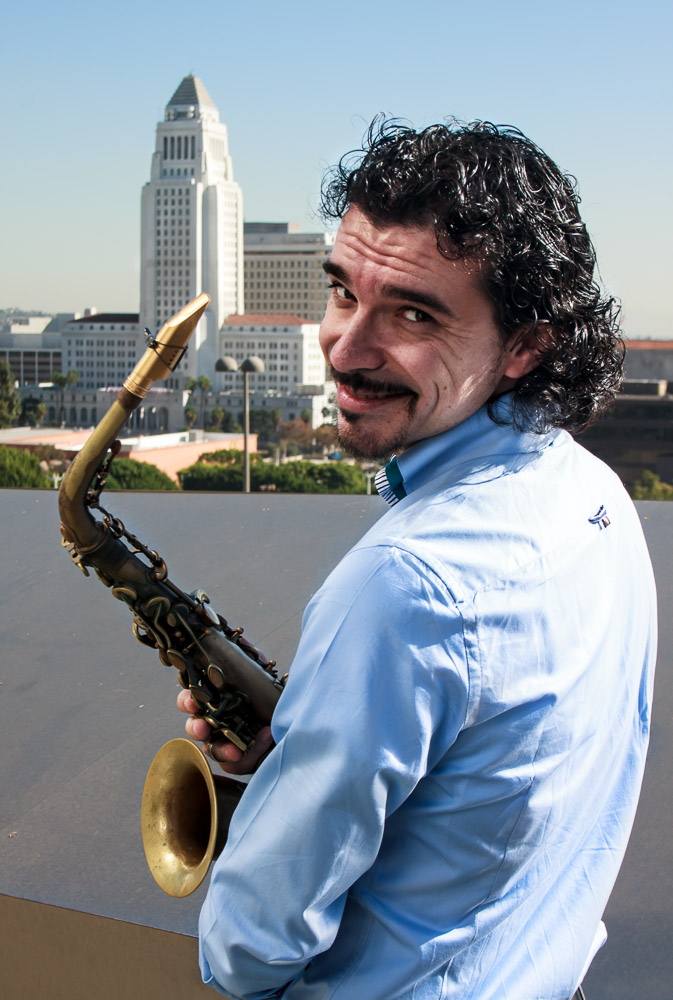
While there are countless professional saxophonists working in the music industry today, few have had the success of Italian musician Gianni Vancini. An award winning saxophonist, Gianni Vancini has continued to woo audiences over the past two decades with his magnificently dynamic sound, which blends elements of jazz, funk, soul, and R&B.
“It’s very hard for me to say that I play a specific genre of music,” explained Gianni Vancini. “I play what gives me the chance to share emotions.”
Vancini, who has performed all over the world, has been recognized and endorsed by several of the music industry’s most prestigious companies including Canada-based Légère Reeds, Italy’s Grassi Saxophones, as well as American-based companies Cannonball Saxophones, Theo Wanne Mouthpieces, and AMT microphones.
Having worked with an incredible list of internationally known musicians, Vancini names musician and friend Eric Marienthal as someone who has greatly shaped his personal approach music.
“Eric Marienthal takes the cake. We met in 2005, when he was recording for Italian artist Umberto Tozzi, who I’ve been touring with since 2002. The approach he has with music and life is so inspiring to me,” said Vancini. “What I really like about him music wise is his preparation, his high level of professionalism and the way he strives for perfection in everything he does.”
Marienthal, who is a Grammy Award winning contemporary American saxophonist, has released several successful records including Oasis, which ranked in the top five of the Billboard Contemporary Jazz Charts.
In addition to collaborating with such well known artists as Andrea Bocelli, and Sting, Vancini has also used his musical genius to help raise money for charity organizations like Terra Mosse; an organization which came into being after two earthquakes with magnitudes of 5.8 and above hit Northern Italy within 10 days of each other leaving businesses in shambles and thousands of people homeless.
“I did a song for a benefit two years ago after a series of tremendous earthquakes hit my birthplace in Mirandola, Italy. Together with a famous radio station, we decided to put together an all-star band to raise money for the territory,” explained Vancini.
“The song is called ‘Insieme’ (Together) and it became a single CD for the association called Terre Mosse, which is taking care of all the major businesses that were damaged by the earthquakes.”
The all-star band, which included Gianni Vancini (saxophone), Claudio Dirani (drums), Marco Dirani (bass), and Emiliano Fantuzzi (guitar), released the single CD entitled Insieme, which was produced by the Italian radio station Radio Pico, in 2013.
Vancini is currently represented in America by the artist management company Max Bernard Management, which also represents internationally known musicians Terry Wollman, Maltida Madison, Rob “Funksta” Bacon, among others.
As for the future, Gianni Vancini plans to continue his life-long passion of playing music around the world and hopes to embark on another tour in the United States later this year.
French cinematographer Johanna Coelho is not only a phenomenal director of photography who has a background working with an array of different genres, but she is capable of shooting on any format, a feature that sets her apart from the masses.
“Film and digital have the same purpose: create images for telling a story. There’s a lot of discussion going on about what is best between shooting on film or digital. For me in a sense, it’s like having a discussion about which lense to use. It’s a decision that concerns one’s choice, taste and style,” explained Coelho.
With the global technological advancements we have experienced over the last two decades, the most noticeable shift when it comes to the film industry can be found in the format in which films are shot.
For instance, feature films that were once shot on 35mm filmstrips are now predominantly shot on digital, the reason being that digital technology is cheaper to reproduce, and easily transferrable.
The question of whether to shoot on digital or 35mm will always come down to the aim of the director and what the film’s director of photography (DP) feels is the most viable option for producing the director’s vision. However, for the DP to even consider taking one of these two routes they must first be capable of shooting on both formats, a skill Johanna Coelho can accomplish in her sleep.
“I think it’s amazing to want and know how to shoot both, because today we still have a choice, ” said Coelho. “I pick one over another depending on the project, story, shooting conditions, and visual style. There is a sharpness to digital that is really appreciated nowadays, and film will always give you this beautiful grainy image that gives a really cinematic aspect to your film. They do not look the same, and that’s the great thing about it.”
Coelho’s talent as a cinematographer and her ability to choose whether to shoot on film or digital depending on what will be the most compelling for the overall project, has allowed her to be far more creative than most in the craft.
The film Broken Leaves, which was directed by award-winning director Sasa Numic, follows two teenage best friends, Lana and Annie, as they go on a picnic with three boys in the woods. The film focuses on Lana’s jealousy over the attention Annie is receiving from the boys, a feeling that quickly turns to anger and leads her to do something that she immediately regrets.
Coelho worked her magic as the director of photography for the film, which was shot solely in the woods using 35mm film. Coelho’s use of the perfect filter and film, in addition to the way she captured the sunlight breaking through the trees creates a hazy, almost dreamlike feeling, one that visually supports the film’s storyline of Lana’s rash actions being grounded somewhere outside of reality.
“Broken Leaves is a story that is supposed to feel like it was shot in the 70’s, so I felt shooting on film was appropriate in order to give a realistic and beautiful grain to the images,” explained Coelho.
“Also, there is a really nice warm look created with the filter I used in the camera throughout the whole film. This particular color created with the filter worked because of the type of film I chose to use, Kodak Vision 3 5213, 200T. So it wasn’t only about the grain, but also about the choice of emulsion. Colors on film can be truly amazing if you know how to use them.”
As the director of photography for the film The Black Room, which was also shot on 35mm film and follows a convicted woman who dances away the reality of her jail sentence by imagining she is a cabaret dancer, Johanna Coelho shows her finesse and versatility with the camera. Because The Black Room was based on the incredible camera tricks invented by French illusionists and cinema genius Georges Méliès, Ms. Coelho chose to shoot on film in order to remain authentic to Méliès’ discoveries.
Creating a mesmerizing sequence of imagery using double and triple exposures on film, Coelho draws audiences in with the way she captures the character’s movements to a place where they too forget that the woman they are watching is in jail.
Concerning the use of double and triple exposure, Coelho admits, “We can do that with digital now, but it’s not as challenging or as fun! Making all of your effects happen in the camera is an incredible experience that shows you the real power of shooting on film.”
While the up and coming generations will most likely switch to shooting solely digital, there are elements of 35mm that continue to be widely cherished throughout the film industry today, and Johanna Coelho’s films serve as a testament to the importance of cinematographers having the capacity to work with both.
“Film is the very first format of cinema, and I think there is something really special about that,” said Coelho.
For most people who do not work in the film industry there is a grave misconception of the scope of work and talent involved in an editor’s work. Often times editors are thought to simply compile footage selected by the director and sequence sounds created by the music department, but this is rarely, if ever the case.
The editor is a creative cornerstone of any production, he or she is the one who sifts through hundreds and sometimes thousands of takes and personally selects and sequences the best scenes in a way that brings the story to life. An integral force in the creation of hundreds of visually and auditorily captivating productions, Russian native Vladimir Boboshin is the kind of editor that leads a project to success.
Earlier this year Vladimir worked as an editor on the world’s first 24-hour music video which featured seven-time Grammy Award winning artist Pharrell Williams’ hit song “Happy.” “Happy” received the award for Song of the Year at the BBC Music Awards and was nominated for an Academy Award for Best Original Song in the film Despicable Me 2 earlier this year.
Something that sets Vladimir Bobshin apart from other editors his love for music and sound in general. The editor explains, “I’m sort of a sound nut and maybe I pay more attention to the sound edit than others. I can edit, cleanup and mix the sound if needed and I did that for the Serta Sleep Systems and Fast Company projects this year here in LA.”
As the editor of several spots for Fast Company’s “Business Simplified” campaign including the spots entitled ‘Simple Advice on Making Creative Ideas Happen,’
‘Simple Advice For Optimizing Social Media,’ and ‘Simple Advice For Working Smarter, Not Harder,’ Vladimir was able to create a series of short, yet highly informative, advice driven projects that assist business owners in reaching their goals, while also promoting the company. Vladimir’s ability to sync and create a symbiotic relationship between the project’s visual and audio elements helped create an end product that is both easy for viewers to understand and entertaining at the same time.
Vladimir Boboshin also worked as the editor of five spots for the Serta Sleep Systems’ promo entitled “iComfort Challenge” earlier this year. The spots follow actual Serta customers using their new iComfort mattress over the course of several weeks comparing their experiences with their previous mattress and their new iComfort. Mixing all of the music in the spots himself, Vladimir creates a feeling that is light, fun and whimsical, and entices audiences to embark on a new life with the Serta’s new iComfort mattress.
Vladimir discovered his passion for the relationship between sound and visuals and the feelings evoked by the combination in his youth. The editor makes it a point to pay special attention to the sound aspects of every project he works on, a feature that continues to pull audiences into each and every story he brings to life on screen.
“I try to find the musical balance in the sequence of pictures, and make them play well with each other,” says Vladimir. “I edit music pretty heavily when needed altering the level balance, as well as EQ and filters, as those are, in my opinion, very underrated tools that help to make the music cue work.”
Over the course of his career Vladimir Boboshin has worked as the lead editor on a variety of commercial, music video, television and feature film productions. Vladimir has been the editor of numerous award-winning commercials including “Chase” for Tele-2, which received the Bronze Award at the 25 kaDR Professional Contest for Television Advertising, “Army” and “Office” for Alfabank, which received the Grand Prix Award at the Red Apple Moscow International Advertising Festival, Ikea’s “Sleepwalker,” which received the Bronze Award at the Red Apple Moscow International Advertising Festival, as well as many more.


 So much of establishing oneself as a successful actor in the world of film and television comes down to an actor’s ability to be chameleonic in their pursuit of a role in order to make a casting director believe that they aesthetically fit the character.




 internationalfilmreview