Actor Cesare Scarpone brings passion and talent to all of his character portrayals.
Cesare Scarpone is an award-winning actor who consistently projects a formidable dramatic presence. The Canadian-born Scarpone inhabits each characterization with a masterly combination of skill and instinct, and whether it’s romantic comedy or a dark suspense story, he deftly crafts a persuasive, tangible persona imbued with the full spectrum of nuance, traits and emotion.
It’s a rare balance of sensitivity and showmanship and Scarpone, surprisingly, stumbled upon his avocation almost by chance.
“I started in high school, not knowing what acting really was, but coming from a town where theatre and acting are seen as a fantasy, imagined only through the TV, this attitude was the norm,” Scarpone said. “At my first performance, I stepped onto the stage and was overwhelmed by the mass of people watching me. I’d gotten through half the play but all of a sudden I froze. I’d forgotten my line and time stopped. This was the biggest rush I’d ever felt and I wanted more.”
Scarpone’s path was set, and the following year his performance as Jerry in the Edward Albee classic, “The Zoo Story,” earned him the Sears Drama Festival’s award of excellence for the York Ontario region.
“From there, I couldn’t get enough. I tried to do as many independent films as I could sink my teeth into,” Scarpone said. “This led to a few spots on television programs, union films and a commercial.”
Scarpone’s talent has shown up in his outstanding character portrayals in the films “Black Forest” from writer-director David Briggs, director Gabriella Bevilacqua’s “Aftermath,” Omii Thompson’s “Modern Romance is Dead,” Rebecca Carrigan’s “All I Need,” Rob Comeau’s “Chance” and “Dead Monday” from director Mark Korven. On TV, Scarpone has acted in History’s “Curious and Unusual Deaths” and Cineflix’s true crime docudrama, “Dual Suspects.”
“Working with Cesare on “Black Forest” was a great experience,” said Briggs. “It was obvious from the first take that Cesare is all about the character, and he digs deep to bring the script to life. He believes in the craft of acting, and that passion brought a lot to his role.”
Scarpone’s meticulous approach is fueled by a soul-deep passion, not just for the craft, but also its role in world culture. “Story telling is something that everyone knows in their hearts. We love it, yearn for it,” Scarpone said. “You see it in your everyday life, in some form or another and through different mediums, but we are slowly losing the original performed art. Our generation no longer needs to even get out of bed to watch a film or read a news article. They have everything in their hand. But the experience of live theatre can be life changing, perspective changing. You can truly connect with people, and not in a way that is buffered by static transmission through a screen. Everyone should know live theatre, and everyone deserves to have access to it.”
With almost 20 film and TV credits, Scarpone knew it was time to reach for an even higher level of accomplishment. “I decided to apply for a drama school, and this led me to London, England—the heart of theatre. What better place to train?” Scarpone said. “I came across The London Academy of Music and Dramatic Art, and decided to audition for their flagship courses. I was surprised to get the call from the legendary Rodney Cortier, head of the school, inviting me to their two-year acting course—the best of its kind in London, which equates as one of the best in the world.”
Arriving in London in 2014, Scarpone subsequently performed in more than half a dozen stage productions (including “A Midsummer Night’s Dream” and “The Tempest”), absorbing a full measure of the almost alchemical depth of skill which has always typified British stagecraft.
“When I got that call I was ecstatic and screamed at the top of my lungs because this meant that I would finally have the foundation I needed to have my skills really develop,” Scarpone said. “Now I am in my final term at the school, graduating in July and ready to attack this growing market.”
“What first led me to acting was the feeling of not only being free on stage, but also feeling the effect I was having on the audience in theatre and film. I love both mediums, each with their joys and merits, and both are something I’m extremely excited about,” Scarpone said. “There are so many new things going on in the industry, like immersive theatre, and advances in technology with film and television that allow new ideas to be better completed and given to the world.”
Scarpone has already distinguished himself as both a capable technician and self-possessed artist. His very sense of wonder itself generates an aura of appealing enthusiasm and is something he’s sure to bring in many more productions to come.
Cristina Tomas Rovira specializes in photography and videography for music, fashion and weddings.
Professional photographer and videographer Cristina Tomás Rovira has worked alongside with some of the greats of the entertainment industry, capturing moments via still photography and film for more than half a decade.
Originally from Barcelona, Rovira’s awareness of the arts was sparked at a young age. “I’ve been interested in this world since I was little,” Rovira said. “Every time I watched a movie or a TV show, I could picture myself working on one of them. I was, and still am, addicted to watching behind the scenes videos.”
After obtaining her first camera around the age of 10 and receiving praise for her photographs, Rovira explained that, “something just clicked. I loved the feeling of people telling me that my talents were special and that they liked my pictures. So, I kept going to continue to get the same reactions from them.”
Rovira began working professionally while attending The Centre de la Imatge i la Tecnologia Multimèdia (Barcelona) in 2010.
“My first job as a photographer was at a music festival in Barcelona. I was 19 years old at the time, and it was one of the best experiences of my life,” Rovira described. At the time, Rovira’s pictures from the festival were used for press, ultimately gaining her work recognition around the city of Barcelona.
It was also during college when Rovira picked up her first DSLR camera in an attempt to figure out the basics of videography. “I was working on a fashion assignment for one of my classes and noted a lack of videographers surrounding me. DSLR cameras were increasing in popularity, so I decided to try the whole video thing for myself. I ended up capturing the making of that fashion project, and from that day forward my life was forever changed,” said Rovira.
Since 2010, Rovira has been in charge of all filmmaking at Padilla Rigau, a leading, Barcelona-based Wedding Photography and Videography company. The company is known for capturing some of lives most precious moments with a unique, modern and fresh twist.
“I truly believe that our work as photographers and videographers is based on feelings – to create them, and to capture them,” said Rovira. “Attending weddings has provided me with a greater sensitivity towards what is in front of the camera, and I now use that sensitivity always, whether I’m shooting a wedding, a commercial or a fashion film.”
In Rovira’s opinion, two of the most powerful qualities a good photographer can have are that of speed and affectivity. One must be fast, humble and approachable, and the same goes for videographers. “If you shoot the same look or seen a thousand times, the subject will get the impression that it is his or her fault. If you have something specific in mind, you need to explain your idea when everyone’s around, so that everything translates, including your excitement regarding the prospective shot,” Rovira explained.
When it comes to her own work and creative tendencies, Rovira tends to enjoy capturing the details that are often overlooked. “I consider myself an adventurer,” said Rovira. “I have always been on the hunt of new perspectives. I like telling stories from a different outlook. I’m really observant. I’ve always been that way, and that fact about my personality has given me an extreme sense of what people like to see in my work.”
The work of a photographer entails so much more than a simple point and click. It is a job that requires an excellent aesthetic eye, and both creative and technical aptitude. For example, when it comes to the different types of lighting she’s worked with, Rovira provided, “You have to be like a chameleon and adapt to the lighting that has been given to you. Sometimes, I’m shooting something that’s happening under one kind of light, and when I turn around to film something else, the light is completely different, so I have a very small window of time to reset my camera to shoot the second scene. I have to be fast and prepared so I don’t lose the moment.”
Rovira developed her own photographic style upon moving to Los Angeles for a year, where she collaborated and refined her camera skills with the internationally renowned photographer, Joseph Llanes. Llanes’ work has been published in Rolling Stone, Billboard, Spin, New York magazine and L.A. Weekly. His wide range of clients includes talents like Rihanna, Justin Bieber, The Black Keys, Katy Perry and Gavin Rossdale, to name a few.
“Everything that surrounded me was invigorating and I felt a constant need to capture most of the people and things that I came in contact with,” Rovira explained of her introduction to the entertainment industry of Los Angeles. “Being a foreigner gave me the chance to see the extraordinary in the ordinary.”
Alongside mentor Llanes, Rovira assisted with multiple photo shoots with top clients, where she ultimately acquired an intense understanding of the building blocks of professional photography. “I always learn something from Joseph in every photo shoot or project that we collaborate on. He taught me the importance of creating a good environment at work, and to always be two steps ahead of yourself with every project. Have a plan B, C and D, so you’re prepared to quickly solve any problem that might occur during the shoot, without the client noticing that there was even a problem to begin with,” Rovira said.
Since this experience, Rovira has photographed and assisted with shoots involving many top tier musicians, bands and musical events, her framework including talent such as Quincy Jones, Phoenix and Els Catarres. In 2013, Rovira assisted Llanes at the world famous annual music festival, Coachella. She has also photographed leading music events in Los Angeles with Llanes such as Hard Summer and the Hard Day of the Dead Festival, where Rovira worked in photographing such famed talents as the Grammy winning DJs Calvin Harris, Skrillex and Zedd.
During the Aokify America Tour’s November, 2013 Los Angeles show for Steve Aoki, a Grammy nominee and Billboard Award winning EDM musician, Rovira photographed Aoki as well as music superstars Iggy Azalea, Linkin Park, Travis Barker and Kid Cudi.
As a videographer, Rovira has engaged her outstanding talents for companies Brownie Spain and Padilla-Rigau, for several years. As an innovative team member, Rovira has, and currently, films and photographs weddings and fashion events. “Nowadays, we are amongst the top ten wedding photographers and videographers in Spain,” Rovira said. “I love doing weddings because I work with two of my best friends. We have built a really strong company together.”
When it comes to fashion, Rovira has created fashion films with some of the most well known brands in all of Spain. Some of Rovira’s clients include Shana, Swarovski, Codigo Basico, Estel Alcaraz and Pompeii Brand, among others. Regarding her work, Rovira commented, “Working with [these brands] on a regular basis allows me to improve and try new things with each video. I love capturing what’s going on around me.”
With industrial designer Estel Alcaraz, Rovira has acted as her, “right-hand person,” as quoted by Alcaraz, since the beginning of Alcaraz’s career. “Cristina is a part of my team. I was lucky enough to know her when we were both starting our professional careers and we helped each other as much as we could. She works with me on every project I start. She’s exceptionally sensitive to detail and puts my ideas on paper or on video. Either way, she always gets what I want because she has the ability to capture the emotion and passion that I put into my products through her work.”
The pair worked closely with one another on one of Alcaraz’s most important projects, The Sardines Boots. The Sardines Boots are bright yellow, light, flexible rain boots that are designed to easily fold and compress to a backpack size. With the motto, “Don’t let wet socks give you cold feet,” the campaign was published worldwide.
“Cristina knows how to showcase the essence of my products and it was great to be known inside the world of industrial design with her work, as she is one of the people who believed in me from the very beginning,” Alcaraz said. “Working with Cristina is great because she always wants to go one step further and is always thinking about starting new projects. Sometimes, she even encourages me to design so that can she make a new video. She has this contagious positive energy that makes you believe that you can make everything come true.”
Rovira has also applied her profound camera skills for a TV commercial with professional Spanish footballer, Andres Iniesta. “I showed my footage and pictures to the director of that shoot and his reaction was priceless. He liked how I captured moments that he didn’t realize happened, and commented that the composition of my work was extremely beautiful.”
Jordi Egea, owner of the Spanish production company Smilefilms, directed the commercial shoot. Previously, Egea and Rovira have collaborated on several projects with the brand Dormity. Regarding Rovira’s sought-after skills, Egea said, “We hire her because she is great at doing her work, she gives you what you and your client ask for, and goes above and beyond what is needed of her. She understands her clients and what they want and captures the essence of every brand while still maintaining her personal style. Plus, people feel comfortable around her, and that’s key when you work with people who are not necessarily used to being in front of a camera.”
Game designer/producer Zi Li has been the brains behind many leading titles in today’s marketplace.
We recently had the opportunity to sit down and visit with Zi Li, a revered game designer and producer who has helped deliver award-winning titles including “Dissonance,” “Paralect,” “MiraLab,” “Dungeon Crash” and “Epic Knights.” Shining in both PC and mobile platforms, Li has also engaged her talents for the award-winning “Leviathan” virtual reality project and for the short films, “The Birthday Girl” and “Fly.”
Li, a Guangdong, China native, has a well-founded background for the field. She received a Bachelor of Engineering degree in Digital Media from Beijing University of Posts and Telecommunications, and a Master of Fine Arts degree in Interactive Media & Games from the University of Southern California.
Dispatching her design brilliance, Li has been instrumental in the development, design and execution of cognitive puzzle games, fantasy RPGs and adventure games. She works with Firefly Games Inc., that operates offices in both Shanghai and Los Angeles, and had prior stints with Digital Domain 3.0 Inc., Floor 84 Game Studio and Ericsson Communications.
Li has constructed a standout career with a formula comprised of artistic creativity, engineering ingenuity and a command of computer programming and design principals. We are excited to share her story below in our exclusive interview!
What was it like to grow up and live in Guangdong?
ZL: To be honest it was kind of boring. I grew up in a middle city. Its economy is okay to maintain people’s basic needs. But we don’t have much to do. People are very chilled and always have morning tea, afternoon tea and night tea. Being chilled and relaxed is not in my nature. I always want to go to other places and see what is exciting and creative. I guess that’s why I am here making games.
What games did you grow up playing?
ZL: I did not grow up playing games. My parents were very strict when I was young. They don’t allow me to access to anything that could make me feel addictive. I was learning painting and into manga when I was a child. I always wanted to do art.
Unlike a lot of game developers, I didn’t fall in love with games first. I have particular types of games I like. I love visual art and engineer first and then found games that express meanings and allow me to feel smart when I am playing are very attractive. That’s why I get into game industry.
What drove you to pursue a career in game design?
ZL: I would say I’m driven by the idea of communicating thoughts through art pieces. For me game is art. Game designers are the same as other artists.
I was good at science related fields when I was a kid. I thought my ability is enough support me to become an engineer in the future. On the other hand, I spent more than 6 years studying paintings until high school. I always thought I could become a part time artist. I did an animation later. I found that doesn’t satisfy my needs of expressing my engineering mindset.
Later, I got clearer that in the field that science intersects with art is what I’m really passionate about.
For me, games is a media that allows both science and art collapse together.
What is your favorite game genre?
ZL: Puzzle. I like games that can make me think and use my logic.
What are your top three favorite games all-time?
ZL: Braid, Machinarium, Windosill.
How would you describe your job as a game designer and producer?
ZL: My job includes a wide range of tasks. As a producer, I work with different teams and communicate with each team about their perspective of the game. Also, because I’m a game designer, I also work on game design decisions and help with correcting the game development direction.
What does it take to be a successful game designer?
ZL: I think a good game designer should be innovative, open-minded, and passionate. Other skills will come along as long as the game designer knows what he or she wants.
How did your academic career help shape your professional career?
ZL: I got an engineering degree in Digital Media. We learned lots of basic knowledge about films, animation and games. I learned how to program and work on cinematic pieces during my study in the Digital Media Department. I found my passion in films and games by trying out various media.
Then I went to graduate school for Interactive Media and Games. I was majoring in game design. I knew that this program is not only limited in traditional games. It matches what I want out of games. So I started as a game design student in the industry and gradually figured out my strength. I was involved in various games projects and learned different skills, like design methodology, cinematic expression and so on. They definitely help me to become a game designer and producer.
“Dissonance,” for PC, won the Indie Prize and the Experimental Game Showcase at the Out of Index Festival. Tell us a little bit about it.
ZL: Dissonance is a puzzle-adventure game developed by Team Dissonance. I created Dissonance as a bridge between puzzle games and a psychology concept cognitive dissonance. It started as my personal project. With six months development, the team has expanded to over 10 people. The developers transmitted the psychological concept cognitive dissonance into the core mechanics of game to make it more than just a puzzle game.
What place do puzzle and psychology games have in today’s gaming market?
ZL: Puzzle games are always popular. But I don’t see many games combining puzzle and psychology together. I think as one of the art media, comparing to other media, video games are still new and have lots of potential. Hopefully it will be growing and explored the usage in different areas.
The fantasy RPG – “Dungeon Crash” – has over one million downloads for Android and Apple. How would you describe the game and what’s made it such a success?
ZL: Dungeon Crash is a fun and adorable game which has playful battles accompanied by strategic role-playing elements.
The gameplay is deep and fun. Players always have the next goal in the game. The main goal of the game is to collect the best team of warriors, mages and healers. When a player is trying to work towards the main goal, he or she can balances other elements like gear, upgrade system, guild and so on. There are numerous things a player can do. Each person has their unique way to get close to the goal. Also they can show off their progress through fight against other players to get to the top position on the leaderboard.
Share with us a little on your background in art and how that’s helped shape you as a game designer.
ZL: At the place I grew up, my life contains 3 major activities: taking regular classes, painting and notebook shopping in bookstores (I collected notebooks when I was younger). Like I mentioned earlier, I spent 6 years studying painting. Also, my dad loves poets and calligraphy. He loves sharing them with me. I think this type of environment helps to build my aesthetic standards, creativity and cultivates my passion in arts.
I do think game design is a pretty flexible area. A lot of times, game designers need to make decisions with their aesthetic and design sense. Those things are very abstract and hard to grow in a short term. I’m glad that I grew up with practicing my aesthetic consciousness.
You contributed to the art that’s featured in the PC game, “Paralect.” What is the premise of “Paralect” and how did you enjoy working as an artist for the game?
ZL: Paralect is a 2D platformer that uses gameplay, visuals and narrative to tell a personal story of cultural un-rooting. It explores the paradigm shifts caused by culture shock and adaptation and investigates how those transformations affect one’s vision of people, their environment, the place you initially came from and, most importantly, the place you wish to call home. It is a story and a world inspired by the creative director Loan Verneau.
I had great time working Paralect. I like the concept a lot. I think the protagonist reminds me a lot of myself. I feel attached to the character. The game is programmed with C++, so all the art asset needs to be designed carefully. Loan and I spent time together figuring out how to interpret the design through programmed visual elements. It is great that I got to apply what I know into the game and learning new ways to express ideas in games at the same time. It also helps me to grow and build up experience to make my independent games.
“MiraLab” went on to win the Gold Award in the Education Category at the Serious Play Conference. Was the educational aspect a motivator for the Miralab team in creating the “MiraLab” concept?
ZL: The world in Miralab is a media arts world and accompanying design methodology that emerged out of a multi-faceted exploration of a naturally occurring biological process: the lifecycle of Turritopsis dohrnii, the immortal jellyfish. The biological structure acts as a contextual framing, research prompt, and unifying theme that generates multiple interdisciplinary arts and science media explorations. It foregrounds knowledge and outcomes associated with arts and design practice experimentation within the realm of interdisciplinary arts science research. It asserts how the unique potential arts practice engagement contributes to interdisciplinary learning. This abstract briefly describes each mode of exploration and contextualizes it within a larger poetic science methodology. It considers this methodology’s contribution to a new understanding of interdisciplinary arts science research centered in transmedia design principles.
That said, the “Leviathan” project you worked on implements some VR along with other components. What’s “Leviathan” all about?
ZL: The Leviathan project, based on Scott Westerfeld’s Leviathan trilogy, takes place in 1895, 20 years prior to the source material. In Westerfeld’s story, World War I is reimagined with bioengineered fabricated animals replacing technology and facing off against large mechanical robots. While the books focus on the tension of war, the Leviathan Project emphasizes the experimental exploration in the concept of fabrication. By taking place earlier than the series, the project builds a world of wonder and amazement for the unknown and the unexpected possibilities that can suddenly arise.
“Leviathan” received the New Frontier Project award at the Sundance Film Festival and was featured at CES in Las Vegas. What were the responses and feedback you guys got on the project?
ZL: Players are amazed by what Leviathan offers. In the Leviathan project, we adapt the techniques that can track the player position in a room. So what players need to do is put on the headset and walk around in the room. It is simple and intuitive.
They love that they can walk around in the Leviathan world and observe the world and the stories as an officer. They can get immersive experience while creating their own version of story.
What opportunities does your role as producer allow for at Firefly Games?
ZL: As a producer, I get the chance of communicating with each team and overseeing the project I’m responsible for. Also, I have been communicating with other producers from other projects to share our experiences and tools. I have lots of practice in project management, negotiation and various problem-solving skills.
What can gamers expect to get from Firefly releases?
ZL: Firefly Games focuses on the games that are intuitive and fun for mobile gamers. We have three games out there and are developing more games. Hopefully players can find that our games are fun and relaxing.
What are some of your hobbies outside of the gaming realm?
ZL: I like reading books and watching animated films. These two media can always offer me endless inspiration. Currently, I’m reading a book called The Hero with a Thousand Faces.
What types of games are you looking forward to designing and producing in the future?
ZL: As an artist, I hope one day I can make a game that offers players a unique experience in a way that they reach part of the mind they have never explored before. I always have fun knowing myself and learning about myself. I find it fascinating that a lot of us don’t know ourselves very well. And a lot of art pieces help us. For example, the pilot in The Little Prince does help me to see that I’m just like him. He wants to be a painter, not a pilot. And I’m a person who always wants to be an artist instead of an engineer. I hope people can try the game and then say ‘This game is affecting me. I never knew that I’m a person like that.’
There are many different types of acting, but the most universally recognized can often be when one is standing on a stage or in front of a camera. For Brazilian actor Lucas Zaffari, a different type of acting challenge is presented to him on a regular basis.
Zaffari dubs Spanish telenovelas into Portuguese, his native language. Dubbing, also known as revoicing, is the replacement of the voices of the original actors with a different performer in another language. To do so, Zaffari receives the video and script with all the timelines of exactly where his character speaks and reacts in an episode. He then studies those lines and goes to a sound studio to record the revoicing of his character.
“As an actor, specifically for film and television, you get all you can from circumstances that are happening around you and in your imagination. When it’s me, I try to absorb as much stimuli as I can from my acting partner, location, sometimes music, smells, senses,” he said. “But in a sound studio all you have is a cubicle with foam and the recordings that you see on the screen, and on top of that, all you have to show what your character is feeling is through your voice. It is challenging.”
Zaffari is currently cast in three telenovelas with Voxx Studios. These seven to nine month commitment are the Colombian Allá Te Espero which is soon to be completed, Venezuela’s Piel Salvaje, and the Venezuelan American Voltea Pá Que Te Enamores.
Although it is more common for Portuguese dubbing studios to be in Miami and Brazil, Voxx set up their studio in LA because they believe that is where the most talented actors are located.
“I’m really honored to know that after I joined Voxx Studios, they continued to hire me on all of their new telenovelas. It’s a great opportunity to voice different characters,” said Zaffari.
The sound booth where Zaffari works is a cubicle about eight feet by eight feet covered in foam so the sound does not reverberate, a microphone, a headphone, two televisions (one for the video and one for the lines with the proper time codes). There is also a sound-proof window that goes through to a different room where the sound engineer and the director are located.
“It can be quite hard,” described Zaffari. “You need to match your voice to the mouth of the original actor. Sometimes the Spanish is too fast and it is hard to match everything in Portuguese to that pace. Sometimes we have to change it to what people would understand instead of a perfect translation, without changing the meaning, of course.”
Zaffari describes acting as the hardest job in the world. He says that feeling as someone else is extremely challenging, but with dubbing, you do not have the capability to pull from your surroundings and react instantly to the people around you.
“Dubbing is not on location,” he said. “You are in a cubicle. You don’t have another actor to pull emotion from. Your partner is a microphone and a television. The senses I use when I am acting
I can’t use when I am dubbing. I am not there. You need to put all of those things you would normally use into your microphone and just use your voice.”
Despite the challenges that dubbing can present, there are many parts that Zaffari enjoys.
“In a way it is less stressful because you are not on camera so you can just wear your comfortable clothes,” he said. “But I really like to put a little bit of my interpretation into a character, even though it is another actor’s performance.”
Zaffari said that when he first started dubbing, he was conflicted on how to approach each character.
“Should I dub as my personal interpretation of what that character is going through? Or as the original actor’s interpretation?,” he said, describing his initial thought process. “But to me now, it is a mixture of those two things.”
Leila Vieira, Zaffari’s dubbing director for Piel Salvaje, thinks Zaffari’s mixture is working out very well.
“One of the main qualities an actor has to have in order to be good at dubbing is being able to recognize and mimic pace,” described Vieira. “Lucas has an incredible ability for listening to the dialogue and being able to reproduce it in Portuguese with perfection, making the process fast at the same time as high quality with his great acting skills. Aside from recognizing pace, acting with only your voice can be a challenge that Lucas masters with flying colors.”
Vieira believes that it is not only Zaffari’s inherent talent that makes him successful at dubbing, but also his personality as a whole.
“Lucas is the nicest person you could ever work with,” she said. “Not only he has an amazing working ethic, but he also has a great personality that accepts critiques and understands the adjustments, which makes the whole process fast and productive.”
Sebastian Zancanaro, another director at Voxx, describes Zaffari as the ultimate professional.
“I cast Lucas as Francisco (Pacho) in the dramatic soap opera Alla Te Espero and I was mesmerized by his commitment to our team and by his stamina. His unique skill as a Portuguese speaker actor in conjunction with his acting abilities make him one of our most valuable cast members,” said Zancanaro. Lucas has also being cast as Pedro in our upcoming soap opera project entitled Our Family, our longest and most prized project to date.
Zaffari says that dubbing with Voxx is a great working environment.
“It is so much fun,” he said. “There are so many nice and talented people around, which makes this creative work much more richer.”
Zaffari has no plans on slowing down.
This versatile actor has already started dubbing the new telenovela Somos Família (Our Family) as Pedro.
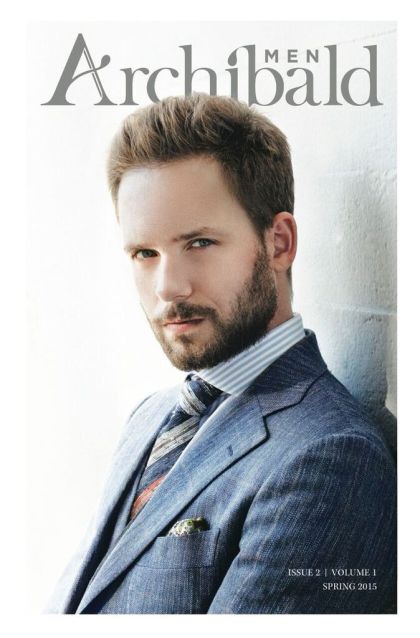
Archibald Spring 2015 cover styled by Kirsten Reader
Sometimes, the greatest success can come from stepping outside of your comfort zone. Leaving what you know and experimenting with new things can lead to the extraordinary. This is what happened with wardrobe stylist and fashion director Kirsten Reader when she embarked on a journey to create Archibald Magazine’s spring 2015 cover.
Reader left her home in Toronto to shoot in Los Angeles. Not only was this her first time shooting in LA, it was her first time shooting in the United States. On top of this, Reader had to not just be in charge of fashion, she was also the fashion editor, creative director, wardrobe stylist and groomer.
“This was my second issue as Fashion Editor for the men’s fashion publication, Archibald,” said Reader. “I wanted to do something to really show what the publication could do and achieve given not only was it my second issue, it was also the second issue for the publication as a whole. I wanted to truly push myself and do a shoot in LA and also create content for the publication that showed being a new publication we could compete with the best men’s publications. This was a personal challenge to see what I could achieve.”
Reader decided to reach out to her former schoolmate Patrick J Adams to see if he would be interested in being featured in the shoot. Adams, a SAG-Award nominated actor well-known for playing the lead role of Mike Ross in the critically acclaimed television series Suits, jumped on board, along with the photographer Vanessa Heins.
“Vanessa was actually going to be there, and had been trying to get a shoot with Patrick so it was a project that was just meant to be,” said Reader.
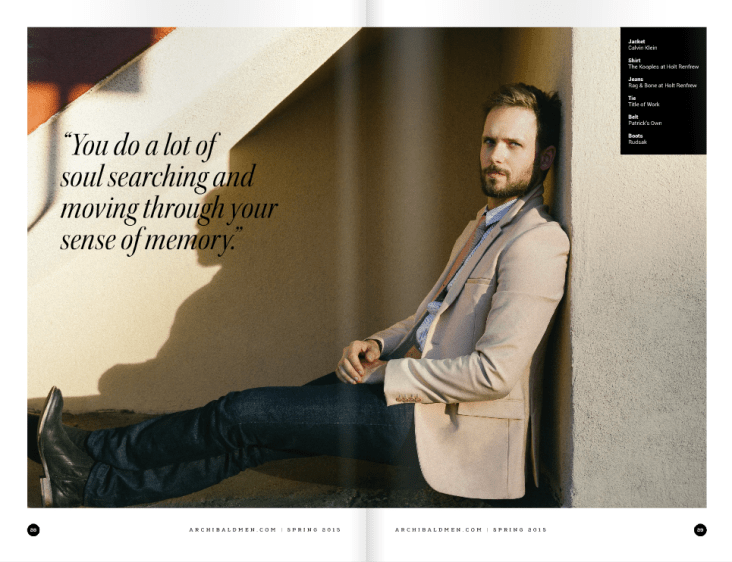
The shoot was just Reader, Adams, and Heins, and took place in Los Angeles with a lot of it in Silver Lake and around the LA River.
“Once in LA we just location scouted and ended up shooting the whole concept fairly guerrilla style,” Reader described.
The threesome of Reader, Adams, and Heins worked extremely well together, and were able to create a successful feature for the magazine.
“It was great to work with Patrick as we hadn’t worked together since drama class back in high school,” said Reader. “To have Vanessa on board and her to have a relationship with Patrick already made the whole atmosphere of the shoot relaxed and enjoyable, really allowing us to have fun with the process and create some great images that showcased Patrick in a way that hadn’t been shown prior.”
Adams agrees, and attributes Reader’s talents as the reason the magazine sold over 50,000 copies in Toronto and received over 1.3 million views online.
“This extraordinary success would not have been possible without Kirsten’s prowess,” he said. “She successfully represented me as an actor and an artist.”
Adams describes the collaboration as “nearly flawless”.
“Kirsten always kept a laid back atmosphere for the shoot while directing the overall project and styling,” he continued. “She is widely recognized for her contribution in Canadian fashion, especially within Toronto, and is listed as one of the most recognized stylists in the world.”
Despite having to overcome some difficulties initially, Reader describes the shoot as a learning experience.
“There were numerous challenges for the shoot like not having an assistant,” she said. “I definitely learned by doing.”
Reader acknowledges that she was lucky to be able to reach the talents of Adams and Heins at the click of a button.
“I was lucky enough to go to high school with some incredibly talented people who have made an impression in LA,” described Reader. “Patrick was one of them and I took the chance and reached out. Vanessa has been a great friend and work colleague who I always feel privileged to work with. Her talent behind the lens is one that inspires me to be better on every project.”
All in all, the experience was a great one for Reader.
“The whole day was a so much fun and even though I was wearing many hats for the project we had fun just trying out the concepts we had loosely brainstormed,” said Reader.
She even got to discover some natural talent that was hidden before.
“My favorite part was probably the motorcycle shot. We actually shot it with my driving across the LA River Bridge keeping pace with Patrick on his motorcycle and Vanessa leaning out the window to shoot,” she said. “Apparently I make an excellent pace car driver as well.”
Patrick Adams styled by Kirsten Reader featured in Archibald Magazine
Cinematographer Colin Akoon at home behind the camera
In the fiercely competitive film industry, it takes a lot more than some camera know-how for a cinematographer to stand out. Many people are skilled in the technical process but lack the artistic vision required to create compelling cinema. Others possess vivid imaginations but are unable to meet (or unwilling to yield to) the expectations of the director. A person with all of these traits is a rare gem, an invaluable asset with the potential to outshine all those around them in the highly saturated industry. Colin Akoon is just such a man.
An award-winning director of photography, or DP, Akoon is responsible for a countless array of critically-acclaimed film and commercial productions. He has been fascinated with storytelling his entire life, and at a young age discovered the power cinema can have on an audience.
“I remember being six years old, watching a horror movie at a neighbor’s house, one I probably shouldn’t have been watching at that age… I still recall the fear that paralyzed me… That night I slept in my parents’ bed. I made them put the radio on to distract me from the bumps in the night,” Akoon recalled. “Good cinema gets a hold of every part of you and doesn’t let go.”
In 2014 he was critical to the wild success of the award-winning “Canadian Tire Ice Truck” ad campaign. The campaign’s name is quite literal, as Akoon explained. To promote their new cold-weather battery, Canadian Tire contracted Ice Culture to build a fully operational truck out of ice. Ice Culture is internationally-known for making everything – from ornate sculptures, to exotic lounges around the world, from Thailand to Dubai – out of ice. But this project was their most ambitious undertaking of all.
Still of Ice Truck built by Ice Culture for Canadian Tire shot by Colin Akoon
“They were having a truck built out of ice, one that would actually start and drive,” Akoon said. “It was important that we tell the story of Ice Culture – a small family-owned business – and also get a sense of the small town where they’re situated… We really wanted to get across the idea that this incredible record-breaking feat was accomplished by hard-working, everyday Canadians.”
In addition to being used in commercials for Canadian Tire, a documentary-style behind-the-scenes film was made to detail the exhaustive process of creating a working truck out of ice. Akoon was the DP on the making-of film, which played a large part in the campaign’s overwhelming popularity — particularly among the judges at a number of high-profile awards ceremonies.
“The resulting video really shows the detail of the hard work that went into the making of this ice truck,” Akoon said proudly. “The ‘Ice Truck’ campaign went off to be nominated and win more than a dozen awards… and our making-of documentary was a big contributor to the overall success of the campaign.”
It was a brilliant stroke of marketing genius to complement the campaign with a making-of documentary. A fascinating glimpse into the creation of the eye-catching ice truck, Akoon’s work captured the attention of consumers and advertising critics alike. The campaign’s laundry list of accolades include the Best In Show Award and two Gold Medals (for “Best Brand Building Campaign” and “Most Innovative Idea or Concept”) at the 2014 PROMO! Awards, third prize at the 2014 world-renowned New York Festivals International Advertising Awards, and the honor of being on the shortlist of contenders for the 2014 Cannes Lions Award, often considered the most sought-after and prestigious award in the advertising industry.
As a cinematographer, Akoon has his fingers in a lot of pies and doesn’t restrict himself to any one type of project. His exceptional work in advertising is widely-recognized, but his creativity and visual mastery shine their brightest in his work on narrative film and television productions. One such example is director Mateo Guez’s 2014 film “Together Alone,” for which Akoon was the DP. The emotionally-charged film looks at the love and lust within a group of three star-crossed young lovers. However, “Together Alone” is much more than the story of an ill-fated love triangle.
“Mateo assembled a very small team to make “Together Alone” a feature film about two young men and one young woman as they struggle through friendship, sexual relations, and self-identity,” Akoon said. “Mateo desired to make a film that did not strictly adhere to any one script or blueprint, but rather would evolve through improvisation and experimentation. As a result, the filmmaking was a very intimately creative experience.”
Of the countless projects he has been involved in, Akoon describes Lorne Hiltser’s “The Incident(s) at Paradise Bay” as among his personal favorites. Gripping and heart-wrenching, “The Incident(s) at Paradise Bay” is based on the real-world Tranquility Bay reform school in Jamaica, which became the focus of global outrage in 2007 after allegations that the facility’s strict disciplinary methods were actually child abuse.
“The moral question of whether the procedures… were just or merely abusive was an interesting one, but mostly Lorne and I were fascinated with the poetic style by which the short script was written,” Akoon said, describing what drew him to the project. “There was an eerie dreamlike quality to the script that Lorne and I knew we wanted to explore visually.”
Akoon captured that eerily surreal sensation flawlessly. Every shot of every scene was painstakingly planned and calculated to maximize that dreamlike quality of the film. His use of zoom shots as a nostalgic beginning and ending of the film contrasts seamlessly with the close, tight shots used to introduce Marcus, the film’s protagonist.
“The sequence that shows Marcus in the ‘solution room’ cage was a very important one. This was our real introduction to the character and to the harsh treatment of the academy’s disciplinary attrition,” Akoon said. “We wanted the audience to feel they were Marcus in that cage. Depth of field for this sequence was kept to a minimum, visually suggesting the claustrophobic feeling of being caged.”
Throughout “The Incident(s) at Paradise Bay,” “Together Alone,” and all of Akoon’s countless other films, his talent and experience are unmissable. Akoon has a natural gift for capturing the exact aesthetic a project demands, a deliberate manner of planning and setting up each shot, and is unsurpassed in his aptitude for collaboration, constantly working closely with each project’s director to conceive and achieve a shared vision. In an industry with so much competition, nobody can hold a candle up to Colin Akoon.
International Entertainment, and the Talents that Leave us Buzzing….





 internationalfilmreview