Tag Archives: Chinese Filmmakers

Jing Wen talks becoming a web phenomenon

Jing Wen
Jing Wen

When Jing Wen sits to envision how to begin working on a new project, every fibre of her being comes to life. She is addicted to the power she experiences when she witnesses her audience feeling her story. From the very first take, she knows what she wants them to see and she commits herself to ensuring that every single step is taken with care to do her ideas justice. For the renowned director, her work allows her to be free to express herself and her opinions before the world in a way few other professions allow. It is a job unlike any other and her passion for her work is unprecedented.

For as long as Wen can remember, storytelling has been her calling and she has done so for the better of every project she has ever embarked on. In her work on films like Blossoming Flowers and Golden Eagle Festival, Wen has taken the inner workings of her mind and shared them with her audience in the most raw, authentic way possible. She is a natural connector, knowing all of the intricate roles involved in bringing a film to life and ensuring that each and every person she works with knows exactly what they need to do to help carry the film to greatness. When a problem arises, she knows exactly what to do and she makes sure that her co-workers are at ease and confident in their roles at all times.

Wen’s leadership skills are unparalleled and they have been instrumental to her success as a director. In 2016, she was tasked with re-vamping the Chinese reality show, Mom is Superman 1. The show’s producer, Baili Yuan, sought Wen’s help in the midst of a struggle to change the direction of the show after its first season. Yuan knew that the script needed the perspective of a director like Wen. Someone who had the creative edge to keep their audience fully engaged and eagerly anticipating each new episode. Yuan also knew that it needed a natural born leader. It required a skilled director who could talk the stars through their roles and establish attainable targets. To Yuan’s satisfaction, Wen agreed to share her talents with Yuan’s team and presented her vision for Mom is Superman 2.

The result was astounding. Wen far exceeded any expectations that Yuan had for her. The wildly successful web series received 1.4 million viewers online and became a Topic Discussion online over 3.2 billion times. Unsurprisingly, Mom is Superman 2 won Macau International Advertising Festival’s “2016-17 Best Program of China” award and Wen is without a doubt the reason why.

Wen’s satisfaction, however, came from the chance she seized to use her talents for the better of her viewers. She got to do what she loves more than anything else. She got to tell stories. “What I love about directing is story telling. It is the most essential part of any film. As a director, the way in which you choose to tell your story is crucial. I want my audience to feel amazed when they watch my films. More importantly, I want them to find meaning in the stories I tell,” said Wen.

Mom is superman 2 poster 2
Mom is Superman 2 poster

The challenge, for Wen, is that making her films often involves the assistance of a sponsor. She knows how difficult it can be when a sponsor pushes her to accept their advice and their suggestions. Her vast experience in the industry, however, allows her to overcome this obstacle each time she is presented with it. She is passionate about her work and she understands the need to stay true to her original ideas. In order to do so, she has grasped the ability to liaise effortlessly with her sponsors and ensure that any compromises she makes wont jeopardize the integrity of the film. Her professionalism is one of the many reasons that sponsors and producers are eager to work with her at any chance they get. Mom is Superman 2’s producer, Yuan is a prime example. Having worked with Wen on several occasions, Yuan continues to return to her whenever she is looking for a high quality director who can help take her projects to the next level.

“I first met Jing when she was a graduate but I haven’t forgotten her since. She is so full of curiosity and she thrives in a variety of situations. She is such a creative director and her experience makes her an asset on any project. She knows how to handle any emergency we encounter on set,” told Yuan.

After achieving such acclaim for Mom is Superman 2, Wen has already set her sights on an even bigger, brighter outcome for Mom is Superman 3. Every time she finishes a project, she is already thinking about the next best thing she can bring to the screen. This is because directing is a lifestyle for Wen and storytelling is her artistry. It isn’t something she can shut off, and why would she? She is fortunate enough to be able to do what she loves and to be great at what she does. She lives every artist’s dream on a daily basis and she does not plan on stopping any time soon.

Producer Xueru Tang connects with her heritage on upcoming film ‘Hot Pot Man’

headshot 1
Producer Xueru Tang

Xueru Tang has two mottos by which she lives her life. The first is “work hard”. Her friends call her a workaholic, but to her, she is focused. She loves what she does and she strives to be the best, and she makes no excuses for that. Her second mantra is “believe in yourself”. The world “believe” is important to her. Every project she takes on, she truly believes it will succeed, and this belief keeps her pushing through any tough times, or any problems that may arise, causing her to face her fears. These two qualities, hard work and faith, combined with an innate talent, are what have allowed Tang to become the film producer she is today, and she is recognized around the world for what she does.

Having worked on award-winning films like Locked, Inside Linda Vista Hospital, and Emily, as well as last year’s popular commercial for Chinstudio’s Fall Collection, Xueru Tang has had a career filled with success. However, with her upcoming film Hot Pot Man, she got to feel a sense of accomplishment that she has yet to feel in her esteemed career, telling a story of her hometown.

“I was born and raised in Chengdu, China. The hot pot was created in Chengdu, and it’s my home food. It really important to me. All the story in the film happens in Chengdu, and it is shot in Chengdu. This really excited me when I heard about the project. I want to show the world how beautiful my city is,” said Tang.

The film, which will premiere in October in Chengdu, has received a lot of media attention. Newspaper Xin Cheng Kuai Bao and Jin Ri Toutiao reported about Tang, calling her a New Power filmmaker from the generation after the 90’s. They interviewed her about her experience in U.S. film industry, how she combined the differences between China and U.S. in film production and operated the whole project from funding to future distribution.During these interviews, Tang also shared her opinions about helping Chinese independent filmmakers spread their strength in U.S. market and form its own way to distribution and achieve a greater personal, marketing and social value.

“Five years ago in China, not every filmmaker studied film, and we don’t really think about the professional and how it is important. For today, we still don’t request professional producers who study producing or filmmaking as their college or university major. Everyone just works, never studies, and they just use their way or someone’s way to do thing. For me the kind of the producer who studied and worked in Hollywood, and knows about Hollywood style, is really difficult to find in China. I think this is similar to what it is like in Hollywood, they don’t know a lot about the Chinese market there. When they call me a New Power Filmmaker, I think it is because I understand both markets. In that way, I am a unique producer,” Tang described.

This understanding of both the Chinese and American film markets is vital for Hot Pot Man. Tang brought the Hollywood style of thinking to her hometown. She did the funding and location scouting for the film, and dealt with the stars, like the famous rapper Di Xie and the Chinese comedian Jian Liao, and their agents. She checked all the contracts with crews and locations, and made sure there was insurance and the required permits. She made sure labor was fair and didn’t allow for too long of work days. For distribution, she got the film into Chinese cinemas, negotiating in what she calls the “Hollywood” way.

“Xueru is our excellent producer. She delivered a business plan and pitch book in english and Chinese in one day. This work efficiency we have never experienced from one person in China. And Xueru was a very responsible producer. I remember, another producer couldn’t find the location and couldn’t make a deal with talent, so we called Xueru. She didn’t blame them, she just bought a plane ticket and came to China to solve all the problem. I really like working with her. She has respect for the views of others, and she brings a lot Hollywood working style to us, making our shoot very smooth and all the crew members very happy,” said Dage Zhang, Director of Hot Pot Man. “Xueru loves her job, she crazy loves what she does. She told me she believes the movie will change the world. She wants to produce good movies that will affect the world. And most importantly, I never once heard her say she could not do something, she always tried first, and I think that is remarkable not just as a producer, but as a person.”

Tang found the story of Hot Pot Man very interesting, and when she got the call asking for her help, she didn’t care that she was on the other side of the world, she wanted to come and do what she could.

“No one thought of this as a job or work, everyone thought of it as a film. It was really great team work. But working for this project, it’s my passion. I have special feelings for my city, my city helped build my personality,” she concluded.

Producer Albee Zhang talks her award-winning film ‘Caged’

Other - CAAM Film Festival
Albee Zhang

From the time Albee Zhang was a child, growing up in Shanghai, China, she knew she wanted to make movies. The entertainment industry always fascinated her, and her creative senses were always strong. As she grew, this dream turned into both a passion and a reality. Now, Zhang is an internationally sought-after producer, living her childhood dream.

Throughout her career, Zhang has achieved what many still dream of. She has worked on hit television shows around the world, such as the British game show The Cube and the Chinese home renovation show Mei Hao Jia. She has made many successful commercials such as the series for Alpine Dairy. She has made films, such as Bride: Shanghai, I Love You, that have gone on to premiere at international film festivals. However, despite all of this, the highlight of her career was just last year when she made the film Caged.

“For a very long time, I was surrounded by fantasy, drama and science-fiction stories. When I was approached about this project, my eyes were brightened up. I had never done any sort of masculine project like this. Brotherhood versus self-ego, money versus fame, blood and underground fighting, all these elements had so many possibilities to be an outstanding project. I knew I had to challenge myself and see how much I could pull out of a project like this,” said Zhang.

Caged is a short film that follows James, a young man who fights in underground cage matches to make ends meet. In the film, James gets the life-changing opportunity to fight professionally, but when his brother Marco crosses a desperate drug dealer, James is forced to choose between his obligations to his brother and his dream of a better life.

“It is a very strong and straight forward theme for a narrative film. By looking at the character struggling through his life, at some point it kind of reminds me of the filmmaking life. Until the day we shine, we are always struggling. The character inspired us, we made the character. It’s a story about MMA fighter, but truly it’s a story to everyone who is fighting for their dreams,” said Zhang.

The film premiered at the New York City Independent Film Festival in May, and went on to have tremendous success. At the 2016 Media Awards it was recognized for Achievement in Film Direction, Achievement in Production Design, and won Best Male Actor. It was an Official Selection at some of the world’s most prestigious festivals, including the Festival Corner of Festival de Cannes, the Auckland International Film Festival, and the London Lift-Off Film Festival Online.

“It means the world to me and my crew that the film has done so well. It proved that everything we risked was worth it. Most cast and crew worked on this film because of friendship. Some of them even volunteered to work on this film. We all had the faith that this project would carry our enthusiasm to somewhere. It didn’t let us down. The honor belongs to the whole Caged family,” Zhang said.

As producer, Zhang managed the cost of the film to fit in an extremely tight budget and schedule. She also acted as production manager for the project, and ensured the crew was always safe and well taken care of on the set. Half of the sets were built in an abandoned basement of an ancient apartment to create an underground style, beat-up looking environment. It was a very bad condition location for filming as it was moist, very dusty, bad air-circulation and completely in the dark, pretty much like a dungeon, but it was perfect for the feel and look of the film. yet it’s exactly we wanted for the film set. Zhang made sure everyone was safe and happy, taking on yet another role.

“I was worried it would be too depressing to work in this kind of environment for four days in a row. We started working when the sky was dark in the morning, we walked out of the location and it was still dark but it was at night. Not seeing daylight for four days could be very intense and uncomfortable. I received zero complaints,” said Zhang.

Zhang made sure any dangerous spots were labeled and blocked, masks were provided, hanging wires were well placed and taped. She oversaw the crew and the fierce fighting shots were shot in the safest but most realistic way. She also arranged a crowd funded online campaign for the film, and received 20 per cent more than what she was aiming for. There is no doubt that she was pivotal to the film.

“Albee was indispensable to the making of our film and bringing it in not only on budget but under budget. She is an energetic, diligent and down-to-earth person who always speak for her crew. People work for her again and again. I also look forward to working with her again,” said the Director, Nick Powers-Gomez. “She has the drive to roll up her sleeves and do whatever needs to be done and fill up whatever position that needs her.”

All those that work with Zhang are continuously impressed by what she brings to the table, not just as a talented and committed producer, but also as a kind and thoughtful person. She not only understands what it takes to make a film a success, but she aims to do more than win awards. She is a storyteller, and constantly seeks to challenge herself. Her passion for what she does is always evident.

“Making film is utilizing a visualized universal language tool to bring out our mutual emotions. I put a lot of attention and work building up character relationships and finding the universal themes, such as love, family, fear, and friendship,” Zhang concluded.

Editor Minghao Shen helps terrify audiences in award-winning horror flick ‘Emily’

Growing up in Beijing China, Minghao Shen always loved film. Unlike many who enjoy watching a movie, he would think about how it was being made. The details behind how each scene was put together were what captivated him; he wanted to be a filmmaker. Eventually, the nuances and strategy behind editing caught his attention, and he knew that was where his future was. Now, he is an internationally celebrated editor.

Shen has worked on countless critically-acclaimed projects, earning him a reputation as one of China’s best recent film editors. His work on films such as Inside Linda Vista Hospital, Stay, Cartoon Book, and Red String has allowed worldwide audiences to see what he is capable of, showing without a doubt why he is so respected in the industry. His work on the horror film Emily perfectly encapsulates what the editor is capable of.

“It is a simple but tense horror film. The movements of shots and the whole visual style are really outstanding. I knew that there would be challenges, but that it would be a great chance for editing,” said Shen.

The film tells the scary story of a woman named Emily. Emily dies giving birth at home after her husband, John, abandons her. However, she will have her revenge from beyond the grave when she returns as a ghost set on killing her widowed husband.

“My favorite part of the whole production was talking about the story, because we found out that there were multiple options would work for it. Although each of the options would have been great, but couldn’t mix them all together, otherwise the tone would be chaos. As an editor, having to narrow this down and figure out how to properly tell the story and convey the right tone was great,” said Shen.

Shen’s instincts proved to be spot on, as Emily went on to do very well at several prestigious film festivals. It was an Official Selection at the Los Angeles CineFest, the SoCal Creative and Innovative Film Festival, the Pittsburgh Independent Film Festival, the Action on Film International Film Festival, the California Independent Film Festival, and the Columbia Gorge International Film Festival. It won Best Overall Micro Film at the Indie Gathering International Short Film Festival and at the Accolade Global Film Competition it won the Award of Excellence.

“I had many complex feelings when I discovered the film was getting a lot of awards. It was a blend of excitement and satisfaction after the hard work everyone had done. We know that we took a bunch of time and work on the film, so I was so glad that our hard work got such encouragement from the festivals,” said Shen.

None of this could have been possible without Shen’s editing talents. He spent his time taking notes every time he met with the director, ensuring he still achieved the vision of the film while bringing his own touch to it.  After the first rough cut, there were a lot of points that needed to be ironed out and redone, but based on notes he did originally, it greatly assisted to the time it took.

“Horror film is always about beats, so the director worked really hard with me to specify each second to make the film the best,” said Shen. “I talked with the director about our thoughts and he trusted me for the style based on my previous experience. There were always some different editing choices between me and the director. He is a talented and continuously brainstorming how to make the film better, so I always let him know more than one choice to let our minds be more open, so that we could avoid some useless change and waste of work time. We actually had some different thoughts in some parts. After a lot of meetings, we finally compromised our differences and both of us thinks this made the finished product better than what just our own ideas would have.”

The director, Jun Xia, agrees, and knows that without Shen his film could not have achieved what it did. The two have worked together on multiple projects since Emily, and Xia knows that Shen’s talents are essential to making a good film.

Minghao and I had worked together for a few times before, and he is always a good listener. He can take feedback and produce more ideas all the time. Minghao is an experienced editor. We talked a lot about a lot of different ways to make Emily better, and it did. He can always come up with unique thoughts when it comes to editing,” said Xia.

Everyone that works with Shen is continuously impressed by his editing skills. Without his work on Emily, audiences may not have been on the edge of their seats, terrified about what would happen next.

You can watch Shen’s impressive editing work on the short film Emily here.

Production Designer Shuhe Wang talks award-winning film ‘Red String’

Born and raised in Taiyuan City, China, Shuhe Wang was destined to be a production designer. Design was always her passion, and she never questioned what it was she wanted to spend her life doing. She understands every aspect as to what it takes to be an exceptional production designer, and that is why she is so highly-respected around the world for what she does.

Despite any challenges that arise, Wang loves what she does, and always shows audiences what she is capable of. Her work on the films Stay, Dancing for You, Cartoon Book, and Inside Linda Vista Hospital helped earn the respect of international audiences and win awards at several film festivals. However, despite this success, she considers working on the film Red String the highlight of her esteemed career.

“With each screening, people are really interested about the story and what is the background of creating the story. As a film, it is always the most important target that let people think about the meaning and something related in society after watching it,” said Wang.

The film tells the tale of an illegal Chinese immigrant who wants to keep his last line of his privacy in a terrible restaurant where he works. However, when he finally goes against his dignity, he finds that he even makes his life worse.

“This is a film about low-level class Chinese immigrant’s life. To make the film reliable and vivid, it relies on the production designer to create the atmosphere about Chinese culture and low-level people’s life. I did a lot of research about what exactly their life had going on, and created some characteristic elements in the film,” said Wang.

Making its way to several international film festivals, Red String impressed critics. It was an Official Selection at the Los Angeles International Shorts Festival, the Festival de Cortometrajes “Jose Francisco Rosado” Pacas, My Love Michelle Short Film Festival, and the Lift-Off Film Festival. It screened at the Festival de Cannes Short Film Corner, was a finalist at the Miami Film Festival, was nominated at the Golden Knight Malta International Film Festival, and was the winner of the Asians on Film Festival.

“I feel excited that the film got a lot of attention by telling a small and rough part of our traditional culture, and glad that the true and hard life of normal people is still being considered and cared a lot by universal audiences. This is a story about my national country’s culture, and it happens in some low-level class people. That is kind interesting to do because I can show audience a different angle of Chinese culture that not very noticeable in real life. And the story is absolutely tense and strong,” said Wang. “The director was very creative and open-minded. It was really great to work with him. He fully trusted me in my department’s process. It makes the work smooth and well- communicated. We were sharing all the thoughts and brainstorming without any concern. We were on the same page for each step.”

The director, Minghao Shen, knows Wang’s commitment to the film and her talent as a production designer largely contributed to the success Red String saw. The two had talked about the script and had found out that they both had a lot of deep thought and ambition regarding the story. Shen trusted that Wang totally understood the story and would create the sets perfectly.

“Shuhe is a designer that does not just care about how to make set pretty, but also about telling a story by the designing, due to her directing skills, so that actually helped the film be better. When Shuhe was working, she was always focused on the details and she was always careful about each single image,” said Shen.

While keeping true to the message of the film, Wang wanted to show some of the key elements to the world without over dressing them. The overall tone is a small bakery and restaurant in old Chinatown of an American city. Wang would go to Chinatown in Los Angeles to simply observe, and to capture the feeling of life there. She would see how they liked to dress and what they liked to eat, what they believed, what way they connected with the outside of Chinatown, what the difference was between the new and old immigrants, and more to truly understand what she needed to create.

“Once I locked each character’s personality, I chose the key elements of each of them and made it into the entire set,” said Wang. “However, the most impressive part of filming Red String was that everyone was so engaged in the story and helped to make it better. The lead actor even gave us some impromptu action with the props as the character and it worked very well. Sometimes we shared the thoughts based on our position to make the film more complete.”

The film was a collective effort by everyone involved, and Wang’s work helped to turn it into a masterpiece.

Ingenious Production Designer Yihong Ding Wraps Production on “Mira”

Yihong Ding
Production Designer Yihong Ding

The striking talent of Yihong Ding as a production designer and art director is literally visible in every project she has touched. She moves seamlessly through the worlds of film, television and advertising; not an easy feat when one considers that the approach a person must take when designing the ambiance of a feature film to match a director’s vision is vastly different from their approach to creating the backdrop of a commercial meant to persuade an audience of consumers.

Originally from Shanghai, Ding studied in London and eventually got her master’s in production design at the world-renowned American Film Institute in Los Angeles. Since then, she has been hard at work on an ever-growing list of projects. To ensure each film, show or commercial conveys the right mood and feeling, she works closely with the director of the production to capture and physically recreate their vision. From color schemes to lighting, props to set design, she is responsible for turning the conceptual into the living, breathing worlds we see on film.

Ding has worked on projects ranging from The Birthday Boys starring Bob Odenkirk (Breaking Bad, Better Call Saul, Mr. Show) to Mandala, the winner of the 2015 Los Angeles International Film Festival award for Best Foreign Film. She’s done several commercials for Diomany high-end lingerie and served as art director of an advertisement for the Microsoft Outlook app. It’s her work on films like Mira however that really showcases her incredible talent for production design and her awe-inspiring ability to create a self-contained world on the screen.

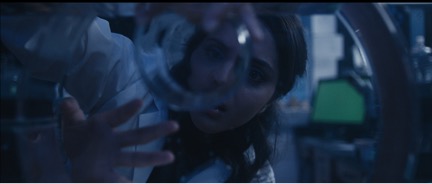
Working on director Amanda Tasse’s Mira, currently in post-production, Ding was given a dual-challenge. First was creating a marine biology research laboratory complete with the appropriate scientific equipment and actual jellyfish tanks. Second, she had to design an intricate “memory wall” which the title character uses to keep a log of her life.

“I had a lot of fun doing the research for this project,” said Ding, who studies every project’s background meticulously to ensure the environment seen on camera is authentic and accurate. “We ended up filming at an empty lab on Catalina Island, and dressing the lab into the jellyfish lab for the story.”

Vanessa Patel as Mira in the lab created by Yihong Ding in "Mira"
Vanessa Patel as Mira in the lab created by Yihong Ding in “Mira”

Filming on an island presented its own challenges. Ding had to personally pack all of the glass tubes and prop equipment by hand, and shipping all of the fragile items to Catalina was expensive and required her to closely observe weight restrictions and eliminate any waste in the budget while maintaining the realistic integrity of the set.

“Finding the jellyfish tank was another challenge. They were all costume-made and very expensive,” she said. “I almost had to build them myself, but luckily we found a person that was willing to rent three to us for a really great deal.”

The experience tested and proved Ding’s invaluable ability to balance the creative and financial sides of production design with aplomb. The laboratory she created is so authentic and convincing it’s absolutely indistinguishable from a research facility one might see at a university. While the lab provides the backdrop, the “memory wall” Ding created gives the viewer a personal connection to Mira’s title character.

The character of Mira suffers from a form of epilepsy that causes intense seizures and short-term memory loss of the hours preceding each attack. Mira dedicates herself to studying a species of jellyfish which may hold a cure for her disease, but her condition poses a huge challenge and she has to find a way to overcome the amnesia. So Ding helped design a “memory wall,” which becomes Mira’s method of constantly reminding herself of what’s happened before each seizure.

“She would take a picture right before she knew she was going to have a seizure… and then she would map out all the pictures on her bedroom wall,” Ding described. “It was a very complicated visual graphic to create, and I wanted to make sure that it looked real… and for the very first time I sat down and considered myself as Mira… I started to think like Mira, which was really amazing, because I found myself digging deeper into the design than I normally do.”

Yihong Ding has what many specialists lack: a multifaceted skillset combined with extensive experience in every level of design and the ability to work within any range of budget without ever compromising the quality of the project. From envisioning the conceptual to building the practical, from dressing sets to arranging the details and minutia for the perfect shot, she is a one-woman creative army.