PACKING A PUNCH ON SCREEN WITH ALYSSA VENIECE

Female action heroes; yes, the time has officially arrived. Between Gal Gadot’s Wonder Woman and Charlize Theron in Atomic Blonde, the age of lead action female star is upon us. There have doubtlessly been those who have preceded them but these two hit films prove that women in these roles are not only equal to their male counterparts but are currently exceeding them in popularity (to say nothing of revenue generating). Assuredly, a host of productions which offer these female alpha types and actress Alyssa Veniece is ready. She’s not just interested in pursuing these types of opportunities, they are her goal. She espouses her love of action films, especially the ones in which the females overcome emotional weaknesses and matters of the heart. As with the aforementioned actions stars, Veniece possesses not only the aesthetic beauty of a lead actress but also the athleticism which is a necessity. It’s the reason that the filmmakers of “My Ex-Ex” cast her in the role of Tina Phung for the film.

In contrast to actresses who prepare a part once they are cast, Alyssa had literally been training for years when she was serendipitously offered the role of Tina. She had been working out at Tommy Chang’s Black Belt World Taekwondo school for a year and a half prior to being offered the role and training in kickboxing and muay thai for seven years before that. Heeding her father’s advice that “success happens when preparation meets opportunity” Veniece has always been driven to make the best of use of time varying her skill set. “My Ex-Ex” was her first project as a stunt actress and first opportunity to play a character who spoke and could also use her fight technique. Tina Phung is fearless and brimming with self-confidence. Reinforcing her father’s words, her work on this film allowed Alyssa to experience what it was like to work as a professional using all the skills she’d developed specifically to land jobs in entertainment, which includes years of acting training. Mirroring the mental state of her character, the experience gave Veniece the confidence to know that she was on the right path and capable of achieving her dreams.

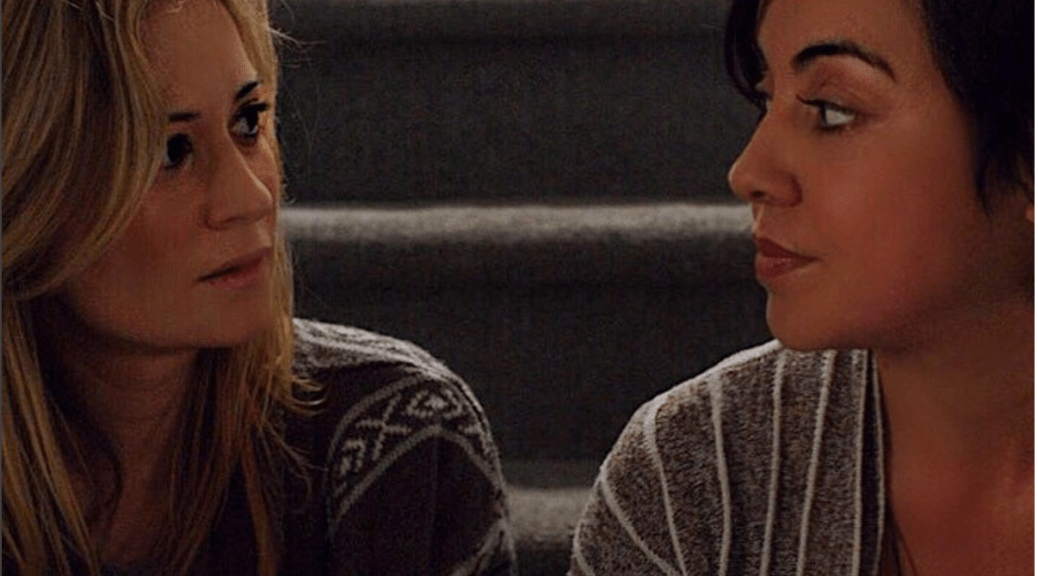
MyExEx_Screenshot1

“My Ex-Ex” is not the typical vehicle for an action role. It’s the tale of a recently-jilted woman (Mary) who has to decide whether to take back the man who dumped her or return to her college boyfriend. When Mary’s boyfriend Ted invites her out to a fancy restaurant she’s convinced he’s going to pop the question but instead of getting hitched, Mary gets dumped. To cheer her up, Mary’s friends take her to see a psychic who casts a spell to reconnect Mary with her ex-boyfriend. The only problem is that Mary didn’t say which one. She bumps into her college boyfriend Patrick, and despite feeling he’s completely wrong for her, she slowly falls for him again. Ted soon realizes his mistake and wants Mary back. Mary is torn between her two exes: Mr. Right on paper, and Mr. Right for her.

Alyssa appears as Tina Phung; a young, fearless, actress and skilled fighter. She is the contrast to the main character when they are both auditioning for a role, however he was not so skilled and definitely more nervous. In one of the most hilarious scenes of the film, these two characters audition for a casting director who asks for a glimpse of the character’s ninja skills. Phung rips off her Adidas tearaways and begins her (actual) fight routine: a mix of punches, spin kicks, and roundhouses. The casting director praises her and then requests the other auditionee to perform the same, which is less than extraordinary. The entire group watches him in disbelief and, in the end, the director awards Tina Phung the role, which she happily accepts while still popping her bubble gum.

Alyssa describes the charismatic Tina Phung as being part herself and part the self she aspires to become. Veniece relates, “I created Tina to be a girl who takes every moment as it comes, every challenge as it comes. She was super confident, uncomplicated, and self-assured in her talents and capabilities. I believed she came from a close-knit family who supported her and had faith that she was a star, so when she entered the audition rooms she already believed she would come out the winner. I’d describe her as a totally un-phased, free-spirit with pretty bad ass martial arts skills. Tina and I are alike in our fearlessness and sense of adventure. We like to push our boundaries and challenge ourselves without worrying about who wants to take our spot. I’d say our style is different. She’s pretty bubbly and a bit unaware of her surroundings, almost in her own happy bubble. Me on the other hand, I’m always aware of who is around me and the vibes they give off. I probably wouldn’t be the one obnoxiously popping my bubble gum in an audition room. Her confidence is quite loudly displayed, and mine is simply internal.”

There’s no danger of Alyssa being a one trick pony/action film based actor. Veniece got her start early on as a bikini model and purposely avoided music video work after she had been cast one too many times as the “hot girl.” These days she has numerous Hollywood blockbusters, commercials, and stunt actor roles to her credits. She readily admits that it’s like a secret hidden power when she is sized up as “just another pretty face” and then demonstrates her agility and fighting skills. She reveals, “It’s show business and you have to let people know all the abilities you bring to the table. If you’ve got it, flaunt it. When I first enrolled at Black Belt World taekwondo school, the owner took note of my skills and was dong fight coordination on the Pacific Rim production filming in Toronto. At the time I had no stunt demo reel, nothing to show for my technique, only modelling photos. He brought me to the set to meet the stunt coordinator, who took one look at the shots and said “Well, she knows how to wear a bikini.” You can imagine my disdain. I never let that happen again.”

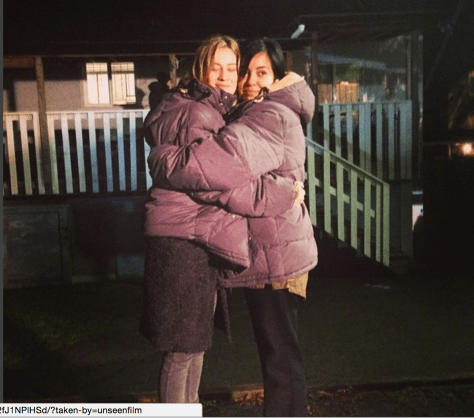
MyExEx_Screenshot2

So what’s the most unexpected secret weapon in her arsenal that she exhibited on “My Ex-Ex”? Veniece declares without hesitation, “I can rip off my tear-away pants like any pro now. It’s pretty impressive.”

Rhythmic gymnast Ana Perez talks National Base Spanish Championship 2015

Ana Perez has always loved rhythmic gymnastics. It was her first love, and she realized it when she was just four years old, growing up in Valencia, Spain. She appreciates every aspect of it, basking in the sense of achievement that comes from having a perfect routine. She loves the concentration of the sport, only having two minutes to make something flawless, knowing even the smallest twitch can throw off everything for the judges. However, what she likes most, are the hours spent training, knowing she is fighting for a dream. She felt this when she was a competitive athlete for twelve years, and now, she feels it as a coach.

Working with many top athletes, Perez quickly became recognized as one of Spain’s best rhythmic gymnastics coaches at the age of sixteen. Ten years have gone by, and her reputation is known, not just in her native country, but around the world in her sport. She has won championships and trained the best, sharing her experience with beginners and shaping them into professionals. In 2015, this is just what she did for her winning team at the National Base Spanish Championship with her club, Club Morvedre.

“When I saw the result on the screen of the ranking and saw that Club Morvedre was the first, we were calm, since there were some teams to compete, but when the category ended and Morvedre was first in the National Base Championship in the Juvenile category, we embraced the technical team and the gymnasts who make up the whole and we were excited. At that moment, we felt very proud, because it was a dream that we had finally achieved. At other times, we had not had good days of competition and at last here we had performed a perfect exercise,” Perez described.

Every November, this Championship occurs, where 16 teams of each category come from all the communities. This Championship of Spain Base level corresponds to the second highest level that Spain has, only ahead is the Absolute level. It is a competition that allows gymnasts to be evaluated on their level, where they can take a step forward in the rankings. It is one of the most vital competitions for the athletes in the country.

“I love being able to teach gymnasts, transmitting the values of sport, competition, discipline, companionship and self-improvement that are essential to rhythmic gymnastics. Even more importantly, about the relationship between a gymnast and her coach. A good relationship leads to the achievement of results. There is a very strong relationship between myself, as a coach, and this youth team, as performers. Our mutual work has allowed us to obtain the best result that we could achieve,” said Perez.

As a coach, Perez helped to make the corrections and modify those parts of the choreography that did not work well. Thanks to these corrections, the team were classified in the autonomic phase for the National Base Spanish Championship, in Zaragoza, and were champions of Spain in the Young Category.

“Ana worked closely on the project where we managed to help the youth team win first place in the Spanish Championship. She is an excellent co-worker and a good support in the hardest moments or, better said, in the most stressful moments as well as in the happiest ones. She always tries to look for the best for the Morvedre club, and she gives it her all. She is ferociously committed to her work. I have worked with her for a long time and she has taught me many things, among which I emphasize commitment, discipline and comradeship,” said Alicia Gaspar, Perez’s fellow coach.

When preparing the team for the competition, Perez worked on the warm-ups, handling of the ribbon, and the physical preparation required for competition, as the gymnasts needed to be in the proper physical condition at the required level of competition. This sport is about sets of repetitions of the choreographies prepared by the trainers so that the exercise is successfully performed. They trained in the summer, preparing the choreography with the music. They trained three hours a day, five days a week, making sure every detail was ironed-out.

“My contribution has been to give my best to bring about the best result, both in the editing and in the choice of music. I have given them the commitment and the confidence to be able to get the result obtained. I find this to be an essential element to coaching any sport, both when it comes to training and when it comes to competing. The instructions are key, as well as the part that the athlete plays,” said Perez.

Some parts of the choreography originally did not go as planned, as the apparatuses fell and the gymnasts became nervous. Perez then decided to make it easier for some pitches, so gymnasts felt safer with their choreography. That is essential when it comes to competing, because gymnasts should be comfortable with their exercises. Without Perez, the team could never have achieved what they did, and this was acknowledged by all who witnessed the team’s results.

“As president of the Morvedre Club where Ana has been working for more than ten years, I have to thank her for everything she does: for being part of my team of coaches, for the great work done season after season at all levels and for her results obtained. But above all, I have to thank her for creating the good atmosphere of fellowship between coaches, parents and gymnasts, as well as the excellent preparation of the gymnasts that led to one of the competitions in which more than 100 gymnasts competed, getting to be among the best,” said Luis Marín.

Needless to say, Perez’s commitment to coaching is greatly appreciated by all.

Videographer and video editor Maria Aguado had “the courage to pursue her dream”

“All of our dreams come true if we have the courage to pursue them.” Maria Aguado wrote this to herself at the beginning of her career. At the time, she was just a girl from Barcelona with big dreams; she wanted to make films. Throughout her life, Aguado never stopped believing she was meant to be behind a camera, and this belief became her mantra. Now, she is one of Spain’s best videographers and video editors, and her faith to overcome any obstacle has contributed greatly to her acclaim.

Throughout her career, Aguado has shown international audiences what she is capable of with a series of celebrated projects. She worked with high-profile fashion designers Claudia Morera and Carlota Cahis, the popular shoe brand Alvarez & Moixonet, the fashion company Brownie, the iconic fitness brand Les Mills, and the eclectic Spanish shop Button Barcelona. She worked with the advertising company Puente Aereo helped the company gain new clients, her videos for the magician Nilo with MCN Magic helped put the magician on the map, and just this year, she worked with the fitness company Human Body Experience to create outstanding informational videos for consumers. Her work in both filming and editing has impressed many, and her passion for what she does inspires others.

“As editors, having another point of view is basic. Working together gives us the opportunity to fusion our minds and obtain the best results. Maria brings a very creative perspective to every project. She is very hard working and has a huge knowledge as an editor. Working with her is a pleasure,” said fellow editor Felipe Bravo.

Bravo is a well-known editor in Barcelona, and has worked alongside Aguado many times.  The two immediately connected because of their shared passion for film, and make quote the team. Last year, they worked on the award-winning short Happy Burger, a project that Aguado thinks of fondly.

“I love the feeling of being emerged. While I film or edit everything else disappears,” said Aguado. “I create a world that is later shown to an audience to express a feeling, a concept or an idea. Since the age of seven, I filmed my dolls, edited my films and wrote screenplays without being aware of what I was doing. I grew up with a camera.”

Aguado’s first job was years ago, working as a film editor for Puente Aéreo, an advertisement company. Just beginning, it helped the now esteemed filmmaker learn a lot about advertising and editing ads for television. Since that time, she has worked for countless brands. After Puente Aéreo, she moved on to working for the interactive party platform Get Wasted Events. She was ready for a new experience, and it was there was she learned exactly what style she enjoyed that has now become her signature.

“I always film with a bit of camera movement. My shots are not static and I use a lot of close ups. While filming I try to forget everything I’ve ever seen and have a new vision in each project. I play while I am filming, I don’t see it as a job. I also edit in my head while filming, I know which shot will go next to the other, it’s like building up a story,” said Aguado.

Aguado’s first time working with the fashion industry was with Carlota Cahis, a well-known designer of jewelry and clothes. By this time, Aguado already had an outstanding reputation, and the firm contacted her to film and edit Cahis’ fashion show. Cahis was instantly impressed, and contacted Aguado many times after this to shoot for her. Quickly, other designers began to notice her and to seek the videographer out. She did several fashion videos for fashion designers such as Mercedes Arnus in her “Pure White” Collection and Claudia Morera’s brand, selected in 080 Fashion Week Catwalk Barcelona.

“I’ve always known this is what I wanted to do. I grew up playing with a camera. This is what I’ve always done. Filming and creating is a huge part of me. Without filming and editing I wouldn’t be able to fully express myself,” said Aguado.

Not only does Aguado excel with advertising and fashion videos, she is highly experienced in film. She worked with director Max Larruy on the film Caperucita Roja, and later worked on the feature film Barcelona Nit destiu. She has an extraordinarily artistic eye whilst looking through a lens, and her editing experience helps her know exactly how to frame a shot. She also edits films, such as the short Blanco Roto by Director Belen Reina.

“Creating movies is a way to believe in the magic of life. It is a way to experience different lives. It is a way to be a part of new stories and experience another point of view. It is a way to make people feel, know, and experience new emotions, new ideas! It is a way to express the parts most inside of your soul, and surprise yourself in the process by opening your mind to new perspectives. It is a way to make your dreams come true while you show them to the world. Making cinema is the same as travelling around your dreams. Making movies is not letting the child you’ve got inside to die. It is a game. Being able to make cinema is a good reason to be alive,” concluded Aguado.

AVI AGARWAL’S COMMITMENT TO LOOSE ENDS

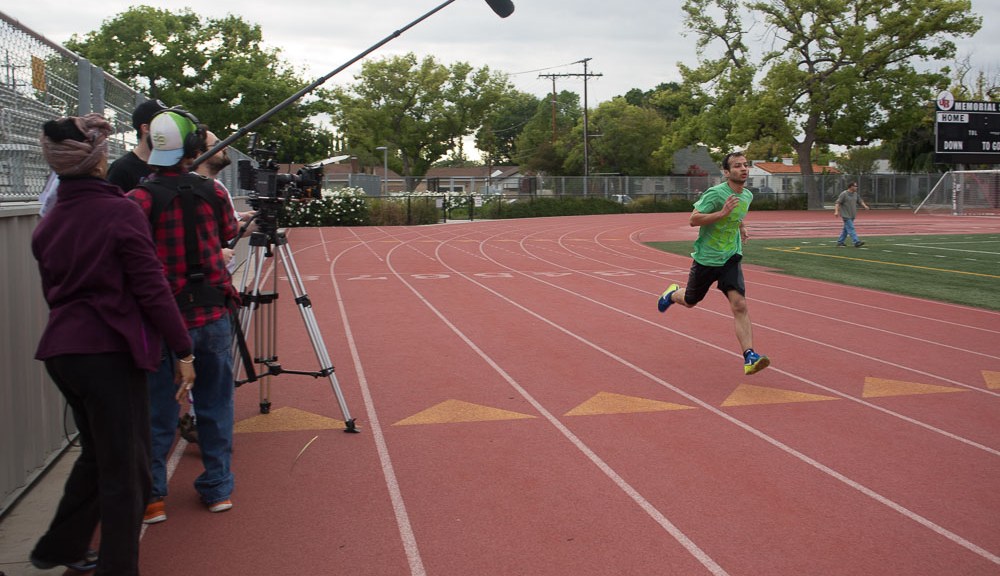
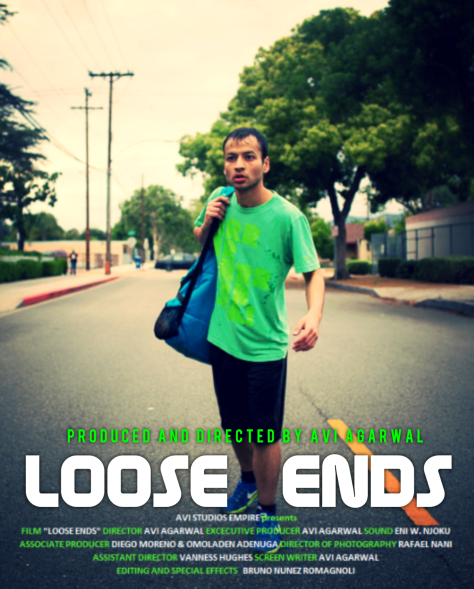
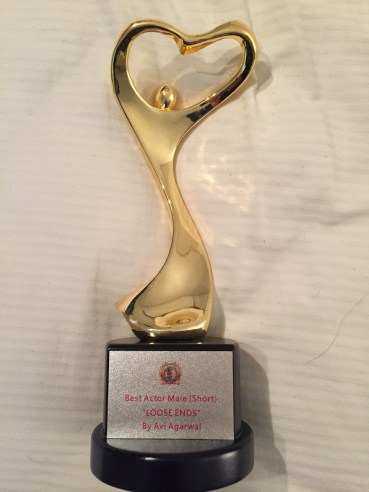
Avi Agarwal has received resounding accolades for his comedic performances in films like “Cowboys” but in “Loose Ends” he delivers a serious performance with gravitas (for which he was awarded the BEST ACTOR MALE at the Hollywood Boulevard Film Festival, CA. September 2016).  “Loose Ends” literally portrays an experience that many of us have likely had inside our own minds. Almost everyone has that “tipping point” in life in which they see that they can either focus on something that will add positively to their life or negatively. It might be a relationship, a career choice, or simply a pattern of behavior that will lead to a peaceful or tumultuous existence. In the film “Loos Ends” Avi Agarwal becomes a proxy for the audience, considering the many decisions available and how they will manifest his future.

LOOSE ENDS 5 png

Agarwal is known for his physicality and intense discipline in approaching roles. The film’s cinematographer Rafael Nani notes, “It’s easy to see the talent of Avi in front and behind the camera. What most people can’t see is his tremendous dedication and passion for his job and his art. A serious hard worker who never gives up before getting the best, Avi is an example to the other professionals around him that greatness requires immense dedication. It was an honor work with him in ‘Loose Ends’ and it’s always a pleasure work to with him. Avi Agarwal is an artist who makes you want to do your best, and who you can always learn from.”

Avi’s physical dedication to the role came long before anyone arrived on set or began filming. In preparation for playing a college student, the actor’s training required a lean and in-shape build. Among his many means of training was an eighteen miles per week running requirement to sculpt the svelte appearance of a man this age. It’s a combination of mental, physical, and artistic purpose that drives Agarwal as he relates, “I show this intensity for every role I take. Sometimes I’m not able to get enough time but I work with whatever time frame I am given to make sure the results are visible.  Every day, I used those voices in my mind of people demoralizing me saying ‘You can’t do it’ on the track to make sure I kept running. I basically used the negativity to my advantage and turned it into a positive. It really motivated me. Although I have nothing against the people who did not believe in me because I know they had the best interest at heart for me but, as an actor I used whatever I could find to become Sid. I take this approach since the change in my appearance definitely changes the way an audience see me in ‘reel’ life compared to me in my real life.”LOOSE ENDS 4

“Loose Ends” was screened in December at the Mumbai Shorts International Film Festival in 2016 where it was recognized with the “SPECIAL FESTIVAL MENTION.” Agarwal appears as the main character, Sid, in the story that is a cautionary tale depicting one man exploring his potential for good and bad. Sid is an affable guy but a habitual partier and slacker. As a college student, he often ditches class due to hangovers or simple laziness. When he does attend, he is ill prepared and mocks those who are serious. His support system of friends enables this behavior and embraces him as their “always ready for a good time friend.” Sid begins to have visions of himself in the future leading the lives of others whom he feels likely lacked the focus and self-discipline that he does. Walking about in his everyday life he sees his own face in that of the alcoholic janitor, as a menacing felon on a wanted poster, and many less desirable life pursuits. In a course of “Rocky” determination, Sid begins applying himself, both figuratively and literally cleaning up his life.LOOSE ENDS 7

The role and the schedule required Avi to access and convey such a wide variety of emotions that it was immensely taxing. So what’s the secret ingredient that allowed him to do all of this so effectively? For this actor it’s a combination of the Meisner and Chekhov techniques. He elucidates, “The role of Sid required different emotions such as, happy, sad, angry, lost, confused, uncomfortable, disturbed, hurt, frustrated, awkward, dismayed, ignorant, concerned and hopeful. There were times when I had to switch from different emotional states instantly in order to deliver the performance. I used the Meisner and Chekhov techniques in order to bounce off from one emotion to another. For example, I had just finished shooting a very emotionally challenging scene and right after that I had to shoot a happy party scene, I used Chekhov and started throwing my hands and legs at different places at fast pace, to loosen the nerves and let the heavy emotion drain from my body. I had discovered in Chekhov how the body movement and image has effect over our emotions. In my opinion, a technique is best implied when you use it but is not shown on screen. People who have studied Meisner sometimes know when on screen the actor has used it to make it look authentic on screen. I use Meisner and then combine it with other techniques such as Chekov to find the character. The difference being Chekov mainly focuses on attaining emotions through physicality of the character. However, Meisner mainly focuses on emotions so to find the characters posture I use Chekov. The combination of both has so far really helped me in making my characters more memorable ones.”LOOSE ENDS 6

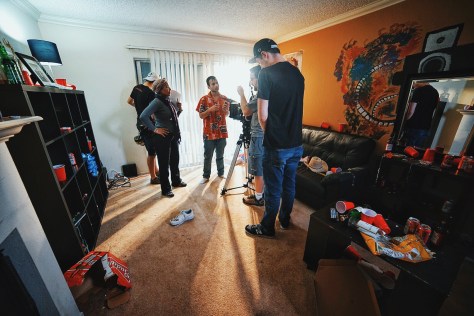
“Loose Ends” required a great deal from Agarwal and he confirms that he learned just as much from doing it. In what might be one of the most important lessons for this diverse, talented, and educated actor, his experience of intent that fell short revealed a truth to him. During the filming of a scene in which Sid sees himself as a down on his luck homeless man, the makeup artist was nowhere to be found. With the pressure of an extremely tight filming schedule, Avi improvised and grabbed a handful of actual mud from the street, smearing it on his face. To his surprise, his great overture of actual mud was not even visible on screen, yet his frustration shown through as the character. The moral; you never know what truly works until you see it onscreen.

XING-MAI DENG VISUALIZES THE FEELINGS OF A NEW WAY OF WAR

Artists often bring up ideas that we may or may not agree with but it is important to see things from differing viewpoints. The artistic mindset is about the freedom to express ideas; they might be truth or they might just be opinion but in a well-balanced society it’s important to have all ideas heard and then weighed out. Whatever your opinion is on any particular subject, there is someone who disagrees with you, and that person should be important to you. By presenting an argument that challenges your belief, you either become more committed or you reassess; either way, this person has done you a favor. Artists of many different mediums have challenged our thinking for eons. Filmmakers like Xing-Mai Deng are simply the newest manifestation of this. As a cinematographer, Deng is the modern day painter with film and digital images as his canvas. The way the visuals appear in the Drama/Thriller “Drone” (2015) affects the viewers’ attitude towards one of the most modern approaches in warfare in an almost imperceptible manner, but achieves the desired emotional impact. It was for this very reason that producer Abi Corbin sought out Xing-Mai and persuaded him to take on the project.

1660814_10152005791207615_847302355_n

“Drone” appears at first to be a film about the military when in fact, it is about humanity. It was his own personal experience with these two factors that actually convinced Deng that he wanted to be a part of this film. He explains, “Before working on the project, I happened to know a few people who were working on developing treatments for veterans with PTSD. Among them, the air force veterans were the majority and most of them were military drone pilots. Through my friends, I learned that even though the drone pilots did not see their enemies and the actual battles, they had a higher chance on incidence of PTSD because of their working schedule and the suppression of sleep. I knew what the pilots were going through. I invited my friends to the screening of the completed film and they all felt that the film was a realistic portrait of a drone pilot’s life.”

“Drone” is a story about a rookie air force drone pilot who finds himself increasingly attached to a target as he watches from halfway around the world. As a newly minted drone pilot, Matt (played by Daniel Sharman) enthusiastically flies his first stalk and kill mission, unconcerned that he knows nothing about the enemy target in his crosshairs. As the hours of surveillance turn into days, then a week, he finds it increasingly difficult to see the target as a mere white dot on the screen. When the strike order finally arrives, Matt must face the very real person behind the pixelated image.

Making any film is not as simple as displaying the actions of the characters onscreen. A story that concentrates so intensely on the emotional inner conflict of the main character requires a great deal of planning and expertise on the part of a DOP to properly convey this emotional turmoil. The subtlest of changes can achieve substantial returns in eliciting the proper response from a viewer. Deng prepared his concept in terms of the tone and the look before meeting with “Drone” writer Tony Rettenmaier to present these two different worlds he had created. Lighting in particular was key for this film as Xing explains, “When Matt is alone, his life is not fulfilling to him. To achieve the lonely feeling for the audience, we made sure the lighting on him is half a stop darker. It appears as if his life is always one shade darker than the rest of the world. And when Matt was doubting his world, we used a lot of close-up shots with a wide-angle lens on Matt to bring out the emotion. We placed the actor very close to the lens so he got distorted by the wide-angle lens, while other actions are happening in the background. After the strike, Matt was crushed by what he did. We placed him further away from the camera, using a longer telephoto lens to compress the background just to show how small he is compared to the world he is doubting.” He continues, “Most of the scenes were in the cockpit. We did research on what a real drone cockpit looked like. It was actually very different from what we imagined. In reality, the pilots were operating the drones flying on the other side of the planet, so they usually work during the night. In order to keep the pilots awake, the cockpit was usually lit with bright fluorescent lights. It is very bright and flat. We wanted the scenes to look interesting so we decided to use minimal lighting fixture to achieve the dark and dramatic look. The production built this on a stage so I had total control of the lighting. Most of the lighting was motivated from the monitors in the rack in front of the two pilots with cold colors. That was a very planned out cinematographic choice.”

1901350_10151906724721010_457869631_n

The manner in which the characters and their surroundings are framed is exceptional in communicating what they are feeling. Whether it be of a claustrophobic nature or the insignificance of being miniscule in an open space, the viewer feels the impact of this perspective. The short, cutty, and lock-off shots of the main character early in the film contrast with later long moving shots to show the internal struggle of the character and the tension of the situation when Matt must decide to pull the trigger during the strike. We immediately understand the tunnel vision and comprehend that time is slowing down for this drone pilot. During the final sequence of the film as Hunter (played by Michael Trucco) tells Matt about his own story, the extreme-wide shot inside the drone hanger with a military drone in the foreground and the rusty roof on top depicts how small they are compared to the world of drone warfare. The metaphor relates that this kind of story happens every day.

IMG_2360

One added benefit for Deng working on this film was an association with the famed Industrial Light and Magic who had allowed the production to use their drone model in conjunction with green screen shots. The investment was obviously well placed as Deng and his crew achieved a nomination for Outstanding Achievement in Cinematography (2015 First Film Festival) as numerous awards from others such as the DisOrient Asian American Film Festival, Phoenix Film Festival and numerous others. While these accolades were appreciated by Xing, he reiterates that his connection to the veterans who have been in these situations and the positive response which he received that “Drone” accurately and honestly portrays the experience of these men and women means that his highest goal was achieved.

YOU CAN’T TAKE YOUR EYES OFF ALSION ARAYA IN THE UNSEEN

Faust has been the inspiration for countless films about those who make a pact with the devil to get exactly what they want but end up making a great sacrifice for their gains. There’s always a loophole “gotcha” moment. While this has nothing to do with the theme of the movie The Unseen it might be found in the story of one of the film’s stars Alison Araya. If the actress were to design an ideal situation for herself, it would be The Unseen. While Araya has made numerous appearances in blockbuster films like X-Men Origins: Wolverine and Watchmen (and many others), this was her first major role. Alison’s portrayal of the fearless Moll who is involved in a same sex relationship drew great praise from critics. She even got to act opposite one of her adolescent crushes (Aden Young as Bob Langmore) in one of the film’s most climactic and prominent scenes. Everything was perfect except…wait for the twist…The Unseen is an action/sci-fi/horror story and Araya is one of the most squeamish individuals on the planet. A self-described chicken who can’t make it through the horror film trailers at a movie theater, the actress found herself in a perfect environment save the very premise of the film. With no way out of it and too much to lose by passing on The Unseen, Araya bit the bullet and accepted the role as Moll. Alison and the entire audience benefitted from this decision. The film itself was a resounding hit whose recognitions include: two Canadian Screen Awards nominations, eight Leo Awards nominations, selection of the Molins de Rei Horror Film Festival and Vancouver Film Critics Circle, and wins at the Other Worlds Austion SciFi Film Festival, Molins de Rei Horror Film Festival, and others.Screen Shot 2017-07-03 at 3.31.23 PM

While The Unseen is based on the lore of The Invisible Man, it’s a very different and unique take. Writer/director Geoff Redknap didn’t want to update the already familiar story with new actors and VFX; he wanted to create an entirely different focus. The Unseen dissects the idea of how this fantastic situation would affect the family of the person in this very odd circumstance. The inclusion of an ex-spouse, children, extended family members, etc. is similar to looking at a 3-D picture where your eyes cross and present a totally new subject…one which was previously invisible. The character Moll is the partner of Darlene, ex-wife of Bob who has literally disappeared. She is stepmother to Eva, Bob and Darlene’s daughter and has become fiercely protective of her new family, particularly when it comes to Bob. The actress portraying Moll would need to be both fierce and tender. Redknap stipulates, “Alison stood out during the audition process. She was fierce but what captured our attention was the vulnerability she bought to the role. She could have easily played a mere foil to her step-daughter but instead Alison’s multi-layered performance brought a greater depth to her own and the other actors’ performances. Alison was not afraid to go head to head with Aden Young and they created one of the most climactic scenes in the film. We knew we ‘got it’ when the air felt like it was buzzing with the electricity of the performance Aden and Alison had just given.” Producer Katie Weekly confirms, “It was important to find an actress who could carry the gravitas of Moll. We were looking for a dynamic and strong actress who could also play the vulnerability of the character. Alison bought nuance and passion to the role and really made it her own. A different actress might have played Moll as ‘the bad guy’ but Alison brought such life to the character that her transition from the beginning to end of the movie was much more satisfying.”

Moll could have been presented in a variety of ways; it was this fiercely loyal woman who protects her family and her partner that attracted Alison to the role. Moll is deeply in love with Darlene (played by Camille Sullivan) and has completely bonded with and come to love Darlene’s daughter Eva (played by Julia Sarah Stone) from Darlene’s previous relationship with Bob as her own. Being the woman in Darlene’s life, Moll has a chip on her shoulder when it comes to Bob. A drifter and absent father, Moll has seen firsthand the pain Bob has caused and will stop at nothing to protect the family she calls her own. Moll is stunned when she discovers that Bob is back in town and Eva is missing. Suspicious of Bob and the company he keeps, she pursues the truth and the two. When Moll is finally let in on the family secret, she is able to make peace with the relationship Bob and Darlene will always share and relaxes with her place in Darlene’s life knowing there are no secrets. The story is family drama with a very substantial secret ingredient.

Screen Shot 2017-07-03 at 3.34.53 PM

In one of the film’s most intense scenes, Alison was called upon to do something that has been common place for her in numerous productions, exhibit the signs of seeing something that wasn’t there; which is both literal and figurative when you are in a movie about an invisible man. She recalls her process noting, “I remember struggling with that particular moment in the film, when I had to react to seeing something shocking and new to me. I remember trying to figure it out intellectually and I wasn’t getting anywhere. Then I just closed my eyes and visualized what was in front of me. Immediately my body reacted and I understood on a visceral level what was real for me. I love moments like that because we don’t always have it worked out in advance. Some moments stump me and they challenge me to look deeper into my tool belt or think outside of the box. There is no one path to the truth of the moment, there are infinite paths it’s a matter of knowing which one to follow on any given day.” One thing Araya wasn’t confused about was working with her co-star Aden Young. She admits, “Working with Aden was a career highlight for me! I was a huge fan growing up in Australia; Aden has always been on my radar. I had a huge crush on him after watching “Black Robe” and when I saw his name on the cast list, I could hardly believe it. Aden was so generous and really invited me to get inside the ring with him and go for it…and we did! It was exhilarating and scary and live. It was incredibly fulfilling and I hope to have many more moments on set just like that. I held it together and kept it very professional but there was a younger version of me inside that was going crazy with excitement.”

boudoir shoot 2014 014

The Unseen as a film is contradictory; not in the sense that it doesn’t line up in terms of story or production but rather that this movie about the unseen is made so believable by what is seen. It’s not overuse of VFX or trickery that makes it compelling, it’s the performances of Alison and her cast that pull us into believing this very fantastic situation is as real as any discomfort a non-nuclear family experiences. The filmmakers ask us as the audience to buy into quite a bit and it’s the performances onscreen that make it much easier to be at ease with and suspend our view of reality. What is seen in The Unseen looks very good.

SIMULACRUM’S ENIGMATIC SARAH FAY

Sarah Fay has always enjoyed the inner game of acting. This idea that only the actor (and the director) truly know the character, rather than laying everything out for the audience in an easily digestible manner; it’s something that has shaped many of her roles. For someone of artistic temperament, the less obvious choices make for a more engaging experience, on the part of the viewer. This is a premise that Fay has always admired whether she is an audience member or a participant in the story. She notes that her early experience acting in the film Simulacrum (which received the Norman Jewison Filmmaker Award) was instrumental in her appreciation of the subtleties possible in character presentation. A sociological sci-fi tale, Simulacrum presents many of the ways in which technology affects our culture and relationships. Although set in an alternate reality, many of the ideas presented more than fifteen years ago, are coming of age in modern society. While the overall theme questions mankind’s use of biotechnology, Fay’s stand out role gives a glimpse into the complexity that she would bring to following productions.

In a very clever manner, Simulacrum presents the possibilities of our own world, by presenting the events in one, which we feel could not exist. Asking the audience to suspend their sense of reality, immediately disarms them into accepting any possibilities. The story takes place in a pre-apocalyptic Soviet world. Dallas is a young technician who has a clone (common place in this futuristic society) who seeks her assistance. The clone needs her to help with a government test because the two share the same DNA. What unfolds is a story of deceit, governmental constriction/abuse which eventually sees Dallas fleeing for her freedom. At the heart of the story is the question “What is identity? What is self?”, and the answer is not easily defined for the viewer.

Screen Shot 2017-08-01 at 7.36.33 AM

Perhaps the most interesting aspect of the film is that the lines between right and wrong are not presented in a clearly defined manner. The living embodiment of this, in the film, is Sarah’s character who, in congruent fashion, is known only as “Taxi Driver”. This only enhances the mystery and mystique of this pivotal character in Dallas’s search for truth and resolution. Fay so convincingly plays the unknown intentions of the character, who is both taxi driver and either governmental agent or agent of freedom, that viewers of the film differ in their conclusion of her motives. Sarah remarks, “An actor must always make clear, defined choices within themselves. I knew who I was and why, as the Taxi Driver and that was decided with the Director and in my own creative discovery. I don’t see a duplicitous character as undefined. Both types of characters have an alliance to themselves. A good wholesome character has an alliance to themselves and their belief in good, truth, and love. They act with those motivations. An evil character has less honorable motivations but is still true to themselves. They may not have a moral compass but they will defend their actions. A duplicitous character will flow with the wind but still remain true to their own survival and their self- alliance. Both the audience and society like to label. I think part of the joy of acting, for me, is discovering the true gray area of human existence, in different circumstances. The more layers you have as a character, the more real you are, the less you fully fit into a label of completely one way or another. Either way a character must have consistency to be connected to and duplicitous characters have that too.”

Screen Shot 2017-08-01 at 7.36.47 AM

A role like this is intriguing for any actor, but can only be presented as such when the director also sees the potential for the role. Sarah worked extensively with Director Anita Doran to present this character in terms of dialogue and physicality to create the mystery that made her so fascinating. Doran saw a quality in Fay from the very beginning and notes, “I hired Sarah for the film because I saw a lot of stand-out qualities in her audition. She took great care to understand her character with a depth that many others would miss. Sarah was precise and concentrated, revealing a dedication to craft that has only grown since this early state. Once on the set, she was generous with her creativity and a consummate professional. I’ve rarely seen an actor throw themselves so deeply into a role. She had immense commitment and made it her responsibility to add as much as she could to the overall quality of the film, and I think the end product is exponentially better thanks to her presence.” Fay confirms that this is her normal approach. Her intense discipline and dedication has served her well since this early experience. Contrary to being restricting or overwhelming, she finds this intensity frees her in roles and allows for less thinking and more feeling. These days, as an LA resident she finds that this mindset is expected in an entertainment centered city. Sarah states, “I’m pretty obsessive and singular in my focus and strive for success, but it makes me happy. To be in L.A. doing this, I am living my dream. In terms of the others in my life, everyone knows if I have an audition…I’m going to need to cancel with them. That’s part of the thing I love about living in LA. It’s an actor and industry town. People understand and we are all here to succeed, so they get it. All the people in my life get it. In Toronto, I experienced a little more frustration and eye rolling. I’d hear, ‘No really, when are you going to give it up and find something stable?” a lot more. That just doesn’t happen in LA. The key to life is finding a place where you fit in and I feel like I’ve found it here.  I am working on filming ‘CON’, a great film that is also going to be a series, with Oscar nominated producer Joseph Wesley Adams and I just got a couple new roles I am overjoyed about. When you work towards a goal your entire life and people see it as a positive rather than negative, it makes you feel that you finally fit in. Taking chances like I took in Simulacrum were part of the journey that got me here.”

Art Director Ji Young is vital to success of new film ‘The Sacred Mushroom Edition’

“There are few films that show how much the art department pays attention to details. In the film Room, the art department team studied the sun’s movement and bleached the part of the wall where the sunlight comes through the shed’s skylight and hits. They believed most of the objects inside the room should have some sort of stories because the five-year-old main character personifies every object. In Danish Girl, the set starts with the gloomy grey bedroom in Copenhagen where the main character couldn’t find his real identity, and then it shifts to a colorful room with beautiful floral pattern wall and Art Nouveau style architecture in Paris where he finds his real identity as a woman and starts blooming. I love art directors who are storytellers, who transfer the words into imagery by conceptualizing, using imagination, and creating the mood with emotion, style, and feeling,” said Young.

When Ji Young Lee talks about what it is to be an art director, one immediately understands that this is someone who not only loves what they do, but someone who appreciates every intricacy of their craft so fully that their passion and commitment are unrivaled. Young wanted to be an art director because she wanted to create a world that affects people who are watching the film; she thought it was fascinating that she could make the background world that helps people believe the story, whether it is real or fantasy. This is exactly what she does, and this vision is evident on every film that features her name in its credits. Director Ryan Betshart says without Young, he would not have the success he does today.

“Ji was my art director for two projects, the first being Paper Chase, a music video that has played Ann Arbor Film festival, which was a highlight of my career. Ji did so well and was so exciting and thoughtful to work with that I hired her for my next short film The Sacred Mushroom Edition,” said Betshart. “Working with Ji helped my career so much so that I intend on hiring her again on all my future projects. Her attention to detail is second to none – no one has an eye for set design like her – meticulous yet on budget and fast, a true professional. Her communication with the other departments, as well as with her own crew is clear and effective in ways I have rarely seen on set. Things get done, and so quickly and quietly one would think magic was being used to make everything perfect. Does this make Ji a magician? Does she have magical powers like a sorcerer? I’d say yes. Everyone on set respects her. The actors love her. She is the first to show up and the last to leave. I wish I had met her sooner, my previous films would all have done much better!”

Such accolades, although flattering, are not what keeps Young going. For her, it is all about her work. The Sacred Mushroom Edition is at the beginning of its festival route, and has already seen tremendous success. It premiered at Portland Underground Film Festival on April 9, followed by the prestigious Mammoth Lakes Film Festival on May 25, the Moviate Underground Film Festival in Pennsylvania on May 28, and internationally at Winnipeg Underground Film Festival in Canada on June 1. None of this could have been possible without Young’s artistic eye, and yet, she remains humble.

“It feels very surreal and exciting to have the film be doing so well. I don’t know much about experimental films, so I had no idea what kind of films our film was going to get chosen with for the festival. I’m just very glad that now I got some experiences in experimental film, which was the world that I never got to explore before and got these great festival opportunities by working with my great friends,” said Young.

The Sacred Mushroom Edition is an ode to the 1978 version of Kenneth Anger’s film Inauguration of the Pleasure Dome and its peculiar use of Electric Light Orchestra’s album ‘El Dorado’ over images of a ritual orgy between gods. The Sacred Mushroom Edition finds two fallen angels arguing over ELO and their lead singer Jeff Lynne’s affiliated super group The Traveling Wilburys – and his connection to the dark side.

“I watched the original film and loved how stylized the set design was. It was visually stunning and very artistic. Most of the films I’ve worked on wanted the art department team to stick to what’s exactly written in the script in terms of creating the set, but Ryan loved to hear about team members’ interpretation on the script and discuss with them which sometimes led to something unexpected. This film helped me to use more imagination and understand sometimes the filmmaking is less about form or content than it is about context,” said Young.

Although Paper Chase was a music video that focused on more digital manipulation of the video with a minimum set, The Sacred Mushroom Edition was the exact opposite. The film required two different sets, with strong contrasts between the two. The film starts in a backyard, and then it transitions into a darkroom. For the backyard, Young made some colorful choices for the set dressing, because she wanted to create brightness and lightness. For the dark room, she wanted to create some intimate, gruesome and cluttered environment, and therefore put different materials and furniture that had great textures for the set dressing.

“As this film is an experimental film, what it says is very abstract and poetic. The good part is it’s very artistic and unique film, but it could be difficult to understand for the audiences who used to watch the traditional narrative films. Therefore, my job was to provide some sort of device that would allow the audience to connect themselves with the film, so they don’t feel total alienation,” said Young.

There is little doubt as to why Young is considered one of Korea’s best recent art directors, and even less doubt that we will continue to see her name attached to many high-profile l films for years to come.

Musician Jose Roman captures the feelings of film ‘30 Days with My Brother’ in song

premier 30 days
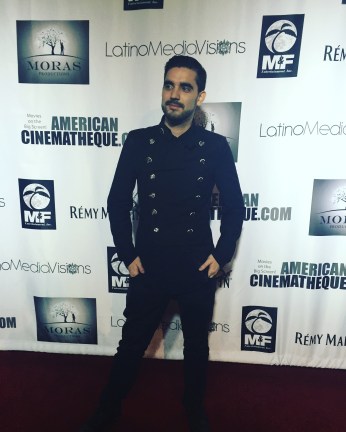
Jose Roman at the premiere of 30 Days with My Brother

When Jose Roman thinks of his childhood, growing up in Quito, Ecuador, he recalls being exposed to a great variety of different music genres, artists and styles. As far back as he can remember, his dad would play him classical music, from Bach to Chopin. His mother, a self-taught pianist, inspired him to try playing the electric organ in his house. Later, when his parents purchased an acoustic piano, Roman experienced for the first time, the sensation of falling in love. He knew, no matter where life took him, the piano would be his driving force, and now at 27 years old, this remains his truth.

Roman has become an internationally successful musician, gaining fame as a member of the rock band Daphne’s Roots. He has always been a strong composer, writing hit songs and catchy melodies. His keyboard skills are instantly identifiable on a track, and his classical roots are an evident source of inspiration, no matter what genre he is playing.

“As my musical background grew while I aged, I listened to more keyboard driven bands such as Deep Purple, Pink Floyd, Queen and Dream Theater, just to name a few, the transition to play the keyboards was a given. My love for music was then solidified,” he said. “But now, I always try bending different flavours in my playing from my classical roots to blues, rock and even some electronic music.”

Despite his success with Daphne’s Roots, Roman’s versatility lends itself to all mediums, from accompanying individual artists, such as Sahandra Sundstrom’s Thinkin’ Out Loud, and even films. The 2016 drama 30 Days with My Brother, features an original song accompanied by Roman, as the producer Omar Mora, had heard the pianist’s previous work and knew he needed him to be a part of the music department.

“Once I heard how the concept of the song related to the movie, I knew exactly what I needed to do in order to make a top quality compelling work as a keyboardist. I realized that the style of the song was right on my ally. I was very inspired the whole time I was working on my keyboards part and I felt very comfortable doing it. I really liked the song so working on it was very pleasing and the keyboard arrangements came to me very naturally,” Roman described.

The song titled “Never Too Late” was written by Andrea Sandoval, the singer. When Roman started working on the track, the melody and basic structure were already taken care of, so his job was to enhance the harmony, write and perform all the keyboard parts. The song was mainly piano and vocals driven with some strings arrangement that Roman also wrote and recorded. It was vital to the film’s story and the film’s success.

“When I first heard about this movie I was immediately fascinated by how original and interesting the plot was. Then when I was asked to be part of the music department and record and arrange the keyboard part for the main song featured in the movie I was very excited. It was a no brainer for me since I love to collaborate with these amazing talents. When I heard the demo of the song and how it relates to the film I knew this was an amazing opportunity to create something memorable,” he said.

With a 92 per cent on Rotten Tomatoes and a 5-star rating on Fandango, 30 Days With my Brother has resonated with audiences. It tells the story of Alexis and Jonathan, two brothers from Puerto Rico that were separated after a terrible family tragedy. After 17 years, Alexis has become a doctor while Jonathan has become entangled with a dangerous group of people. One day, suddenly, Alexis packs up his things and moves to Los Angeles on a mission to reconnect with his long-lost brother. The two brothers meet and are forced to face their past, themselves and try to restore the bonds of brotherhood.

“It’s always satisfying to know that good movies are recognized and well received. It is particular rewarding to be part of such an extraordinary project that is highly celebrated. I always knew from the very beginning that 30 Days with My Brother was going to be a great success, since it has heart and top-quality production. I feel honoured to have been part of this project,” said Roman.

After premiering at the famous American Cinematheque’s historic Egyptian Theaterin Hollywood in April of last year, the film was picked up by AMC for national distribution across the United States. The song was essential for the film, and Roman’s contributions greatly affected the feeling, encapsulating the story and the struggles the brothers were going through. The song is piano driven, with intimate vocals. It has a memorable piano hook at the beginning, and a very sensitive keyboard interlude in the middle of the song.

“I believe that the balance between the vocals and piano accompaniment was essential for the song success within in the film. It is a very simple, but at the same time very touching piano ballad,” said Roman.

Producer and writer Omar Mora could not agree more. When he first heard the song, he was ecstatic, giving Roman the confidence to know that they had accomplished something special. Mora was so impressed, in fact, that he asked Roman to work alongside him once again on future projects.

“Jose is very easy to work with, and he is very professional,” said producer Omar Mora.

The next short film Mora is producing, titled White Orchid, is expected to premiere late this year. Audiences once again will be privy to Roman’s original music while watching that film. It is definitely something to look forward to.

JAMES BARNES TRAVELS THE WORLD TO DO GOOD THINGS…WITH A CAMERA.

Director James Barnes has always felt the need to be inspired about the productions he has worked on. Whether documenting ground breaking artists in Abbey Road Studios, capturing some of today’s most famous and influential artists in informal interview settings, Barnes has been closely tied to music for much of his work. His time at UK’s MTV enabled that and he was compelled to use this to altruistic ends for the TV documentary “Travis McCoy’s Unbeaten Track” which was part of the Staying Alive Foundation. James had the idea for this show and pitched it to the Foundation’s president Georgia Arnold. Barnes explains, “Throughout my time at MTV I had been aware of Staying Alive and seen the annual documentary they would make but I’d never been involved.  Then after my work on the Pete Doherty doc my confidence to develop and to direct had grown so when I heard they were looking for ideas I thought I’d give it a go.  I had the idea of essentially a trip to visit grantees, recording sounds and producing a track. Through a friend at a record label I made contact with Travis McCoy.  He was the final piece of the puzzle, installing him as the figure head of the show.  Although it is hugely enjoyable, sometimes working in entertainment television can feel like you’re in a bubble. I saw this as a way of feeling like something I was working on was doing more for the greater good.”

Staying Alive is the international MTV initiative to promote safe lifestyle choices and at the same time combat the stigma and discrimination of HIV. It is the largest HIV mass awareness campaign in the world. Barnes created and directed “Travis McCoy’s Unbeaten Track”, an MTV documentary featuring McCoy (lead vocalist and songwriter for alternative hip hop band Gym Class Heroes) in his role as Ambassador for the Staying Alive Foundation, traveling with an MTV film crew to South Africa, the Philippines, and India to raise awareness about youth-driven HIV and AIDS prevention initiatives supported by The Staying Alive Foundation. The hour-long program witnesses McCoy’s experiences in Cape Town, Manila, and Mumbai, interacting with some of the grassroots youth-led HIV prevention projects supported by The Staying Alive Foundation. Far from the romantic and hedonistic manner one expects from a rock star, the impoverished areas and the oppressive 100 degree plus temperatures are a contradiction to the graciousness of the local hosts which greet Travis and the crew at each stop.

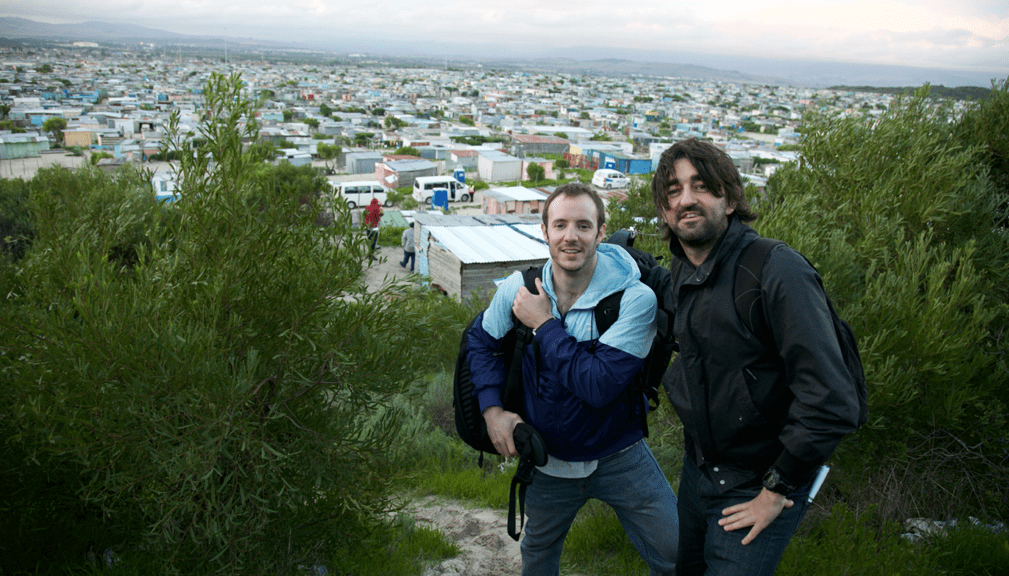
The three locations exhibited in the special were specifically chosen to show that the effects of this disease on people covers a vastness and is not localized to one region or culture. It also displayed the different work that Staying Alive does across the planet. In Khayelitsha (South Africa) dwellings of corrugated iron with coat hanger cables for power conduits were overshadowed by the smiles and dancing of the children who playfully performed for the camera’s attention. In Manilla, the production recorded a sex education class filmed in a graveyard in which the homeless residents were using the tombs as shelter. Bhubaneswar (India) was well off the tourist path, providing no paved roads and whose residents had never seen Westerners before. While each location provided Barnes with touching moments, it was Bhubaneswar that most poignantly reminded him why he had set this production in motion and wanted to direct this message. He recalls, “Our female grantee had herself tried to take her own life for testing HIV positive and having been rescued was now doing the same for other young girls. Hearing this, even through a translator, was an intense emotional moment for all of us.” The final filming moments had James working with Travis and the world famous Bruno Mars in a Miami studio. Having McCoy as the centerpiece/proxy for the rest of the world to witness the work of Staying Alive was key and a composition involving these two noteworthy artists would add to its attention. Barnes notes, “Having a young, cool, contemporary character as the face and voice of the film was the first way in which we approached this production. We figured that not only would this make people listen to the more educational pieces of information but we also hoped he would take it in and then explain it in the type of language our viewers would understand, rather than a doctor or professor. I would say 90% of this was done in pre-production where we thoroughly researched each project in each location so that we could prepare our talent for every eventuality.  During production it was just a case of ensuring we got the most important touch points of each project across. Travis did an exceptional job and I think his feelings for those he spoke with on camera transferred to our viewers.”

Screen Shot 2017-07-28 at 8.10.18 PM

At the World Media Festival in Hamburg (a global competition dedicated to recognizing excellence in branded content from the areas of information, education and entertainment), “Travis McCoy’s Unbeaten Track” was recognized with an Intermedia-Globe Gold Award in the ‘Documentaries’ category. As both creator and director of this program, it’s appropriate that James is appreciative that his show received accolades. In complete contradiction to this very idea, Barnes states, “It’s interesting to me that Marcus [Liversedge-Series Producer], Benedict [Spence-DOP] and I still cite this as our favorite thing we’ve ever made even though it’s by no means the most high-profile. Experiencing the locations, contributors, and their stories is something that will always connect us. I think the most rewarding part of this production was giving a platform to these young people who were doing such brave and admirable things in the face of adversity. It was always my hope that this would inspire and inform others on the issues.”

International Entertainment, and the Talents that Leave us Buzzing….