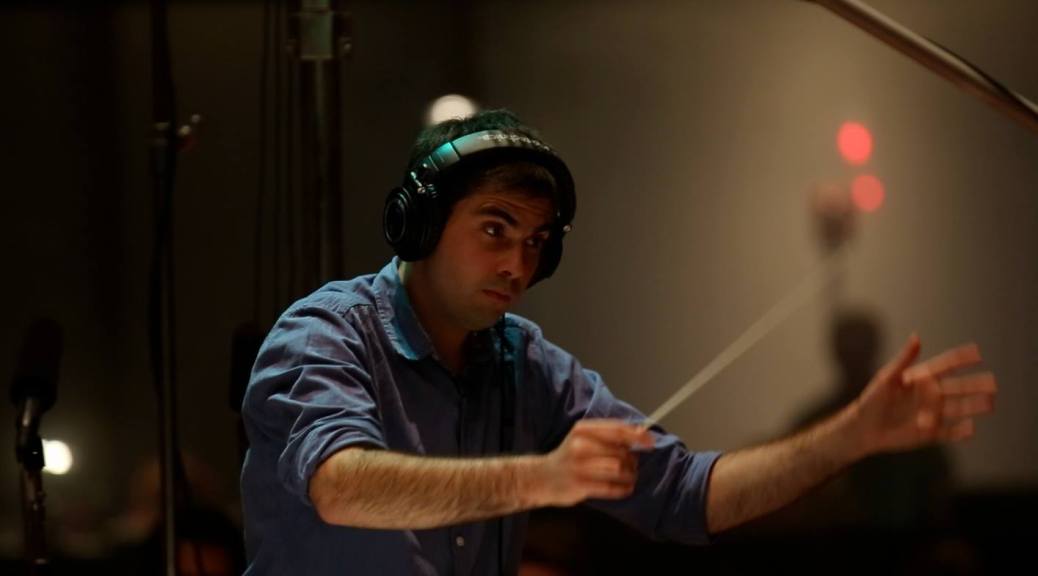
While Kevin Smithers was studying his undergraduate degree in music, he came to the realization that he enjoyed sitting down and writing down a good sounding solo over a jazz piece than improvising. This realization shaped his future and career; making the transition from a performer to a composer. Throughout the rest of his studying, this passion grew to become a career. Now, Smithers is a successful film and video game composer.
During his career, Smithers has worked on over 20 films and web series, as well as the new PlayStation VR video game World War Toons. However, it was with the award winning film On the Roof that he received his nomination for best original score at the Sitges International Fantastic Film Festival under the Noves Visions SGAE Nueva Autoría section, which he describes as a great honor.
“It’s the way that Kevin understands the music for films: he also puts the story and the characters before his own work. He is very conscious that he’s making music in order to tell a story, for expressing feelings, not only for himself or for people to listen to his music separately,” said Damià Serra Cauchetiez, the director of On the Roof. “Working with Kevin is amazing. He is very hardworking and was very motivated about the story. He always understood what I wanted in every scene, and also he proposed many of the good ideas that they finally ended up in the score.”
On the Roof (also known as En la Azotea) tells the story of Adrián and his friends, who climb to a roof every afternoon to spy a girl who sunbathes naked. However, one afternoon won’t be like the others, as the friends realize that one of them is more interested in a guy showering in a close building.
“Working on On the Roof was a great experience. Damià and I bonded over some of our favorite scores when we met in Spain and was really excited when he asked me to score his film. He gave me a lot of creative freedom to do something that I thought was interesting and new. In fact, the temp music in the film was radically different to what we ended up doing,” said Smithers.
Smithers wanted to tell part of the story with the music, with a very warm Spanish sounding score for the film as the film takes place during the Spanish summer. However, they didn’t want to go all the way with Spanish flamenco, which is when Smithers came up with the idea of using only an acoustic guitar.
“It’s a very Spanish instrument. I spent time trying to get as many different sounds from the guitar as I could and recording them in various ways. Once I had all these sounds recorded and ready to play with, it’s as if I had a standard ensemble that’s normally used to score a film” he described. “But we altered the sounds to have that cinematic feel as well. Even though it’s a very personal and introspective story for the character, it feels big and daunting from his perspective. By modifying the guitar recordings and doing a lot of guitar passes, we managed to get an intimate Spanish sound that could also grow into a full wall of sound needed for some moments.”
On the Roof has premiered at many film festivals, including Cannes, Berlinale, Sitges, Seminici, Vancouver International Film Festival, Seattle International Film Festival, and more. It has won awards at several of those festivals, including a nomination for best director and Miguel Casanova Rodriguez won for best screenplay at the Sitges International Fantastic Film Festival.
“The most pleasurable thing to me when writing music for film or games is when you’re done with a scene and the music just sits perfectly over it and really adds something to the project that wasn’t there before. This way of telling a story through music is a very specific way of writing, which I deeply enjoy,” Smithers concluded.
There have been many, many films about World War II. With subject matter as prolific as this it is difficult to find a new angle. The film All These Voices is one of the few films to achieve this goal. The film’s producer Beatrice von Schwerin understood this when the opportunity came her way. While history informs us about the events, the arts enable us to comprehend the lessons learned as well as to take on the emotional quotient of these events. It is often true that the perspective of a war is viewed differently based on your geography. It is this fact that helps to make von Schwerin the perfect person to oversee the making of All These Voices. In addition to her excellence as a producer, Beatrice hails from Europe; giving her an ideal perspective to produce this Hollywood film. A member of Swedish nobility and possessing a resume of celebrated European film work, this producer brings many obvious talents…as well as a few less obvious ones. All These Voices struck a resonant chord. The award-winning film was screened at a wide variety of festivals including; AFI Film Fest (Los Angeles, CA), Carmel Film Festival (Carmel, CA), American Film Festival (Wroclaw, Poland), LA Polish Film Festival (Los Angeles, CA) ICARO Festival International de Cine (Guatemala) Las Vegas Film Festival (Las Vegas, NV – Winner Best International Short), 24 FPS International Short Film Festival (Abilene, TX), Kino Otok Isola Cinema Festival (Izola and Ljubljana, Slovenia), LA Jewish Film Festival (Los Angeles, CA), Resistance Film Festival (Tehran, Iran), Southway Film Festival (Mykolaiyy, Ukraine), Centre Des Arts (Geneva, Switzerland – Special Screening and Lecture), European Student Film Festival (Geneva, Switzerland – Special Screening and Lecture), Newport Beach Film Festival (Newport, CA), FIC Autor Film Festival (Guadalajara, Jalisco, Mexico), Washington DC Jewish Film Festival (Washington DC, MA), Woods Hole Film Festival (Woods Hole, MA). It’s important to view this list as a whole to understand that All These Voices had such a major appeal to so many different sections of the world population. Based on the locations of these screenings, we can easily assume that regardless of cultural, economic, or religious affiliation, these audiences were intrigued and attentive to the film’s message. This is proof that films which don’t involve CGI or superheroes can have mass appeal to audiences with many varied lifestyles. The fact that Beatrice was able to produce this film on a minor fraction of the average Hollywood budget is a major achievement for any production these days.
All These Voices is highly unique in the way that the story is presented. The film takes place in the days following the end of World War II. A young SS officer has sought out refuge by hiding in an abandoned Polish theater. A theater troupe of survivors enters to celebrate the end of the war. Having camouflaged his identity, and remaining mute so as not to reveal his native German tongue, the soldier joins the survivors in a vibrant celebration. As he witnesses the expression of their painful past, he is forced to come to terms with his complicity in their grief. It’s an idea that seems quite possible to have occurred in post WWII Europe. Multiplying the ease with which the audience can accept the story is the location. Nothing could be as appropriate as watching a film in a theater while the action takes place in a theater. Of course, with the events taking place in 1945 Poland, the surroundings needed to reflect that era. Beatrice chose the Roxie Theater in Downtown Los Angeles. Hollywood continually proves that its ability to be malleable is one of its greatest assets. This attribute, in addition to the talented community, is what has interested von Schwerin in possibly pursuing a residency in LA even though she has already experienced great success as a producer in Europe. She concedes, “Hollywood has always been the center of film; I don’t think that that will ever change. The film industry has been active here for over 100 years. The major studios are still located in and around Hollywood. It falls naturally that once a center for any type of industry is built, it stays there. I am actually looking forward to the day when I am part of a movie that will shoot its full production days in Los Angeles; it would be wonderful, to be closer to home. I know that the shorter commute home would be nice [laughs].”
The production All These Voices took on some highly difficult tasks, not the least of which was the presentation of its theme. Making sure that the story was told in a proper and respectful way was the greatest challenge. The Holocaust and the effect that it has had on people is a very important story to tell. Beatrice reveals that she gained some new knowledge from her director and multiple-productions collaborator David Henry Gerson. She notes, “I had what I thought was good knowledge about the Holocaust and its effect on people. However, working with David Henry Gerson helped me to get a stronger sense of it. Seeing it from David’s point of view, he has family that lived through the holocaust, and hearing his stories together with their stories has opened my understanding. None of my direct family has ever lived through such a trauma, so this has definitely helped me understand in more detail what the survivors had gone through.” It is obvious that Gerson was appreciative of von Schwerin’s attention and care of the subject matter as well as her producing skills as he comments, “Beatrice cares deeply about protecting and supporting the creative vision of the film. Working with her on All These Voices made this more apparent to me than ever before. She is an utmost professional, who inspires greatness and action in her crews and those working with her. Everyone performs their best having Beatrice around as a producer. Regardless of whether it was with myself as the director of any other member of the cast and crew, she listened carefully, assessed scenarios swiftly and effectively, and always, always, always was 110% prepared. Her intelligence governs all of her decisions. She has a rare ability as a leader and is a great force of positivity, effectiveness, and inventiveness. Making this film without her would be inconceivable.” The film’s writer, Brennan Elisabeth Peters echoes this sentiment stating, “As the screenwriter on All These Voices, having a producer as capable as Beatrice supporting my vision was crucial to its development and execution. As an artist, an important part of my process is thinking in terms of possibilities rather than limitations, especially on the script level. Unfortunately, due to the nature of filmmaking as a particularly logistically challenging and collaborative art form, this is not always possible. On other projects, I frequently feel the need to hone my vision and rein in expectations based on the limitations of my collaborators. However, with Beatrice on All TheseVoices, I truly felt free and uninhibited to write a script that was ambitious, gratifying, and, ultimately, award-winning. That was due in large part to my faith and trust in Beatrice as a producer.” One of the most difficult obstacles for the film is probably unnoticed by the majority of American audiences. All These Voices is extremely detailed in its recreation of the era and location of the events taking place…even down to the language being spoken. As producer, von Schwerin had to be involved in just about every aspect of the film production. This meant making sure that the dialogue was spoken correctly and believably. Beatrice states, “The cast on ATV were a very special bunch. Seeing that the film is all in Polish and German, probably the hardest part was making sure that the dialogue and pronunciation was correct. Parts of our cast were born and raised in Poland and some were not. Our film was seen all over the world, including places where Polish and German are the native languages; this required us to be painstakingly critical of the language in order to be authentic. I’m really proud that we were able to achieve this goal so well.”
It’s hard to imagine a young Beatrice von Schwerin roaming the grounds of her family’s castle in Sweden and then maturing into this commanding presence on set. How many of us would leave a comfortable life of adulation and nobility in order to face challenges day after day on a production? Beatrice conveys this commitment best in her own words declaring, “Producing is never an easy job, if it were easy, I would probably not be working as a producer. I need a proper challenge and producing gives me that challenge. When I moved to LA I promised myself that once I stop smiling when I see the Hollywood sign, I would quit my job and move back to Scandinavia. I am still smiling.”
Storytelling has taken many forms. The original orators had to be skilled in manipulating their voices and contorting their bodies in ways that helped those around the campfire to “see” all the characters and places being presented. Authors used their literary abilities to “paint” all manner of odyssey in the mind’s eye. Theater began to pull the great works into manifestation with the aid of thespians, lighting, music, and props. Modern films began as a visual marvel that eventually succeeded in allowing us to literally see things that had previously only been imagined. The miracle of modern cinema is that it allows us, as viewers, to experience scenarios we will likely never actually be in and sometimes…even view the same situation from different emotional perspectives. This idea perfectly explains the premise of The Reunion as well as the experience of watching the film. Director/writer/producer Carmen Elly Wilkerson’s 2015 production has received immense attention in the past year and Justin Ivan Hong is the cinematographer whom she worked with to design the look of the film. It’s a tall order for a film which mostly takes place in a single room with the four female characters discussing their personal view of the conflict in the film. At the Cannes Film Festival, Kodak named Wilkerson one of 16 Filmmakers to watch. The Reunion received great praise and numerous achievements including: the Charlotte Black Film Festival – Audience Award, HollyShorts Film Festival – Audience Award, nominations at both the Pan African Film Festival (Best Short) and the Burbank International Film Festival (Best Short & Best Actress). The Reunion was also an Official Selection at the following festivals: Miami Short Film Festival, Black Harvest Film Festival, Urbanworld Film Festival, Reel Sisters of Diaspora Film Festival, San Francisco Black Film Festival, Martha’s Vineyard African American Film Festival, and the Gary International Film Festival. For a film with such a simple scenario (or maybe not so simple) as four women in a room discussing a pivotal moment in their lives, the film definitely garnered a lot of attention. The film that Wilkerson created is provocative and has the audience guessing as to what actually happened, all the while being enabled to do so by the believability of the world she created with Hong.
Justin was highly recommended by the American Film Institute’s head of cinematography, so Carmen had no trepidation when she contacted him about working with her on The Reunion. She quickly realized why Hong had received such glowing accolades. Wilkerson comments, “Justin and I immediately starting working to pre-produce the film even as he was on location in another city. He helped craft the look of the film and collaborated well. He was so thorough in his approach and extremely detail orientated. As a filmmaker, he understands performances and story, helping to elevate the script’s potential. Justin even stepped in and helped me edit a
few sequences that weren’t yet working. He’s one of those artists who adds to the mix and makes the director’s job easier. Justin is a very bright collaborator and cinematographer.” It would seem that the biggest challenge on this film production was the deceptively simple scenario; four girls holed up in their room, hiding from the outside world. From the beginning of pre-production, the discussion between the director and Hong centered around finding a way to sustain visual interest due to the fact that it was basically four characters talking inside a room for twenty minutes. Justin recalls, “We identified all the dramatic beats and worked out a plan of movement and blocking that flowed with the emotional flow of the film. In order to fully work within the tight confines of a bedroom, we planned out the different camera positions within the room in such a way that the blocking complimented the actresses’ movements and that in turn added a sense of fluidity and immediacy that fit the story very well.”
One of the things which cinema can achieve quite proficiently is to sometimes “deceive” the viewer with different perspectives. Everyone has the ability to color their memory with an emotional slant. Numerous psychological studies and experiments have been conducted in order to prove the effect of emotion on memory. Filmmakers often make use of this tool as well. The same holds true for the way the action of film can translate a mood based on the cinematography. Justin concedes, “Another aspect of the film was the ulterior motives of each character and the relationships they have, as it relates to the collective secret that they are hiding. I used subtle framing choices to visually portray this volatile dynamic between these friends. This also worked in conjunction with the blocking. When the four characters were feeling united and close to each other, I used wider lenses and included all of them in the composition. When they start to fragment, we had them walk away to different parts of the room and I used slightly tighter lenses and framed them alone, adding to the feeling of distance from each other.”
The Reunion is a compelling film which explores the varied ways that individuals can perceive the same circumstance. Presenting the same situation, colored through the lens of the different characters, and culminating in unique perspectives is a superior achievement which the film’s creator, Carmen Elly Wilkerson, the cinematographer, Justin Ivan Hong, and indeed the entire cast and crew can be proud of, as proven by the critical and public acclaim the film has received.
Actor Souleiman Bock’s intriguing and versatile look coupled with his phenomenal acting skill have been integral to the actor becoming a hit both at home in London and abroad. Considering that Bock landed one of his first roles on the hit British TV series “MI-5,” aka “Spooks,” it was an easy bet that the uber talented actor would soon be hot on everyone’s radar, and he has become just that! In “MI-5” Bock took on a major role as an ill intentioned terrorist who plans to bomb London’s House of Parliament and takes a ship hostage along the way. For anyone who has had the chance to watch his performance and how he embodied a man of evil deception down to the most minute detail, it’s easy to see why he has continued to land roles of a similar nature.
In the dramatic crime series “River,” which aired last year, Bock took on the critical role of Khaalid Mohamoud, a hard-working immigrant who harbours a game-changing secret to protect a friend. In “River,” which earned the Golden Nymph Award from the Festival de Television de Monte Carlo, as well as a BAFTA TV Award nomination, Bock acted alongside one of his icons, multi-award winning actor Stellan Skarsgard (“Good Will Hunting” “The Avengers”), a memorable experience to say the least.
Bock recently wrapped filming on an episode of the upcoming series “Riviera,” which stars Golden Globe nominee Julia Stiles from (“The Bourne Ultimatum,” “10 Things I Hate About You”). In the series Bock takes on the critical role of a doctor acting alongside multi-award winning actor Idal Naor from hit series “The Honourable Woman” and “The House of Saddam.”
With undeniable magnetism on screen, those with even the toughest of standard will conclude that Souleiman Bock is a gifted performer. Aside from bringing some of the most challenging characters to life, Bock is fluent in English, French and Somali, something that gives him an edge over others in the industry.
To find out more about Souleiman Bock and some of his exciting upcoming projects make sure to check out our interview below!
Hey Souleiman thanks for joining us! Can you start by telling us where you are from?
SB: I was born in Djibouti, East Africa. I traveled a lot as a kid because my dad was in the French army, we then settled in Paris when I was about 10. But I have been living in London for almost 10 years now.
When and how did you get into acting?
SB: Acting was always on my mind growing up since I loved films. Although i wanted to play soccer professionally as a kid and almost ended up doing it, when I turned 20 I went to my first acting class in Paris and after that I was hooked and never looked back.
When did you land your first onscreen role? What was the project and how did it feel being a part of it?
SB: MY first professional acting job was on the British Drama “Spooks” or “MI-5” as it’s known outside the UK, I was really happy getting the role since I had been a fan of the show before and I considered it to be the best spy/action drama anywhere. It was quite an experience being on a show of that quality with a really great cast and crew.
You’re currently shooting the upcoming series “Riviera,” can you tell us about the show’s story?
SB: The show is about a rich family who inherits an empire from their father when he dies in the South of France. But all hell break loose as they discover all the dark secrets he left behind. The lead actress is American actress Julia Stiles.
What character do you play and why are they important to the story?
SB: I’m not allowed to go into to much details right now since the show is in production, but I can say that I am playing a Doctor who is key to the storyline, and there is a nice plot twist regarding him.
Did you face any challenges in bringing this character to life?
SB: Being quite young, playing a Doctor with a lot of experience and weight to him has been a very interesting challenge.
What was it like working with director Damon Thomas and the rest of the cast on the series?
SB: I think this has been my best shooting experience so far since we were shooting in the South of France in some amazing locations. The director was really experienced and efficient, and the cast and crew are really friendly, which always makes things better.
How about the crime series “River,” what was that about?
SB: “River” I would say is my best job to date, and definitely my most demanding job as an actor. It was a great experience bringing Khaalid to life because of the complexities of the story and the character. Also acting opposite Stellan Skarsgard which I considered before I met him on set to be one of the best actors out there, was a really amazing experience. I learned a lot watching him work and grew a lot from it as a result.
Still of Stellan Skarsgård (left) and Souleiman Bock (right) in “River”
How did it feel when you found out you had landed a recurring role on the series?
SB: I was really happy, again because I knew I was going to work with Stellan Skarsgard and the story I felt was really different and special. The show has has some amazing reviews on its quality and originality.
Can you tell us about your character Khaalid Mohamoud? What kind of guy is he and what happens to him in the story?
SB: He’s an immigrant in the UK who has been working hard to support his family and struggles to find his place in society, he’s central to the story because he’s hiding information in an effort to try and protect someone, a move that could change the course of the story.
You are also in the series “Call the Midwife,” can you tell us about your character?
SB: I actually just finished shooting and I am in season 6. I play a British Merchant Navy Seaman in the show. It is set in the 60’s and my character is trying to have his wife go back to Africa to give birth and that’s when all the drama begins.
What is the series about?
SB: The story is about midwives in the 60’s in post war London, and the job they did. It is a very popular show worldwide with great reviews.
In the episode you are in, how did your character fit into the story?
SB: I will be in season 6 episode 6, which comes out in 2017. The entire episode is dedicated to my storyline and that of my wife in the show. It’s a really heavy and sad story that will be very interesting to watch.
How did the character challenge you as an actor?
SB: Having to play a man living in the 60’s was the challenge, since people of that time had a completely different view on things but we had an amazing script to help, and I asked for details from my parents to find out what it was like for them during the 60’s as well.
Can you tell us about the project “Spooks”?
SB: “Spooks” was my first job on TV. It’s a Spy/Drama and was one of the influences for the “Bourne” movies, it is a very gritty and realistic show about the Spy world. “Spooks” is slang for spy in government official circles. I was playing one of the terrorists who planned to bomb the house of parliament in London and took a boat hostage. As this was my first experience with a show of that scale, I had to overcome a bit of nerves at first but was quickly put at ease by the cast and crew. The director of this show was Paul Whittington and I was playing opposite Richard Armitage (“The Hobbit”) who was the main Spy I took hostage in the episode and Iain Glenn, who went on to be one the main character of “Game of Thrones.”
You’ve had quite a bit of success as an actor on television so far– do you have plans to focus more on film work anytime soon?
SB: Definitely in the future that is my goal!
What is it about working in television that you enjoy?
SB: Television has become such a great quality media that you would really miss on a lot of opportunities if you didn’t look at it. Plus it is a great way for an actor to show their skills as you could have more time to develop a character, and really these days TV has amazing quality shows!
Can you tell us about some of the film projects you’ve done?
SB: Around the same time I was shooting “Spooks,” I had my first role on the big budget film “Gulliver’s Travels.” I was playing a soldier and it was a great experience. It was a massive shoot and Jack Black was really great to work with and very friendly. I also did a film with French director Mass Youssoupha called “Conscience” that we are looking to show at film festivals next year and I am really excited about that but I can’t really talk much about the story as I’m forbidden to do so. Also I have the typical actor’s story when I started I did a couple of background jobs in film to pay for for acting school, and that was also a great learning experience.
They are all very different, what made you choose to participate in these projects?
SB: At the moment, for example, the movie “Conscience” that we hope will be selected for festivals, the main reason I did this film was the director Mass Youssoupha. He saw my work on “River” and wrote that story for me specifically so I was really keen to work with him. In the beginning of my career working on films was not my priority, of course if you get an amazing project you will do it, but I was more focused on TV and now that my name is out there I go for castings for some great movie projects with great directors, and that’s what you want as an actor really– to create a window for you to have access to quality projects.
You get approached all the time to work on projects with people, what makes you pick one role over another?
SB: Now that my name is getting known it’s really about choosing that quality project that will make a difference in my career, that’s why I am very picky of what I want to be associated with. That’s why if you look at my work on TV so far it’s only be quality work. I am choosing quality over quantity!
Do you feel that you get cast to play a certain type of character more than others?
SB: At the beginning of your career you get typecast always, but you have to get your opportunities and show what you can do, and now really I get all kinds of characters. “River” has been a turning point for me really. But I would definitely say that I usually get the intense sometimes menacing type.
Out of all your productions both in the theatre and on screen, what has been your favorite project, or projects, so far and why?
SB: My favorite job so far has been the show “River,” this was where I learned the most and also the complexities of the character were so fun to play! Acting with Stellan Skarsgard has been the highlight of my career so far because I really admire him as an actor.
What has been your most challenging role?
SB: My character Khaalid on “River” was the most challenging, the range of emotions was great, and my character was always on the edge. This is really challenging as an actor.
What is your favorite genre to work in as an actor?
SB: Definitely drama, I think this is where I shine the most really. And it is also my favorite genre to watch.
What separates you from other actors? What do you feel your strongest qualities are?
SB: I have always been told that I have this sort of presence which is menacing and charming at the same time so maybe that, although it’s quite hard to judge yourself but I suppose I would agree with that.
Have you been in any commercials or music videos?
SB: Yes I did a Spring Water commercial for “Voslauer” with supermodel Agyness Dein, you can actually still see it on youtube it’s called “Voslauer Part II”.
What projects do you have coming up?
SB: Coming out next year are my roles in “Call the Midwife” and “Riviera.”
What are your plans for the future?
SB: I would love to be as versatile as possible as an actor and maybe learn a new language to act in, that would be really great since I have a passion for language.
What do you hope to achieve in your career as an actor?
SB: Hopefully grow as an actor and do lots of quality work.
Why are you passionate about working as an actor?
SB: It’s always such a joy for me really to disappear into a character, there is nothing like it!!
If you weren’t an actor what other profession do you think you might have chosen?
SB: My dream as a kid was to be a professional soccer player, so definitely that! I am still very much passionate about soccer and sports in general, i also love the NBA.
Sometimes, in order to do your job to the best of your ability, you have to change the manner in which you perform your role. This is not done for the sake of ease or to be lazy, it’s quite the opposite. Taking the normal or more obvious path does not always lend itself properly to the presentation. It can be frustrating and taxing but in the end, it becomes quite gratifying. Xiao’ou Olivia Zhang understands this only too well from her experience working on the film Looking at the Stars. The ironic title of this movie about blind ballet dancers challenged Zhang to come up with many new approaches to grant an empathetic ear to relate the tactile experiences of the dancers. Ultimately, it was a requirement for Olivia to put on her Foley hat and go about discovering augmented sounds to give the audience a better idea of what it felt like (literally) to understand the experiences of these dancers. The work on this film was a far cry from her normal sound designing experience on a film, and yet…Zhang states that she was thrilled to be forced to come up with new sounds that would have the greater impact of what the characters in the film were experiencing. With celebrated films like Lost City of Tomorrow, The Hunt, Thunderstorm, Los Villanos, and others…it’s encouraging to see that a professional with so many achievements, like Olivia, is excited about finding a creative solution for the productions in which she is involved.
When Veronica Li (Supervising Sound Editor of Looking at the Stars) was looking for someone to work with her on the film, she approached Zhang because she wanted someone with strong Foley abilities and an extremely discerning ear. Li explains, “The sound design of Looking of the Stars depends a lot on the Foley. Olivia was one of the most important parts of the sound design team. Her work brings us as an audience a lot closer to the character. We feel what they feel through the detailed Foley sounds, and thus, we become more involved in the story. She had a very good understanding of the characters and the story, and the Foley she recorded brings the movie alive, which is the essential part of the sound design of this movie.” The excellence of both Zhang’s work and the entire production was proven by the achievement of Looking at the Stars being awarded a USA Student Academy Award, an Urbanworld Film Festival win (the Documentary Prize), and a nomination from the International Documentary Association. Zhang admits that receiving accolades is never an unwelcome gift when it applies to your work but she also feels that this production was especially meaningful as she shared a common trait with the subjects of the film. She notes, “The degree of us focusing on sound in life connected me in a significant way to the dancers. I would often close my eyes to hear the sound of the materials I had selected, attempting to get into the subject’s mind and test out if I could imagine what thing I’m holding in my hand from the sound it makes. Moments like this made the story somehow personal to me. Of course, I couldn’t understand the depth of the courage of the dancer’s but, this small attempt to relate to them with a common sensory focus and application, it raised my appreciation for the way in which they ‘see’ the world. It’s an amazing audible environment which they appreciate that I think many people might overlook. That was an unexpected gift I received from working on Looking at the Stars.”
Looking at the Stars is an intimate glimpse into the lives of the extraordinary ballerinas at the world’s only ballet school for the blind; the Fernanda Bianchini Ballet Association for the Blind. The story of these dancers goes beyond the challenge of learning to dance without a visual reference. Like many of us, these women want to be good professionals, partners, & friends. They want to be relevant and self-sufficient. They work fiercely to become the best versions of themselves. One of the dancers, Geyza, is the school’s prima ballerina. She is an example of grace, strength and determination. She began studying ballet with Fernanda Bianchini after losing her sight at the age of nine. In the film, Geyza arrives at a crossroads. Like many women, she feels pulled in two directions, between her family and her career. Preparing to get married, Geyza believes that in order to be a good wife she must dedicate herself to her family. She is also determined to not let married life end her aspirations as a ballet dancer and instructor. Whereas the obvious focus of the movie could have been overcoming a physical situation (blindness), Looking at the Stars chooses to instead focus on the heart and strength with which the dancers approach their entire lives.
While the film focuses on the dancers lives and interaction with the outside world, Zhang focuses on the sounds which helps the audience understand what is going on with them at a personal level. One scene in particular is a prime example of this work. Veronica Li recalls, “There was one scene in which the main character (who is blind) is touching her wedding dress. The movement of the character’s hand across the material and the sound Olivia recorded was so detailed and believable that it not only gives an enhanced sound but, it conveys the essence of that emotional moment.” Olivia continues, noting, “One of my most fond memories was re-creating the sound of ballet movement. I’m not a ballerina myself and my size is very different than the dancers. Half of the time the sound of ballet movement was made with my hands wearing the ballerina shoes to create swift jumps and slides over the dance floor. It was a fun day trying to be a ballerina who dances on my hands. Sometimes the great sound you are hearing in theatre was not made in the way you would imagine. That’s movie magic!” That makes Xiao’ou Olivia Zhang fall somewhere on the scale between scientist and magician; which sounds like possibly one of the most unusual and fun careers in the world.
Imagination can be wonderful but it can also make things harder for us in the real world. That statement might contradict what most of us think about imagination. Escapism can be a beneficial tool, right? Most of the time it is, but consider the predicament of Writer/Director Joe Beverly, a celebrated filmmaker who had written a deep and intense character driven piece called No Place (the film would go on to be screened at the Forum Film Festival and win ‘Best Short’ and ‘Best Screenplay’). The central character, William Aims, would need to communicate his inner turmoil without words as often as with. Aims is such a strong force in the story that casting anyone less charismatic or “alpha male” as the character would cause the story to “lose its teeth.” Luckily for Beverly, young British actor Sebastian Sacco was seeking an intensely dramatic role. Joe Beverly declares, “I needed to cast an exceptionally strong actor to successfully execute what I had written in the script. I was extremely lucky to find Sebastian and, when he auditioned, I knew almost instantly that he was the absolute perfect choice to essay the role of William. He has an uncanny ability to communicate without speaking or even moving much, a gift which only the very best actors possess, and which he put on full display in No Place. His performance went beyond what I had even hoped for and truly made the film a special tour de force about the cult of money and how it can topple lives. There is no way the film would have been possible without Sebastian’s stunning performance and everyone who has seen it has been floored by his portrayal of William.” The film’s star states that the reason for his being cast is likely due to a combination of acting and inherent character traits as he sates, “I’m an extremely moral person and will speak up if I think something is wrong. I think it was this trait which Joe saw in me. In my opinion, a strong actor is someone who isn’t scared to go there, to look ridiculous, to fail in front of people and to keep trying. That’s a strong actor. I think what Joe meant was that I was capable of holding the audience’s attention. I take it as quite a compliment that Joe saw that in me.”
No Place is unsettling in how contemporary and possible it seems. The plot depicts a scenario in which England has seen a political, economic, and social change. The government has fallen, the banks have crashed, and the old system has fallen into the hands of three remaining corporations. These three corporations are now ruled by the Bank of Britain, posing as three separate organizations that still give the public an opportunity to vote. Young economist Will Aim’s (Sebastian Sacco) works his way to the top of the system, eventually working alongside Tony Darwin (Paul Dewdney) who is the final over seer of Britain’s future. Will’s moral compass and girlfriend, Skylar (Danielle Norman) rejects the new system, seeing the bigger picture, she tries to open Will’s eyes. He slowly begins to uncover the truth that Skylar saw all along and, with Skylar by his side, Will has a life changing decision to make; one which is harder than he ever expected. As inspiration for Aims, Sebastian reverted back to an earlier time and emotional state of mind which he had experienced. He remarks, “I went back to my private school days. Trying to impress people in that world. It’s all about how you talk, dress, posture eat; everything is judged and weighed up. If you can do it all the ‘right way’ then you’re part of the club. That sense of constant self-awareness and trying to look and act a certain way but never above your station was important to me. Will was very straight edged. He rose to his position so quickly because he was smart, not because he was imposing or a risk taker. In my own private school days, I thought some people were rich because they were smatter and harder working than others. I believed in these ridicules lies. The truth is most people are stuck and trapped by their circumstances. I’ve been as ignorant and blind as Will was and I’ve come out the other side. So I understood his journey.
The film was well received by critics, the film community, and the public; no doubt due to the intense performances which Sacco and his supporting cast delivered as well as the timely subject matter. Sebastian reveals that he is somewhat conflicted about these recognitions as he remarks, “It was amazing to hear it won awards. Joe called me straight away to let me know. I’m always very hard on my performance and wasn’t happy with it, so to hear that it had won two awards…I couldn’t have been too bad. I think awards are pointless in many ways. Arts are about expression. Not all expression is nice. A lot of awards are like a popularity contest. I think as long as you don’t make films with awards in mind, staying true to the original idea and express it in the strongest way possible to that truth…then if someone wants to give you an award for that, I feel that is good. The best reward is just making the film. When that happens, my entire life just stops. It is fulfilling and draining simultaneously. When you finish, you have this piece of art that you have all worked together to create. You have this thing that existed in your collective minds and you made it materialize, then you send it out for others to experience. Now that is an award!”
From the first frame and song of Pressure-Man (writer/director Kai Kuei-Chieh Hsu’s musical comedy) you instantly recognize the color of John Potter’s suit and tie as prominently as his singing. This is by design. The theatrical, somewhat fanciful approach is designed to place the viewer into accepting the “sleepwalking” lifestyle that the main character John is immersed in. The colors are over the top on purpose. The color makes a subliminal impact, it’s the reason that the filmmakers approached colorist Hugo Shih to use his expertise on Pressure-Man. Even the scene over the closing credits shows the wild color schemes Shih can use to great effect. The heart of the film is intact regardless of the color, but it is the talent which Hugo brings that truly gives this film the character to make it stand out as unique. Among its many recognitions were: 2016 American Movie Award (Best Production / Art Direction (Winner), 2016 Praxis Film Festival (Audience Awards), & Official Selection of the 2015 Los Angeles International Film Festival Awards (Winner – Best Comedy/Dramedy). In hopes of understanding why Kai Hsu and this production were so intent on having Shih work on Pressure-Man as the colorist, we spoke with him in order to understand his role and the essential parts of his vocation. Because the film is so stylized in terms of its use of color, it is a perfect example of what a colorist is capable of doing in modern cinema.
In current American society, Pressure-Man is the norm. This film is about an accountant who is so tied to his job that he doesn’t take the time to participate in actual life with his family. The idea of living to work rather than working to live is ingrained into the life of many in the US. Pressure-Man is as subtle as a sledgehammer, which is exactly what is needed to wake the main character John (and many of us) from this enslavement. In pursuing the dream, we forget to live the dream, which is exactly what Hsu is saying in this film…about everyone, not simply those in the film. To create such an altered state, Hsu worked closely with Hugo in creating the approach he wanted for a color scheme.
From the opening scene, Shih’s handy work is evident. As Pressure-Man introduces himself and the film in song, his brightly colored suit and bow tie grab the viewer’s attention as a spotlight illuminates him. The director wanted everything but the Pressure-Man hidden so Hugo added a lot of mask, covering everything else and tracked the actor, so that the mask would follow with him. It’s a technique which the viewer doesn’t notice but focuses the attention right where the filmmaker desires it to be. Even the transition from the opening song into the action of the film required Hugo’s expertise. Shih explains, “There was one shot we worked on very long time, which is the shot when Pressure-man stops dancing and starts to introduce us to the main character and the idea of the story. The Director wanted the lighting to look like he was using dimmer. It was difficult because it wasn’t shot this way. I needed to add the dimmer effect myself. In order to achieve this, I brought down everything at the background but the Pressure-man. Secondly, I key framed the background to gradually light it up, but without effect on the Pressure-man. Sometimes the director wanted it as dark as possible, but without losing any of the detail. Thus, the director and I were looking for a balanced light that we could both be happy about. I like working with directors that have specific ideas and requirements. Even though their requests might be difficult, we can build a style of communication. I know how to achieve many things as a colorist but if I learn how to communicate better and more easily with the directors and cinematographers I work with, I will work more and we will all enjoy the process.” Describing another shot in the film, Shih states, “There is a shot in which the Pressure-man is in the bathtub with father. When I graded this scene, the director asked me to make it look like the actors were in their own little world. I made the spotlight stronger, and used two shapes to mask out the sides to be dark. Then I added overall blur to simulate the steam because I want to make more feeling of taking shower. There was also a scene in which the father has a nightmare. He dreams that every member of his family has become a ‘Pressure- Man’. This was composed of multiple green screen shots. Because we have a rushing to meet our deadline, I decided to do compositing in a color grading software. Before I was able to do that, I had to do a perfect color balancing so that I could get a clean key and make a proper composition. It isn’t exciting to hear about but the finished product really made the director excited.”
A common misconception about the colorist job on a film is that they only deal with grades and tones of color. Because of the work they do and its effect on the action taking place in the frame, they often control how the lighting feels on film as well as the color. Because the colorist almost always performs their work after the filming has taken place, it is important that they work closely with the director and have a strong sense of why the lighting was established on set during filming. Just as with the actors, the environment in which the colorist performs his/her work is crucial to achieving the proper effect. The working environment of a colorist is very different from other positions on a production. During a color session, the room must be totally dark. There only light which can be turned on is a 6500 daylight lamp because it will adjust to the colorist’s eyes once they go out of the room and come back in. Also, the room must be 18% Gray (which is a neutral color and won’t reflect any colors to influence the eyes of the colorist towards the image). A colorists’ room also requires specialized equipment to aid in the color grade process, making things efficient and accurate. Hugo Shih’s work in Pressure-Man highlights the impact of the role of a colorist in modern film. While many audiences may not understand the substantial amount of time required and the valuable expertise that Hugo possesses; the look of the film stands as proof that his contributions create a unique and artistic experience.
As far back as we can trace the history of mankind is how long storytelling has existed; that’s because storytelling allows us to communicate our own history. At some point (most likely around a campfire) storytelling became an art and, as art does, the tales became more grand and entertaining. Through the ages, the means by which stories were communicated has evolved; oratory, legible, theatrical, and eventually we came to our modern cinematic means. Moving Pictures may be just a skooch over a century old but they have already transformed in so many ways and have escalated the art of storytelling on a global scale. Hollywood may be the epicenter of TV and film but many countries in the world have ingrained some form of the industry into their social fabric. Hollywood can be proud that its child has become loved everywhere on planet Earth. All the corners of the world use this means to tell their tales. By studying the productions of different countries we can understand more about them as well as gain insight into how they see themselves. Petr Golikov is a Russian producer who has had immense success in the world of commercial production but who has also been a producer on many documentaries which present the history of his country as well as how historical figures have effected Russian society. Because of his successful career as a producer and his respect for US productions, he has a healthy respect for Americas contributions. Viewing the documentaries, he has produced allows one to have an insider’s look at many historical figures and social aspects of Russian society that are not often presented to the US. It’s particularly interesting that a producer like Petr, who has such a lauded career (working with well-known US companies like: PUMA, Gillette, Kraft Foods, Ford, Phillips; with campaigns that won awards such as: an Effie Award, a Silver Prize at the Kiev International Advertising Festival, and a Golden Prize at the Golden Hammer International Advertising Festival, as well as others) is always searching for a way to hone his abilities and challenge his approach. Golikov left the world of commercial producing for a period of time to work at the award-winning Studio Ostrov. Studio Ostrov is a recipient of many prestigious awards including: an Emmy Award, Bafta Award, and Nika Award. This award-winning production company was founded by the award-winning filmmaker Sergey Miroshnichenko. Petr admits that when he was offered the opportunity to work with an artist as important as Sergey Miroshnichenko, he could not forego the experience. It is a scenario that has altered his approach to production ever since, particularly his style of communication with directors.
The production Gogol: The Farewell Letter mixed actual letters of correspondence from one of the most celebrated Russian writers with a very artistic presentation. The film was recognized and awarded at the Kiev International Film Festival in 2009. The film is based on Nikolai Gogol’s correspondence with friends and contains reconstructed scenes from the life of this writer and the intellectual debates which he led with them. The main role was played by Eugeniy Voskresenskiy (he won an award at the Kiev International Film Festival for this role). Golikov describes the creative approach which the film is known for, stating, “Three-fourths of the film took place in the set designed and built to look like a huge head of Gogol. People appeared there like ghosts or thoughts or images. We wanted the viewer’s to feel that they were inside Gogol’s head and we took the metaphor to a very literal place, which the audience seemed to really enjoy.”
One of the films Petr produced (at Studio Ostrov) which received the most accolades was The Word. This film is about the life of famed writer Aleksandr Solzhenitsyn. The Word received a TEFI Best TV film nominee, a LAVR (2009) Best documentary film award, and a special award at the 2nd New York Festival of Russian documentary (2009). The Word was filmed shortly before Aleksandr Solzhenitsyn death in 2008 and discussed the writer’s book The Gulag Archipelago, his ideas, & future plans. The documentary contains rare footage of his life outside Russia and unpublished exclusive interviews in which he discusses modern literature and the future of Russian in the 21st century. Because the film discussed one of the most important writers and thinkers who witnessed such an extensive change in the world, it was paramount that it present his firsthand take on history and the literature of his lifetime.
One of the most intriguing documentaries which Golikov produced for Studio Ostrov is titled Closest. This is a riveting and poignant documentary which views the city of Kazan in Russia. This location is extraordinary in the fact that its population is comprised of Christian, Jewish, and Muslim people who live peacefully together. It is a model which attempts to explain if we can live amongst each other with these differences without strife and war. The production asks if “love thy neighbor” can truly exist. Filmed on location over a ten-day period, Closest gives first-hand accounts of what these different ideological groups think of each other and how they implement their religious teachings.
Reaching much further back into Russia’s history, Petr produced Pyotr and Fevroniya:Story of Eternal Love for Studio Ostrov. The Orthodox Church in Russia has declared this couple saints and the keepers of family and marriage. According to lore, Pyotr and Fevroniya were buried in separate tombs but the following day their bodies were discovered together in the same tomb. Many people visit this tomb and ask for intercession. Golikov communicates, “I had to approach the story with great care before it was presented to channel’s producer. There was a presentation for a priest from the Orthodox church because this couple is recognized as saints. The church was happy with it and the film crew was actually very moved by the story, as were the viewers…which gave us such high ratings. It’s a wonderful love story.
Petr’s acclaim as a producer of both documentaries and commercials in Russia has led to upcoming productions with Feel Good Video in the US. Golikov has been enlisted to bring his talents to a number of projects for Feel Good Video including the documentaries Dreams by the Ocean and Twinsters in addition to a series of commercials for both Dyno Wave and Joe To Door brands. Petr’s immensely popular and acclaimed work in the past is a causality to the effect of these international offers. The best reward for a professional such as Golikov is the abundance of offers that continue to find their way to this consummate producer.
There are people in the world who are destined to succeed. No matter what circumstances they are involved with, their inherent ability surfaces. For those who are fond of the adage, “lightning never strikes twice” they mistakenly forget about the lightning rod. Kieran Kiely is a musical lightning rod. While many musicians struggle for their entire lives to get “one shot” (to quote Eminem), Kieran has credits which include multiple globally popular artists. While spending his youth touring the world and recording with these artists, he now makes his home in Los Angeles; it’s a long way from the other side of the Atlantic where Kiely grew up and started his journey in music. Now he is a long way from the huge concert stage as he finds himself on a different musical journey. Although he has had experience for many years as a composer, Kieran is now focused on creating music in the seminal location of film…Hollywood. Kiely is proving that he is a source of authentic and imaginative music, regardless of the presentation or format of said music.
The first phase of Kieran’s musical life reads like a movie itself. Until recently, he spent his entire life recording and touring with the artist that are household names. Dave Stewart (of the Eurythmics), Stevie Nicks, Sinead O’Connor, Shane McGowan, The Corrs, and many others have enlisted Kiely to be a part of creating the music that their fans adore. While Kieran is respected among the elite of the rock world as a consummate musician, it is often his mastery and authenticity of the traditional Irish sound for which he is known. It is this same characteristic that led filmmaker Tommy Reid to hire Kiely to compose the music for his film Danny Greene:The Rise and Fall of the Irishman. This film is a documentary about Irish mobster Danny Greene, famed in the late 60’s as a key member of the mob war which led to the dissolution of the Cleveland, Ohio mafia. The film includes interviews with Greene’s family as well as government officials and Cleveland Police Enforcement. Reid wanted to go to primary sources to communicate the story directly from those involved and he wanted the music to be just as authentic. Reid declares, “A good film score not only compliments a story but also helps it rise to greater dramatic heights, and Kieran’s expertise as a composer did exactly that. You’d be hard pressed to find an Irish musician/composer who has experienced as much success as Kieran. He occupies a space among the top percentage of his peers.” Kieran admits, “Tommy didn’t want a Hollywood version of Irish music but he wasn’t looking for traditional scoring either. It was very collaborative. Tommy had a long standing relationship with Composer Greg Morgenstein on his Films and Greg collaborated with me along with Adrien Van Vessel. Tommy provided a locked picture, so we could get to work. Very early on it became immediately obvious from Tommy’s feedback, that what I was doing was going to work. We had a spotting session to decide where the music was needed but the only other real direction I was given was to make the music authentic.”
Kiely approached the film in a very nontraditional way as a composer. With a locked picture available, he was able to watch the entire film to gain a sense of the emotional qualities that his composition would aid. Although he was unfamiliar with the Danny Greene story, Reid’s film gave Kiely all of the information and inspiration he needed. He recalls, “Having watched the Film, I immediately felt like the music needed to be tough. I chose a dark tone on the Accordion for the main source of pad type chords, with a driving detuned Bodhran (Irish Frame Drum) for a pulsing rhythm and Ethnic Irish Flutes for melodic elements. These three instruments made up the main palate of the score. Once I had laid down these initial ideas, I would add more instruments where needed. When I wanted it really big, I would Orchestrate it. Referring back to Tommy’s note about the music being authentic, and having used some fake Orchestral samples on some of the cues…I decided it needed to be performed by real players, so I Orchestrated the parts and we recorded them with live musicians.” The music which Kiely composed and orchestrated for Danny Greene: The Rise and Fall of the Irishman emphasizes the intensity and emotion of this tale, yet it also stands as a work of art in itself; a flavor of the Irish sentiment that Greene and all those who hold a place in their hearts for the culture of Ireland. As the music inspires audiences, it also inspires other artist…in this case leading them to seek out Kiely.
More recently, Kieran has been working with award-winning composer Tyler Bates, in the role as orchestrator. Bates is known for his work on films such as: 300, Guardians of the Galaxy, Watchmen, and Sucker Punch, to name just a few. Kieran is working on upcoming films Guardians of the Galaxy 2 and Deadpool 2. As a recording and touring musician who has experienced the thrill of performing for massive audiences, Kiely is embracing the thrill of this new avenue for his talents. He notes, “I do enjoy Orchestrating. I have always loved the sound of an Orchestra and getting to do this sort of work is a pure joy. It’s a pretty steep learning curve. You have to be an expert in music notation and really understand the inner workings of an Orchestra, but’s it’s really rewarding when you attend a session and hear your orchestrations being played. I am Orchestrating on NBC’s Timeless TV Show. We work with Emmy nominated Composer Robert Duncan to Orchestrate his music weekly for the show. It’s a pretty fast turnaround, we have about two days to Orchestrate each episode with about 30 minutes of music per show.” In the case of Kieran Kiely it seems to be nature and nurture rather than one or the other. This consummate musician has conquered the world of rock as a sought after sideman and performer; now he has thrown himself into embracing the composition, orchestration, and conducting of large ensembles to create the moods that effect millions (if not billions) of film and television audiences. The one constant throughout his career is his pursuit of his love affair with music, regardless of the way he presents it.
One of the most positive aspects about the Arts and specifically film, is that it allows us to step into the experiences and thoughts of others. Film often makes the impossible transition from sympathy to empathy, in a very safe way. Rita Mahtoubian Is Not A Terrorist is a film which approaches a very prevalent and modern situation. The filmmakers have chosen a very unusual approach in the presentation of their idea; a romantic comedy. It’s not the usual approach for this subject matter and Brain Mancini is not the typical producer. With films like; A Meditation, Dryland, Star-O, and others to his Producer credits, Mancini has enabled many diverse films to be created for the public’s viewing. With Rita Mahtoubian Is Not A Terrorist, Brian was attracted to a number of aspect of this film. His litmus test is always, “Would I want to see this movie?” and it was a resounding “YES!” for him. Ultimately, Mancini states that what confirms his decision to work on a project is if he believes in the story being told. Rita Mahtoubian Is NotA Terrorist is a film which challenges the idea of stereotyping others in our modern age and tells us as much about ourselves as it does about those whom we might be unfamiliar with, as well as engaging us to question the reasons behind our thoughts. That probably sounds like a lofty status for a Rom-Com if you haven’t seen the film. The use of this genre to tackle the idea at its core, as well as some very interesting approaches to filming, removes a great deal of negativity out of the film, allowing the audience to focus on their own individual perception rather than a mob mentality.
Rita Mahtoubian Is Not A Terrorist garnered a nomination at both the 2015 Tribeca Film Festival and the Casting Society of America, USA. Being recognized by perhaps the most famous New York film festival as well as the professional community which seeks diversity in casting is the kind of outstanding achievement that lets Mancini know that he is striking a resonant chord with this film. His fellow producer Roja Gashtili (known for her work on Morgan Spurlock’s A DAY IN THE LIFE, MTV’s EXILED ,SATURDAY NIGHT LIVE: IN THE 90s) refers to Brian as “a magician!” Assembling the components (crew, cast, logistics, finances) needed to make a film which deals with people fears, prejudices, and matters of the heart, would certainly take some sort of magic to manifest. Rita Mahtoubian Is Not A Terrorist is really the story of someone who is being treated as an outsider even though they’ve spent their entire life in the US. When Iranian-born Rita sets out to change her life from ordinary to extraordinary, she accidentally captures the attention of Homeland Security. The film is a satirical comedy about romance and trying to be a better person. For example, when Rita attempts to make some friends by hosting a dinner party, it just so happens that she’s also acquiring the same household materials that could be used to make explosives. With her Iranian background, she gets flagged as a possible threat to public safety. Mancini states, “In the film we do critique the close-minded attitude that anyone of Middle Eastern decent must be a terrorist but the film’s intent is to show how that’s not the case. Rita Mahtoubian moved to America as a child and grew up American. It’s a subject that can be relatable not only for Americans but for all immigrants in any country. It’s all about not believing in stereotypes and actually seeing who people really are. The film is really romantic comedy about an FBI agent falling for the person he’s investigating. Most people found it to be heartwarming with a good message of how absurd it could be to judge someone solely on their family’s background and ethnicity.”
Brian and his production team came up with one very interesting approach which solved two hurdles for their film. He explains, “We shot “Rita” in Los Angeles as most of the script was written with specifically LA in mind. Early in development we had discussed the idea of shooting abroad as we had several scenes located in the Middle East. The creative way around this was when we decided to build miniatures and shoot all of those scenes in that style. Our main goal was to not sacrifice the story for any amount of money. We would often ask each other ‘How can we creatively get this same feeling that’s written in the script?’ Being able to shoot on a stage and creating the miniature sets gave us the capability of shooting a desert scene in the morning and then moving to steel mill only a few hours later.” Creative producing resulted in time and money saved, which could be channeled into other aspects of the film.
This production which has such an unusual approach to a timely situation, has been enormously accepted and appreciated by audiences. Brian feels that this validates his motivation to be involved in the core message of Rita Mahtoubian Is Not A Terrorist. His role as producer necessitates his involvement from pre to post production, which means Mancini puts a lot of time, effort, and heart into the films he helps to create. He comments, “The grand consensus is that the film is well liked by the mass audiences. I feel that because people can relate to the characters, it gets them invested. The humor successfully releases the tension when needed and helps audiences stay inside this world that we created. I hope that people see this movie and take a moment to think about our overall message. The feedback we’ve been getting from the film is that people understand and enjoy the message. Additionally, they enjoy the choices in our visual storytelling. The miniatures successfully capture audience’s imagination and the ending when the Agent walks through the explosion site into a heart shaped hole creates a warm and fuzzy feeling.” While Brian Mancini has no aspirations to the stardom and celebrity that drives many, he is always striving for the films he takes part in and believes in making. It’s about both the story and the art of telling the story for this producer. He confesses that there are so many possible ways to portray these tales…and he is eager to experience as many as possible in his career.
International Entertainment, and the Talents that Leave us Buzzing….














 internationalfilmreview