Category Archives: Film

XIANG NAN GONG ENABLES THE PRODUCTIONS THAT TELL THE STORIES OF CHINA TO THE WORLD

IMG_4375

It has been said that everyone has a story. In the world of television and film production, writers and directors are considered to be the creators of these stories. While this may be true, without the mastery of a technical director and producer…none of these tales would ever reach an audience. Having a vision is a very different thing from having the skills and knowledge to manifest it. Xiang Nan Gong has served this role for decades at Shandong Radio and Television, earning him the status as one of China’s most respected professionals in this field. During his time with Shandong he oversaw the multiple technical facets in the creation of documentary and scripted series. From massive scale variety shows to location documentary series which told the history of the Chinese people, Gong designed and facilitated lighting, staging, sound, and a myriad of other components which are essential to delivering the filmmakers vision. Xiang Nan might be the least well-known member the production team but he is definitely the most vital.

As with all cultures, the Chinese people are interested in the history of their ancestors and land. A country of such immense size and variety of inhabitants has many stories to tell. “The Story of Yili River” is a documentary depicting the Yili River from the perspective of the cheerful running water line.  It explores the Yili river people’s folk customs, rich life, and delicacy. Gong focused on his expertise as a recording engineer for this production, recording and placing the authentic music of the inhabitants of this region to tell the folk customs of the people on both sides of the Yili River.

Xiang Nan worked closely with the director and a small team of professionals in the studio to create and recreate the sounds of the Yimeng People for the “Shandong Report.” Layering a series of sounds and sound patterns, Gong created the sound design with a mixture of authentic music, location recordings, and studio sonics which depicted the hard lives of these people. This village is surrounded by high mountains and steep cliffs, streams, and other harsh natural environmental factors. To properly recreate and communicate what these inhabitants experience required a consummate expert like Xiang Nan.

As technical director and producer on Shandong’s “Sun Bin Military Strategist”, Gong aided this production which tells of a man who also lived through a difficult situation but persevered and elevated himself to the level of great respect. Famous for receiving the punishment of face tattooing and having his knee caps removed, Sun Bin later became one of the most respected and trusted strategist of his country’s era. While remarking that his difficulties were nothing compared to Sun Bin’s, Xiang Nan concedes that the equipment of the 90s which he used was less than desirable for this thirteen-episode historical series. He tells, “Historical dramas are grand in scale with many layers of sound. This is what makes it so believable to the viewer. While your conscious mind may not notice it, something in your unconscious tells you that you are really there amidst these battle scenes and different locations due to the small details. Today’s state of the art technology makes the process much less cumbersome but back when we made this series, it took many hours to achieve what can happen in minutes now. Regardless, the finished product is what is important and ‘Sun Bin Military Strategist’ was very well received and popular.”

Another of Gong’s productions, “44 Notes” received international and domestic acclaim. “44 Notes” won the first prize from the State Council Information Office and the Ministry of radio and television, the “Golden Bridge Award” in the United States, Japan, Germany, Taiwan, Hong Kong and other countries and regions, and was adapted for television drama production at the center in Beijing. This documentary shows the bicycling trip of teacher Du Xiangjun and forty- four of his students (of the Zibo Normal School in the Shandong Province) as they made their way to the capitol to perform a concert. Along the way, they sing and experience a number of hardships on their journey. Half way between reality TV and unscripted drama, “44 Notes” called upon Gong to be prepared for an unlimited amount of variables that could affect the filming and recording of this production. Its international acclaim is a testament to his expertise on this project.

As a loving husband and proud father of a daughter, Xiang Nan was especially happy to assume the duties of technical director and producer of Shandong’s “The Charm of Women.”

The program is the first female Chinese series about female characters with outstanding contributions from all walks of life. It introduces the work, study, life, and successful careers of each woman. Shot in documentary style, Gong took particular care to oversee the lighting and sound to present these women with the respect and admiration which their achievements deserve. While certainly not the most famous subjects of the many productions he has overseen, Xiang Nan professes that they are among the most important because they serve as an example to current and future generations like his daughter, exhibiting the great importance and impact that Chinese women have on their families and society.

As the professional who literally “sets the stage” and supplies the sounds on a wide variety of productions, telling the stories of China’s past and present; with international award-winning productions to his credit, the respect of his industry, and a long history at Shandong Radio and Television, Xiang Nan Gong is among the elite technical directors and producers who continues to bring new ideas to an ever expanding production community.

EVA YE IS CALM, COOL, AND COLLECTED FOR WARM SMOOTH MEAN

10178115_10152071663201519_6690902688629142441_n

Conflict is a deeply embedded part of our lives; no question. It’s ironic that in an attempt to escape the day to day difficulties which we experience, we often find escape by watching the problems of fictional characters in films. Most of us are oblivious to the fact that the filmmakers who grant us this means of solace experience an ample amount of conflict themselves in their endeavors. Cinematographer Eva Ye experiences conflict constantly with her involvement in films. It might be hazardous conditions, inclement weather, differing opinions on set, and others factors. The main difference is that when Eva deals with these factors, budgets and artistic expression hang in the balance. Ye has a reputation for keeping a cool head while getting the desired shot. For anyone who has even been on set during a production, that’s much easier said than done. Whether she is the DP on a TV production, music video, film, or any manner of creative filmmaking, Eva’s small size holds big ideas and large talent. Come to think of it, she’s a bit of a contradiction herself with so much talent inside a small container.

Ye’s work on the film Warm Smooth Mean (Official Selection of First Look Film Festival) has received great praise. This film with its surprising reveal near the end is full of mystery and tension. Warm Smooth Mean follows Hunter Nelson, a young man troubled by the suicide of his father River Nelson. River was the singer of a legendary country duo named Silent Station. When Hunter receives a royalty check from his father’s work, he travels to a small town to give the check back to his father’s former bandmate Jerry Lee McCoy…and to search for the answers behind River’s untimely passing years ago.

Jess Maldaner (director of Warm Smooth Mean) and Eva worked extensively in preproduction to make their plan for the film. Past experience had taught them that having the film specifically and painstakingly planned out would benefit them later. While the industry has been around long enough to make it difficult to create a truly “original” premise, the look and stylized quality of a film can often set it apart. The first part of the film takes place in Oklahoma and the lighting appears soft, mellow, and yet somewhat cold as Hunter begins his journey. As the film goes on, the secret reveals, the fight ensues, and the filmmakers begin to use more harsh and warm light to construct the scene, which heightens the stakes.

Ye’s work is center stage in perhaps the most climactic scene of the entire film. She describes, “Because of my dance background, my strong ability to operate a handheld camera is something that makes a lot of sense to me. I’m not a strong person. I’m actually quite petite compared to a lot of operators, standing at 5’4” and 110 lbs. To be able to move a camera with my hand quite intuitively is something I’ve learned through years of dancing. The rehearsing was definitely crucial in achieving this shot. We spent almost the whole night shooting this scene. There were at least 10-15 times of me moving with the actors without the camera to test out camera positions. When it came to the actual shooting, I knew exactly where I needed to go. There were people spotting me from behind in case I ran into something when I was backing up. I backed up with the actor coming towards me and stopped when he stopped. I pushed in when he got a hit in the face and fell backwards. It all worked out really naturally. Planning and rehearsing was the core of getting the scene right.” Director Jess Maldaner augments this description stating, “Eva’s handheld camera operation in this crucial fight scene was flawless! Her creative instincts allowed her to deliver the perfect amount of camera movement in the shots to create a high level of tension for the viewing audience. Eva’s work was paramount to the final look and emotional effectiveness of Warm Smooth Mean. Her technical skills coupled with her understanding of how to convey an emotional experience visually was a huge asset to the final film. She is a master of camera movement. She is also that rare exceptionally talented artist who is completely free of ego. ”

Sometimes your talent is welcomed, other times it requires some convincing when opinions differ. While filming one of the opening scenes which required some very smooth and stable camera work, the production found themselves without a car mount for the camera. While Maldaner was convinced of the need for green screen to achieve the look for the shot (taking place on a bumpy stretch of highway in Palmdale), Eva was convinced that the quickly disappearing sunlight would not accommodate this. Arbitration was in process and Ye held to the fact that her abilities and ideas would get the desired effect with greater expediency…which it did. The finished scene shows a steady shot with the blurred flat desert outside the window. Conflict averted, artistic vision intact.

Part psychosexual thriller, part art-house film, Shen is a unique portrait of desire and domination in their most cerebral and bodily manifestations. Conflict abounds in the storyline and the imagery Eva produced for this film propels it. Shen’s life is irreversibly altered when she discovers an anonymous artist has drawn her in an erotic position. After a series of strange occurrences, Shen realizes this man is drawing her future. Though her obsession with him begins as a mere daydream, his continual re-appearance starts to make her question what is real and what is hallucination. Meanwhile, her relationship with her fiancé takes a turn for the worse as he suspects she is fantasizing about someone else. His desire to control her reaches a fever pitch after he invades her journal and uncovers her disturbing secrets.

Writers Jace Casey (also the director of Shen) and Abigail Flowers understood that they needed an exceptional DP to create the mood and look which the storyline evoked. Ye’s reel had suspense, romance, thrillers, drama, & music videos. The style of shots and feeling delivered in Eva’s camera language clicked with theirs. While Casey had a plethora of experience in theater and as an actor, having an accomplished cinematographer like Ye greatly aided his process for this film. Eva recalls one scene in particular in which she was able to use her abilities to aid her director recalling, “On set, we maintained communication and respect for each other constantly. There was one occasion when we needed to take a shot of the downstairs swimming pool through the point of view of the actor standing at the 30th floor apartment window. In Jace’s mind, he knew that’s what he wanted but he was unsure if the focal length of the lens, the height of the camera, and the tilt-down angle of the lens barrel were appropriate to convey the action. He was on the verge of eliminating the shot. My experience and knowledge of such shooting situation helped Jace to understand how we could achieve this particular shot, which turned out just the way he wanted if not better. I think it is the understanding of the fine line between a creative collaborator and a loyal supporter of his original vision that made us work so well together.”

The fruit of that cooperation among the two resulted in a film whose achievements include: Harlem International Film Festival “Top Short” (2016), Tampa Bay Underground Film Festival “Best Escapism Film” (2016), and Official selection of Studio City Film Festival, Laughlin International Film Festival, & Monarch Film Festival (2016).

While there are so many talented filmmakers in the industry these days, ability alone is not the deciding factor in regards to who other professionals choose to work with. Many times it is the proper combination of expertise, artistic vison, and temperament that win out. Eva agrees, “My ability to always find the right angle makes me incredibly versatile, yet I am also very strong and firm with my suggestions. I know what I want, yet am willing to consider alternative options. That is a courtesy I always offer to my fellow filmmakers as well. The willingness to listen to others while believing in yourself is an asset. I’d like to think that my calm presence on set helps create a balanced, mindful atmosphere for shooting. Even when things may not be going right, you should always find a way to stay focused, remain positive, and strategize.”


MACBETH’S MODERN COOL LOOK, COURTESY OF AWARD-WINNER JANE JOHNSTON

Only the brave (sometimes the foolish) fear to tread upon the hallowed ground known as Shakespeare. For centuries the works of the playwright have been treated as gospel for actors and all those involved in their production. Their rhythm and essence of these storylines have been the base and inspiration for much of modern cinema and theater. While the stories have been retold in their basic original form in film, on seldom occasion they have been reimagined. Such was the case with Geoffrey Wright’s Macbeth starring Sam Worthington in the title role, produced exactly 400 years (to the year) from what is considered the play’s original premier. Set in modern day Melbourne, this Australian production of Macbeth is a gangland interpretation. In a congruent fashion, Worthington (as Macbeth) is convinced by his drug addled wife to seize his destiny and assume power by killing his close friend Duncan, setting into play a domino effect of tragic events. This modern interpretation of a classic called for slick cars and suits while also wanting to give a nod to Scottish themes and touches of a more historic Macbeth. The film’s design has pops of color throughout the tones of greys and blacks. Once he became King, Macbeth owns his look donning color and texture. By the end of the film he is battling for his life in a more military garb. When a tale is as well-known and loved as Macbeth, the audience knows what to expect, just not the accent it will be presented with. It was paramount for this presentation of Macbeth to visually be set apart and above all others. To great means this was achieved through the talent and artistry of costume designer Jane Johnston. She readily admits to being terrified going into the production but her plan was to bite off small chunks and manage these bite sized pieces. The plan worked to the delight of Johnston, the filmmakers, the audience, and critics. The film’s director Geoffrey Wright professes, “I very purposefully sought out Jane Johnston to create the costumes and look of Macbeth. Her resulting vision of combining old world styles with modern fabrics was instrumental to its themes and moods. From a visual-textural point of view it remains the richest and most complex film I’ve directed and I was thrilled by Johnston’s planning, communication, and execution of craft. Johnston’s work was especially impressive in enhancing the character portrayed by the star, Sam Worthington, whose next film was as the lead in the biggest budgeted and most profitable film (up to that time) ever made – ‘Avatar’ by legendary director, James Cameron. Cameron’s company was impressed by Worthington’s impact in Macbeth and Johnston’s work was a critical part of the reason for that assessment. Worthington had never previously looked as good as he did in Macbeth. His elevation to an international star was made certain and Johnston received an AFI award, the highest Australian accolade possible, for her accomplishment.”

sam 3
lachyvic3

sam&vic

Jane’s very tried and true process involves reading and dissecting the script and coming up with tear-sheets to piece together her thoughts for looks. Meetings with producers, the director, etc. follows as a cohesive form evolves for each character. It’s essential to have conversations with the hair and makeup departments to see what they are thinking. Taking advantage of the city’s location itself, Johnston notes, “Melbourne has some interesting public art and some great locations which I think that added to the production design value but as far as costumes were concerned I think the fact that we were shooting in winter definitely added to the look. Needless to say, we would have made a very different film had we shot in Sydney. Melbourne is also known for its fashion and I tried to use interesting Melbourne designers whenever I could and mix them up with pieces of vintage clothing. There was one particular men’s label called Calibre who were incredibly helpful. I also found some really obscure independent fashion and jewelry makers whose products I incorporated into the designs.” She continues, “I remember sitting in my car outside a bar in Sydney with Sam Worthington ‘doing my pitch’ and hoping that he could see it too. Thankfully he was totally on board and excited by the character. I think it was one of those times that the look and clothes helped the actor feel grounded, and helped them see who they were. I started having fittings and our ideas evolved. Once we felt we had our character, I could develop it further and add certain touches or details to the point where I knew it was right.”

This Film Finance production of Macbeth received six nominations and two wins, one of which was Johnston’s Australian Film Institute (AFI) Award for Best Costume Design. The AFI Award is the highest honor in Australia and a massive achievement for anyone involved in the film industry. Describing the experience, Johnston recalls, “The event went over two nights with the first night being the technicians’ awards, which was our night. The second night was the more glamorous red carpet event where the actors turned up. The experience itself was quite surreal. A lot of people around me felt quite confident for the production designer and myself but you never know. David’s award (David McKay won Best Production Design for Macbeth) was called out first and he made his speech and then costumes were announced and I think I really stopped hearing anything in that moment! I gave my speech and thanked my fabulous team and met David out the back to have our photos taken. Then of course we celebrated! I think that the film overall had a strong impact; it was visual, had a great soundtrack, and it really hadn’t been attempted on this sort of budget before. The production design and the costumes worked really well together and I believe that helps for a film to receive recognition. I put Sam Worthington in a suit and that hadn’t been done before! I also put him in a kilt. I think it was a stylish looking film and it happened to stand out amongst the other films of that year.” Proof that with talent and quality material, you can excite and expose different generations to the most classical of stories.

_VIC6667

Shu Zhang brings authentic historical makeup to film Death in a Day

Born and raised in Hangzhou, China, Shu Zhang brings her heritage into her work as a makeup designer. She has worked and volunteered around the world, lending her skills to completely different projects time and time again, showing both her clients and those that see her work just how innately talented she truly is.

While working on the short film Death in a Day, Shu had a pivotal role as lead makeup artist and hair stylist. She aimed to give the actors authentic, historically accurate makeup, as the film takes place in the early 90s. Shu’s background in art history and period makeup made her integral to the authenticity of the production.

“The hero is the early 90s American immigrant. The look is totally different with the America born Chinese nowadays. I wanted to focus on her 90s traditional Chinese style, but also to show her makeup under the influence of 90s American style. So, I put her major look into the decade which is more nature in tone, a sculpted look with a more idealized face shape,” said Shu.

Death in a Day tells the story of Evan, a young Chinese boy who, after visiting his comatose father in the hospital, witnesses his mother’s struggle and must come to grips with the impending death falling upon their family. Death in a Day, which premiered in June last year, was announced as the Best Narrative Short at San Diego Asian Film Festival in 2016, and was officially selected for a number of film festivals, it received a huge response from there.

“It’s fun to get involved in this original concept movie. I always came with idea of my own, so I know how this is important to a director to make a film,” said Shu.

It took three months of pre-production and many meetings to work out the perfect makeup design. Shu then had to test the makeup on a couple of actors to make final decision.

The mother’s makeup throughout the entire film is very key to its success, and there are many close-up on her face. Her makeup had to look beautiful but also desperate to highlight the soul of story, and Shu was more than up to the task.

“Shu is good at researching and widely knowing the cosmetic market. She always finds the most suitable products based on actors’ situations. She is always the one to meet my requirement accurately and without fault. Shu can really create with makeup. Everyone knows how to put on lots of makeup on, but looking simple is even harder, and she can do that,” said Yuin Zhang, an investor and advisor of the film.

Yuin Zhang was extremely happy Shu’s work on the film, and invited her to join the feature film she is investing in, Venus by Water. She works for the largest film studio in China, Hengdian World Studio, which is often called the Hollywood of China.

The writer and director of the film, Lin Wang, was also extremely impressed with Shu’s work. The two had previously worked together for a photoshoot for the NBA, where Shu was the first ever Chinese makeup artist to do the makeup for NBA players. The two formed a friendship and business relationship from there.

“Lin Wang is creative, young, and talented director. I knew Lin would make an award-winning film. The script was originally written by just herself. I feel we focused on every detail to perfection: makeup, wardrobe, props and the set needed to be completely historically accurate, which led us achieve a higher artistic level. All our efforts have paid off,” said Shu.

Wang will also be directing Venus by Water, which will begin production later this year. Shu is constantly looking for opportunities to keep doing what she loves, because she is a true artist, and all those that view her work know this to be true.

“Makeup is art to me. Faces are perfect canvases. My inspirations come from art history and from fresh makeup products that come out. I love looking at people’s faces from different worlds, and transforming them. It’s always been the biggest part of my life,” she concluded.

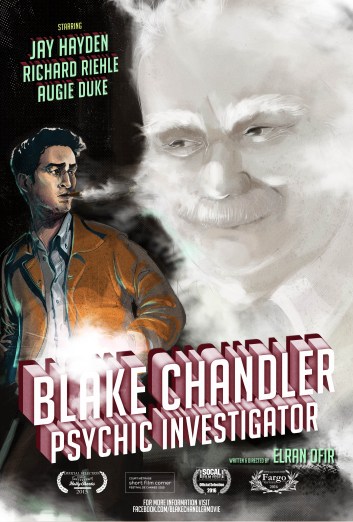
Graphic Designer Joy Sun does noir film poster for “Blake Chandler: Psychic Investigator”

Joy_04_poster
Film poster for Blake Chandler: Psychic Investigator

While growing up in Tainan city, Taiwan, Joy Sun always loved drawing. She knew quickly that she had to be involved with art in her future, but she didn’t immediately know how. Failure wouldn’t get in her way, and after teaching herself storyboarding and working on business cards, she wanted to be both a storyboard artist and graphic designer. Now, she is recognized internationally for her talents as both.

As a storyboard artist, Sun has worked with some of the world’s largest companies, such as LG when she did the storyboard’s for their commercial Bring the Aurora to Life with Power of Perfect Black. As a graphic designer, Sun designed both a website and logo for Bruber Media Partners, as well as business cards for the famous transgender advocate Rodrigo Heng-Lehtinen. She has an extensive resume, but she would consider the highlight of her career working on the posters for the film Blake Chandler: Psychic Investigator, a project that truly combined both her graphic design and storyboard artist talents into one.

Blake Chandler: Psychic Investigator was a very fun and special project since a lot of movie posters nowadays are made with photographs and are heavily Photoshopped. It was a rare chance to get to take a more minimalist approach in terms of style and execution of a movie poster, and I enjoyed having the opportunity to do so,” said Sun.

Blake Chandler: Psychic Investigator is a critically acclaimed and highly successful feature film. It is a science-fiction comedy about a psychic investigator who tries to seek revenge on the ghost of his former crime fighting partner. The film was written, directed, and produced by Elran Ofir, who describes Sun’s work as immensely vital to the production as she was the lead graphic designer for the film, therefore creating the overall image that was most accessible to the public eye.

“There are very few people in the industry with the level of extraordinary talent and ability as Joy Sun and she has earned her lead roles on some of the most widely distributed productions for some of the biggest production companies in the industry. I feel extremely honored to have worked with Joy Sun throughout the production of Blake Chandler: Psychic Investigator and know that she will only continue to create commercially successful and critically acclaimed productions, which is why Joy is an excellent addition to the graphic design industry,” said Ofir. “I personally commissioned Joy for this lead role because she is the only graphic designer in the industry able to recreate the classic style of noir films. Joy’s illustrative and graphic design abilities are undoubtedly distinguished within her field. In addition, I wanted someone that could visualize my direction clearly and the result was an extraordinary film poster that neither me or the rest of the production crew could have expected.”

When the director Ofir approached Sun, he had very clear vision of what he wanted, but still gave Sun the space to be creative. Through his words, Sun says she found myself in a world of fonts. He specifically stated that he wanted the main character holding a flashlight with a cigar in his mouth and with the ghost smoking out of the cigar. Sun immediately wanted to make it her own. She started researching what noir films posters look like and tried to bring that vision onto the paper. She used her knowledge of colors and her digital drawing skills to mimic what Ofir had in mind, and made something he wanted and still from her own creation.

“It is always good to work with someone knows what they are doing as a leader. Elran is a great director and producer with an artistic vision that demands attention, I wanted to work with him for this reason. He is a succinct and clear individual whom is easily approachable, which I respect within business relations,” said Sun. “Also, Noir film has an amazing and deep history and the production of Blake Chandler: Psychic Investigator set out to revive the style. Beyond that, the crew I worked with was magnificent and made the process very enjoyable and interesting. Moreover, who wouldn’t want to work on a film about taking revenge on a ghost?”

The film has seen an enormous amount of success, having been selected for HollyShorts 2015 Official Selection, Fargo Film Festival 2016 Official Selection, SOCAL Film Fest 2016 Official Selection, and the Festival De Cannes 2015 Short Film Corner. For Sun, going to Cannes was an overwhelming experience, as she knows the prestige the film festival has. Not only would the film be showing, but people from all over the world would see her one-of-a-kind poster.

“I am so honored to be part of this process and had the pleasure to have my work out there to share with people,” Sun concluded.

Cinematographer Jon Keng feels lucky to be doing what he loves every day

No matter how many awards he wins, festivals he attends, or film sets he works on, Jon Keng remains humble. For him, it isn’t about the recognition or the praise, for him, it is just about doing what he loves. He knows how fortunate he is. Keng is from Singapore, where people rarely get to pursue their true passions in life as they get forced to conform with societal norms. Despite all that he has accomplished, he just feels to be able to make a living out of being a cinematographer.

Keng started out wanting to be a photographer, but as he grew so did his dreams, and he turned to cinematography. His understanding of how to beautifully frame a still image greatly contributed to his talents as a cinematographer when he began, and now he has worked around the world on a variety of award-winning films and television shows. He previously worked on award-winning LGBT themed films Cocoon and The Stairs.  He recently shot the TV pilot Pineapple, which was selected for Sundance Film Festival 2017. His film Fata Morgana won a prestigious Golden Rooster Awards last year, China’s equivalent of the Academy Awards. There is no shortage of achievements for this cinematographer.

I enjoy my work a lot. Every film presents a different work environment, so I never get bored of what I do,” said Keng.

Working on the 2013 film Tadpoles, Keng began experiencing his enormous success. The film screened at over nine festivals, including the Vladivostok in Russia, Jogja-NETPAC in South East Asia, and the Singapore Short Cuts. He was also the first Singaporean to win the Jury Prize at Locarno International Film Festival in Switzerland for his work on the film, the world’s longest running film festival, which is widely considered to be one of the top film festivals.

Tadpoles was, by far, the toughest film set I had ever worked on,” said Keng. “Being forced to tackle extreme challenges with a team of people is my favorite aspect of filmmaking. I feel that it really bonds the crew and gives us so many great memories to look back on.”

Keng was involved with the film right from the beginning of the screenwriting process, and was able to give his feedback to each new draft as it came along. He worked alongside his childhood friend Ivan Tan, the writer and director of the film. The two of them always had a shared interest in filmmaking, and became a compatible team.

“Jon is a great pillar of support on set. Even when things get stressful, he is always on point and calm with his decision making. This is very reassuring to the crew,” said Tan. “Jon never tries to impose a particular style onto a film. Instead, he digs deep into the core of the story and together, we find a unique look for every film we work on.”

Tadpoles follows two families who are forced to stay indoors and confront their fractured relationships as an unusual monsoon threatens to flood the eastern part of Singapore. There had been a series of floods in Singapore prior to the film, which became the inspiration.

“It feels great to be able to share this uniquely Singaporean story with the rest of the world,” said Keng.

After the triumph of Tadpoles, it became clear to not only Singapore, but the rest of the world, that Keng has extraordinary talent as a cinematographer. In 2015, he worked on the film Home, which became the first Chinese film to win at Best International Film at Raindance International Film Festival.

Home is a unique project because it started right from the ground up. We threw around some themes that we wanted to explore, being migrant stories in China, but we never really had a specific story in mind,” said Keng. “One day when we were on location scouts, we came across an abandoned hotel resort with a gigantic water lily pond. We spoke to the old caretaker of the resort, a migrant worker that had been left behind by the construction company many years ago after the construction had fallen through. inspired by this unique location and character, we decided to write an entire story around it.”

Home tells the story of Lao Tian, an elderly migrant caretaker of an abandoned construction site. On his last day of work, he encounters a five-year-old city girl who has run away from home. Bie Pu explores the concept of homelessness across the social classes of modern day Beijing.

“Shooting on real locations with real people cast in many of the acting roles was a great pleasure for me. It showed me that there is a multitude of stories out there in the real world left to be explored,” said Keng.  “I enjoy this organic style of working, to find a location first before writing the script. This brings a level of realism to the film, something that cannot be achieved with set builds. Once the location was found, the script was completed in less than a week and we were shooting within two weeks once the actors were cast.”

The film had its premiere at the Los Angeles Film Festival in 2015, an Oscar qualifying festival and one of the premier festivals in Los Angeles. It then went on to not only be screened at 13 international festivals, but win the HBO Films Competition Award at the Savannah Film Festival, and the Director’s Choice Award at the Miami Film Festival.

“Working with Jon Keng is the epitome of a professional working experience. Jon’s expertise in cinematography is only matched by his great demeanor and ability to remain calm under high pressure situations. Jon has made a name for himself as being the reliable artist and technician you want on set,” said the producer of Home, Edmond Yang. “J on is good at what he does because he approaches every job and every collaboration from a place of respect. His interactions with coworkers are based on a foundation of trust and professionalism surpassing any of his peers. He is able to keep focus on the overarching needs of a production while never forgetting the micro details which make up each successes. Jon illustrates why creativity fused with technical precision make an artist, but more importantly he reminds us why interpersonal communication is key to our discipline. This is why people want him on every set we have – because he is as talented as he is humble and that’s a combination we want to surround ourselves with in order to achieve our best on film sets.”

It seems that Keng does not work on a project that does not have outstanding results. His meticulous eye and passion for what he does justifies why he is such a celebrated cinematographer. With skills like his, there is no doubt his name will continue to appear on both the big and small screen.

Actor Wadih Dona’s Menace and Magnetism Earns International Renown

WADIH DONA HEAD SHOT3

Australian actor Wadih Dona’s career has been marked by an impressively steady progression of accomplishments. His natural cache of talent and classic theatrical training has earned him two decades of sustained professional success, not only on stage but also with numerous television and film jobs. Dona’s gift for creating fully realized, believable characterizations have landed him several very high-profile recurring roles on Australia’s top TV shows, but those successes are just a minor aspect of the driven actor’s ambition.

“I am interested in telling stories that resonate on a larger scale,” Dona said. “I have been in TV, film and theatre for many years in Australia, and I am interested in opening up avenues for international work. The US is a market that actors naturally gravitate to, and given my long list of credits, I felt ready to take it on.”

It didn’t take long for Dona to reach this goal. His portrayals utilize an impressive mixture of instinct, stagecraft and soulful, emotional intensity; Dona draws viewers in close, building an emotional bond which he deftly exploits for a powerful artistic impact. It was precisely this quality which led him to his first US film, 2016’s Septembers of Shiraz, playing alongside two of America’s biggest movie stars, Oscar winner Adrien Brody and the acclaimed lead actress Salma Hayek.

The film, a thriller set in 1979 Iran, was somewhat of a passion project for the two stars—both also served as producers—and it combines taut suspense and raw emotion into a compelling whole.

Septembers of Shiraz is an art house film, it’s an intimate family story, not an action blockbuster,” Dona said. “The film is an adaptation of the novel by Dalia Sofer, and is based on real life. It centers on a Jewish-Iranian family, played by Brody and Hayek, who are suddenly faced with persecution when the Iranian Revolution unfolds in 1979. Brody’s character is arrested, tortured and humiliated, and the film closely follows his ordeal and the fortitude he had to have to get through it.”

Dona’s personal background—the actor grew up in numerous European and Middle Eastern countries—and formidable resume of successful performances served him well when it came to Septembers of Shiraz.

“I knew Wayne Blair, the director, as we had worked together in a production of Othello for the most eminent Shakespeare company in Australia,” Dona said. “We had history, were good friends, so he trusted me and my work methodology—and vice versa.”

“He sent me the script, asked me to screen test and told me that the project would be cast out of the US, with Salma Hayek and Adrien Brody attached. Obviously, I did well because I got the part, but Wayne had no final say in the casting so it was good to know that I achieved it on my own merit.”

This was indeed the case, as executive producer Heidi Jo Markel said: “We were looking for an actor with gravitas, who could portray the menace of the Iranian Revolution. We knew we had our guy when we saw his fantastic screen test. Wadih is talented actor with incredible screen presence and the icing on the cake was that he was a pleasure to work with on the shoot.”

To develop his character (Rostam, a member of the infamous Revolutionary Guard) Dona focused on Markel’s watchword: “Menace. Rostam symbolizes the forces of chaos and anarchy within the Revolution,” Dona said. “I was cast because I can access those dark emotions quite easily. As a child I was exposed to civil wars and I knew those kind of men, I saw them—young men who suddenly had power, and they could do what they pleased with that power. When we were on set, carrying weapons and with the period uniforms, I was scared when I saw my own reflection in the mirror!”

wadih_on_set

“Adrien Brody and Salma Hayek were both very personally invested in this story,” Dona said. “I had scenes with both, and each was a pleasure to work alongside, but I had more to do, plot wise, with Salma. In one scene, Rostam loots her house and there is an obvious sexual threat as well as one of underlying violence. We rehearsed this scene a few times and kept going deeper emotionally. She went into that dark emotionally territory with me so openly, we built rapport very quickly because of this. She was fantastic to work with—open, accessible and an absolutely gorgeous human being.”

When the film debuted at the prestigious Toronto Film Festival, Dona said, “It premiered there in the biggest cinema in Toronto, the Roy Thompson theatre, with 2,630 people watching. It was massive. I had never seen a cinema that size.”

A complex, thoughtful piece of filmmaking, Septembers of Shiraz was aptly described, by one critic, as “a germane and intelligent observation of the current global political climate in which the world’s ‘have-nots’ are rebelling against the party-political status quo.”

For Dona, it had even more significance. “It was a fantastic, enriching experience,” he said. “Personally, I think we made something quite beautiful and life affirming. And it has helped me leverage myself professionally to do more work. It’s a calling card of sorts for me now—people sit up and listen when I tell what I have done in this film. And, if I had to be selfish, I would say also that shooting a film with one of your friends directing and acting alongside Oscar award winning stars, well, that’s too not bad, either, is it?”

Maryanne Emma Gilbert shines bright in McDonalds Commercial

2016
Maryanne Emma Gilbert is from Calgary, Alberta.

Maryanne Emma Gilbert discovered her calling at a young age. She didn’t know she would fall in love with performing, but she saw her mother on film and thought she wanted to try it. As a shy child, there was a lot that could go wrong. But that is how she knew what she was meant to do; when she stepped onto the stage to perform in her first play, the nerves and shyness melted away, and a star was born.

Now, those days of camera shyness seem like a distant memory, even though the Calgary-born actress is only seven-years-old. Her career has taken off, and she is recognized around the country as being one of the best for her age. She has been nominated for two Joey Awards recognizing her acting abilities, and she has performed in commercials for Doritos and Canadian Tire. She has appeared in films such as Jewel Fools, Season’s Greetings, and the upcoming science-fiction flick Space Rippers.

“Acting is super awesome because I make tons of super cool new friends. Also the food is good. And people are really nice. And I like to tell my family to watch me in movies,” she said.

Despite all of this success, for Gilbert, the highlight of her young but blossoming career was when she appeared in a Canadian nationwide McDonalds commercial. The commercial appeared during the 2016 Summer Olympics, and millions of Canadians began to see Gilbert’s face regularly in their living rooms.

“My whole family in Quebec saw me at every Olympics commercial. My grandpas and grandmas said they saw me all the time at the Olympics commercial. They called me. So I got to talk to my grandparents, and my cousins and aunts and uncles too. They said they saw me. Even a stranger we were talking to recognized us, that was funny,” said Gilbert. “Also, my dad loves to eat McDonalds. He would eat there every day if he could. Also, there was a cow named cupcake.”

The commercial is one of McDonalds’ campaigns trying to show canadians that their food is Canadian. This one was Alberta beef. The commercial features a group of children going to a local farm to learn about cows.

“We got to learn how the beef gets to our plate at mcdonalds and how the cows are treated and where the cows live. We meet the cows and the farmer and we run in the field. There were many things I did not know. It was interesting to see cows. I live in the city and rarely see cows that close,” said Gilbert.

During the commercial, the children follow around the farmer and run around in a field. The director, Tom Feiler, was impressed with Gilbert’s natural instincts as a performer. At one point, when she was supposed to be running around the field with the other children, Gilbert stopped to pick up some flowers, a moment that made it into the final cut and one of the highlights of the commercial.

“I only wanted the best and brightest young actors to be part of the shoot. What struck me the most about Maryanne was her ability to provide a lively performance, while still maintaining a great degree of focus, which increased the productivity of the other kids as well,” said Feiler. “I can’t tell you how proud I am to have directed Maryanne in her leading role.”

Even though she had to battle the cold weather that occurred the day of the shoot, Gilbert’s professionalism and genuine passion for what she is doing shines on screen. For her, it isn’t about just getting to try new things and learn something, it is about who she is with along the way.

“I love meeting new friends. This commercial was with other kids. I met a good friend, Victoria. The other kids were super nice. The crew was really nice too. It was not easy as it was cold that day but everybody was still really nice,” she said. “Also we got to run around lots. I like to run. And it was great to discover a farm. I don’t have one.”

You can see Gilbert in the McDonalds commercial here.

“Rollin’ with the Nines” Reveals Anthony Warren’s Flare for Action

Actor Anthony Warren
Actor Anthony Warren shot by Will Tudor

There’s a scene in the hit film “Rollin’ with the Nines” where Anthony Warren, playing the Jamaican drug dealer Karnage, stabs an informant trying to buy drugs. Warren’s performance is so believable and his Jamaican patois so on point that anyone could be forgiven for thinking they were watching a documentary about crime on the island nation. Upon meeting the successful British actor however, it’s clear that the scene was very much a reflection of his impressive acting talent. Warren is a charming and imposing figure all the same, representing the ideal combination for leading men in the world of film.

Anthony’s ability to jump into distinctive roles that prove to be memorable and game-changing for any film of which he takes part is making him known in the industry. He tells us that the aforementioned scene in particular was “so violently gross [to film] but it was fun.” If anything, the London native was so convincing to his co-stars on the set of “Rollin’ with the Nines” as a menacing drug dealer that “Eastenders” star Terry Stone felt compelled to literally hit Warren in the head with a frying pan in a scene where he and his buddies try to swindle Warren’s antagonist. It hurt, according to Warren, but he swears it was an accident.

Anthony Warren’s hugely successful career began over 20 years ago, in a more humble fashion than compared to his current position of fortune. His work in “Rollin’ with the Nines” marked the beginning of his dominance in the action genre that began simultaneously over a decade ago with his critical role in “Control” opposite Academy-Award nominee Willem Dafoe (“Spiderman,” “The Aviator”), and “Fast and Furious” and “Avatar” heroine Michelle Rodriguez. Leading and starring roles in similar projects have continued, and when watching his impactful performances in films like “Rollin’ with the Nines” and “Control,” it’s clear why Warren hasn’t lived the typical life of the struggling artist.

While many actors take on work whenever they’re hired, Warren’s sought after stature in the industry means he needn’t be concerned with just taking on any project. If anything, his filmography proves his careful selectiveness and irreplaceable position within the acting field.

The truthfulness of Warren’s leading performances in other genre films like “The Deaths of Ian Stone,” opposite “Under the Dome” and “Bates Motel” star Mike Vogel, and as Capt. Naish in the Wesley Snipes (“Blade,” “Passenger 57”) and William Hope (“Aliens, “Captain America,” “Sherlock Holmes”) feature film “The Marksman,” are all proof of Warren having firmly found his own place in a world characterized by high-standards, loyal fans and blockbuster thrills.

rolling-with-nines
“Rollin’ with the Nines” film poster

“Rollin’ with the Nines” in particular has been a thrilling highlight for Anthony, notably so for representing his collaboration with successful director Julian Gilby who also directed Will Poulter (Oscar-Winner “The Revenant”, “We’re the Millers”) and Emma Rigby (ABC hit “Once Upon a Time in Wonderland”) in the 2014 hit-film “Plastic.” It further reinforced his growing profile with action films shot in the UK and his association with the music industry, as “Rollin’ with the Nines” concerns small-time drug dealers releasing their music in urban London.

And therein lies part of Warren’s truly exceptional talent – he has managed to traverse genres effortlessly. In his case (and maybe for this decade) action and musical theatre specifically. Alongside his key roles in action films “The Contract” with Academy Award winner Morgan Freeman (“Driving Miss Daisy,” “The Dark Knight”), Warren’s classical singing training and skill on stage landed him a leading role in Opera North’s Rodgers and Hammerstein production of “Carousel,” directed by Jo Davies, and “Brashana O”, directed by Geoffrey Creswell.

In “Brashana O”, a story based on the legendary rolling calf that forms part of Jamaica’s folklore, Warren wowed audiences with his portrayal of Barker. His connection to Jamaica gave the production a refined sense of integrity, helping to sustain the belief that the Rolling Calf is really a ‘duppy’ (ghost) that has the ability the change, if and when necessary, into other animals. Warren’s performance was easily considered as both impactful and humorous all at the same time. His role as Heavenly Goggin in “Carousel,” a more traditional musical, was an important one that esteemed reviewer Geoffrey Mogridge noted as “mysterious,” and set the scene for the protagonist’s confrontation with the production’s antagonist.

One could say that Anthony Warren is something of a ‘jack-of-all-trades.’ But his success in the different areas of the acting field prove that he is certainly not a ‘master-of-none.’ We look forward to seeing him in many more blockbusters (hopefully action movies, and more musicals) for years to come.


Diana Chao: A Creative and Thought-Provoking Director on the Rise

Originally from Taipei, Taiwan, Diana Chao is a highly successful, 32-year-old, Los Angeles-based director. After obtaining her MFA in Film Production from USC’s School of Cinematic Arts in 2013, Chao continues to direct shorts, commercials, and features professionally, both locally and abroad.

“I was first hired as a director in 2011 for Violence in the Closet in Taiwan,” Chao said. “In 2013, instead of directing a school thesis film, I decided to do The Restoration as an independent project in which professional crew were on board, where I could immerse myself in telling the story without supervision. I launched a Kickstarter campaign to raise funds for making the film. Upon its completion and recognition for festivals, I have had the pleasure to be hired as director for more projects.”

therestoration_03
Diana Chao on the set of The Restoration 

For Chao and her career, this achievement was just the first of many.

The Restoration is a story that focuses on our desire to say goodbye. Inspired by an event that occurred in Taiwan in 2008, it follows Sean, a young restoration apprentice, who learns about closure and his feelings toward a family member’s departure while working on a project with an experienced restorative artist named Joanna. Together, their skills in preparing a corpse for its transition from the present are challenged by the extensive damage caused to the body. The film stars John-Scott Horton, Katie Savoy and Jason Caceres.

Chao first wrote the script back in 2010, where it was short-listed twice for a USC production class. “I pitched it the first time and had meetings with various directors the second, but ultimately they had their own visions about the project. Jeff – my classmate and trusted friend as well as the editor of The Restoration – encouraged me to make the film myself. With his support and encouragement, little by little, The Restoration storyline evolved into its current version,” commented Chao.

The short film was beautifully shot by the award-winning Cinematographer, Will Jobe. He and Chao initially met at USC where they were classmates and both received their MFA degrees in Film Production. Jobe’s work has screened at South by Southwest, Slamdance, and Cannes, his clients including well-known names such as ESPN, Hallmark and Subway Sandwiches, to name a few.

“Diana was the principal creative force behind The Restoration,” Jobe praised. “She was meticulous in the planning of her vision for the film and coordinated with the heads of each department to ensure its proper execution. I remember in the many preproduction meetings how Diana exposed me to a variety of visual references that I had never seen before. I discovered the work of both Easter and Western directors and cinematographers that exhibited fresh aesthetics that differed from the Hollywood norm. It was obvious to me that Diana had a keen academic understanding of film history, but was also well versed in many different genres and aesthetics of modern independent and international cinema. I feel that The Restoration was only a first step in seeing Diana’s true potential.”

therestoration_01
Diana Chao and the crew of The Restoration

The Restoration was the independent project Chao directed in which she had full control. Thanks to her training and education from USC, Chao had acquired a full understanding of how production works, as well as the role of every individual on set. Elaborating on this, Chao said, “Production is teamwork with hierarchy. As a director, it’s crucial to do my job and let the team do theirs. I was passionate about making The Restoration. I don’t necessarily know the technical details of how to execute each person’s job, but as long as I was clear about my vision, my team wasn’t confused about how to help me make the film.”

Chao wound up receiving much praise and recognition for her film, including an award for Best Original Score from the 2015 Long Island International Film Expo and a Merit of Cinematography from the 2015 Rochester International Short Film Festival.

In April of 2012, Chao was asked to document the production of the feature film Finding Mr. Right in New York City, a US-China collaboration. Chao acted as the director of the film’s promotional materials and was therefore given the challenging responsibilities of conducting interviews, editing footage, and bridging communication between three main parties: the production company, the promotion company, and the main cast, directors, and their agents and assistants.

According to CEO Lisa Chen, who collaborated with Edko Films on Finding Mr. Right and speaks very highly of Chao, creating the promotional material is the, “Single most important tool for a film’s publicity. Great promotional material can get you into festivals, boost your crowdfunding, and even land you a distribution deal.”


findingmrright_01
Diana Chao working on Finding Mr. Right

From a commercial standpoint, Finding Mr. Right grossed the U.S. equivalent of $84.4 million at the box office. Additionally, the film won 2 China Film Director’s Guild Awards for Best Screenplay and Best Actress, was nominated in the same awards show for Best Director and Best Picture, took home a win at the 2013 Golden Phoenix Awards, and received 2 nominations at the Hong Kong Film Awards in 2014.

“We fully trusted Diana as the director for our promotional material and the footage that she made was exceptional and used for marketing and promotion throughout China. Due to Diana’s prowess as a bilingual filmmaker, Diana was able to bridge the gap between the Chinese production team and the local freelance filmmakers. Her work provided an easy way to get the word out about the production with her concise, creative, and impressive directional style, which also influenced the entire production as a whole,” said Chen.

It is evident that Chao excelled in generating extraordinary press materials for the film, her efforts playing a vital role in its ultimate viewership and success. Her work has a tendency to reach and inspire wide audiences in every instance, as also demonstrated by her work on the 2011 short film Violence in the Closet.

Violence in the Closet is an eight-minute short film and Public Service Announcement (PSA) that brings awareness to domestic violence among the LGBT community. The film tells the story of a 30-year-old lesbian, WenWen, undertaking multiple pressures in life and arising conflicts between her and her girlfriend. “It was meant for promoting the amendment of the Domestic Violence Prevention Act and letting the LGBT community know that homosexual couples, partners, and roommates are also under protection of the law,” Chao further explained.

Due to budget limits and time constraints, Violence in the Closet was shot over two nights and finished within one week in order to meet the deadline of the annual fundraiser it was intended to screen at. “Because of the NPO’s (Non-profit Organization) budget limitations and of Taiwanese actors’ hesitation to be cast for lesbian roles, we ended up casting non- actors who are lesbians,” Chao added. This route came with a few challenges when it came to directing, but nevertheless, Chao overcame them and prevailed.

violenceinthecloset_03
Diana Chao directing Violence in the Closet

“There’s a set of languages a director uses when working with professional actors,” she went on to describe. “Non-actors don’t really take those directions. I found method acting helpful – it doesn’t require actors to become the characters, which is difficult for non-actors. Instead, it helps actors find the expressive emotions that they share with the characters. By walking them through the emotional beats the characters had in the script, I was able to overcome that challenge.”

Chao performed the service of directing the project for free, out of the grace of her heart, and for the betterment and expansion of the Taiwan Tongzhi Hotline Association.

Originally founded in 1998, the Taiwan Tongzhi Hotline Association is a non-profit organization aimed at providing a space for acceptant and empathy in the LGBT community. It is now the oldest and the largest, lesbian, gay, bisexual and transgender organization in Taiwan.

Violence in the Closet was released at their 2011 annual fundraiser, Taipei Hotline events, and online in an effort to help raise awareness and funds for the organization. Chao’s work helped the Taiwan Tongzhi Hotline Association earn a total of $103,722 in donations.

Jennifer Hsin Chieh Lu, the Taiwan Tongzhi Hotline Association’s Director of Public Affairs, stated that Chao’s generosity provided them with, “A rare instance where we were able to engage an extraordinary filmmaker and director for the betterment of our cause, and thus, the betterment of our society. Violence in the Closet was highly influential, important, and touching to many viewers. We needed to work with a remarkable director who understood its sensitivity and was able to deliver a powerfully striking, unforgettable message. Without a doubt, Diana Chao achieved to direct such a powerful short film for us and was able to successfully send the message to the audience.”


For more information on Diana Chao, please visit:
http://www.imdb.com/name/nm6371027/
 https://dianachaos.com/

For The Restoration, please visit: https://vimeo.com/121533655
For Finding Mr. Right, please visit: https://www.youtube.com/user/edkofilms
For Violence In the Closet, please visit: https://youtu.be/MXfVRGk3kSg