Masters of any field are not born, they are made. However, some individuals possess attributes which cause them to be ahead of the crowd. Those who are leaders in their field have become so because they recognize there is always another way to hone and define their abilities. Mari Lappalainen is this type of professional. Although she has many films and television productions to her credit, Gehenna: Where Death Lives was her first horror film as Production Designer. Director Hiroshi Katagiri recognized her talent as well as the opportunity for her to experience a new genre of film, partly due to his own experience. The film is also Katagiri’s directorial debut, which meant he took care to insulate himself with a crew he completely trusted. Lappalainen is known for her work as an Art Director on films such as: Danny Boy, Share, Awaken, and others but has been working increasingly as a Production Designer crafting the look of a film early on. Katagiri is lauded for his special effects makeup career (working with Steven Spielberg on Jurassic Park, A.I., and War of the Worlds as well as films with Rob Marshal, Guillermo del Toro, Sam Raimi, and others). There was a kinship shared between Lappalainen and Katagiri as talent recognized talent. With Gehenna, the results were entertaining, chilling, and culture blending. A great deal of this is a result of the look of the aesthetics of the film which Mari and Hiroshi worked so hard to create.
Gehenna is the story of a group of American real estate developers who travel to Saipan to scout land on which to build their next hotel resort. Unknown to the group, the area is sacred land that had been cursed centuries ago. They cross paths with an old Japanese WW2 bunker and enter to see if this will be an issue for their development. Soon, the door gets shut and the team is at the mercy of the curse; a curse which states that the last one alive loses and must face eternity alone in the dark. Although the film’s setting is on this Pacific island, the actual filming took place in Los Angeles. Director Hiroshi Katagiri is a stickler for authenticity. This meant that he took Lappalainen, as well as the Cinematographer, and Line Producer on a trip to Saipan to get a feel for how the set should be. Mari recalls, “The story was set in Saipan, on a small island across the world with significant WW2 memories. To get the feel of Saipan, their history of the war, and get accurate references for our Japanese bunker set to be built in Los Angeles, we flew to Saipan in early September. We scouted our filming locations there and photographed old war time bunkers and materials/finishes for reference. As almost everything in prop and set dressing wise was Japanese, I spent a few days in Tokyo to look for our hero props and set dressing references from museums and archives of the war period.”
As Production Designer, Lappalainen used some modern tools to give Hiroshi and the crew the most realistic sense of what the set should look like. Mari comments, “For Gehenna, I did the 3D modeling myself, adding textures to the model to show the director what we would be expecting and helped him to develop ideas for the storyboards and imagine the blocking for the action. It took a lot of research, especially for the small details as it was a Japanese WW2 bunker. There were no standing sets in Los Angeles like this so we had to create if from scratch. We looked at Japanese war movies and went to museums to learn about Japan at this time.”
Mari took great care to study the script for Gehenna, breaking down the script to understand the needs of the film in terms of visual language and character. Her trip to Japanese museums gave her a complete understanding of how the troops quarters were organized as well as the psychological and emotional “vibe” of the space; an element key to the actors and the audience getting a sense of the surroundings.
Gehenna: Where Death Lives was an obvious success as its inclusion in so many well-known festivals attests. Gehenna was selected to The New York City International Film Festival (NYCIFF), the Bram Stoker International Film Festival 2016 (UK Premiere), A Night of Horror film festival in Australia, and LA’s Shriekfest. Katagiri states, “Gehenna is a biblical term for a horribly evil place, and Saipan was the site of the heaviest fighting of WWII. To keep my vision, the look of the film needed to communicate this with the surroundings in an unspoken way; Mari Lappalainen made this happen flawlessly. She perfectly achieved creating the setting I imagined.” Lappalainen’s foray into horror films proves that her consummate abilities as a Production Designer translate from genre to genre. Being vetted by a recognized leader in the horror, fantasy, and sci-fi genres like Hiroshi Katagari is certain to bring Mari continued work. Whether in a romance, drama, comedy, or horror film, Mari will be bringing her self-demanding work ethic to the positive reviews of filmmakers and audiences alike.
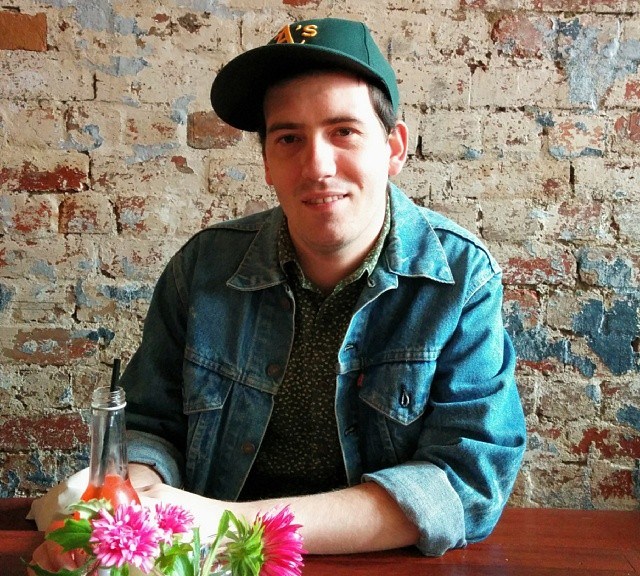
Nick Fulton has deftly parlayed his personal interest in pop music into a successful career as a professional writer. The New Zealand-born Fulton’s concise, insightful style, impeccable taste and natural affinity for his subject have enabled him to go, in a decade’s time, from startup blogger to internationally recognized voice. His groundbreaking Einstein Music Journal was one of the first web presences in the remote island nation and virtually introduced the music blog format there.
For Fulton, it came together almost by chance. “I started writing after a friend encouraged me to start a blog,” he said. “In 2004 very few people in New Zealand were blogging, so it was pretty exciting to enter that space. It also meant that the people I connected with online were mostly outside my local community. I made friends and connected with other writers in Sydney, Los Angeles and London.
“Around that time I tried to connect with a couple of print publications that were based in Auckland, which is where all the major publications in New Zealand are based,” Fulton said. “But I was living in Wellington and struggled to find my way in. As a result, I started writing more frequently on my blog, which later evolved into Einstein Music Journal (EMJ). I got another writer on board and used Myspace to reach out to bands and music blogs in other countries. Before long we had a steady readership, and when we eventually launched Einstein Music Journal in 2006 we were able to throw a massive party and sell out one of Auckland’s best live music venues.”
“We operated slightly differently to the traditional music media,” Fulton said. “We didn’t always go through conventional channels to secure a story. We quickly gained a reputation for being bold and enthusiastic, and many publicists and record labels responded well to us. On several occasions we managed to secure stories that much bigger publications and other established writers in New Zealand missed out on.”
From this somewhat cheeky Do-It-Yourself start, Fulton, thanks to a reputation which was gaining respect and admiration beyond New Zealand, found respectability being thrust upon him and soon eschewed such pop guerilla tactics.
“My biggest achievement is finding an audience for my writing outside of New Zealand,” Fulton said. “With EMJ, I had regular readers in New York. LA and Australia. More recently I’ve worked with influential writers like Jessica Hopper, Cuepoint’s Jonathan Shecter and co-authored a column with hip hop writer Michael ‘DJ’ Pizzo. Being personally asked by Shecter to contribute to his publication was such an honor, and one that I will never forget. He wrote to me after I self-published an article on Medium, asking if he could republish my story on Cuepoint and if I’d be willing to join him as a writer and editor there.”
This natural momentum has served the writer well, and Fulton’s aim is always true—his 2015 Pitchfork magazine editorial “It’s Time to Put Our Cameras Away” (which called for a cessation of fan cellphone recording at concerts) not only inspired a contrarian clickbait response from venerable NYC weekly the Village Voice, it coincided with the practical use at numerous music and comedy performances of a variety anti-cell phone technology, a practice that is steadily growing.
“I like writing about a potential trend, or an unusual observation,” Fulton said. “My Pitchfork Op-Ed started a healthy debate online and had an overwhelmingly positive response. Pitchfork‘s Facebook and Twitter received a lot of comments, mostly agreeing with me, which was good. The only real dissent was shown by that writer at the Voice, who penned a response telling people to keep doing whatever they wanted. I think he thought I was being too politically correct.”
With a kaleidoscopic range of subjects from world class pop superstars to offbeat independents like Italian noise rockers Father Murphy, offbeat New York hip-hop group Das Racist, New Zealand filmmaker-music video director Simon Ward or a behind the scenes piece of music studio production Fulton’s analytical easy going methodology always holds the reader
“Nick’s a great guy and a great writer,” broadcaster David Klein said. “EMJ was one of the key music blogs in the country, and one that was a real defining authority. We met when he was a guest on a radio show I hosted. It was awesome to have Nick onboard, he always presented interesting new music, and could speak about it with a good understanding of trends, composition, and just the way music appeals to you at an emotional level. I’d trust Nick’s taste, and the quality of his writing is what has made him so successful. And he is always expanding his range –I just read something about music studio production he’d written a few weeks ago, and it was great.”
Now an almost ubiquitous figure in the local music scene, Fulton’s achievements and variety of outlets continue to grow.
“Being viewed by the public as an expert in my field is one the highest honors,” Fulton said. “I’m proud of the times I was invited on to radio shows, to comment publicly about a trend in music or share my thoughts on a popular band. Now my goal is to become a trusted voice outside of New Zealand and Australia. I’d like to immerse myself in the American music scene for a while and soak up as much knowledge as possible. I got a taste of it all when I visited in 2012, but there’s still so much to discover and write about.”
Fulton’s elegant yet hard charging style has taken him far, but the writer is just now really coming into his own, and this success is very easily explained.
“Working with Nick was great,“ editor Katy Hall said. “He’s the kind of writer you hope will stumble into your inbox at some point but rarely does. He’s personable, professional, knows how to stick to a deadline, and most importantly, he always delivered really high-quality work. It was engaging, tailored to the publication’s tone and needed no editing. I don’t want this to sound cheesy or overhyped; it was just the reality of working with a great writer.”
Animator Angela Yu: “I love telling stories carrying a message that matters to people.” (photo courtesy of Angela Yu).
With a dazzling visual style, an acute eye for design and a keen ability to overcome unexpected challenges, animator-art director Angela Yu’s boundless technical capacity and artistic creativity are remarkable. Moreover, she has an innate knack for approaching projects with a transformative originality that frequently redefines and improves upon the initially proposed concept.
Yu’s spent her entire life preparing for this, going all the way back to her childhood in Bejing, China. Yu became fascinated by comics, anime and manga books at an early age, covertly defying her parents’ strict bedtime rule to read them by flashlight under her blanket. “I always loved to draw and became obsessed with beautiful things and I wanted to know how to create things like that,” Yu said. “Manga books were my earliest inspiration for drawing—I’d doodle the characters all over my text books. I also loved watching animation, especially Japanese anime—“Dragon Ball” and “Sailor Moon.” I still watch anime these days, such as “One Piece.”
“I grew up in a very traditional family in China, and though I dreamed of being a Manga artist or animator as a kid, I never thought I’d have a chance to do it in reality—because for all my life I had made decisions based on whether or not they would impress my parents,” Yu said. “But when I was 22, I came to America and was studying at Michigan State University, just as my parents planned. This gave me a chance to view my culture from a distance, with a different perspective, and it gave me the space to think independently and the courage to pursue what I really wanted for my own life.”
Once that decision was made, Yu, with an MA in advertising from MSU, did not hesitate. “I studied Motion Graphic Design at the Ex’pression College for Digital Arts. Since I graduated, I’ve worked at studios and agencies such as Goodby Silverstein and Partners, Oddfellows, First person. And I worked on projects for clients like Google, Yahoo, Cisco, Comcase, NBA, Motorola, GE, Adobe.”
“I love telling stories carrying a message that matters to people. It needs to be meaningful. It can be either an artistic short film or a commercial project. As long as I feel what I am creating has a purpose, I find it fulfilling,” Yu said. “It’s all about how strongly I believe in the message I work on, even on a branding video for a digital product. If I believe the message in the video will make a difference to the brand, to people who work for the brand, then I enjoy what I am doing.”
Once Yu brings her talent to bear, the results are impressive. The ability to enhance and elevate has been a hallmark of her career; if Yu is brought in to consult, she’ll envision something that takes the entire project to a higher level; when Yu finishes a task, it often assumes a life of its own, garnering more notice and appreciation than anyone expected, whether a promotional film or a rock music video.
As Dorry Levine, Digital Media Strategist at ReThink Media, describes her: “Angela was easy to work with, very accessible, met every deadline, was flexible with our ever-changing requests, and turned out a phenomenal project that people are still talking about. The video she animated for us was even covered by the New York Times. I’d work with her again in a heartbeat!”
Yu’s artistic vision is a marvel in its own right. Her gorgeous animated short, “This is California,” is a perfect example of the animator’s rich aesthetic. With stunning visual design and flawless animation, it depicts some of the Golden State’s most iconic spots in an arresting, irresistible form that earned Yu the Best Animation award for 2015 at the IndieFEST Film Festival.
Yu’s already impressive roster of successful jobs with some of the world’s biggest companies underscores both her illimitable potential and singular gift for expanding the parameters of any design or animation undertaking. “Angela is the type of person that makes the seasoned artist step up their game, while also reminding everyone what that fire looked like when they first started,” said Mike Landry, Creative Director at Goodby, Silverstein & Partners.
Most importantly, Yu loves what she does: “I see animation as music written in pixels. I don’t play music very well, but I am fortunate to find animation as the medium to express my creativity,” Yu said. “To this day today, I still enjoy spending the whole afternoon nerding out a motion curve in the graphic editor. It is a very ‘zen’ feeling. I enjoy my craft, and I never stop creating original content. I want to keep developing myself as a better animator and designer.”
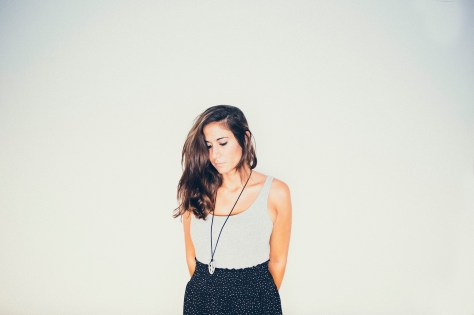
Cristina Tomas Rovira specializes in photography and videography for music, fashion and weddings.
Professional photographer and videographer Cristina Tomás Rovira has worked alongside with some of the greats of the entertainment industry, capturing moments via still photography and film for more than half a decade.
Originally from Barcelona, Rovira’s awareness of the arts was sparked at a young age. “I’ve been interested in this world since I was little,” Rovira said. “Every time I watched a movie or a TV show, I could picture myself working on one of them. I was, and still am, addicted to watching behind the scenes videos.”
After obtaining her first camera around the age of 10 and receiving praise for her photographs, Rovira explained that, “something just clicked. I loved the feeling of people telling me that my talents were special and that they liked my pictures. So, I kept going to continue to get the same reactions from them.”
Rovira began working professionally while attending The Centre de la Imatge i la Tecnologia Multimèdia (Barcelona) in 2010.
“My first job as a photographer was at a music festival in Barcelona. I was 19 years old at the time, and it was one of the best experiences of my life,” Rovira described. At the time, Rovira’s pictures from the festival were used for press, ultimately gaining her work recognition around the city of Barcelona.
It was also during college when Rovira picked up her first DSLR camera in an attempt to figure out the basics of videography. “I was working on a fashion assignment for one of my classes and noted a lack of videographers surrounding me. DSLR cameras were increasing in popularity, so I decided to try the whole video thing for myself. I ended up capturing the making of that fashion project, and from that day forward my life was forever changed,” said Rovira.
Since 2010, Rovira has been in charge of all filmmaking at Padilla Rigau, a leading, Barcelona-based Wedding Photography and Videography company. The company is known for capturing some of lives most precious moments with a unique, modern and fresh twist.
“I truly believe that our work as photographers and videographers is based on feelings – to create them, and to capture them,” said Rovira. “Attending weddings has provided me with a greater sensitivity towards what is in front of the camera, and I now use that sensitivity always, whether I’m shooting a wedding, a commercial or a fashion film.”
In Rovira’s opinion, two of the most powerful qualities a good photographer can have are that of speed and affectivity. One must be fast, humble and approachable, and the same goes for videographers. “If you shoot the same look or seen a thousand times, the subject will get the impression that it is his or her fault. If you have something specific in mind, you need to explain your idea when everyone’s around, so that everything translates, including your excitement regarding the prospective shot,” Rovira explained.
When it comes to her own work and creative tendencies, Rovira tends to enjoy capturing the details that are often overlooked. “I consider myself an adventurer,” said Rovira. “I have always been on the hunt of new perspectives. I like telling stories from a different outlook. I’m really observant. I’ve always been that way, and that fact about my personality has given me an extreme sense of what people like to see in my work.”
The work of a photographer entails so much more than a simple point and click. It is a job that requires an excellent aesthetic eye, and both creative and technical aptitude. For example, when it comes to the different types of lighting she’s worked with, Rovira provided, “You have to be like a chameleon and adapt to the lighting that has been given to you. Sometimes, I’m shooting something that’s happening under one kind of light, and when I turn around to film something else, the light is completely different, so I have a very small window of time to reset my camera to shoot the second scene. I have to be fast and prepared so I don’t lose the moment.”
Rovira developed her own photographic style upon moving to Los Angeles for a year, where she collaborated and refined her camera skills with the internationally renowned photographer, Joseph Llanes. Llanes’ work has been published in Rolling Stone, Billboard, Spin, New York magazine and L.A. Weekly. His wide range of clients includes talents like Rihanna, Justin Bieber, The Black Keys, Katy Perry and Gavin Rossdale, to name a few.
“Everything that surrounded me was invigorating and I felt a constant need to capture most of the people and things that I came in contact with,” Rovira explained of her introduction to the entertainment industry of Los Angeles. “Being a foreigner gave me the chance to see the extraordinary in the ordinary.”
Alongside mentor Llanes, Rovira assisted with multiple photo shoots with top clients, where she ultimately acquired an intense understanding of the building blocks of professional photography. “I always learn something from Joseph in every photo shoot or project that we collaborate on. He taught me the importance of creating a good environment at work, and to always be two steps ahead of yourself with every project. Have a plan B, C and D, so you’re prepared to quickly solve any problem that might occur during the shoot, without the client noticing that there was even a problem to begin with,” Rovira said.
Since this experience, Rovira has photographed and assisted with shoots involving many top tier musicians, bands and musical events, her framework including talent such as Quincy Jones, Phoenix and Els Catarres. In 2013, Rovira assisted Llanes at the world famous annual music festival, Coachella. She has also photographed leading music events in Los Angeles with Llanes such as Hard Summer and the Hard Day of the Dead Festival, where Rovira worked in photographing such famed talents as the Grammy winning DJs Calvin Harris, Skrillex and Zedd.
During the Aokify America Tour’s November, 2013 Los Angeles show for Steve Aoki, a Grammy nominee and Billboard Award winning EDM musician, Rovira photographed Aoki as well as music superstars Iggy Azalea, Linkin Park, Travis Barker and Kid Cudi.
As a videographer, Rovira has engaged her outstanding talents for companies Brownie Spain and Padilla-Rigau, for several years. As an innovative team member, Rovira has, and currently, films and photographs weddings and fashion events. “Nowadays, we are amongst the top ten wedding photographers and videographers in Spain,” Rovira said. “I love doing weddings because I work with two of my best friends. We have built a really strong company together.”
When it comes to fashion, Rovira has created fashion films with some of the most well known brands in all of Spain. Some of Rovira’s clients include Shana, Swarovski, Codigo Basico, Estel Alcaraz and Pompeii Brand, among others. Regarding her work, Rovira commented, “Working with [these brands] on a regular basis allows me to improve and try new things with each video. I love capturing what’s going on around me.”
With industrial designer Estel Alcaraz, Rovira has acted as her, “right-hand person,” as quoted by Alcaraz, since the beginning of Alcaraz’s career. “Cristina is a part of my team. I was lucky enough to know her when we were both starting our professional careers and we helped each other as much as we could. She works with me on every project I start. She’s exceptionally sensitive to detail and puts my ideas on paper or on video. Either way, she always gets what I want because she has the ability to capture the emotion and passion that I put into my products through her work.”
The pair worked closely with one another on one of Alcaraz’s most important projects, The Sardines Boots. The Sardines Boots are bright yellow, light, flexible rain boots that are designed to easily fold and compress to a backpack size. With the motto, “Don’t let wet socks give you cold feet,” the campaign was published worldwide.
“Cristina knows how to showcase the essence of my products and it was great to be known inside the world of industrial design with her work, as she is one of the people who believed in me from the very beginning,” Alcaraz said. “Working with Cristina is great because she always wants to go one step further and is always thinking about starting new projects. Sometimes, she even encourages me to design so that can she make a new video. She has this contagious positive energy that makes you believe that you can make everything come true.”
Rovira has also applied her profound camera skills for a TV commercial with professional Spanish footballer, Andres Iniesta. “I showed my footage and pictures to the director of that shoot and his reaction was priceless. He liked how I captured moments that he didn’t realize happened, and commented that the composition of my work was extremely beautiful.”
Jordi Egea, owner of the Spanish production company Smilefilms, directed the commercial shoot. Previously, Egea and Rovira have collaborated on several projects with the brand Dormity. Regarding Rovira’s sought-after skills, Egea said, “We hire her because she is great at doing her work, she gives you what you and your client ask for, and goes above and beyond what is needed of her. She understands her clients and what they want and captures the essence of every brand while still maintaining her personal style. Plus, people feel comfortable around her, and that’s key when you work with people who are not necessarily used to being in front of a camera.”
Photographer Tom Penpark specializes in panorama, natural landscapes, architecture, electronics, food, people and objects.
Tom Penpark has been at it since he was 6 years old.
“I was inspired by my father to become a photographer,” he said. “He carried his camera with him all the time. His main subject was my mom. One day, he handed me my first camera, and I’ve enjoyed taking pictures ever since.”
And since that initiation, it’s been a pattern of success, recognition, accolades and honors stemming from Penpark’s world-class photographic brilliance.
His outstanding work has been published with The Huffington Post, The Telegraph: UK, Discovery Channel, SF Chronicles: San Francisco, Amazon.cn, Photographer’s Forum Magazine, Popular Photography Magazine China, Chicago Metropolitan Association for Education of Young Children, and American Photographic Artists (APA) San Francisco, to name a few.
His photography clients have consisted of well-known brands like Adidas, Google, Crossroad Trading, Monster Products, and Rodeo Realty Beverly Hills. Additionally, Penpark has demonstrated his retouching skills with clients such as Men’s Warehouse, Levi’s, Old Navy, Peet’s Coffee, T-Mobile, Charlotte Russe, Airbnb, Adobe, Nike, See’s Candies, and Gillette.
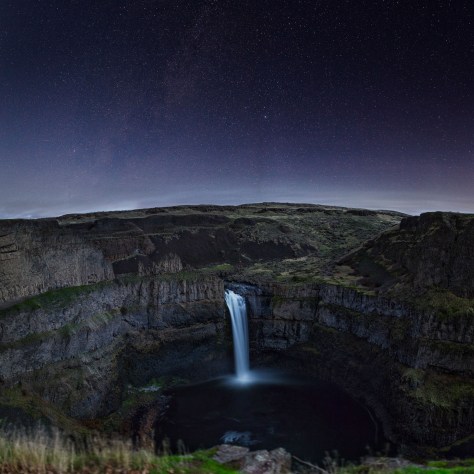
Originally from Bangkok, Penpark was used to photographing communities where the scenery around him was all quite similar. Exploring America allowed Penpark to expand his photographic imagination and immerse himself into the realm of panoramic photography. “My first trip to the U.S. started with Yosemite National Park in 2007. I had my old Canon Rebel with me. I learned that I could not capture what I saw in one frame and I couldn’t show what I actually saw through my pictures. That’s when I began learning about panoramic photography and started shooting panorama in order to get exactly what I saw,” Penpark said.
While panorama remains one of Penpark’s highest interests, he thoroughly enjoys photographing many different subjects. From architecture, electronics to food, people and objects, and natural landscapes, his photography spans a wide range of topics.
Photo: Tom Penpark.
Regarding his versatile style of capturing, Penpark commented, “If I had to pick a favorite subject, it would have to be either landscape photography or people in landscapes. I enjoy traveling to places I’ve never been and conversing with and learning from new people. I love capturing people’s emotions and the perfections made visible in still life through my photography. Having to hike up to new destinations and dedicate copious amounts of time in order to ensure I get the perfect landscape photography always inspires me and constantly pushes me to work beyond my limits.”
Over the past ten years, Penpark has dedicated his time to exploring the different avenues of photography. “At the moment, I think my photography goes in two directions,” Penpark explained. When he has the time, Penpark continues to pursue his love of landscape photography through various road trips. “When it comes to my personal photography, I think the beauty of my photographs is the perfect of the imperfection. However, for my commercial photography, I focus specifically on perfection and what my clients are looking for.”
Early on in his career, Penpark worked as an Assistant Photographer to some of the biggest names in the business. For several years, he assisted talents such as Shalom Ormsby, Trinette Reed, Chris Gramly and David Fischer.
“I have learned all of my skills from others,” said Penpark. “My processes of planning, shooting, post-processing, and printing are all of general knowledge, the same as other photographers. Personally, I plan all of my shoots when I can. Long preparation and a short execution are always better than no plan at all for me. I will go the extra mile to find the best times and locations that will allow me to obtain the best final images as a result.”
Penpark has collaborated since 2008 with John Lund, a stock photography phenomenon, founding member of Blend Images and current APA SF Board Member.
“Tom’s background in art direction and design is apparent in his work, his Photoshop abilities are deep and professional, and his understanding of Lightroom and digital capture is extensive. Tom is more than just a talented photographer; he is a problem solver as well,” Lund said of Penpark’s many talents.
After earning recurring awards and recognition as a remarkable photographer by the American Photography Association (APA) early on in his career, Penpark was selected as a member and actively participates as leading voice in their events.
The APA is a non-profit organization built by photographers for photographers. It exists to provide business tools and creative inspiration in order to aid artists in the artistic process of photography and maintaining a stable, profitable business.
Over the years, many of Penpark’s images have been accepted by APA judges and exhibited throughout several selective shows such as the APA SF Something Personal Exhibition and the APA SF Selected Works Exhibition. In 2011, Penpark was awarded a Judges’ Fourth Place Award from the APA San Francisco Something Personal Exhibition.
“APA is a well-respected community for professional photographers. It was an honor to be selected for the APA Judges’ Fourth Place Award in their exhibition that took place in 2011,” Penpark said. In 2012, he acted as APA’s guest speaker at the Apple Store in San Francisco for their Creative Professional Series.
“After that,” Penpark continued, “my pictures were selected for their exhibitions almost every year.” In 2015, he was selected to be an APA judge. “As a professional photographer, this is a great honor.”
National Board Member of the APA and Chairman of the Board APA of San Francisco Chapter, Christian Peacock, commented of Penpark’s valued skills, “His talents and dedication to the excellence of his craft were evident in his examples of imagery that cannot be seen with the naked eye. I highly endorse Tom Penpark as an outstanding member of the APA and am looking forward to seeing his future accomplishments in our industry.”
Photography is a profession that requires both creative and technical abilities. Throughout the years, Penpark’s spent proving himself as an esteemed photographer. His work clearly showcases his mastery of having acquired both.
Photo: Tom Penpark
“Being a professional photographer requires a lot of investment in technical and artistic education,” Penpark said. “Having a solid foundation of the arts, painting and the history of photography are necessary qualities. However, at the same time, having excellent camera and lighting skills, knowing how to retouch images, and being knowledgeable of digital printing and digital assets management is important, too. Digital photography is half art and half tech. As a photographer, I can never stop learning and exploring.”
For the 2014-15 and 2016-17 editions, Penpark was selected and published as one of the Best Ad photographer’s for Leuzer’s Archive Magazine, a leading magazine for innovative ideas, photography and illustration. The honor is among the best in professional photography.
“The photos in Archive Magazine inspired me to become a full time photographer,” Penpark said. “I am proud and honored to be part of the selected group of photographers from around the world.”
In 2011, Penpark first initiated his role as a Contributing Stock Photographer at Getty Images and Blend Images.
Based out of Seattle Washington, Getty Images is a stock photography agency that is known for supplying business and consumers with an archive of over 80 million still, stock images and illustrations, and more than 50,000 hours of stock film footage. Similarly, Blend Images is an international commercial stock agency, founded by some of the world’s most successful photographers and industry veterans.
Penpark continues to successfully contribute his work to these stock agencies to this day and is now a Photoshop Production Artist with Schawk! on-site at Apple Headquarter in Cupertino.
Penpark formerly worked as the Digital Media Group Manager and Lead Photographer for Monster Cable Products, Inc., a company known for it’s manufacturing of audio and video cable products. The photographer fondly remembers one of his most recent shoots with the company – a concert at CES in Las Vegas, Nevada.
“It was a Michael Jackson Tribute Concert,” Penpark said. “I was given the opportunity to take pictures of Aerosmith’s Joe Perry, Ne-Yo, Rick Ross, Magic Johnson, Shaquille O’Neal, Christina Milian, and the Jacksons. I was their official photographer at that event. One of the best moments was when my prints were signed by Jermaine Jackson, one of my idols.”
At Monster Cable Products Inc., Penpark worked under Ryan Notch, the Former Digital Media Group Manager of the company. “Tom is the real deal,” Notch said. “Not only is he an incredibly skilled technician at his craft, but he is amazing at concept and creative as well. I have been extremely fortunate to have Tom as the rock on my team here at Monster. He is very hardworking, dependable, and self-driven. Best of all, Tom is truly a pleasure to be around. His thoughtful and eager-to-help attitude has always made him an integral team player within our department. I can’t say enough wonderful things about Tom. I would, without hesitation, recommend him for any and all opportunities that come his way.”
In 2013, Penpark had the opportunity to meet Hossein Farmani, the founder and president of the legendary “The Lucie Awards,” Co-Founder of the Palm Springs Photo Festival and an all-around icon of photography. “I showed my prints to Hossein and they were selected to be a part of the 180th Anniversary of Thai – U.S. Exhibition,” Penpark said.
Penpark’s photos were showcased in the same exhibition as other world-class famous photographers such as James Nochtwey, Steve McCurry, Greg Gorman, Colin Finlay, Benya Hegenbarth and Douglas Kirkland.
Penpark’s photographs have also been featured in a solo exhibition at Google Headquarters and recognized as an award winner in the Travel Category of the Top 50 Sony World Photography Awards of 2015.
Katie Bright and her “My Fairytale perspective on Love” collection shot by Enzo Amato
In today’s world, the term “artist” is used rather loosely. Virtually anyone who has ever picked up a pen, brush or guitar is free to describe him or herself as an artist. Some however, possess an indisputable acumen for more than just aesthetics and are able to use the craft for its original intent. A visual storyteller, Katie Bright is one of these true artists. Her strikingly visceral works are seeped in both beauty and symbolism – the marks of true artistic masterpieces – and continue to grow in popularity among collectors and galleries alike.
Bright specializes in the fantastical, and her art is right at home on the other side of the rabbit hole. Much of her work features familiar characters from fairy tales like “Little Red Riding Hood” and Lewis Carroll’s “Alice’s Adventures in Wonderland,” and she has a rare gift for reimagining classic childhood fables from a more mature and often darker perspective.
“Fairy tales were the first stories to capture my imagination as a child,” Bright recalled. “They are a combination of morals with a touch of mystical and supernatural elements that propel the creativity.”
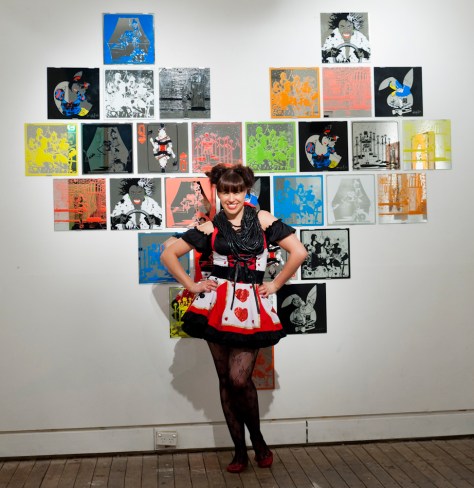
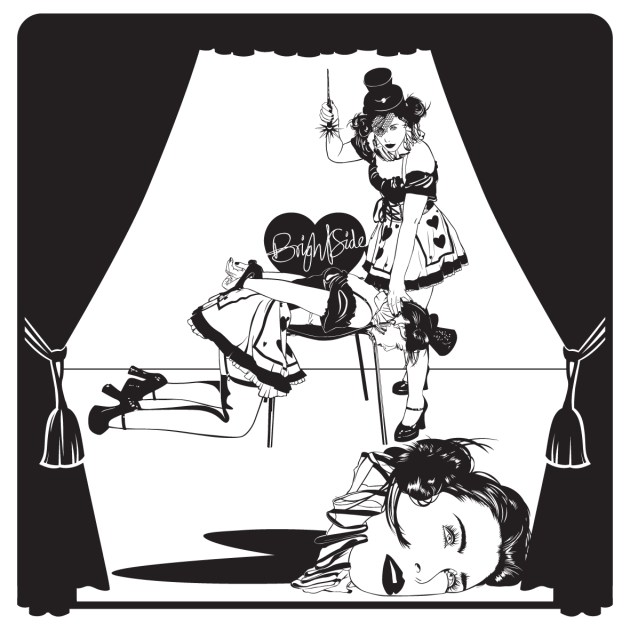
Bright, or Miss Brightside as she is known professionally, kicked off her career with a bang. The first time her work appeared in a gallery was at aMBUSH in Sydney, Australia, and was aptly publicized as an extravaganza, rather than as an exhibit or installation. The pieces on display exemplified the unique fairy-tale-gone-bad style that she has continued to cultivate, and which has become her trademark in the years since. Snow White, Tinkerbell and the Queen of Hearts are among characters depicted in Bright’s often hyper-sexualized scenes.
“From an adult perspective, fairy tales have a whole darker element. In particular, from a scholar’s level, the unraveling of the encrypted symbolism is prolific,” she said. “I found I had a division between my childhood ideals and existence in an adult sexualized society. For this reason I began entwining and reworking fairy tales within my artwork.”
“X Off with their Head” illustration screen printed on glass by Katie Bright
It’s a recurring theme, which Bright employs as a deliberately eye-catching metaphor for the dichotomy between childhood innocence and the expectations subconsciously placed on the children who grow up hearing those fables. The images used at aMBUSH were primarily screen printed on mirrors, and in tandem with Bright’s careful selection and placement of lighting, attendees were transported through the looking glass to a world of her invention. Her use of color in prints such as “Some Day My Prince Will Come” and “If I Had a World of My Own, Everything Would be Nonsense” is mesmerizing; an array of prime reds and blues and yellows, starkly contrasted with ominous black and white backdrops, with the shimmering surfaces of the mirrors serving to further capture viewers’ attentions and imaginations.
“It was more than an art show; it was a whole visual feast and a circus production. I made and curated 102 artworks, we had two pole dancers, a contortionist, dwarves dressed as cupids, two bands, a DJ, a film crew and press,” said Bright, describing just how extravagant the whole affair was. “The major alcohol sponsor was an absinthe brand, which supplied a mixologist who made ‘Love Potion’ cocktails, two women dressed as green fairies and two topless male waiters working the bar.”
The massive event, launched on Valentine’s Day 2012, was Bright’s first solo show and a watershed moment for her. Its opening night saw more than 1,000 people in attendance, and both inspired her and established her in the incredibly competitive field. Since the success of that first exhibit, Bright has organized several other huge art-and-culture events, including one in Swindon, England in early 2015. Working with Harris + Hoole Coffee, she took it upon herself to propose, plan, organize and ultimately produce a huge event for the company.
“The event I coordinated turned into a 3.5-mile radius tour of three artisan coffee stores that have opened in the last year. My concept was Love Coffee for Valentines Day,” Bright said. “I liaised with three venues, arranged sponsorship, wrote copy, designed promotional material, illustrated the map, logo and branding, filmed and edited a promo video and created a website. In addition to the tour I orchestrated Creatively Made In Swindon. An art and design exhibition displayed over the three venues during the Love Coffee Tour, which continued into March. For the exhibition I collaborated with seven local artists to curate and install the show.”
Currently, the extraordinary Miss Brightside is wrapping up work on a series of interior visual designs for the luxury hotel Surftides Lincoln City in Oregon. Asked to create a design based on a unique fairy tale, Bright chose to write her own, “Atargatis.” A brilliant show of her unlimited, cross-media creative talent, “Atargatis” tells the story of a mythical beauty, a girl who can transform into anything. But in so doing, the girl retains conflicting features of both bird and mermaid and realizes she has lost herself and become something unrecognizable and unsustainable.
“When creating the wallpaper design I wanted it to have a moral. This quote from Thich Nhat Hahn encapsulates the meaning behind the fairy tale of Atargatis — ‘Changing is not just changing the things on the outside of us. First of all we need the right view that transcends all notions including of being and non-being, creator and creature, mind and spirit. That kind of insight is crucial for transformation and healing,’” Bright said of her inspiration. “After I created the fairy tale based on the Thich Nhat Hahn quote, the illustration element was straightforward; I just illustrated the story.”
The results are as beautiful as they are imaginative. The gorgeous series of scenes tell the tragic tale of Atargatis, and in such a way that they would be just as suited for a children’s book as they are in this luxury beachfront locale.
Bright’s ability to accentuate and illustrate the darker undertones of familiar stories has made her an international sensation in the art world. Followers of her work will be excited to hear that she is currently planning for her next solo exhibition, tentatively scheduled for early 2016. A visionary master of storytelling through imagination, illustration, creation and design, Bright certainly lives up to her name and will never cease aweing viewers with her work.
International Entertainment, and the Talents that Leave us Buzzing….





 internationalfilmreview