Tag Archives: Film

Caihong City: Ye Zhu Explains the City and Film of the Future

Caihong City.JPG

Creating and completing a film is in itself something of a miracle. The amount of work done by a varied group of artists and skilled professionals is layers deep; similar to an iceberg in the fact that most of these are not evident to the public. Director Florina Titz had poured everything she had into the film Caihong City but found the project stalled with some challenging postproduction obstacles. Titz reached out to Ye Zhu to channel the post efforts and create a new workflow to deliver the film to its final form. A multimedia production specialist with a wide skill set, Ye’s knowledge of the different production teams which coordinate behind the scenes allowed her to breathe new life into the film during the final stages. The director’s trust proved well placed as Caihong City appeared as on Official Selection at important events across the world from LA’s Valley Film Festival to the Paris Play Film Festival, Romania’s 12 Months Film Festival, and many others. Awarded the Best Trailer Awards at the Philip K Dick Film Festival in NYC, even the most brief glimpse into this film communicated that it was something truly unique.


Caihong City is a truly daring work of cinema. Filmed in over thirty locations in and around New York City’s five boroughs, this production features an international cast and a language created specifically for the story. This dystopian science fiction tale is set in a futuristic world where dying genius Liu Junjie (Zhao Lewis Liu) forms an unlikely alliance with crazed vagabond Serioja (Marian Adochitei) and depressed prostitute Lavinia (Lana Moscaliuc) to complete a super task to survive. The storyline and the footage was exceptional but the production came to a halt due to a number of postproduction obstacles. The most significant of these was a clear vision for the integration of a software interface that would transform modern NYC into Furui and Caihong City. Inseparable was a work flow that would allow multiple artists to share data, visual concepts, and delivery strategies. The ideas were available but it was Ms. Zhu who would help manifest them into reality. The greatest impediment to this was the fact that the film’s international cast and crew were now dispersed throughout the globe. She designed and coordinated an interwoven and overlapping series of tasks within a tight schedule involving all aspects of postproduction. Ye’s motivation, communication, and tenacity are prime assets which drove the production to completion.


Proving that her role is as much about creative vision as practical coordination. Ye not only enabled Caihong City to become finalized but even helped reimagine it to some degree. After organizing a WIP screening with a mixed crowd of sci-fi lovers, filmmakers, and potential investors for the film, she used the responses of these individuals to convince the filmmakers that a re-edit was called for. The cinematography and visual style was transfixing but the main characters had not been fully developed. Ye reveals, “After presenting the results to our post production team and going through the entire film scene by scene with the director and editor to discuss possible solutions, we decided to re-edit the film. During this process, we focused on building the three main characters by cutting out less significant characters and plotlines. We adjusted the pacing of the film by deliberately leaving long beautiful scenes in the film in between critical intense moments to create some breathing room for viewers. More emphasis was put on VFX to further explore ways of using the look and functions of the map to solidify the plot. The re-edit of the film integrated more logic and structure into the previously heavily instinct and emotion driven cut to reach a perfect balance that’s transformative to the final film. It’s like putting a puzzle together. You need to know what are the missing pieces for everyone involved in order to move on to the next stage and try to figure out the best approach to get things done efficiently.”


Beyond its remarkable aesthetics and adventurous use of linguistics, Caihong City continues the lineage proven by films like Crazy Rich Asians and Black Panther in proving that Hollywood and the entire world is ready to view a diverse cast. The impediments of previous generations of film have given way to the creativity of productions like Caihong City which prove that it is in fact a brave new world for film.

Cinematographer Colin Akoon’s Creative Eye Makes Every Shot Stand Out

Colin Akoon
Cinematographer Colin Akoon at home behind the camera


In the fiercely competitive film industry, it takes a lot more than some camera know-how for a cinematographer to stand out. Many people are skilled in the technical process but lack the artistic vision required to create compelling cinema. Others possess vivid imaginations but are unable to meet (or unwilling to yield to) the expectations of the director. A person with all of these traits is a rare gem, an invaluable asset with the potential to outshine all those around them in the highly saturated industry. Colin Akoon is just such a man.

An award-winning director of photography, or DP, Akoon is responsible for a countless array of critically-acclaimed film and commercial productions. He has been fascinated with storytelling his entire life, and at a young age discovered the power cinema can have on an audience.

“I remember being six years old, watching a horror movie at a neighbor’s house, one I probably shouldn’t have been watching at that age… I still recall the fear that paralyzed me… That night I slept in my parents’ bed. I made them put the radio on to distract me from the bumps in the night,” Akoon recalled. “Good cinema gets a hold of every part of you and doesn’t let go.”

In 2014 he was critical to the wild success of the award-winning “Canadian Tire Ice Truck” ad campaign. The campaign’s name is quite literal, as Akoon explained. To promote their new cold-weather battery, Canadian Tire contracted Ice Culture to build a fully operational truck out of ice. Ice Culture is internationally-known for making everything – from ornate sculptures, to exotic lounges around the world, from Thailand to Dubai – out of ice. But this project was their most ambitious undertaking of all.

Canadian Tire
Still of Ice Truck built by Ice Culture for Canadian Tire shot by Colin Akoon

“They were having a truck built out of ice, one that would actually start and drive,” Akoon said. “It was important that we tell the story of Ice Culture – a small family-owned business – and also get a sense of the small town where they’re situated… We really wanted to get across the idea that this incredible record-breaking feat was accomplished by hard-working, everyday Canadians.”

In addition to being used in commercials for Canadian Tire, a documentary-style behind-the-scenes film was made to detail the exhaustive process of creating a working truck out of ice. Akoon was the DP on the making-of film, which played a large part in the campaign’s overwhelming popularity — particularly among the judges at a number of high-profile awards ceremonies.

“The resulting video really shows the detail of the hard work that went into the making of this ice truck,” Akoon said proudly. “The ‘Ice Truck’ campaign went off to be nominated and win more than a dozen awards…  and our making-of documentary was a big contributor to the overall success of the campaign.”

It was a brilliant stroke of marketing genius to complement the campaign with a making-of documentary. A fascinating glimpse into the creation of the eye-catching ice truck, Akoon’s work captured the attention of consumers and advertising critics alike. The campaign’s laundry list of accolades include the Best In Show Award and two Gold Medals (for “Best Brand Building Campaign” and “Most Innovative Idea or Concept”) at the 2014 PROMO! Awards, third prize at the 2014 world-renowned New York Festivals International Advertising Awards, and the honor of being on the shortlist of contenders for the 2014 Cannes Lions Award, often considered the most sought-after and prestigious award in the advertising industry.

As a cinematographer, Akoon has his fingers in a lot of pies and doesn’t restrict himself to any one type of project. His exceptional work in advertising is widely-recognized, but his creativity and visual mastery shine their brightest in his work on narrative film and television productions. One such example is director Mateo Guez’s 2014 film “Together Alone,” for which Akoon was the DP. The emotionally-charged film looks at the love and lust within a group of three star-crossed young lovers. However, “Together Alone” is much more than the story of an ill-fated love triangle.

“Mateo assembled a very small team to make “Together Alone” a feature film about two young men and one young woman as they struggle through friendship, sexual relations, and self-identity,” Akoon said. “Mateo desired to make a film that did not strictly adhere to any one script or blueprint, but rather would evolve through improvisation and experimentation. As a result, the filmmaking was a very intimately creative experience.”

Of the countless projects he has been involved in, Akoon describes Lorne Hiltser’s “The Incident(s) at Paradise Bay” as among his personal favorites. Gripping and heart-wrenching, “The Incident(s) at Paradise Bay” is based on the real-world Tranquility Bay reform school in Jamaica, which became the focus of global outrage in 2007 after allegations that the facility’s strict disciplinary methods were actually child abuse.

“The moral question of whether the procedures… were just or merely abusive was an interesting one, but mostly Lorne and I were fascinated with the poetic style by which the short script was written,” Akoon said, describing what drew him to the project. “There was an eerie dreamlike quality to the script that Lorne and I knew we wanted to explore visually.”

Akoon captured that eerily surreal sensation flawlessly. Every shot of every scene was painstakingly planned and calculated to maximize that dreamlike quality of the film. His use of zoom shots as a nostalgic beginning and ending of the film contrasts seamlessly with the close, tight shots used to introduce Marcus, the film’s protagonist.

“The sequence that shows Marcus in the ‘solution room’ cage was a very important one. This was our real introduction to the character and to the harsh treatment of the academy’s disciplinary attrition,” Akoon said. “We wanted the audience to feel they were Marcus in that cage. Depth of field for this sequence was kept to a minimum, visually suggesting the claustrophobic feeling of being caged.”

Throughout “The Incident(s) at Paradise Bay,” “Together Alone,” and all of Akoon’s countless other films, his talent and experience are unmissable. Akoon has a natural gift for capturing the exact aesthetic a project demands, a deliberate manner of planning and setting up each shot, and is unsurpassed in his aptitude for collaboration, constantly working closely with each project’s director to conceive and achieve a shared vision. In an industry with so much competition, nobody can hold a candle up to Colin Akoon.

Ingenious Production Designer Yihong Ding Wraps Production on “Mira”

Yihong Ding
Production Designer Yihong Ding

The striking talent of Yihong Ding as a production designer and art director is literally visible in every project she has touched. She moves seamlessly through the worlds of film, television and advertising; not an easy feat when one considers that the approach a person must take when designing the ambiance of a feature film to match a director’s vision is vastly different from their approach to creating the backdrop of a commercial meant to persuade an audience of consumers.

Originally from Shanghai, Ding studied in London and eventually got her master’s in production design at the world-renowned American Film Institute in Los Angeles. Since then, she has been hard at work on an ever-growing list of projects. To ensure each film, show or commercial conveys the right mood and feeling, she works closely with the director of the production to capture and physically recreate their vision. From color schemes to lighting, props to set design, she is responsible for turning the conceptual into the living, breathing worlds we see on film.

Ding has worked on projects ranging from The Birthday Boys starring Bob Odenkirk (Breaking Bad, Better Call Saul, Mr. Show) to Mandala, the winner of the 2015 Los Angeles International Film Festival award for Best Foreign Film. She’s done several commercials for Diomany high-end lingerie and served as art director of an advertisement for the Microsoft Outlook app. It’s her work on films like Mira however that really showcases her incredible talent for production design and her awe-inspiring ability to create a self-contained world on the screen.

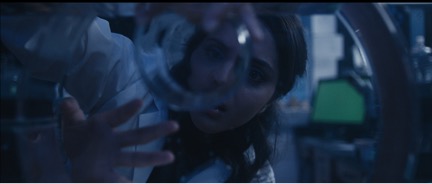
Working on director Amanda Tasse’s Mira, currently in post-production, Ding was given a dual-challenge. First was creating a marine biology research laboratory complete with the appropriate scientific equipment and actual jellyfish tanks. Second, she had to design an intricate “memory wall” which the title character uses to keep a log of her life.

“I had a lot of fun doing the research for this project,” said Ding, who studies every project’s background meticulously to ensure the environment seen on camera is authentic and accurate. “We ended up filming at an empty lab on Catalina Island, and dressing the lab into the jellyfish lab for the story.”

Vanessa Patel as Mira in the lab created by Yihong Ding in "Mira"
Vanessa Patel as Mira in the lab created by Yihong Ding in “Mira”

Filming on an island presented its own challenges. Ding had to personally pack all of the glass tubes and prop equipment by hand, and shipping all of the fragile items to Catalina was expensive and required her to closely observe weight restrictions and eliminate any waste in the budget while maintaining the realistic integrity of the set.

“Finding the jellyfish tank was another challenge. They were all costume-made and very expensive,” she said. “I almost had to build them myself, but luckily we found a person that was willing to rent three to us for a really great deal.”

The experience tested and proved Ding’s invaluable ability to balance the creative and financial sides of production design with aplomb. The laboratory she created is so authentic and convincing it’s absolutely indistinguishable from a research facility one might see at a university. While the lab provides the backdrop, the “memory wall” Ding created gives the viewer a personal connection to Mira’s title character.

The character of Mira suffers from a form of epilepsy that causes intense seizures and short-term memory loss of the hours preceding each attack. Mira dedicates herself to studying a species of jellyfish which may hold a cure for her disease, but her condition poses a huge challenge and she has to find a way to overcome the amnesia. So Ding helped design a “memory wall,” which becomes Mira’s method of constantly reminding herself of what’s happened before each seizure.

“She would take a picture right before she knew she was going to have a seizure… and then she would map out all the pictures on her bedroom wall,” Ding described. “It was a very complicated visual graphic to create, and I wanted to make sure that it looked real… and for the very first time I sat down and considered myself as Mira… I started to think like Mira, which was really amazing, because I found myself digging deeper into the design than I normally do.”

Yihong Ding has what many specialists lack: a multifaceted skillset combined with extensive experience in every level of design and the ability to work within any range of budget without ever compromising the quality of the project. From envisioning the conceptual to building the practical, from dressing sets to arranging the details and minutia for the perfect shot, she is a one-woman creative army.