Category Archives: Reviews, Interviews & Features!

How Dreamstreet Entertainment Leads Projects and A-List Talent to the Top

Story by Alex Jack

Usually it’s famous actors who attract press attention for their high-profile relationships or roles in blockbuster films. In the case of Dreamstreet Entertainment however, their unique approach to producing both feature films and TV shows that have achieved terrific levels of success mark it as a production company worthy of media coverage usually reserved for the A-list talent they employ to feature in their projects. The next year, with an innovative TV series and series of films slated for production and release, is set to be Dreamstreet’s biggest one yet.

Central to the success of Dreamstreet is its board of producers and executives, all of whom have an impressive pedigree in filmmaking to support the company’s standing in the entertainment industry. Tony Eldridge produced Denzel Washington’s “The Equalizer”, also starring Oscar-winner Melissa Leo and A-lister Chloë Grace Moretz, and is currently working on the sequel. Bradley Hirou for instance was notably an executive producer on “Roar: The Jaws of the Lion” from Iconoclast Entertainment, while VP Producer Rocky Yost was a writer of “Lilly’s Thorn,” a drama starring Windy Marshall from “Days of Our Lives” and Joseph D. Durbin (“Rangers: Furies”).

Similar to other production companies that are not necessarily tied to any one major studio, like Cross Creek Pictures (“Black Swan,” “Everest”) or A24 (“Room,” “Moonlight”), Dreamstreet Entertainment has a clear focus and uncompromised vision when it comes to its projects: an ethos of maintaining artistic integrity. This principle has given rise to Dreamstreet’s unique catalogue of distinguished narrative content and association with high-profile acting talent. Indeed, they have developed a reputation as a picture-house capable of producing popcorn fare aimed as mass audiences, as well as stories exploring humanity that attract glowing critical reviews.

“So This is Love”, helmed by now executive producer Gloria Morrison, reflected the company’s capacity for telling quirky stories with an edge before it was the norm with shows like “Love” on Netflix. In this way, it’s not untoward calling Dreamstreet a pioneer of sorts within the entertainment industry.
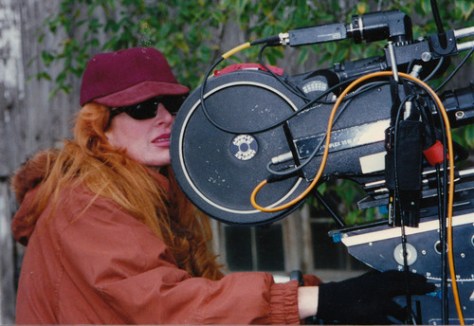
gloria_camera3dlowsmaller
Gloria Morrison on set.

Concerning an old-aged in-love couple who bicker much like Lucy and Desi on “I Love Lucy”, “So This is Love” starred Jack Donner and Jody Jarress in the leading roles.
Donner’s casting signified the power of Dreamstreet to easily acquire successful acting talent. In addition to his roles on “General Hospital” and “Cold Case,” Donner is best known for his key role in studio blockbusters “Four Holidays” with Reese Witherspoon and Vince Vaughan and Clint Eastwood’s “J.Edgar”, where he played Oscar-winner Leonardo Dicaprio’s father. Jarress equally brought heart to the series in the role of Josey, underscoring Dreamstreet’s reputation of bringing humanity and frank humour to their projects with known actors. Jaress, who appeared opposite Oscar-winner Adrien Brody in “Hollywoodland”, is also known for her role as Ruby in “Terminator: The Sarah Connor Chronicles” and her striking appearance in the Academy-Award-nominated “Charlie Wilson’s War.” While both Donner and Jaress set a high-standard for the casting choices of Dreamstreet Entertainment, they also simply are examples of Dreamstreet’s status as a leader in entertainment.

The company’s future slate reinforces that status. “Last Ride…Ride as If It’s Your Last”, has acquired G-Machine as a distributor as well as cinematographers Steven Kaman (“Hangmen” with Sandra Bullock) and Keith Holland (“Wrong Turn”, with Eliza Dushku) to shoot it. Adding to that impressive line up, the multi-million dollar budgeted sporting-themed feature “The Futboleros” has Misha Segal (“The Phantom of the Opera,” “The Human Centipede III”) on board as the composer. A common theme between all of these projects? No doubt a desire for preserving the integrity of the story and the artists involved.

TUNA’S INTERNATIONAL COOPERATION

Producer Tuna Erturk’s films and commercial work is widely recognized with awards and their prevalence in the industry. If you don’t know of him that’s likely because you don’t live in Turkey. Fame and recognition does not typically transfer internationally unless you are an actor with a marquee name. This doesn’t bother Tuna as he has always preferred creating behind the scenes. Still…he has been a part of some productions in the US which means it’s likely that you’ll start hearing his name more often, at least if you are in the industry. As the world’s communication becomes more immediate, our interest in different cultures and the stories we share cross international boundaries. Established and creative professionals like Erturk are increasingly becoming sought after to lend their skills and sensibilities to an entertainment thirsting public.

Erturk served as a producer on Dervis Zaim’s Fish which won a Crystal Apricot Award, a SIYAD Award, and was an official selection of the Istanbul International Film Festival. The film is an excellent example of the rich storytelling that is found outside of the US. Fish follows the story of a poor fisherman who, desperate to cure his daughter’s muteness, tries to catch a fabled magic fish. As the film’s producer, Tuna played a huge role in the creation and ultimately ensured their fantastic degrees of critical and commercial success. The film was shot in Golyazi/Bursa, Turkey (a peninsula) where the spectacular views and natural beauty complement the mythical hopes of the main character. Tuna concedes that coordinating a location shoot there was more than worth the effort. Having done only one feature project prior to Fish, Erturk was overwhelmed by Zaim’s insistence that he come aboard the project. He notes, “I was so busy with shooting T.V. commercials at the time. Dervis Zaim came to office one day to meet and asked me to work on Fish. I said that I really wanted to and then he replied to me with this Turkish idiom ‘There is no wedding without the orchestra. You must be there!’ He was stating that I was the orchestra in the wedding. With that kind of confidence, I found a way to make my schedule work and I’m glad I did.” As proof of the positive working relationship and Erturk’s work, Fish won multiple awards at the Malaysia International Film Festival and was nominated for Best Film at Nuremberg Film Festival.

Commercial Shooting 1

Tuna was already in LA amongst the Hollywood industry and experiencing it firsthand when he was hired as producer for the film Uzun bir Gun or “A Long Day.” This film is about a sick father who is accompanied by his son to find the patriarch’s childhood home was filmed in Turkey. Having served as producer in both the US and Turkey, the difference in the two industries was redefined for Erturk. He states, “There is a very close connection between the film industry and school in LA. It’s not just directing or production, technically that is the way it is. Active people working in the sector give lectures on light, sound, visual effects, and many other topics. They share with you all their experiences on set. This makes it possible to educate qualified personnel in every way. There are university graduate set workers and assistants, production assistants, sound assistants in LA. Everyone is very professional and educated in their work. There is great support for students. You can rent the finest cameras, the best equipment, and the most amazing team almost for free. The working rules here are much stricter than in Turkey. For instance, the health and rest time of the team working on the set is very important. In the simplest case, you can call at least 12 hours after the last worker who left the set. I can count many other rules for protecting the workers like this. I think these rules make things work better quality. It was with great pride that I applied my experience here in Hollywood to producing in Turkish films.” “A Long Day” received awards from First Run Film Festival – Wasserman Award, Golden Orange Film Festival, and Tehran International Short Film Festival.

Most recently, Tuna was enlisted as the producer for Noah Tree. Set to be shot in Bursa (Turkey), it tells the story of a man named Omer who goes to his dying father’s childhood village to fulfill his last wish: to bury him under the Noah Tree which his father claims to have planted long ago. But the villagers believe the tree to be the first tree Noah planted after the Great Flood and they will do anything to stop Omer from debasing their sacred tree. The production has already received a Cannes Film Festival Residence invitation.

Choosing to focus on films these days, Erturk has a long history in producing with various formats. Every producer and director gets their start in commercials and Tuna is no exception. He has no disdain for them, in fact…he quite liked the work. What’s not to like when you’re working with international stars like Megan Fox and for massive brands like Coca Cola and Doritos? It does however not come without it’s challenges as he notes, “We shot the Doritos commercial with Megan Fox in Istanbul. When she arrived at the Istanbul International Airport all the paparazzi were waiting there for her. She was very famous in Turkey like the rest of the world. The commercial was about a celebration of new product of Doritos “Fritos Shots”. There was an academy in commercial that brings together the young bright brains. So one of the teachers was Megan Fox. We shot the commercials for 3 days in one studio. The most challenging part of the commercial was Megan’s fame. She was so famous and it was hard keep paparazzi and media attention away.” Erturk adds, “My tasks during these productions were: making budgets, hiring crew, and keep it running smoothly. I was reporting every process to the executive producer Emre Oskay. We were finding solutions together if we had a problem. He was a friend more than a boss. That positive working relationship grew into twenty-three commercials together and film work.” Oskay adds, “In addition to our commercial work together, I have also worked with Tuna on a pair of feature films, both of which he produced. These films, 2014’s Fish and 2013’s Cycle, have each accrued a fantastic degree of commercial success and have drawn the acclaim of audiences and critics. Neither film would have garnered such a significant degree of international acclaim if not for Tuna and his fantastic gifts as a producer. Tuna Erturk stands among the top tiers of Turkey’s film producers.”

IMG_9826

SHAHZAD: AN UNFAMILIAR HOME EXPOSED BY CHRIS LEW

People talk about the problems in the world. Politicians make policies that either aid or harm those in peril. Artists tell the stories of these individuals in a way that can allow all of us to personalize and connect with those facing life’s extreme difficulties. Chris Lew is just one such artist who used his skill and talent as a cinematographer in the film “Shahzad.” The entire world seems aware of the crisis of immigrants and refugees; it’s a global circumstance. The BravoFact short film “Shahzad” tells the story in a very real and intense manner. The filmmakers went to great extents to portray the story of two immigrants who move to Canada in hopes of living a better life. It’s a story that is difficult at times to watch but important to do so if we are to have empathy for our fellow man. While Lew has served as DP on a number of varied productions from films to music videos, he counts “Shahzad” as one of the most important and rewarding experiences of his illustrious career. Without heart, talent fails to resonate with any gravitas in any artistic endeavour; “Shahzad” rings out like a loud drum, full of emotion and soul in its conviction. To say that “Shahzad” is full of surprizes is a gross understatement. A gripping film which keeps you on the edge and full of astonishment, “Shahzad” is modern storytelling within a realistic framework.

Director/writer Haya Waseem and Chris have had a close relationship in and out of work for a number of years now. As passionate filmmakers, they often discuss potential projects. When Waseem wanted to make a film commenting on the disassociation one can feel on a societal and personal level, it was a given that Lew understood her perspective and would be the ideal cinematographer to help manifest the tone and look to communicate the film’s message. With Producer Prionnsias James Murphy overseeing the project, director and cinematographer were able to focus on the storytelling. Murphy comments, “The film’s subject is as relevant to today’s society more than ever. Chris’s immense skills as the cinematographer allowed this story to breathe an authentic life into the frames that captured it throughout the course of the filming. His incredible understanding of form and function, both character and character arc, as well as the protagonist’s relationship to the surrounding world is what made Chris the perfect individual to work with throughout this film. His expert use of lighting and camera placement captured a character throughout scenes of uncertainty and conflicted identities. Even if you have a great story, you must create heartfelt and intriguing imagery to portray it. Chris Lew is without a doubt an expert in this field.”

  Audiophiles have been espousing the merits of vinyl in the past decade and have actually steered a portion of the recording industry back to this century old method. They are adamant that the sonic benefits are massive. In a similar way, Lew persuaded the production of “Shahzad” to use actual film rather than digital to capture the imagery for this story. This was not due to any disdain for digital but rather that he felt the quality of 35mm Fuji Film stock was ideally suited to match the story. He explains, “We wanted to shoot on film for a couple reasons. For one, all of the narrative work which Haya and I have done has been shot on film. It’s special to us and we believe in the format enough to fight for it. We also felt the look was appropriate to this story. There are software and effects to help mimic the look but it never looks exactly the same. No matter what you apply to the digital file in post, the sensor isn’t capturing the same color, producing the same grain that’s reacting to the light, and maintaining the same dynamic range that film has. The reason for our decision was artistic but it’s worth noting that there is a misconception that film is radically more expensive than digital…when in fact it isn’t. Because there aren’t as many film projects anymore, equipment is cheaper to rent as a lot of it isn’t being used. On top of that, labs are willing to cut deals because they want to encourage filmmakers to shoot on film. If you’re concise and know what you need on set, film can be the same cost or even cheaper than digital. I acquired the film through a UK company called frame24. They had a batch of 35mm Fuji film that we purchased and had shipped to Toronto.”

The inspiration for this was a product of Chris’s research for the film. In his work pouring over old photographs from the 70’s shot in Pakistan, the colors of the images conveyed a strong emotion. The photos were shot on Kodak using their Kodachrome stock. This Kodachrome stock was full of contrast with grainy and blue tones that really stood out. The images made Lew feel the texture and dust of Pakistan. Kodak has since refined their stock to be some of the cleanest film imaginable but Chris found that Fuji was very similar and even added a “dirtier” look that he admired.

The film revolves around the boy Shahzad and the culture shock he goes through and the internal turmoil that it creates for him. Without giving away the major twist of the film, Shahzad begins to find his personal home life as confusing as his social life in this new city and school. Lew’s affinity for handheld camera work allowed him to communicate the boy’s emotional and mental state. As always, empathy enabled Chris to create touching and provocative imagery. He describes, “He’s a shy boy who’s been placed in a new world so he’s both nervous and curious. Knowing this and reflecting on my own experiences being that age and going to a new school, I translated those feelings into the movement of the camera. This then resulted in choosing to shoot the early school scene and dinner scenes static and the later scenes at the school handheld. When I was younger I was the quiet boy in class. I was always nervous at the beginning of every school year and wasn’t very good at socializing. However, I also knew how great it was when you did manage to connect with people who would eventually become your friends.”

Conflict is part of life and a big part of what Shahzad is dealing with in this film. It’s an aspect which is present in all of our lives no matter what our age or position in the world. Lew admits that there was pressure put on himself and Waseem to shoot in digital because of its prevalence in the industry. Just as the character in the film, the filmmaking duo stuck to what they knew was right for their vision because some things in life are worth giving your best.

Screen Shot 2017-06-07 at 9.58.18 PM

Alon Juwal’s Sci-Fi Film “Visitors” Keeps Viewers on the Edge of Their Seats

"Visitors" Alon Juwal
Film Poster for Alon Juwal’s Film “Visitors”

Last year producer Alon Juwal wrote, directed and produced the riveting dramatic sci-fi film Visitors, which has been gaining traction with audiences and festivals across the U.S. since its release at the tail end of 2016.

Starring Kei’la Ryan (Bad Friends & Family, Kingdom, Night Crawlers) as Kaleigh, Nick Unger (Front Seat Chronicles, Phil of the Future) as her brother Cole, and Tim Juliano as their father, Visitors follows two siblings who return home to their estranged father’s house after a long absence, only to find their home being invaded by a group of uninvited visitors from another world as the night progresses.

As the producer of the film, Juwal’s ability to bring together a talented cast and crew, execute the business side of things, such as raising the necessary funding to actually make the project happen, as well as overseeing all aspects of the production from pre to post were integral to the success Visitors has achieved since its release.

Garnering extensive attention across the country, Visitors earned Juwal the Best Director of a Sci-Fi Short Award at New York City International Film Festival, as well as the Honorable Mention Award from the Boston Sci-Fi Film Festival. Visitors was also nominated for awards at several festivals including the USA Film Festival, Vail Film Festival, Phoenix Comic-Con and Newport Beach Film Festival, and was chosen as an Official Selection at the New Hope Film Festival.

“Working with Alon has been an amazing experience… he doesn’t like to waste time, he knows when he has the shot which makes him a great decisive director. Alon is good at what he does because he knows that preparation is key, and you can see it in the way he put the project together,” explains Tom Edwards, Visitors’ aerial cinematographer and behind the scenes videographer.

“Before principle photography he made the time to meet up with his actors and crew members to make sure everyone was comfortable and on the same page. To have a good friend like Alon who is just as passionate as you are, working together to make stories come to life is a real charm.”

Visitors film Alon Juwal
Egor Povolotskiy (left), Alon Juwal & Nick Unger (right) on set of “Visitors” by Majid Alkhatib

Through the powerful combination of the film’s score, specific angles, lighting and purposeful pacing, Juwal does an impeccable job of building the suspense within the story in a way that keeps viewers on the edge of their seats.

The long shots of the brother and sister running through the trees at night trying to make it to safety, while neither the characters nor the viewers really know what they are running from, the bright lights beaming down from above creating eerie silhouettes in the forest, but still leaving us unsure of where the light is coming from, and sporadic sounds of their father’s dog barking in distress, are a few of the cinematic devices Juwal employs to heighten the tension within the film.

While all of this was tantamount to nailing the thrilling, otherworldly sci-fi elements, what really makes Visitors such a unique film is the burdensome relationships Juwal paints between the siblings and their father. As the producer/director of the film Juwal remarkably captures the palpable feeling of emotional discontent that exists between Kaleigh, Cole and their father, revealing the years of turmoil that persists within the family with a subtlety that allows the audience to draw their own conclusions. Visitors is proof that Juwal’s style is one that shows rather than tells, a mark of a truly talented and thoughtful filmmaker.

"Visitors" Alon Juwa
(left to right) Kei’la Ryan, Nick Unger, Alon Juwal & Braden Pruss on set of “Visitors” by Polina Krasovicka

Like the work of most producer/directors, Juwal’s personal life experiences have had a strong impact on the stories he chooses to bring to life on screen. Originally from Tel Aviv, Israel, Juwal’s parents separated early on in his childhood; and it is clear to see how his first-hand experience growing up with divorced parents gave him the insight necessary to accurately portray the strained relationship that exists between the children and their father in the film Visitors.

“I spent the majority of time with my mother as I was growing up. Even though I saw my father quite often, we were always pretty distant from one another. The first thing they teach you in film school is to write about what you know, so I always tried to channel these experiences to my work,” explains Juwal.

Juwal’s approach to Visitors is uniquely powerful in that the film includes all of the elements necessary for an entertainingly suspenseful sci-fi film, while also portraying a moving emotional story that touches audiences on a deeper level.

“First and foremost, good cinema must be entertaining. Cinema is a way of escaping from reality, so when we go to the movies, we basically want a break from our boring, every-day lives. We want to be entertained,” admits Juwal. “Personally, when I go to the movies I’m looking for more than that. I want to be moved. A good movie can often stay with me for an entire day, even more.”

A beautifully shot film with a heartfelt message, it’s not at all surprising that producer and director Alon Juwal has received such far-reaching acclaim for Visitors, and we can’t wait to see what he comes up with next.


BEHIND THE CAMERA AND THE SEA INSIDE

Back in 2004, when Juan Matias Ramos Mora received an invitation to be the Steadicam Operator on The Sea Inside, he had no idea that he would be part of an Academy Award-Winning film (the film received the Oscar for Best Foreign Film at the Academy Awards in 2005 and several European prizes in 2004 and 2005) as well as witness the evolution of an international star in the performance of Javier Bardem. If the truth be told, the only two factors that enticed Juan to join the film were his constant pursuit of challenging work and the opportunity to work with director Alejandro Aménabar. The tipping point in the career of artistic individuals like Juan Ramos often happen when it is the most unexpected and when accolades are not a factor in the equation. Now more than a decade later, The Sea Inside is just one of the many award-winning productions which Juan has worked on but it is possibly the one which delineates that point when many began to recognize his talent on an international scale. Recent series such as “Fear The Walking Dead” and “Mozart in the Jungle” display the eye and skillful camera work which brings a larger than life look to the small screen; one which Juan has used so many times on the big screen.

It is a common analogy but, pressure turns coal into a diamond; it can also refine professional skills. While Juan was already a respected camera operator prior to his work on the Oscar-Winning The Sea Inside, the experience of working with famed cinematographer Javier Aguirresarobe was both inspiring and challenging…in other words, pressure! Aguirresarobe is internationally recognized as one of the contemporary greats in cinematography. He has worked with the best camera operators and he expects the best. More than a decade ago, Juan admits that there were lessons for him to learn and Javier was a masterful teacher. Prior to The Sea Inside, the two had worked together on El milagro de P.tinto, which was the first film by Javier Fesser, a rather famous director in Spain. The fact that Javier wanted to work with Juan again speaks to his belief in the then young camera operator. Aguirresarobe comments, “As a cinematographer, I must sometimes rely on a Steadicam and Camera Operator for the crucial element of frame composition; it builds the visual narrative of the film and I must entrust it to someone who understands my vision, the director’s vision, and can deliver exactly what my critical eye demands. It’s not easy to find someone whom I can trust with this important role but Juan is one such professional. He has a keen eye for seeing things the way that I need them, even in very complex situations. When we were working together on Alejandro Amenabar’s Academy Award-Winning Film The Sea Inside, Juan was our Steadicam Operator. The complexity of the film would be a challenge for anyone and I am demanding as well. Juan delivered to perfection every time. Neither myself nor the director could have been more pleased with his incredible work on this film. I have worked with Juan on a number of films and he continuously brings this exemplary performance on all the productions he is a part of.”

The films’ director Alejandro Aménabar and Aguirresarobe work well together in part because they are both so discerning and scrutinizing.  Alejandro is a director who carefully picks out every tool he wants to use to tell the story. He’s young but he’s very classic in his language. His careful study of the greatest directors in film history has given him the perspective which created his reputation. Juan Ramos credits Aménabar with inspiring both panic and a call to greatness in his early career.

One of the unexpected pleasures and respite of his involvement in The Sea Inside was that it gave Juan the opportunity to work with Javier Bardem in one of his most important performances, and the one that would catapult him into international stardom. Juan recalls, “The extent of his preparation and dedication to the performance was pretty huge, which is why this role opened up so many opportunities for him. Watching such an actor at work was truly amazing. The only resource he had to convey in the movie was his face, and thus his performance. That means you have to be extremely precise. The camera has to be respectful of the internal process the actor goes through to get to those levels of interpretation. He was so immersed in the role that nothing really could go wrong. That made everyone in the film, who were already working at really high standards, deliver their best work. This ultimately meant that Bardem and Amenábar were the only ones in charge of bringing the character from one point in the story to another one. To see that depth of commitment was truly inspiring.”

The notoriety that the film and Juan’s work received opened numerous possibilities and productions for him both in his homeland of Spain and internationally. He was quickly invited to work on Jonathan Glazer’s first feature film, Sexy Beast, for which Ben Kingsley was nominated for Best Supporting Actor. More than a decade later as he looks back on his work on The Sea Inside and contemplates the most important lesson he learned, Juan confesses, “One of the things I realized was that this really young director was surrounding himself with the best people available, and that was a life lesson for me. There’s no better experience than working with people who know more than you and are more experienced than you.”

MASSIMILIANO LOMBARDO ON THE SWEET & SALTY SCORE OF NOCTURNALLY YOURS

Storytelling has been with mankind for as long as we can remember; yes…that’s humorous. Whether it began as a means of oral history or entertainment (it was likely both) it has captivated people. The means have changed over time, what was spoken by a single orator or actor in front of the cave’s fire is now a vision manifested by the most skilled artists and advanced software. Filmmakers have returned to the keystone of imagination and its limitless possibilities. Whether it be rocks and a drum aiding Cro-Magnon man or current day symphonies and music software with composers, the relationship between music and stories is one of the longest enduring marriage in the arts. 2017’s Karma is a CGI animated film of a cautionary tale. This recent release has already been nominated in over 30 film festivals all over the world and has won 8 awards, including Best Original Score: Honorable Mention at the Asians on Film Festival (US, 2017) for its composer Massimiliano Lombardo. Director Peter Zhou directly reached out to Lombardo (also known as Max) after seeing bits and samples of other animated movies he had previously scored. Because Karma contains very little sound FX and no dialogue at all in the movie, the music would become a main character. The film also has a wall to wall score, meaning that the music is present from the opening scene through to the final credits. Keeping the music interesting and effective all the time without being able to hide behind sound fx or dialogue required an inventive and assertive composer like Max. Zhou requested a score that would engage the audience but not pull their attention away.

A film composer’s task is to write music to picture in order to enhance the emotional impact of the movie and help tell the story. Karma is a traditional 3D animated movie (like Pixar’s movies). After meeting and discussing the music with director Peter Zhou and animator Franklin Okike, Max decided to write a classical full orchestral score with memorable melodies and motifs. The first step was to write a theme for the main character, from which the whole score would be developed. Lombardo recalls, “I watched the picture twice and then shutdown the computer and focused on music for an entire day. Once I had a theme I started composing the actual score to picture, adapting the theme to it. During this process I wrote entirely on the piano in something called sketches.” Sketches are reductions of what will be the actual full score. They contain the main ideas, the rhythm, and the harmony but without orchestration. From there Max began the orchestration, choosing the right orchestral colors and arranging for an ensemble. Given the size of an orchestra, writing for it without a sketch can get a bit dispersive. Max used this method to focus on one thing at the time: rhythm and dramatic impact of the music first, then orchestral embellishments, textures, and finally colors.

Lombardo had an immediate affinity for this film and its message, which greatly aided his role as composer. He confirms, “It really makes a big difference when you fall in love with the movie you are scoring. With Karma it was love at first sight for me. First of all, the movie is incredibly well designed and animated. Characters and landscapes are incredibly detailed and evocative. Furthermore, the movie is very well structured and has a built in rhythm to it. All these elements together are the perfect backbone to a score. The characters would suggest the themes, the colors and textures would inspire orchestral colors and arrangements, while the structure would dictate the rhythm of the score.” Karma tells the story of a boy who meets a fish in a mysterious forest. The boy starts feeding the fish and the fish grows exponentially. He gets carried away and feeds the fish everything he has with him regardless of whether this is good for the little creature. The fish keeps growing until he eventually turns into a monster and eats the boy. The movie is a metaphor for the way we are treating our planet and the animals in it. Actions without conscience lead to disaster for us and all who inhabit Earth.

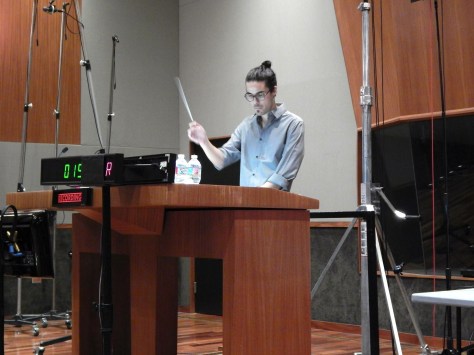
conducting

Upon viewing, the music in Karma seems so perfectly matched and obvious…yet, prior to Max’s compositions there were a myriad of possible ways that the score could emotionally affect the audience. Carefully taking this into consideration so that he might deliver the intended impact of the action, Lombardo delicately crafted the music for Karma. He explains how his work colored scenes stating, “There are two scenes in which I think the music really added a layer to the movie. One is when we first realize the fish is getting bigger. In this moment the score gets majestic and magical taking the point of view of the boy, but then goes into a darker tone as we start sensing that something is wrong. Here the music really anticipates and creates suspense before the big reveal when the fish turns into a monster. The other moment is at the very end when the fish eats the boy. Here I didn’t want to make it too dramatic as the movie had to be playful overall. I decided to build a dark orchestral piece that ends with a silly resolution that almost sounds like a Tom & Jerry cartoon, leaving a smile on people’s face when the end credits come in.

Contemplating Lombardo’s score for Karma, Peter Zhou relates, “We were really trying to go to some new places with this film. We straddled a line to deliver a message while making it entertaining and not heavy handed. I’m sure that it is frightening for a composer to play their new creation to someone for the first time; it’s a very delicate moment. As soon as I watched the film with Max’s score, I couldn’t stop smiling. It was perfect! He perfectly captured the message and the mood of the movie, adding an extra layer to it that made it complete. I think he really captured the essence of the movie.” Whether he is working with the finest LA musicians, the London Symphony Orchestra, or digital music software, Max Lombardo continually brings a fresh and creative approach to modern film composition and orchestration.

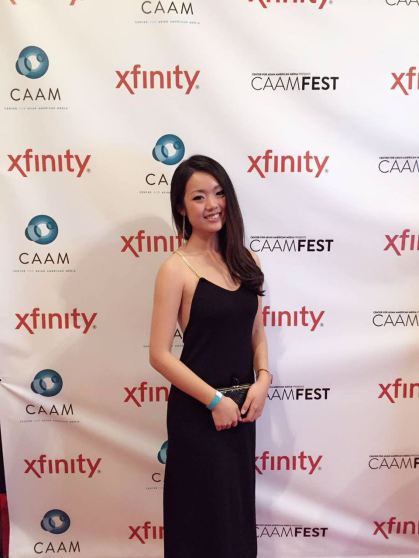
Headshot2

Producer Albee Zhang talks her award-winning film ‘Caged’

Other - CAAM Film Festival
Albee Zhang

From the time Albee Zhang was a child, growing up in Shanghai, China, she knew she wanted to make movies. The entertainment industry always fascinated her, and her creative senses were always strong. As she grew, this dream turned into both a passion and a reality. Now, Zhang is an internationally sought-after producer, living her childhood dream.

Throughout her career, Zhang has achieved what many still dream of. She has worked on hit television shows around the world, such as the British game show The Cube and the Chinese home renovation show Mei Hao Jia. She has made many successful commercials such as the series for Alpine Dairy. She has made films, such as Bride: Shanghai, I Love You, that have gone on to premiere at international film festivals. However, despite all of this, the highlight of her career was just last year when she made the film Caged.

“For a very long time, I was surrounded by fantasy, drama and science-fiction stories. When I was approached about this project, my eyes were brightened up. I had never done any sort of masculine project like this. Brotherhood versus self-ego, money versus fame, blood and underground fighting, all these elements had so many possibilities to be an outstanding project. I knew I had to challenge myself and see how much I could pull out of a project like this,” said Zhang.

Caged is a short film that follows James, a young man who fights in underground cage matches to make ends meet. In the film, James gets the life-changing opportunity to fight professionally, but when his brother Marco crosses a desperate drug dealer, James is forced to choose between his obligations to his brother and his dream of a better life.

“It is a very strong and straight forward theme for a narrative film. By looking at the character struggling through his life, at some point it kind of reminds me of the filmmaking life. Until the day we shine, we are always struggling. The character inspired us, we made the character. It’s a story about MMA fighter, but truly it’s a story to everyone who is fighting for their dreams,” said Zhang.

The film premiered at the New York City Independent Film Festival in May, and went on to have tremendous success. At the 2016 Media Awards it was recognized for Achievement in Film Direction, Achievement in Production Design, and won Best Male Actor. It was an Official Selection at some of the world’s most prestigious festivals, including the Festival Corner of Festival de Cannes, the Auckland International Film Festival, and the London Lift-Off Film Festival Online.

“It means the world to me and my crew that the film has done so well. It proved that everything we risked was worth it. Most cast and crew worked on this film because of friendship. Some of them even volunteered to work on this film. We all had the faith that this project would carry our enthusiasm to somewhere. It didn’t let us down. The honor belongs to the whole Caged family,” Zhang said.

As producer, Zhang managed the cost of the film to fit in an extremely tight budget and schedule. She also acted as production manager for the project, and ensured the crew was always safe and well taken care of on the set. Half of the sets were built in an abandoned basement of an ancient apartment to create an underground style, beat-up looking environment. It was a very bad condition location for filming as it was moist, very dusty, bad air-circulation and completely in the dark, pretty much like a dungeon, but it was perfect for the feel and look of the film. yet it’s exactly we wanted for the film set. Zhang made sure everyone was safe and happy, taking on yet another role.

“I was worried it would be too depressing to work in this kind of environment for four days in a row. We started working when the sky was dark in the morning, we walked out of the location and it was still dark but it was at night. Not seeing daylight for four days could be very intense and uncomfortable. I received zero complaints,” said Zhang.

Zhang made sure any dangerous spots were labeled and blocked, masks were provided, hanging wires were well placed and taped. She oversaw the crew and the fierce fighting shots were shot in the safest but most realistic way. She also arranged a crowd funded online campaign for the film, and received 20 per cent more than what she was aiming for. There is no doubt that she was pivotal to the film.

“Albee was indispensable to the making of our film and bringing it in not only on budget but under budget. She is an energetic, diligent and down-to-earth person who always speak for her crew. People work for her again and again. I also look forward to working with her again,” said the Director, Nick Powers-Gomez. “She has the drive to roll up her sleeves and do whatever needs to be done and fill up whatever position that needs her.”

All those that work with Zhang are continuously impressed by what she brings to the table, not just as a talented and committed producer, but also as a kind and thoughtful person. She not only understands what it takes to make a film a success, but she aims to do more than win awards. She is a storyteller, and constantly seeks to challenge herself. Her passion for what she does is always evident.

“Making film is utilizing a visualized universal language tool to bring out our mutual emotions. I put a lot of attention and work building up character relationships and finding the universal themes, such as love, family, fear, and friendship,” Zhang concluded.

Director/Producer Richard Kenyon Embarks on Several New Projects

Richard Kenyon
Director/producer Richard Kenyon shot by Jill Marie Robinson

Some creatives seem to have their hands in so many different projects that we can’t help but wonder if they’ve been blessed with a superhuman gift or discovered a mysterious way to create more hours in the day. The collective work of director/producer Richard Kenyon, which spans the gamut and includes award-winning films, PSAs and high profile theatre productions, is one that begs the question: How does one man accomplish so much?

Earlier this year Kenyon produced, directed and co-wrote the film A Girl’s Guide to Drowning starring Young Artist Award nominee Alexis Rosinsky from the films My Best Friend and The Archer, as well as the Golden Globe Award winning series Modern Family.

A Girl’s Guide to Drowning brings to the screen a story about the drastic manner in which a young woman tries to cope after a painful breakup with her boyfriend. Based on the character of Ophelia from William Shakespeare’s play “Hamlet,” who is as tragic as she is iconic, Kenyon’s newest film is a modern take on a classic play, which he says is, “proof positive that Shakespeare is relevant in the 21st Century.”

The film, which is expected to screen at festivals around the world later this year, is one that Kenyon has wanted to make for many years, but only came to full fruition after a chance meeting with Alexis Rosinsky, who plays the lead character in the film.

Kenyon recalls, “My wife and I were at a dinner party and Alexis performed a monologue from Ophelia and it blew us away. She was 13 years old at the time and I have never witnessed a more natural talent than the way she spoke Shakespearean text. So my wife and I went home and wrote ‘A Girl’s Guide To Drowning’ for Alexis.”

Considering his long-standing passion for Shakespeare’s work, and his ability to craft a story that hits home with modern audiences, A Girl’s Guide to Drowning was the perfect film for Kenyon to direct.

Richard Kenyon
Director Richard Kenyon & Alexis Rosinsky on set of “A Girls Guide to Drowning” photo by Maynrad Brenes

A highly sought after director, Kenyon is also in pre-production with the film Measure for Measure, a feature based on Shakespeare’s play of the same name, which he will be producing and directing. The storyline for the film revolves around a nun who’s propositioned by a high-ranking official and faced with the decision to lose her virginity in order to save the life her brother, or do nothing and keep her chastity intact. With Kenyon behind the wheel, there’s no doubt that Measure for Measure will do justice to Shakespeare’s original play, while also appealing to the palettes of modern audiences.

“To say this film is my opus is really an understatement. I have been around this play for my entire adult life. I saw a production of it at Stratford Canada in 1992 and it hasn’t left my mind. It starred the amazing Colm Feore and a young actress by the name of Elizabeth Marvel-who now both appear in ‘House of Cards’,” explains Kenyon. “Since that day I have directed the play twice and have been in it so I know the power it has in for an audience.”

In addition to Measure for Measure, Kenyon is also busy laying the groundwork for the upcoming film Some Day, a biographical tale about the struggles he personally faced as a child when he and his family moved from England to Canada, which is slated to begin shooting in Canada at the end of the year. If his plate wasn’t full enough already, he will also be directing the upcoming horror film Branded, as well as the film Ice Cream.

A film about the penal system, which focuses on the way seemingly simple decisions are overwhelmingly difficult for prisoners as they try to assimilate back into society after being released from the system, Ice Cream is expected to begin shooting in Barcelona at the end of summer.

“It is unlike anything that I have ever been offered before which was the real attraction. I love being challenged by my work otherwise why do it,” says the director about the upcoming film.

Kenyon’s directing career, which stretches back over the past three decades, first began back home in Canada in the late ‘80s when he directed “The Actor’s Nightmare” performed at the Alberta One Act Play Festival. His love for the theatre and his unparalleled talent as a director eventually lead Kenyon to serve as the artistic director and co-founder of several prestigious theatre companies, including The Shakespeare Company (TSC), Shakespeare in the Mountains and Knights in Waiting.

Over the years Kenyon has directed innumerable iconic plays including “A Midsummer Night’s Dream,” which was performed to sold out audiences during TSC’s inaugural summer season, “Richard the Third,” which received rave reviews for its ingenuity, “Cyrano de Bergerac” by Edmond Rostand, and more.

He says, “There is something very unique and exciting when an actor steps onstage and performs. A bond is made with the audience and they aren’t afraid to tell you how they feel. That is thrilling.”

While he’s achieved extensive success as a producer and director in the film world, with his first film Insomniac winning the award for Best Overall Score at the AMPIA Rosie Award as well as being nominated for the Best Editing, Best Cinematography and Best Drama Awards, the theatre is something Kenyon says, “never leaves you.”

This summer he will be directing the production of “Hamlet” produced by the Lovers and Madmen company, which will be performed at several venues throughout Pasadena. He is also directing and producing the upcoming production of  “The Curious Mind of Will Shakespeare,” an immersion show that will take audiences into the exciting world of Shakespeare and is slated to run at the Shakespeare Club Villa of Pasadena on October 26, 27 and 29.

Maynard Brenes, who served as the director of photography on A Girl’s Guide to Drowning, says, “Richard’s theatre background is probably his most valuable asset to directing that he brings to the table day in and day out. Part of the creative puzzle is being able to communicate with talent and having that background is invaluable. His work speaks for itself.”

In addition to his film and theatre work, Richard Kenyon has also made a huge mark in the entertainment industry as the producer and director of several riveting PSAs, such as The Keys, which earned an AMPIA Rosie Award Nomination for Best PSA in 2015, as well as the “Pason Systems” PSA, which earned him an AMPIA Rosie Award Nomination for Best Producer in 2008.

Beyond all this, Kenyon is the creator and radio host of “The Director’s Cut with Rich Kenyon,” an informative series that airs on Kaotic Radio and sheds light on all areas of the film industry.

Driven to create new and enticing work at every turn, Kenyon says “Stagnation is the death of art.”  

Anyone who’s had a glimpse of Kenyon’s work over the years would easily conclude that he is definitely one creative genius who’s never stagnated, and with four new films in the works, it’s doubtable that he ever will!

PLACING THE LAUGHTER AND HEART INTO THE DEVIL’S TAIL WITH PHIL LUZI

Phil Luzi is in an underground water cave in the Mexico and he is nervous. “Hey, are there snakes in here?” he says with concern. His inner monologue is comparing the pros and cons of the situation. On one hand, he is filming a feature film in a tropical climate, far away from the cold of the Canadian winter. He is staying in a beach house with a personal chef at his disposal. To offset that, he finds himself wondering what manner of science fiction horror film based creature might rise from the dark and murky depths in which he currently finds himself. Luzi wonders exactly how he arrived at this point in his life. Oh…he wanted to be a successful actor and he is one. Still, does danger have to be part of the equation? Phil recalls when he first met writer and star of The Devil’s Tail (the film being shot) Samantha Swan. The two met and worked together at The Second City in Toronto. This is also where he met his Devil’s Tail co-star, Rob Fulton. Their work on previous projects together led Swan to write the role of Dave specifically for Luzi. She confirms, “The director (Christopher Comrie) and myself always wanted Phil in the film. I wrote a part specifically for him that only he could play. I can’t imagine anyone else in that part. Once on board, from first read- through to recording ADR in post-production, Phil Luzi commits with great energy and humor. We always considered ourselves lucky to have him on The Devil’s Tail and would be lucky to have him on any of our future films.”

DevilsTail1

Luzi plays Dave in The Devil’s Tail. Dave is that loyal and abiding friend who would do anything if you asked. Even if he is scared, even if he thought for a second that he might die, even if he knew it was a bad idea…he would be there for his friend. Dave is the low-status character that gives the high- status character the courage they lack when they need it the most. He’s that guy in a group of friends that’s along for the ride but never knows for sure where they’re going. He’s the ‘YES’ man and everyone counts on it. In the storyline of The Devil’s Tail, Dave follows his best friend (Pete) to a strange land to find someone he doesn’t even personally like, all because he loves Pete unconditionally. Like all nice guys, even Dave has a boiling point. He reaches that boiling point after much tested patience and compliance. It’s always fun to watch that person who never loses it FINALLY lose it and then immediately go back to being that docile team player everyone counts on him to be. Phil states, “The Devil’s Tail was my first large role in a feature film. The thought of it was at first intimidating. I was working with actors with so much more experience under their belts. I was afraid that I’d show up in Mexico to a wall of ego and rejection. I was challenged to muster my own self-belief and confidence, not only in my abilities as an actor but in my ability to socialize and open myself up to learning, adapting and becoming part of a fresh social dynamic. It was a challenge to consider myself a talented actor, deserving of this opportunity. It was an exercise in self-belief in the face of doubt and insecurity. More experience doesn’t necessarily make you better than another actor. It just gives you the confidence and belief that you can conquer any fleeting fear of failure. That is a huge lesson.”

The Devil’ Tail is the type of film which contains something for everyone; adventure, romance, danger, even comedy. Dave is the comic relief of The Devil’s Tail. The storyline itself is intense. Pete (Fulton) goes to a strange country and into the backroads of the Yucatan Peninsula to find his missing friend (Eddie) and the unrequited love of his life Kate. Danger is inevitable, and Pete’s courage is found in Dave – that friend who always has your back and gives you so much confidence, you think you can do anything. Dave is Pete’s sidekick, the Robin to his Batman. What Dave lacks in courage he makes up for in his belief in and love for Pete. Dave is the quintessential best buddy who isn’t afraid to look like a fool, to suffer ridicule at his own expense, and to get wet, or dirty, or go anywhere (even climb a ridiculously tall ancient pyramid) all because he loves, admires, and respects his best friend. Luzi professes, “I love Dave. I’d like to think that to some extent I’m a lot like Dave. The film’s hero Pete would not have succeeded in finding Eddie and Kate in this intimidating strange place if it wasn’t for the companionship and encouragement of his buddy Dave. Truthfully, this is probably one of the things that actors love about what we do; if only for a little while, we can become that better person that we aspire to.”

DevilsTailbts

If one is attempting to be a different person, you may as well be adventurous with your surroundings. Luzi admits that when the filmmakers spoke to him about the location of the shoot, he was excited. The location of Tulum, Mexico was, for the most part, paradise. Living in a large house with a private pool, beach and chef felt like living a dream for Phil. Of course the cast and crew were there to work, not to luxuriate. Mostly shot on location in the surrounding area, the environments were dark, scary, strange places. When not in the murky depths, Luzi’s fear of heights was challenged by climbing the ancient Mayan pyramids. Not many of us would be fond of the idea that facing some of our greatest fears would be captured on film for the world to see, especially while it necessitated keeping a straight face…or worse, being funny. Still, Phil admits that it was a growing experience for him that he was happy to take part in. He gives copious praise and credit to the film’s writer and star as he admits, “Samantha [Swan] knew how to present me with challenges as an actor; to take me on a new journey through this character, and become someone new. I think above all else, Sam hired me because she knew I was capable and talented enough to devour the nuances of the soft-spoken character she wrote; to express a range of emotions from compliance, to frustration and fear, to the discovery of new found courage and self-belief. The growth of Dave’s character from beginning to end is in many ways the subplot to an adventurous love story. She never questioned for a minute her belief that I could carry the responsibility of bringing this character to life with depth, believability, and humor. In fact, to this day her belief in me during that time is what carries me through moments of insecurity and doubt.”


AWARD-WINNING EDITOR JUN XIA’S “INSIDE LINDA VISTA HOSPITAL”

Jun Xia is passionate about his work. As an editor, he is passionate about filmmaking in general but he makes no qualms about his love of Horror films. To be clear, it’s the difficulty of it that calls to him and is so attractive. Jun contends that for an editor, horror films are more difficult and require more of him than any other genre. There are multiple reasons for his opinion but it’s clear that the affinity between this editor and the genre is mutual. His work on the film “Inside Linda Vista Hospital” is evidence that Xia feels called to dig deep and bring brilliance, and the accolades which the film has received have vetted him as one of the premier professionals of the day. In addition to numerous awards, Jun was named winner of Best Editing at the United International Film Festival 2017 and received the prestigious honor of this film being named an Official Selection of the Festival De Cannes Short Film Corner 2017. It’s hard to fathom the concept that a factor which led to such international notoriety was conducted in a small editing room. This is the role and life of an editor however and Xia seems more than comfortable with it. When speaking about his work on “Inside Linda Vista Hospital” it is obvious that his ideas and the images on the screen transport him to another place, just as they do for the audience and even the characters on screen.

Jun is boisterous in his proclamation that editing Horror films is an art form, perhaps even a calling for him. One thing is for sure, when a professional feels as inspired and assured as this, you are certain to get an incredible film. “Inside Linda Vista Hospital” is a pseudo-documentary horror film. The script and fictional elements are used to tell the story but are presented in a style that mirrors the documentary format, giving an implied sense of reality to it. The story is about three explorers of the supernatural who go to investigate an abandoned hospital. They get lost in the hospital and one member of the trio becomes separated from the group. While the other two try to connect and find him, they encounter a variety of horrible things in the hospital. John (the missing member) is lost in the basement as the other two characters encounter patients who had been tortured in the hospital and eventually died. Several surprise twists and turns in the story line deliver the shocks and startles that viewers of this genre love. While it all seems so natural and intuitive when viewing the movie, the film’s editor reveals that it is quite the opposite.

While many people operate under the presumption that an editor simply connects and dissects different scenes, the role is actually one of the most vital in creating a film’s story. Working closely with the director, Jun commonly finds himself in deep discussion about what tone to take in placing the scenes together. As with any creative endeavor, if you aren’t noticing the difficulty that it takes to create the work…it means that a highly skilled artist has manifested it. Xia explains, “Once filming is wrapped, there is still so much work to do before the film takes shape. The story is given to the film editor. The editor should discuss with the director to understand the director’s interpretation and ideas of the script. The editor should also understand the director’s style because every director has a unique voice which will naturally lead to different film styles. After the synthesis of these, the editor will successively present the story’s narrative methods using editing software. It’s paramount to understand the role and temperaments of all these professionals in order to be an effective film editor (the ability to understanding what the writer, director, and actors are doing). When it is most creative and enjoyable is during the post-production, the director and the film editor will communicate and discuss at great length. The film editor needs to understand the style and the ideal effect of the director before starting the cutting.  The director will also give the film editor a large creative space in order to maximize the effect that presented by the film.”

Every editor has a process and Xia’s is very specific when it comes to Horror films like “Inside Linda Vista Hospital.” Obviously, he does an initial check of the footage to find the subjective perspectives and intersperse them into the cinematic look of the film; for example, using the POV shots to present the sense of what the character sees while walking. In this way, the audience will feel like they are moving in the film scene while watching the movie. “Inside Linda Vista Hospital” had a large number of handheld camera shots which can be useful but problematic for an editor. Jun describes, “There are a lot of handheld shots in this film. I needed to edit these shots to move fast, so the audience will feel that it’s real and scary. There is a shot in which the character runs into an abandoned red room; I wanted them to run very fast and then fall down on the ground. To achieve this, when I edited this scene, I removed some frames when they run and fall. This is a good idea when editing moving shots. It adds a jolt and surprise element.” Xia adds, “It’s true that editing with a moving or hand-held shot is more difficult than with a fixed shot. A moving shot is constantly changing and often represents the state and psychology of the characters, such as running, walking, or moving with the visual changes of the characters. The editing of these shots should be very reasonable and the convergence of the character movements should be smooth. When editing this, you need to find the splicing points of the screen and then chose the best joint to link the senses of different contents and form a complete action or concept. In addition, based on the characters’ physical movements on the scenes, it’s best to select the beginning or the end of the action as the editing point. In contrast to this, a fixed shot is relatively static and visually has no obvious dynamic shot.

The challenge for Jun when editing a horror film comes not only from the technical aspect of what he is doing but the content which he is given. The footage for a horror film has such a diverse number of factors that affect its delivery. VFX, Dolly shots, fighting or chasing scenes, and other methods are essentially requirements of the genre. While many types of films include some of these, only the rarest contained what is almost always contained in a Horror film. Of course, no scary movie is complete without those unexpected frights which elicit screams and then laughter. This is yet another reason that Jun Xia loves this type of work; it allows him to use the very best he can muster to draw such a wide range of emotional responses from audiences across the planet.

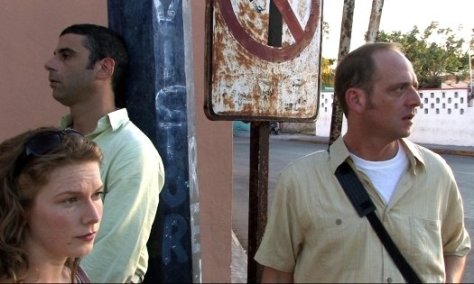
Linda V 1