Category Archives: Behind the Scenes

THE SOUND OF THE GRANDMASTER: JIFU LI

The human experience is diverse and complicated. There are layers upon layers of emotions that make up the life of every individual on the planet regardless of their experiences and their point of origin. This complexity can sometimes go unnoticed in the din of so many people. The beauty that makes up each person’s life is a story in itself. This concept goes overlooked by many but is always present in the mind of Jifu Li. As a Sound Editor, Jifu spends his time ensuring that the voices and sounds present in a film weave in and out of presence in the story as the filmmakers see fit. One might not think of sound in terms of color but it is precisely this perspective that allows a contouring of the experience by the audience. Jifu uses his talents in a wide variety of films ranging from Oscar nominated to independent productions, proving that those of great talent seeks to collaborate with great storytellers regardless of the price tag…because that’s what they must do as committed artists.

Creating any film is a massive endeavor. The Oscar-nominated feature film The Grandmaster was almost hyperbolically so. The footage was extensive, twelve reels by the time that Jifu began his work. The production’s shooting cycle had lasted four years. Li’s previous work on five films had convinced Wu Ling (general manager of the China film post Company) that Jifu’s talent and propensity to work long hours without complaint made him ideal for the position. The Grandmaster is the story of the martial-arts master Ip Man, the man who trained Bruce Lee. While it’s a gripping drama, the film is an obvious action story as well. The picture editing and audio editing of the film were done synchronously, which meant that getting the final frame version in perfect sync was an intimidating proposition. Altogether there were fifteen versions of the film. If an action scene changed, all of the effects and Group ADR required recutting by hand, sometimes even redesigning or rerecording.  Describing what he does in a very literal sense, Jifu states, “If you cut from a punch to a slow motion reaction, the sound pacing should be fast to slow. I might add in some ‘Bass Drops.’ The hit should appear to the audience as it ‘feels’ to the characters, like you can hear the fist beat from the skin to the bones, all the texture and details. What happened a lot in The Grandmaster is that they would then change it on the other side; cut to the fighter’s slow-motion movement first, and suddenly speed up, hitting the others person’s face. The sound design will then change a lot. Sometimes there were voices and sometimes just music and sound effects. There are so many of these sonic aspects in modern films and in particular action films. My job is to make sure these subtleties are executed perfectly and to the desire of the director. It can be arduous but it’s always gratifying.”

A consummate professional like Jifu was necessary for The Grandmaster due to one technique which was employed during filming for the benefit of the action sequences. In this film (as in many action films) the director used music to aid in the fight sequences. This type of choreography is always about timing and music greatly aids in this. Quite often, the music used during filming is not the same that is used in the final edit (sometimes the music is altogether discarded). This results in extensive ADR (automated dialogue replacement). Even beyond the main characters, Li worked extensively on Walla Editing (the background character voices), Wild Tracks (sound effects which are recorded on location by the production sound mixer and then later edited for use), and Foley.

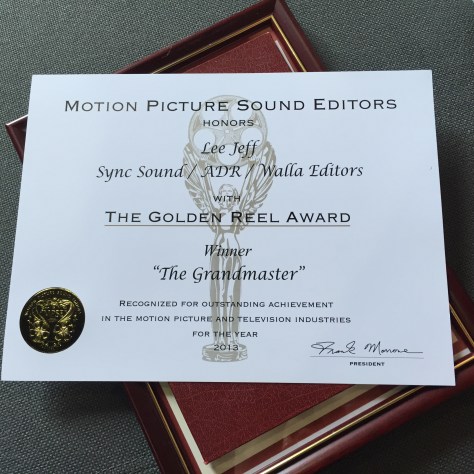
The Grandmaster is a beautiful film, visually and audibly. In addition to its 2014 Academy Award-nomination, it also received the Best film at the (2014) Asian Film Awards, Best Film at the (2014) Hong Kong Film Awards, as well as a Golden Horse Film Festival Audience Choice Award & Best Feature Film nomination. Most meaningful to Jifu was the Golden Reel Award for Best Sound Editing in Foreign Feature Film that acknowledged his skill on The Grandmaster and which he credits for inspiring him to continue to excel in the profession.

Though he enjoys the challenge of a huge budget feature film, Li also welcomes the opportunity of smaller films and the methodology they require. His work in Editing for the film “Love is Color Blind” helped to create the mood for a very different type of adversity and combat between the film’s main characters. The film, which won a host of awards at the London IFF 2017 and the Los Angeles Cinema Festival of Hollywood, is the story of an American woman who adopts an orphan from China and has brought it back to the United States. With adolescent rebellion, the child begins to gradually question the authority of her mother. Teen angst ensues and a rift is created between child and parent. As life educates the daughter, she prepares to sincerely apologize to her mother at her 18-year-old birthday party but the mother faints from weakness due to late stages of cancer. At the last moment of life, the mother and daughter finally understand each other.

Jifu had extensive conversation with director Liu Jiaqi about the emotional shading of the tone she wanted in the film. In creating the sound design for “Love is Color Blind” he used Avid Media Composer  and Protools HD. The program creates sound Design effects and allows them to be categorized and moved around as per the director’s desire for subtle differences. These type of modern tools are equally applicable in major studio films or smaller indie productions. It’s a fact of the modern filmmaking era that both the tools and the skilled professional like Jifu who use them often work in both situations. The key factors in either are talent and hard work, something which Li is always mindful of. He reveals, “I remember when I worked for Kar Wai Wong the director and he told me an idiom which inspires me to this day. Everyone knows that the most valuable part of a toad is the toad oil but do you know how the toad oil is produced? The toad is placed under a light and is scorched by the light. It produces this oil, a process which takes about twenty hours. When I heard this, I thought ‘sometimes inspiration comes from dogged pursuit.’ The best thing/essence occurs at the moment when you feel you reach your limit and want to give up. If you persist, you might be surprised by your achievement. This is what keeps me working as hard as I possibly can.”The Grandmaster -MPSE best sound editing
“IF” HONESTY IS BEAUTY

Director Nikki Ormerod wanted to use her background in still photography as an inspiration for the film “If” which celebrated the differences in human beings. She wanted the most basic of presentations in order to focus all attention upon the individuals presented onscreen. She had long desired to work with cinematographer Stuart Campbell and was pleased when he consented. The resulting film was an official selection of the Ottawa Film Festival (2016) and earned Campbell a nomination for Best Dramatic Cinematography from the Canadian Society of Cinematographers. The most fitting description for the film would be classic. “If” is streamlined and yet possesses a massive emotional impact. If (no pun intended) the desire of Ormerod and Campbell was to exhibit the corporal form and communicate the essence of our connective substance, goal soundly achieved!

Most directors hope to capture a performance that is believable. In her film “If” Ormerod wanted to simply capture the beauty and complexity of what is already in existence. The desire was to manifest a “filmic version” of the type of photography that interested her most. The soul of the individuals onscreen should be visible and instantly relatable to the audience. Nikki knew Stuart’s work and knew that he understood how to capture the correct moments to exhibit this. She confirms, “Stuart elevated the film to levels of quality I had never thought possible. ‘If’ is a very simple film that centers purely on showing the faces of a variety of individuals from different walks of life. Considering the static nature of the shots, it was necessary to have a cinematographer that could think beyond just shooting beautiful photography and instead capture thoughtful, conceptual, and cinematic imagery that delved much deeper, which is exactly why Stuart was the only man for the job. Based on my initial idea, Stuart brilliantly introduced the idea of incorporating slow motion shots and poetic narration to the film to help support the idea and visuals, which I must say was a stroke of pure genius. The slow motion shots and use of black and white photography created strong rhythmic and timeless imagery.”

bts_3

Working together, director and cinematographer created a visual statement which communicates a unifying vision of community; one which literally shows how we are all the same regardless of age, sex, race, religion, and other factors…because we all feel the same emotions. The Rudyard Kipling poem supplies the verbiage which tells this but the imagery packs the punch of this idea. Within mere seconds of viewing those onscreen, one can see the same desires, hopes, and motivation in an outwardly eclectic yet inwardly cohesive group.

The sincerity and simple beauty of Nikki’s idea for the film spoke so loudly to Campbell that he offered up a streamlined and simple approach to the camera’s view. In its singular manner, the cinematography of “If” established the ability of the audience to focus on the individuals seen on the screen rather than a variety of framing, lenses, and other technical processes that Stuart could have used. There’s no shortage of technology available to use on a film these days. Drones, Go Pros, and other technological gadgets enable a cinematographer to create a myriad of different looks for their work. Stuart explains, “Some prefer to have a lot of toys at their disposal so they have options while they’re shooting. I prefer to figure out what needs to be done and focus in on that and get the gear that is needed. Different jobs have different needs. Some jobs you really do need to have two, three, four cameras around because that’s what’s appropriate for the job and what you need to cover. Personally, I love one camera jobs because it allows me to shoot everything the way that I think it needs to be shot. Controlling? Maybe, but everyone is different and everyone sees the world differently. Someone else may not shoot something the same way I would. And sometimes things come up where you need to adjust and roll with what’s happening. There’s no guarantee that someone else will react the same way.”

bts_7

There’s something to the idea that a great cinematographer gets inside the brain of the director they are working with. If the cinematographer is the eyes of the project, the director is most certainly the mind and heart of it. Campbell contributed more than just the images seen in “If” because he “got” Ormerod. Nikki’s original idea was to have music, vague & droning instrumental tracks to accompany the people seen onscreen but after prompting from Stuart and some research, the Kipling poem was added and gave a whole new dimension to the film. That poem was written for Kipling’s son as a piece of paternal advice. It gives general conditions to succeed in achieving a happy & beautiful life. If everyone lived by similar “rules” the world would be a much different place, and potentially a much happier one.

One very obvious and complementary part of Campbell’s contributions to “If” is the use of slow motion. The gravitas of the imagery in the film, coupled with the poem by Rudyard Kipling, are enhanced by the calculated lethargy of the movements seen in the film as a result of this. This grants the viewer the ability to hang on every person, every frame, every emotion, fully supporting the idea and experiment of a “moving photograph”, as was the director’s original desire. Stuart confirms, “The slow motion was a very clear way to allow the viewer to really take in the emotion that the subject was giving out. Like a photograph, the longer you have to sit with something, the more story comes out of it. It was an opportunity to let the viewer take their time and experience the visuals along with what was being said in the poem. The film is an emotional piece and sometimes it’s best to just take your time with things. Using slow motion also gave us an opportunity to make some emotions mean more by speeding them up or picking a speed somewhere in between. Shooting in slow motion just gives you options and lets you bring some more drama to what you’re shooting (sometimes).”

bts_2

Stuart Campbell is known for getting amazing results with an often very basic camera set up. While he is quite comfortable with the updates that technology’s cutting edge offers up, it’s because this cinematographer is so committed to story and connecting with the essence of a production that he often uses a very limited set of tools for himself. It’s via this “primary” approach that Campbell feels he is able to more sincerely communicate the essential ideas that the storyteller wishes to impart. It’s Stuart Campbell’s contention that more tools do not make one more skilled, rather it’s by using the tools you have when they are called upon that empowers one to honestly communicate the essential idea of any story.

THE DESIGN 7 OF LOVE: JAMES CHEN

22163818_10155843589892431_477575936_o

Filmmakers are always searching for a better way to communicate the message and feeling of a story. The characters found in their creations are a means for the viewer to identify the experiences and emotions in their own lives, or the ones they hope to avoid. In the upcoming feature film Design 7 of Love, the filmmakers took advantage of the vision and talent of VFX Artist James Chen to manifest the state of mind of one of the central characters in a very disorienting situation. The film connects the unexpected association of architecture and emotions, or perhaps more accurately…the effect of these on one’s mind. Using state of the art technology in CG, they enlisted Hi-Organic Motiongraphics to do what so many productions desire, to display that which cannot be filmed. Taking a key role in this, Chen worked on some of the most surreal moments in the film. The integration of this tool and the cooperation between artist like Chen and filmmakers continues to be the type of visuals to moviegoers that were nonexistent until the last several years. While CG has allowed the creators of these films to display almost any scenario on screen, the role of artists like James Chen is to make them so real that we almost question our own senses.

The VFX work which James was charged with creating is integral to telling Design 7 of Love properly. One must understand the surreal nature of the storyline in order to appreciate how important Chen’s work on the film was. Yet, even prior to this one must understand that the word “design” in Chinese has two meanings. The first is the dictionary definition meaning “to decide upon the look and functioning of (a building, garment, or other object)”, the second is “to set up someone or something, in a relatively negative way.” The word “design” in this film has both of the meanings in many cases, especially when everyone is trying to “design” a scenario or situation in order to “set up” someone in the emotional world. The beautiful protagonist of the story is Doris, an interior Designer. Her ex-boyfriend Bartz hopes to repair their relationship by providing her with a senior designer position in the architecture studio where he works. This only serves to enrage Emma, the company’s other designer who seems to have feeling towards Bartz. The studio’s pitching process to a hotel goes smoothly as Doris’ presentation impresses the hotel’s young owner Mark, both with her design concept and herself. Doris suddenly becomes the studio’s hot shot. The studio owner Andrew hopes to ensure the company’s revenue by landing the hotel as a client. To achieve this, he encourages (essentially orders) Doris to starting dating Mark. Doris pretends to date Mark to justify her cold actions towards Bartz, leaving Bartz devastated and also making Mark more and more confused. Doris does not fully accept nor deny either of the two men’s pursuits. As the relationship between the characters becomes more and more complex, Doris’ mind world starts to twist. In a congruent fashion, all her “designs” metaphorically turn her vision of this supposed “beautifully designed” city into a pile of monstrosity, reflecting what’s in her own mind. In the end, Doris, Bartz, Mark, Andrew, Emma, and the other two studio staff [Chang and Chiz] all have their own “design” to “set someone up” in love or other affairs. The director of Design 7 of Love even created a scene in which all the characters act like they are “actors” instead of film characters, conveying to the audience “being set up.” The overall theme is that what we label “love” may actually be the result of a “design.” It’s the ability to see the merging of imagination of the mind (brought about by the emotional turmoil) that becomes part of reality that James manifested for the film.  Doris’ main work objective is to provide new design to the hotel to make it a part of Taipei’s new “world design capital” title, but her emotional state has become chaotic and unstable as a result of her complex social relationship. When she wants to make things more clear, more simple, more “designed”, the outside world becomes more complex. This resulted in an approach that Chen describes as “anti-beauty.”

An ideal example of this is in the “Growing Monstrosity” scenes. So called because of the evolving appearance of the city, these changes are a direct effect of the chaos in the emotional state of Doris. Window fences, excessed vent pipes, and poles start to grow from the walls of the street view instead of beautiful decorations. These reflects the character’s mind. Metaphoric steel fences appear as a sign of Doris’ insecurity. James and the team came up with 40 base mechanical objects which were considered elemental to a structure, from factory pipes to a variety of small metal fences to serve as parts pool. The combination of the objects and scripted sequence transformation animation created a large number of wall structures with different shapes, providing a sufficient amount of complexity for the “growing monster” atmosphere in a fast way. The “shattered dream” scene contains CG environment and VFX with green screen footage. Doris is seen standing on a ladder made of piano keys, enjoying the “beautiful dream” environment which reflects her feeling at the time. The scene is designed to have a full CG environment. Later in the film the scene starts to collapse with every step she runs on the ladder as the dream becomes a nightmare. James states, “My colleagues and I utilized a vast amount of relief sculpture photo and traced them onto the models with Zbrush to enhance the details which made the Thinking Particles-powered fragmentation FX more convincing and beautiful.”

IMG_3493

Hi-Organic Motiongraphics Kai-Zhen Lee was FX Lead on the film and explains what made Chen such an asset, stating, “James has experienced a vast variety of CG animation positions which made him very resourceful when facing technical difficulties. He often provided quick and sometimes unorthodox solutions for FX problems regarding the interactions between software functions from time to time. It was thanks to his knowledge, experience, and ingenuity that we were able to create such a unique look for Design 7 of Love.” A result of this was the film’s nomination for “Best Visual Effects” at the prestigious 51st Golden Horse Awards. With over fifty years of filmmaking history to the Golden Horse Awards, the nomination for “Best Visual Effects” places Chen and Hi-Organic Motiongraphics among the most recognized in Taiwan, Hong-Kong, & China. The connection between the images he creates and their effect on viewers is always present in his thoughts. James relates, “In order to get photos of Taipei city with a clear view for this film, the team somehow managed to negotiate with one of the TV stations to give us access to their helipad, which is a rare occasion. It’s not a view that many people get and it is beautiful! When you are up on a tall building and overlooking the city you appreciate the perspective. It’s times like these when I realize that my job is to give other people the ability to see things with the same awe that I experience. I love that part of what I do.”

DISPLAYING THE DISTANCE: RUIXI GAO

Anyone who has been in a long distance relationship will relate to the film “Distance.” Whether it’s romantic or platonic, being separated from those you love is difficult, particularly when you are on opposite sides of the planet. To communicate the feeling in images, director Haixiao Lu enlisted Ruixi Gao to take the helm as cinematographer. Based on her previous work in productions like Last Call, Locked, Under the Pieces, and others, Lu was confident that Ruixi could deliver the sentiment and creativity he was looking for; a notion that was proven correct when “Distance” earned wins at the 2017 Hollywood Film Competition, the LA Shorts Awards, and the NYC Indie Film Awards (earning the Best Short Film). Gao is justifiably proud of the look of the film. What it lacked in big budget financing, Ruixi made up for in creativity, tenacity, and good old fashioned hard work; it’s a situation she often prefers as it requires her to prove her ability to deliver an exemplary product regardless of the monetary factor. The slick look and beautiful vibe of the film belie any struggle to make it. While the storyline of “Distance” may be painful and the process of making it hard fought, watching the film is completely effortless and enjoyable.

The perennial theme of the movie is love, in particular a long distance relationship between young lovers. While in China, a young Korean girl meets a boy and the fall in love. When her love goes to study in LA she is understandably heartbroken. They go about living separate lives while still in the relationship. While it is difficult, they FaceTime every day. Inevitably the spacial distance and their busy lives take a toll, creating an emotional space between them. With a grand romantic gesture to surprise him, the girl flies to LA but finds him in the embrace of another woman. In a letter, she tells the boy that the memory of their love will endure but the relationship cannot, at least it cannot for her. In the final frames we see the two former lovers returning to the places they were in the beginning of the film but appearing changed. While this story is not new, the way it is communicated is done with such grace and beauty that it elicits a transcendent beauty and pain which cause it to be markedly different than similar films that preceded it.

While many filmmakers romanticize over the days of actual film, Gao feels that the digital age has empowered many cinematographers to create a higher quality of imagery in films within greater time and budget constraints. Even more, the transition from film to digital has allowed DPs to create looks previously impossible. The result is the transition to a new age of a more realistic sensory experience, a richer color screen, and new innovation opportunities. Rather than a detriment, Ruixi considers the advantages of digital to be a powerful tool to be used in the appropriate manner. That said, she is fond of using an analog methodology when it is called for…as she did with an important aspect of “Distance.” When the director (Haixiao) told Gao he wanted to have a split screen simultaneously showing the male character in LA and the Female in Korea, Ruixi experimented with different ways of achieving this for the film. She reveals, “It’s always a challenge when you want to achieve the look of a big budget film on a smaller budget but I honestly feel that there is no substitute for being creative. I studied and researched a lot of different methods for doing a split screen. I did camera test before the shooting and then showed the director my experimental video. I simply covered up half camera’s screen(monitor) and then combined the two in post-production, placing one on the bottom. Together they made a perfect complete picture. There are many ways to shoot. Working with the editor gives a variety of means to achieve the effects needed for this.”

distance 01

While the filming was done in one city, it was Ruixi’s job to make sure that the main characters appeared to be in locations on opposite sides of the planet. The moods of the boy and the girl would also need to be passively communicated to relate the emotional mood of the characters. Gao used a simple lighting design for the film with low key lighting and a soft filter for the Korean girl and a somewhat more revealing and higher key lighting for the boy in Los Angeles. Gao professes that a simple design is typically the stronger one in her estimation, which director Haixiao Lu agrees with. He notes, “Anyone who has seen Ruixi’s reel will attest to how attractive it is. She has this innate ability to find the natural beauty in all things, which is always the most honest and powerful when it comes to visual imagery. I did not hesitate to seek her out to be the DP on this film once I saw the reel. She really knows how to work with a director. She is a passionate artist and working with her is exciting because of this. Talent such as hers is rare.”

Ruixi Gao is a reminder to all in the film community that embracing a “hands on” approach to innovation can mean using traditional tools or the most advanced ones available. The only rule that is important in art is the constant pursuit of it. The form is elevated by those who take risks and follow their own muse. While Gao may have learned from others, she forges ahead with an open mindedness that serves her and those she works alongside well. The pain that one feels when watching “Distance” would not be as intense and ironically enjoyable without the look this cinematographer has created for us.

distance03

RACHEL ZHOU DIRECTS A MULTINATIONAL NAIL BITER IN LOS ANGELES KIDNAPPING

China not only possesses an acclaimed and burgeoning film industry but also a huge number of movie goers and cinema fans who greatly contribute to a film’s international box office. There’s a good reason that you see many Chinese names in the credits of Hollywood films these days as well as an increasing number of the country’s talent appearing alongside Hollywood marquee names. The relationship between these film industries has been mutually beneficial artistically and financially. A key ingredient in this scenario is the ability of at least some of the professionals to communicate in both languages (sometimes multiple languages) whether in front of the camera or behind it. Rachel Zhou is a Chinese director well versed in American film. She has found herself working on numerous productions due to her talent and her command of both languages. Communication is key for a director when speaking with the actors, cinematographers, and other members of the film crew. It’s even more so when the same vision must be communicated clearly to a cast and crew who do not share the same native tongue. The China-US production Los Angeles Kidnapping enlisted her as a director due to their need of cross cultural assuredness in both the storyline and the performance of the off camera crew.

The occurrence of US/China film productions is becoming increasingly more prevalent. Directors who are both talented and at ease in communicating in both languages (Rachel speaks four languages) make them even more attractive these days. Zhou believes that the communication involved in a film production transcends even the spoken. Her goal is to have her team work together culturally and spiritually. Directing more than the film, she feels that it is her job to create a positivity, a sense of calm and confidence that permeates the very air of the working environment to sync the minds of all involved. Even though she possesses more than the appropriate verbal skills needed for all on her team, it’s Rachel contention that once she creates this “vibe” on set, everyone understands and anticipates the needs of the work.

Los Angeles Kidnapping is a Chinese story taking place in the US but the theme is universal. Through the experiences of Delger (played by Siyu Lu) the audience is asked the question, to what ends will one spend their life fixated on revenge. Motivated by avenging his brother’s death, Delger follows clues about the murder to Los Angles. As a graduate of the police academy, he both understands the law and is willing to work outside it as a result of his anger. Working undercover as an Uber driver in LA, he continues his investigation. When a friend of a friend is kidnapped by mobsters, Delger is enlisted to aid in the rescue. The experience and a surprising plot twist at the end of the story cause this protagonist to question whether a life solely focused on vengeance is one he is willing to live.

While the list of Zhou’s directing credits is extensive, her work on action films was not, prior to Los Angeles Kidnapping. She fully embraced the idea of the different approach required for the genre. Taking great care to design and discuss the film’s many action sequences with stunt coordinators for entertaining action designers, Rachel’s cast underwent extensive training for them film. While storylines of a more emotional nature are centered around the actors, action films present the action as a character in themselves. This includes crew members and professionals who specialize in the genre such as stunt coordinators, drone operators, traffic controllers etc. The film also gave Rachel a chance to use one of her favorite tools as she describes, “I’m into Steadicam shots a lot. When I direct an action/crime/drama, especially actions scenes, I prefer to go with Steadicam shots. Steadicam is a novel way to shoot a scene as it isolates the movement of the camera operator from the camera. Stabilizing mechanisms counter the movements of the camera operator to eliminate the inevitable imperfections present in handheld shooting. These work in an extremely powerful way since the Steadicam shots, compared to handheld shots, give a stronger sense of subjectivity with steady movements. The audience finds it easy to become engaged in the setup.”

IMG_1546

Los Angeles Kidnapping garnered a plethora of awards at such prestigious events as the London Independent Film Awards (2017), Miami Independent Film Festival (2017), Hollywood International Cine Fest (2017), Los Angeles Film Awards, and received an astounding 1.94 Million views on Iqiyi.com (China’s version of Netflix) which announced Zhou as an action director. Los Angeles Kidnapping’s producer Cleo Zou has an acclaimed career in China as a producer, working with the country’s most respected and successful stars like Jackie Chan. Cleo declares, “With Rachel on the set, I never had to worry about the shoot because she is such a highly-productive artist. She`s talented, smart, hardworking and humorous. She always knows what she wants and how to get it. We all love working with her. She possesses that ease of working with professionals from both cultures which enables everyone involved to relax and enjoy the process, which is when artists are able to deliver their very best.” It’s this tone that Rachel always strives for, in both big and little ways. She reveals, “Everyone works very hard on a film set. I feel it’s important for us to not only support each other but to lift the spirits of one another. I think there is always time to make it fun. When we were shooting a conversation scene in an alley for Los Angeles Kidnapping, the art department was asked to make wanted posters to place on the walls. Because those posters are never in focus, they made ones that said “Wanted, Giraffe” & “Wanted Dinosaur”, etc. It was a tight shoot that day but the funny posters made all of us laugh. It’s not only the little things that the audience appreciates but also the little things the professionals making the film like.”

LA MEETS CHINA IN DIRECTOR RACHEL ZHOU’S LOS ANGELES KIDNAPPING

China not only possesses an acclaimed and burgeoning film industry but also a huge number of movie goers and cinema fans who greatly contribute to a film’s international box office. There’s a good reason that you see many Chinese names in the credits of Hollywood films these days as well as an increasing number of the country’s talent appearing alongside Hollywood marquee names. The relationship between these film industries has been mutually beneficial artistically and financially. A key ingredient in this scenario is the ability of at least some of the professionals to communicate in both languages (sometimes multiple languages) whether in front of the camera or behind it. Rachel Zhou is a Chinese director well versed in American film. She has found herself working on numerous productions due to her talent and her command of both languages. Communication is key for a director when speaking with the actors, cinematographers, and other members of the film crew. It’s even more so when the same vision must be communicated clearly to a cast and crew who do not share the same native tongue. The China-US production Los Angeles Kidnapping enlisted her as a director due to their need of cross cultural assuredness in both the storyline and the performance of the off camera crew.

The occurrence of US/China film productions is becoming increasingly more prevalent. Directors who are both talented and at ease in communicating in both languages (Rachel speaks four languages) make them even more attractive these days. Zhou believes that the communication involved in a film production transcends even the spoken. Her goal is to have her team work together culturally and spiritually. Directing more than the film, she feels that it is her job to create a positivity, a sense of calm and confidence that permeates the very air of the working environment to sync the minds of all involved. Even though she possesses more than the appropriate verbal skills needed for all on her team, it’s Rachel contention that once she creates this “vibe” on set, everyone understands and anticipates the needs of the work.

Los Angeles Kidnapping is a Chinese story taking place in the US but the theme is universal. Through the experiences of Delger (played by Siyu Lu) the audience is asked the question, to what ends will one spend their life fixated on revenge. Motivated by avenging his brother’s death, Delger follows clues about the murder to Los Angles. As a graduate of the police academy, he both understands the law and is willing to work outside it as a result of his anger. Working undercover as an Uber driver in LA, he continues his investigation. When a friend of a friend is kidnapped by mobsters, Delger is enlisted to aid in the rescue. The experience and a surprising plot twist at the end of the story cause this protagonist to question whether a life solely focused on vengeance is one he is willing to live.

While the list of Zhou’s directing credits is extensive, her work on action films was not, prior to Los Angeles Kidnapping. She fully embraced the idea of the different approach required for the genre. Taking great care to design and discuss the film’s many action sequences with stunt coordinators for entertaining action designers, Rachel’s cast underwent extensive training for them film. While storylines of a more emotional nature are centered around the actors, action films present the action as a character in themselves. This includes crew members and professionals who specialize in the genre such as stunt coordinators, drone operators, traffic controllers etc. The film also gave Rachel a chance to use one of her favorite tools as she describes, “I’m into Steadicam shots a lot. When I direct an action/crime/drama, especially actions scenes, I prefer to go with Steadicam shots. Steadicam is a novel way to shoot a scene as it isolates the movement of the camera operator from the camera. Stabilizing mechanisms counter the movements of the camera operator to eliminate the inevitable imperfections present in handheld shooting. These work in an extremely powerful way since the Steadicam shots, compared to handheld shots, give a stronger sense of subjectivity with steady movements. The audience finds it easy to become engaged in the setup.”

IMG_1546

Los Angeles Kidnapping garnered a plethora of awards at such prestigious events as the London Independent Film Awards (2017), Miami Independent Film Festival (2017), Hollywood International Cine Fest (2017), Los Angeles Film Awards, and received an astounding 1.94 Million views on Iqiyi.com (China’s version of Netflix) which announced Zhou as an action director. Los Angeles Kidnapping’s producer Cleo Zou has an acclaimed career in China as a producer, working with the country’s most respected and successful stars like Jackie Chan. Cleo declares, “With Rachel on the set, I never had to worry about the shoot because she is such a highly-productive artist. She`s talented, smart, hardworking and humorous. She always knows what she wants and how to get it. We all love working with her. She possesses that ease of working with professionals from both cultures which enables everyone involved to relax and enjoy the process, which is when artists are able to deliver their very best.” It’s this tone that Rachel always strives for, in both big and little ways. She reveals, “Everyone works very hard on a film set. I feel it’s important for us to not only support each other but to lift the spirits of one another. I think there is always time to make it fun. When we were shooting a conversation scene in an alley for Los Angeles Kidnapping, the art department was asked to make wanted posters to place on the walls. Because those posters are never in focus, they made ones that said “Wanted, Giraffe” & “Wanted Dinosaur”, etc. It was a tight shoot that day but the funny posters made all of us laugh. It’s not only the little things that the audience appreciates but also the little things the professionals making the film like.”

CREATING A STATE OF THE ART LOOK FOR FLATLINERS

At the end of this month (September 29th in the US) the Cross Creek Pictures/Columbia Pictures distributed drama/horror/sci-fi film Flatliners will open worldwide. Why does Hollywood choose to remake such a film (the original Oscar nominated production was released in 1990)? There are numerous reasons but one of the most prominent is that the ability to tell the story has become better, at least in certain genres; that’s code for technology. There’s no denying that there have always been great artists and professionals creating films but technological advances make the unbelievable more believable. As someone who works in this field as a VFX Coordinator, Jacquelyn Racine is always working with the latest developments. The soon to be released remake of the 1990’s film Flatliners (starring Ellen Page, Diego Luna, and star of the original 90’s film Kiefer Sutherland) has a remarkable look thanks to the work of Racine and her team at Spin VFX. Movie audiences have become savvy in regards to VFX, leaving the professionals who create them with the task of creating exceptional visuals that are somewhat grounded in reality. This is especially challenging within the story of Flatliners with its otherworldly settings. The mediator at the heart of this is Jacquelyn Racine.

Spin VFX is a large-scale visual effects studio in Toronto. One of the top three companies which most L.A. based networks outsource their work to, it has over 100 employees working on up to/over 20 projects at a time. As a VFX Coordinator at Spin VFX, Jacquelyn oversaw three groups of artists, assessing strengths and assigning work according to deadlines. Perhaps more than any other professional around her, the human aspect was paramount. The director’s vision needed to be communicated clearly and manifested by those whose individual skill set best met the need. The very nature of the art being created for the film necessitated a two-way street in communication with Jacquelyn as the roundabout.

The look of the film is not the only difference from the original. The new production has a markedly more supernatural turn on the idea of the afterlife that was investigated in the 90’s story. Technological advancements in cinema have made this a much more viable course. When each of the characters in the film go into their ‘flatline’, they enter an alternate universe with magical components. These paranormal experiences follow them back to reality and haunt them in everyday life. The students push themselves so close to the limits of human life that they almost kill themselves to chase a high of the unusual alternate reality. The 2017 film uses the idea of the original as more of a starting point. The work of Spin VFX empowered the filmmakers to take the idea much further than before. It is meant to be a separate film even though it’s a remake. The characters are different and it takes place in modern day, meaning that the same initial aspects remain the same but the overall look can change and has given the story a different bent.

While the flatline experiences were hinted at in the 90’s film, VFX allows them to be deeply explored and displayed in this new version. In this rendition of Flatliners, the visual effects play an integral role, essentially becoming another character within the film as they help direct the plot. A deliberate vagueness makes it hard to differentiate between reality and the ‘flatline’ in a number of scenes. The result of this is that the audience becomes somewhat disoriented in a similar way to the characters in the film. Jacquelyn worked with her team and the filmmakers to develop a look for each of the characters’ ‘flatline’ world based on their history. Some are meant to be ethereal and beautiful while others are enhanced versions of reality. The VFX in the film adds a visual spectacle to a unique story that would otherwise be quite sad.

The work of Racine and her team at Spin VFX is not as simple as just sitting down at a monitor and using software and…Voila, everything looks amazing! From the very beginning, the producers and directors of a film like Flatliners understand the visual needs of their story are great. Racine and Spin VFX were heavily involved in the previsualization meetings that took place before shooting. This included creating mock-ups of some of the more complicated sequences. They created a blocking for the actors and production team members to use on set for complex camera movement scenes (often involving the use of a techno dolly). Bringing a simplified video example on set can help the director understand and perhaps alter the way they choose to shoot a given scene. Jacquelyn was in charge of overseeing all the work being brought on set and ensuring it was completed on time and on schedule. She explains, “The animation team at Spin VFX, with my management and the VFX Supervisor’s direction, created previsualization videos to give guidance to the team on set. It included a bird’s eye view and camera view of the set, actors, and equipment on location. We used software called ‘Maya’ to create a fully computer generated version of what they were seeing in real life. It demonstrated where the camera would need to be placed to perform the required camera movement. It also included each set piece placed to scale (based on location measurements), so it was a realistic depiction of the production. The video was played for the director and DP to determine whether their vision could be achieved in the space or not. We discovered that the actors would need to be relocated since the camera would interact with them. This was something we wanted to avoid, so we rearranged the placement of the elements in the video and demonstrated the new version to the director. This ensured that when they got on set to shoot the sequence it was clear what needed to be done, and no time was wasted.”

Headshot_2

Spin VFX’s Wes Sewell professes, “It was my distinct pleasure to work with Jacquelyn on the feature film Flatliners. We worked closely together at Spin VFX with the animation, effects, and tracking departments. With Jacquelyn’s oversight, we developed a previsualization system for the film. Her excellent and precise management of these teams of artists made it possible to deliver the on-set materials within a tight schedule. It’s not only her knowledge and abilities, it’s that I know I can trust her to keep everything moving. It always gives me comfort to know she’s there. Every success is built on the talent of those involved but also on their commitment and reliability; Jacquelyn is a master of all these.”

GORMAN LEE: THE DARK SIDE OF “I REALLY LIKE YOU”

A working relationship can be like a romantic relationship. Set aside the sexual politics and you are focused on whether or not your interaction with someone else makes you a happier and better person. It can also end you. Thankfully, the professional relationship between writers Jason Karman and Gorrman Lee (who also served as story editor) on the film “I Really Like You” was much more benevolent than the story’s two main characters Michael (played by Steve Bradley) and Brandt (Garrett Black). Michael’s pursuit of Brandt has fatal consequences, while Karman’s pursuit of Lee as a writing partner gave new life to this tale. The 2014 drama/thriller is one of the most frightening of the genre because of its believability. The darkness in each person has the potential to be exorcized or cultivated, and in the action of “I Really Like You” the two writers collaborated to display the fragility of that decision in the characters. Using a commonplace venue but presenting circumstances that become more twisted and the story unfolds, Lee and Karman peel back layer after deceptive layer until a surprise ending shouts to the audience that the only thing they can rely on is that they don’t know where the story will lead.

Jason Karman is a Vancouver-based screenwriter and director whose short films have screened at festivals in Brazil, Hong Kong, Australia, across Europe, United States and Canada. He has a very specific point of view, making films from both an LGBT voice as well as an Asian voice. Jason was already aware of Gorrman’s notoriety as a writer in Canada when the two met at an event put on by the Praxis Centre for Screenwriters in Vancouver. With an idea for a new film already brewing in his thoughts Karman states, “Having worked with Gorrman as a story editor on a previous film, I jumped at the opportunity to work with him again to develop the story of ‘I Really Like You’. His sharp insights, thoughtful notes, and natural instinct for story and structure allowed us to hone in on the themes and character arcs that I wanted to explore. The film would not have been the success that it was without having Gorrman hammering on the story with me.” Although Jason would see the film through its production and release, Gorrman’s hectic TV schedule would only allow his involvement in the writing process.

As with most positive relationships, our counterparts challenge us to become better, which is precisely why Karman persuaded Lee to join him in writing this script. He did not disappoint. Lee recalls, “I questioned everything about the scripts. I was beginning to fear that Jason thought I hated the project! It was a kind of tough love. I looked at everything with my own expertise and would tell him what wasn’t working, offered new ideas, a new structure, and told him where he should be focusing. It’s true with writers as with many professionals in production, you cannot exist without honesty. We had to be brutally up front with each other in order to create an exceptional script…and I feel that is exactly what we got. The plot of the film and the characters are very unique and fresh. Nothing is ever completely new in a film but your presentation of it and the motivations of the characters can be, and ours definitely were in this story. I’m very proud of it.”

“I Really Like You” follows Michael, a loveless and lonely man who runs a diner that’s known as a casual hook-up spot. As he begins closing up for the night, Michael finds himself drawn to a late customer, the handsome and innocent looking Brandt. There’s just something about Brandt that reminds Michael of a past love. As Michael and Brandt bond over food, Michael thinks back to how his past love, Colby, rejected him, and the outcome of that relationship. After Michael shows Brandt his shoe collection (in truth, a collection of shoes he’s taken from his past loves) they have a casual tryst in the bathroom. When Michael asks to see Brandt again and is rejected, all of his loneliness and anger begins to resurface. What happens next is unexpected and will require you to view the movie to find out.

The story depicted in the film is far from what was the original idea of the story, but the dark romantic tone was the essence which both writers were committed to retain. With the proper intent and drive written into a character, a writer can explore almost anything. Gorrman and Jason are certainly not violent people at all but concede that they have both experienced the pain that comes with unrequited love. This is what allowed them to access and explore the motivations and following actions of the characters in this story. For “I Really Like You” it all came down to identifying what Michael wanted, what hurt him, and how he wanted to fix that hurt; his drive and his intention. Once that was nailed down in an authentic way, it was safe for the writers to explore the darker and more violent impulses that drove him. If the writing is exceptional and done correctly, this should make it easier for an actor to channel the authenticity as well without having to go to a method acting place (a potentially dangerous and sometimes unreliable prospect for everyone).

Gorrman 6

“I Really Like You” received tremendous accolades, but was lauded nowhere more than at numerous festivals which understood and reflected an aspect intrinsic to the storyline including: Boston LGBT Film Festival, Shanghai Pride Film Festival, Rio Festival Gay de Cinema, Vancouver Queer Film Festival, Inside/Out Toronto Gay and Lesbian Film Festival, as well as many others. It’s worth mentioning that the film is at heart a very gripping action/drama. While Gorrman finds himself most comfortable with Science Fiction, he is an immense fan of the attributes of the action/thriller and the opportunities it affords a writer like himself. He notes, “The action/drama genre is certainly one of my favorites. There’s a latitude and broadness that the genre affords. ‘I Really Like You’ is rather character driven but still has the mystery and excitement of a more action-oriented thriller. What drew me to it, and what I bring to it as well, is the need to externalize the drama. That’s what good action/drama/thrillers should do: come up with a complex inner struggle and have interesting and compelling ways to externalize those conflicts. “I Really Like You” is all of these things and embodies the concept of “edge of your seat” viewing…all created courtesy of Gorrman Lee and Jason Karman’s clever writing.

AMERICAN & CHINESE FILM GROWS CLOSER WITH A LITTLE HELP FROM XIN GONG

While there are many things that separate the peoples of the world, the Arts have always been something that brings us all together. It can be the Beatles singing “I Wanna Hold Your Hand” or a Monet painting…any number of creative expressions that allow different cultures to intuitively feel our unifying threads rather than discord. When a new facet of an art form is developed it also allows for a possible harmonious cooperation amongst those of different backgrounds. Hollywood filmmaking is cresting a century of creating world renowned films. China has a much more blossoming film industry but is bringing its own identity and talent to the acclaim of a great deal of critics, audiences, and peers. Technological advancements have changed both the look of movies and the way they are made. One of the newest careers in film is that of Digital Imaging Technician or DIT. Xin Gong is a DIT who hails from China but has worked with a number of American productions. Her talent as a DIT as well as her ease in communicating and working with both US and Chinese cultures has allowed her to become a bridge between these two film centers. Helping these differing professionals cooperate while using her knowledge of both industry’s strengths is what she did as DIT for the film Devil and Angel. This 2015 comedy feature was made in China but employed a number of professionals from both America and China. Xin found that more than her DIT skills made her valuable on this production as well as taught her about the people from both areas.

DIT is a fairly new job in filmmaking. As technology quickly advances, DIT’s are becoming responsible for more and more things. In the United States, crew members are familiar with the most modern duties of a DIT, as opposed to the more traditional view of Chinese filmmakers that the DIT is primarily concerned with keeping the footage safe. Gong worked on this specific film because it afforded her the opportunity to change this perception. Xin wanted this predominantly Chinese crew to be aware of her ability to provide options for the directors and DPs, to let them know there are many things that the DIT can do to make the production process a lot more convenient. Gong seized many an opportunity to exhibit how she could help to set data of both cameras and footage and make all the digitalized imaging devices work, such as: monitors, sound devices and the Teradek. Communicating extensively with the DP, Director, and post-production to help these different sects of the team make adjustments and fine tune the field production process. In truth, the DIT is the gate keeper of the film. No one on the set can take a look at the story until Xin decodes and color correct the raw footage.

Cooperating within the nucleus of the camera team and director was not the limitation of this for Devil and Angel. While the film was shot in China, the production recognized and respected the talent of US film professionals. Employing such professionals would not only increase the quality of the final product but would serve as a learning process for those not familiar with the Hollywood way of doing things. As a native of China but with a strong command of the English language as well as extensive knowledge of the American filmmaking process, Gong often acted as a verbal and professional conduit between members of the crew. While there was an obvious language barrier, there was also a difference in opinion about how to approach certain aspects of the filming process. Once again, being proficient in both cultures film process, Xin was able to correlate a process which resulted in both sides finding positivity in the results.

The talented professionals behind the camera need to coordinate and communicate in order to enable the professionals in front of the camera to portray the story. Devil and Angel is a romance which begins with a car crash. The two main characters, Xiaodao Zha & Feili Mo, are combative and somewhat self-centered early in the movie but they get to know each other through a series of cooperative circumstances. Eventually they fall in love as they let down the protective walls that separate them. The film’s story contains the universal theme of love but also vividly expresses some cultural differences. US films tend towards everyday realism while those of China focus on mind and spirit. China prefers a group working together for success while most American films focus on a single hero. The production of this film proves that the borders which separate the two country’s film industries are not as separate as they used to be.

WechatIMG36

Along with the rest of the production team, it was Gong’s goal that Devil & Angel be well received, which it was. Even more than this, Xin wanted to prove that as things evolve it can be beneficial for all involved parties. Through her exceptional work, she convinced her fellow professionals that a DIT can assist the film in a number of ways. Through her positive attitude and comfortability with different languages and cultures, she helped them to see that we can all become better through cooperation.

JAMES BARNES TRAVELS THE WORLD TO DO GOOD THINGS…WITH A CAMERA.

Director James Barnes has always felt the need to be inspired about the productions he has worked on. Whether documenting ground breaking artists in Abbey Road Studios, capturing some of today’s most famous and influential artists in informal interview settings, Barnes has been closely tied to music for much of his work. His time at UK’s MTV enabled that and he was compelled to use this to altruistic ends for the TV documentary “Travis McCoy’s Unbeaten Track” which was part of the Staying Alive Foundation. James had the idea for this show and pitched it to the Foundation’s president Georgia Arnold. Barnes explains, “Throughout my time at MTV I had been aware of Staying Alive and seen the annual documentary they would make but I’d never been involved.  Then after my work on the Pete Doherty doc my confidence to develop and to direct had grown so when I heard they were looking for ideas I thought I’d give it a go.  I had the idea of essentially a trip to visit grantees, recording sounds and producing a track. Through a friend at a record label I made contact with Travis McCoy.  He was the final piece of the puzzle, installing him as the figure head of the show.  Although it is hugely enjoyable, sometimes working in entertainment television can feel like you’re in a bubble. I saw this as a way of feeling like something I was working on was doing more for the greater good.”

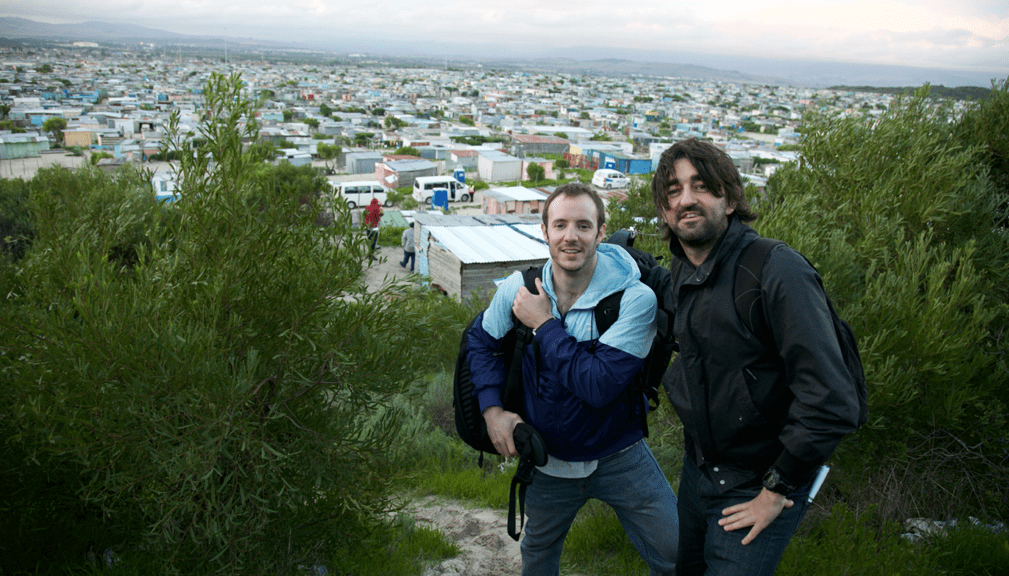
Staying Alive is the international MTV initiative to promote safe lifestyle choices and at the same time combat the stigma and discrimination of HIV. It is the largest HIV mass awareness campaign in the world. Barnes created and directed “Travis McCoy’s Unbeaten Track”, an MTV documentary featuring McCoy (lead vocalist and songwriter for alternative hip hop band Gym Class Heroes) in his role as Ambassador for the Staying Alive Foundation, traveling with an MTV film crew to South Africa, the Philippines, and India to raise awareness about youth-driven HIV and AIDS prevention initiatives supported by The Staying Alive Foundation. The hour-long program witnesses McCoy’s experiences in Cape Town, Manila, and Mumbai, interacting with some of the grassroots youth-led HIV prevention projects supported by The Staying Alive Foundation. Far from the romantic and hedonistic manner one expects from a rock star, the impoverished areas and the oppressive 100 degree plus temperatures are a contradiction to the graciousness of the local hosts which greet Travis and the crew at each stop.

The three locations exhibited in the special were specifically chosen to show that the effects of this disease on people covers a vastness and is not localized to one region or culture. It also displayed the different work that Staying Alive does across the planet. In Khayelitsha (South Africa) dwellings of corrugated iron with coat hanger cables for power conduits were overshadowed by the smiles and dancing of the children who playfully performed for the camera’s attention. In Manilla, the production recorded a sex education class filmed in a graveyard in which the homeless residents were using the tombs as shelter. Bhubaneswar (India) was well off the tourist path, providing no paved roads and whose residents had never seen Westerners before. While each location provided Barnes with touching moments, it was Bhubaneswar that most poignantly reminded him why he had set this production in motion and wanted to direct this message. He recalls, “Our female grantee had herself tried to take her own life for testing HIV positive and having been rescued was now doing the same for other young girls. Hearing this, even through a translator, was an intense emotional moment for all of us.” The final filming moments had James working with Travis and the world famous Bruno Mars in a Miami studio. Having McCoy as the centerpiece/proxy for the rest of the world to witness the work of Staying Alive was key and a composition involving these two noteworthy artists would add to its attention. Barnes notes, “Having a young, cool, contemporary character as the face and voice of the film was the first way in which we approached this production. We figured that not only would this make people listen to the more educational pieces of information but we also hoped he would take it in and then explain it in the type of language our viewers would understand, rather than a doctor or professor. I would say 90% of this was done in pre-production where we thoroughly researched each project in each location so that we could prepare our talent for every eventuality.  During production it was just a case of ensuring we got the most important touch points of each project across. Travis did an exceptional job and I think his feelings for those he spoke with on camera transferred to our viewers.”

Screen Shot 2017-07-28 at 8.10.18 PM

At the World Media Festival in Hamburg (a global competition dedicated to recognizing excellence in branded content from the areas of information, education and entertainment), “Travis McCoy’s Unbeaten Track” was recognized with an Intermedia-Globe Gold Award in the ‘Documentaries’ category. As both creator and director of this program, it’s appropriate that James is appreciative that his show received accolades. In complete contradiction to this very idea, Barnes states, “It’s interesting to me that Marcus [Liversedge-Series Producer], Benedict [Spence-DOP] and I still cite this as our favorite thing we’ve ever made even though it’s by no means the most high-profile. Experiencing the locations, contributors, and their stories is something that will always connect us. I think the most rewarding part of this production was giving a platform to these young people who were doing such brave and admirable things in the face of adversity. It was always my hope that this would inspire and inform others on the issues.”