Category Archives: international Talent

SIMEON TAOLE DELIVERS A COMPLEX SNAPSHOT OF A LIFE IN “EVERYTHING CHANGES”

Simeon Taole believes in the power of photographs. As an actor that might seem both a redundant and ironic statement. His performance in the film “Everything Changes” immediately squelches this confusion. The film and Taole’s performance is nothing short of extraordinary. In many ways it exemplifies great storytelling. Humor, intoxicating passion, tears, and a completely unexpected ending (two of them in fact) are all communicated by both the emotional cinematography and the inspired performances of Simeon and his only costar in the film, Virginia Leigh. As the couple experiencing a first date, these two actors generate a chemistry that permeates the air. Through discussions and coy confessions about their lives and interests we are romance-inspired voyeurs who are nourished by their budding romance. As the action progresses we are witness once again to the fact that life is rarely if ever as carefree as we would hope. The repartee, the longing silence, the honesty of the two characters in this film is so convincing that we want to believe that Leigh an Taole are actually a couple. This very modern tale is a photograph of the complications of romance in this world.

It’s not serendipitous that Simeon’s character in the film is so interested in photography. The idea that a photograph displays and is simultaneously withholding in the entirety of information is a central theme to the story. Calvin’s fixation of photography is a metaphor for his desire to discover and understand himself and the world around him, and perhaps to make it a more beautiful place from his vantage point. We almost feel that if he “frames” the moments in his life correctly, he will be able to relax with them. Calvin is a character who is looking for meaning in his life. He has regrets and hopes he can rewrite his future and change things; which he hopes to begin by forging a connection with Naomi. Calvin is motivated by his desire to capture something with her and ultimately bring meaning to his life. Somewhat naively, he feels confident that he can do this. The naiveté of this is not apparent until the end of the film. Calvin is a nostalgic person and photographer who laments the fact that photographs don’t tell stories with real meaning, at least, not like they used to in Life magazine. In the end, he’s presented with a photograph that has significant meaning for them both and changes everything.
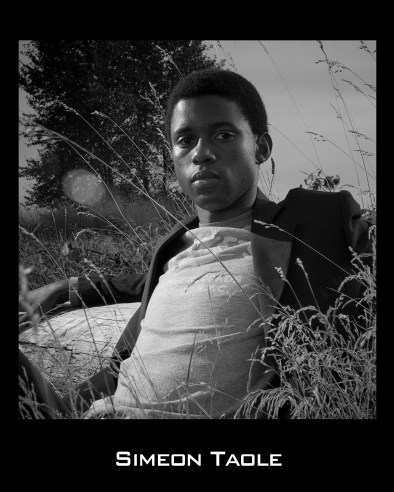
Simeon Taole Headshot 02

With deep insight and information of all aspects and characters of this film, Simeon was aware of the story from many points of view and given the time to deeply understand Calvin, which resulted in the compelling and honest performance seen in “Everything Changes.” Taole states, “I had a very detailed history for both characters in the film. It was great to think about what it is that motivates a character at a granular level. I spent time thinking about what it is that’s complicated about him; the dichotomies that exist in all of us. For example, how we can show love and yet also cause pain. How no one is fully good or bad but alternates between the two. Or sometimes, even simultaneously conveys both. I think for me it’s about taking this rich history and applying the level of detailed information to other roles where I wouldn’t necessarily have all that information at the beginning.”

One of the aspects of the film that makes it so gripping and real is the lack of singularity in its approach. Moments of lighthearted playful romance are mixed with tension and even fear. Real life can go from joy to tragedy in an instant and the film does not deny or shy away from this reality. A large reason why this works so well is the measured approach Simeon uses in his performance. He takes great care to not be overly broad with the comedic moments lest the audience not feel the truth of the more dramatic ones. Most of the actor’s work has been in dramas but he notes that this has given him a conservative approach to levity which plays out well in this film.

There’s no denying that a great deal of the heart in “Everything Changes” comes from the intoxicating chemistry between the two (and only) cast members. While it might be expected that a cast so small would make the viewer perhaps long for other characters but Calvin and Naomi (played by Virginia Leigh) go through a myriad of emotional evolutions that it’s impossible to remove one’s focus from them. Taole remarks, “I do feel a cast of only two does create a sense of intimacy in the film that would not necessarily be there with a larger cast. We both had to be fully engaged. Our chemistry was important because we carry the film and this really works for this story. I don’t think it affected the way I prepared for the role but it may have meant we had less downtime during the shoot because we were in every scene.” Leigh concedes, “Simeon and I didn’t really know each other before this film but I found immediate chemistry with him and this showed on screen. We had a warm, funny connection that engaged the audience and led to an ending that was shocking after such a strong build. Our natural bond was a key strength of Simeon who can read actors and find the paths to organic connection off which the audience can feed. Of course, he was the central leader to this film, and his performance was key to the ensuing success. Simeon carries this film in his performance as Calvin. He brings the audience into the over-compensating, overly- confident young man who one cannot help but root for.”

Simeon Taole Frame Still_Everything_Changes 02

“Everything Changes” has been an immense hit of the film festival circuit with screenings at: at 2016 San Francisco Black Film Festival, 2016 Hollywood Glam Gala, 2016 Las Vegas Lift-Off Festival, 2015 Toronto International Shorts Film Festival, the 2016 North York Arts Anniversary and Cultural Hotspot Closing Party, and a win for “Best Short Film” at the 2016 San Diego Black Film Festival. As Calvin, Simeon Taole is a proxy for the audience. He encourages us to dig to find meaning and connection with those around us. What reveals can be both beautiful and shocking, an idea delivered with impact via Simeon’s incredible performance.

Simeon Taole_On_Set_Everything Changes_01

YOUNG ACTRESS JAEDA LEBLANC IS ACTING WITH SOME OF THE BIGGEST NAMES IN HOLLYWOOD

IMG_9841

Jaeda LeBlanc may be the best kind of actor. She delivers powerful performances which are emotionally moving yet young enough that she is completely unaffected when it comes to the incredible fame and notoriety of those she works with. This powerful professional cocktail results in an individual focused on doing her best and disinterested in any vocational or social politics involved. As proof, Jaeda is too young to watch the most popular TV program in the world “Game of Thrones” …that will make more sense as you keep reading. LeBlanc is a young actor in age but her performances certainly belie this fact. She’s appeared in comedy kid shows (Odd Squad), acclaimed medical dramas (Saving Hope), even crime dramas (Real Detective), but in the upcoming The Death and Life of John F. Donovan she is set to receive the kind of notoriety that follows the marquee names she appears with in the film. LeBlanc appears in the film alongside names such as: Kit Harington (GOT’s Jon Snow), Natalie Portman, Kathy Bates, Susan Sarandon, and a host of other accomplished professionals. The core of the film is about fame, how we perceive those who have it and how it affects their lives. While this young Canadian actress has experienced accolades in her home country, “The Death and Life of John F. Donovan” prepares to project her into the arena of international fame. In discussing the film and her involvement, we get a glimpse into Jaeda’s view of fame and how it correlates to the industry and her involvement.Screen Shot 2017-09-18 at 9.19.19 PM

So many iconic names in the field of film give gravitas to this story’s exploration of fame; how it affects those who possess it as well as colors the vision of those who witness it. It appears that everyone in society finds the idea of fame appealing. In a culture which lists “social media influencer” as a valid job title there can be little doubt that the pursuit of fame is air to many in the world. The Death and Life of John F. Donovan challenges perception and reality. A decade after the death of an American TV star, a young actor reminisces on the written communication he shared with him as well as the impact those letters had on both their lives. American movie star (Kit Harington in the lead role) finds his correspondence with an 11-year-old actor exposed, prompting assumptions that begin to destroy his life and career. Jaeda also appears as a young fan of Donovan’s in the film. The main character is encouraged to interact with her by his manager Barbara Haggermaker (played by Kathy Bates) as a means of creating positive press.Screen Shot 2017-09-18 at 9.19.42 PM

It’s doubtless that millions of GOT fans are envious of LeBlanc’s interaction with Harington but the fantasy show’s more adult themes prohibit Jaeda’s parent from allowing her to view it, leaving her to see Kit as more of a coworker and star of the soon to be released film rather than the dashing bastard heir to the throne. The most impressive individual in Jaeda’s assessment was the film’s director Xavier Holland who helped her focus the approach for her role in the film. Holland comments, “When I saw Jaeda’s audition tape I was very impressed by this little girl’s acting ability. I also started acting at a very young age so when I saw Jaeda, she immediately reminded me of myself at an earlier age. Seeing her on the screen, I was immediately drawn to her character because she has that special kind of connection with the camera and the audience. Jaeda has a strong artistic ability. It allows you to see the picture of the character that she is painting, otherwise I don’t think she would be able to display such a strong image of what she wants her character to be. The camera loves Jaeda! She has an amazing stage presence. Like most artists, Jaeda knows how to create emotions but what impressed me the most were the little moments when she was not talking, just before crying; she was just quiet, still, and sad, but yet she was still making us feel something. That is what I love the most in an actor. Jaeda is an extremely talented young artist and I hope she knows that”.

Teen Choice Award

LeBlanc did her due diligence preparing for the role just as she would any other. Holland’s appraisal of her performance is the epitome of the idea of preparation meeting opportunity. The chance to be in such a major film is exciting for the young actress but even more so is the opportunity to watch so many accomplished actors on set and witness their method and approach towards their characters and scenes. Jaeda’s humility is admirable as she concedes that, as a young actress there are many opportunities ahead to learn and she makes a point to be astute and aware as they present themselves. Names like Bates, Portman, and Sarandon are desirable tutors for a young actress such as LeBlanc. With such exciting circumstances, one would expect the young actress’s favorite moment of this project to be one of heartfelt advice from any of these acclaimed veterans of film…yet, Jaeda’s most memorable moment is seen through the eyes of her own mother. Jaeda recalls, “Yes, there are a lot of famous actors in this movie and I was excited to play along with them so I could study their ways of working and see how I could improve my own skills by learning from them. Now, after working with them I realize that I am like them in the sense that I have the same work ethic. So yes, working with big names is definitely a bonus in this choice of career. But…my favorite moment was when I went to get breakfast. I was in the lineup with my mom when she turned she saw a lady behind her. She smiled at her, then she looked back because that person looked so familiar. My mom’s face started to change at that moment as she realized that it was Kathy Bates. She turned to her and nervously said ‘hello’ to Kathy. I had to take over because my mom looked like she was going to pass out. lol. I said hello to Kathy and just let her know that my mom was acting a little weird because she liked her so much. Kathy was very nice about it. When I think about it, I guess I learned two lessons about being an accomplished actor on this film: how to perform well and how to be gracious to fans. This was a very sweet moment that I still remember fondly.”


GORMAN LEE: THE DARK SIDE OF “I REALLY LIKE YOU”

A working relationship can be like a romantic relationship. Set aside the sexual politics and you are focused on whether or not your interaction with someone else makes you a happier and better person. It can also end you. Thankfully, the professional relationship between writers Jason Karman and Gorrman Lee (who also served as story editor) on the film “I Really Like You” was much more benevolent than the story’s two main characters Michael (played by Steve Bradley) and Brandt (Garrett Black). Michael’s pursuit of Brandt has fatal consequences, while Karman’s pursuit of Lee as a writing partner gave new life to this tale. The 2014 drama/thriller is one of the most frightening of the genre because of its believability. The darkness in each person has the potential to be exorcized or cultivated, and in the action of “I Really Like You” the two writers collaborated to display the fragility of that decision in the characters. Using a commonplace venue but presenting circumstances that become more twisted and the story unfolds, Lee and Karman peel back layer after deceptive layer until a surprise ending shouts to the audience that the only thing they can rely on is that they don’t know where the story will lead.

Jason Karman is a Vancouver-based screenwriter and director whose short films have screened at festivals in Brazil, Hong Kong, Australia, across Europe, United States and Canada. He has a very specific point of view, making films from both an LGBT voice as well as an Asian voice. Jason was already aware of Gorrman’s notoriety as a writer in Canada when the two met at an event put on by the Praxis Centre for Screenwriters in Vancouver. With an idea for a new film already brewing in his thoughts Karman states, “Having worked with Gorrman as a story editor on a previous film, I jumped at the opportunity to work with him again to develop the story of ‘I Really Like You’. His sharp insights, thoughtful notes, and natural instinct for story and structure allowed us to hone in on the themes and character arcs that I wanted to explore. The film would not have been the success that it was without having Gorrman hammering on the story with me.” Although Jason would see the film through its production and release, Gorrman’s hectic TV schedule would only allow his involvement in the writing process.

As with most positive relationships, our counterparts challenge us to become better, which is precisely why Karman persuaded Lee to join him in writing this script. He did not disappoint. Lee recalls, “I questioned everything about the scripts. I was beginning to fear that Jason thought I hated the project! It was a kind of tough love. I looked at everything with my own expertise and would tell him what wasn’t working, offered new ideas, a new structure, and told him where he should be focusing. It’s true with writers as with many professionals in production, you cannot exist without honesty. We had to be brutally up front with each other in order to create an exceptional script…and I feel that is exactly what we got. The plot of the film and the characters are very unique and fresh. Nothing is ever completely new in a film but your presentation of it and the motivations of the characters can be, and ours definitely were in this story. I’m very proud of it.”

“I Really Like You” follows Michael, a loveless and lonely man who runs a diner that’s known as a casual hook-up spot. As he begins closing up for the night, Michael finds himself drawn to a late customer, the handsome and innocent looking Brandt. There’s just something about Brandt that reminds Michael of a past love. As Michael and Brandt bond over food, Michael thinks back to how his past love, Colby, rejected him, and the outcome of that relationship. After Michael shows Brandt his shoe collection (in truth, a collection of shoes he’s taken from his past loves) they have a casual tryst in the bathroom. When Michael asks to see Brandt again and is rejected, all of his loneliness and anger begins to resurface. What happens next is unexpected and will require you to view the movie to find out.

The story depicted in the film is far from what was the original idea of the story, but the dark romantic tone was the essence which both writers were committed to retain. With the proper intent and drive written into a character, a writer can explore almost anything. Gorrman and Jason are certainly not violent people at all but concede that they have both experienced the pain that comes with unrequited love. This is what allowed them to access and explore the motivations and following actions of the characters in this story. For “I Really Like You” it all came down to identifying what Michael wanted, what hurt him, and how he wanted to fix that hurt; his drive and his intention. Once that was nailed down in an authentic way, it was safe for the writers to explore the darker and more violent impulses that drove him. If the writing is exceptional and done correctly, this should make it easier for an actor to channel the authenticity as well without having to go to a method acting place (a potentially dangerous and sometimes unreliable prospect for everyone).

Gorrman 6

“I Really Like You” received tremendous accolades, but was lauded nowhere more than at numerous festivals which understood and reflected an aspect intrinsic to the storyline including: Boston LGBT Film Festival, Shanghai Pride Film Festival, Rio Festival Gay de Cinema, Vancouver Queer Film Festival, Inside/Out Toronto Gay and Lesbian Film Festival, as well as many others. It’s worth mentioning that the film is at heart a very gripping action/drama. While Gorrman finds himself most comfortable with Science Fiction, he is an immense fan of the attributes of the action/thriller and the opportunities it affords a writer like himself. He notes, “The action/drama genre is certainly one of my favorites. There’s a latitude and broadness that the genre affords. ‘I Really Like You’ is rather character driven but still has the mystery and excitement of a more action-oriented thriller. What drew me to it, and what I bring to it as well, is the need to externalize the drama. That’s what good action/drama/thrillers should do: come up with a complex inner struggle and have interesting and compelling ways to externalize those conflicts. “I Really Like You” is all of these things and embodies the concept of “edge of your seat” viewing…all created courtesy of Gorrman Lee and Jason Karman’s clever writing.

SAKARAPANI PROVES HIMSELF AMONG THE GREATS IN SIVALINGA

Photo 2016-10-28, 3 56 12 AM

When considering the industries that America is known for, the ones that originate here and which have preeminence in the world, filmmaking is the most noteworthy. While numerous companies and industries are famous for their contributions, Hollywood has spent more than a century as the world’s leader in the art form. One needs only to stand for a minute at the corner of Hollywood & Highland, near the famed Grauman’s Chinese Theater to witness the eclectic group of nationalities represented in the tourists that travel from all over the world to visit the city which has inspired dreamers and admirers of cinema. The films produced here inspire audience and other film industries across the planet. India is the number three ranked in volume of films produced each year (closely behind China and the US). The past decade has seen the inclusion of many more talented actors of this country than ever before in US productions. While these professionals are lauded household names in their own county, their aspirations to be part of the most established and most respected film production community in the world drives them to Hollywood. It’s an idea that has been in the mind of Indian actor Manoj Sakarapani. He has already starred in a number of Canadian productions (The Pill, Don’t Let Go, Show Cop, and others) but admits that Hollywood holds a special place in the hearts and minds of actor from every country. That statement carries a lot of weight when one considers that Sakarapani was in this year’s massively successful AP International (India) release Sivalinga. The actor delivered a riveting and emotional performance as the antagonist in this 2017 Horror film by legendary Indian Filmmaker P. Vasu.

Photo 2016-09-20, 11 12 28 PM

Manoj plays Rahul in Sivalinga. The jealous boyfriend of leading lady Ritika Singh, Rahul discovers her talking to another man (Raheem) and approaches her father, who sends thugs to beat him up. Things go too far and the beating becomes a murder. The crux of the movie is when this murdered man returns as a ghost to haunt the other characters in the film. When police officer Shivalingesh is assigned to investigate the case, the ghost possesses the officer’s wife, leading him to the clues to crack the case.

Sakarapani was admittedly excited to be in this major feature film release, as well as being the film’s main villain. In his estimation, the primary “bad guy” in the film allows for a wider emotional palate as well as avoids the responsibility that comes with being the centerpiece of the story. For an actor who wants to act and be challenged while still avoiding the publicity game, it’s an ideal situation. Being the villain is something that Manoj is becoming somewhat known for and which he embraces. Rather than focusing on the title or categorization of the character, this actor prefers to find the character which he finds most exciting and interesting…which somehow lean towards the less amiable ones.

Vasu cast Sakarapani as Rahul based on the strength of his audition. Vasu has directed, written, and produced one hundred fourty-one motion pictures in India and worked with some of the biggest stars including Super Star Rajnikanth, K. Bhagyaraj, Sathyaraj, and others. All of this has honed his sense of charisma meets talent in an actor, which he applied to Manoj. Sivalinga saw Manoj working with some of the most established actors in the Indian film world, comparable to Tom Hanks, Meryl Streep, Octavia Spencer, etc. Because the character of Rahul was so integral to the story, the filmmaker and actor had intensive discussion about how he should be portrayed on film. Sakarapani explains, “Mr. P. Vasu didn’t want Rahul to be seen as a crazy villain, a brutal villain, or a notorious one. That was too dramatic and somewhat cartoonish. We discussed Rahul being a very normal type of person at first, one who doesn’t realize that he has the potential to do such harm. He is a college student and that’s where I meet my girl Satya whom I develop a crush on which turns into jealousy. Everything goes downhill from there. Rahul doesn’t see himself as murderous. I played him as an angry, mean, rude, and rich boyfriend who is immature and takes everything personal.”

Standing on set acting with the most acclaimed veteran actors of his country was intimidating for Manoj. He credits P. Vasu with assisting him in navigating the situation. At one point early in the filming, the director pulled him aside and informed him that he was very talented and this role was a blessing, he could choose to relax and perform with the talent he already possessed or allow the experience to overwhelm him. The actor recalls that the minute Vasu yelled “Action” he followed his instinct, finding himself going toe to toe with the actors and actresses he had grown up watching; it was truly an empowering and inspirational occurrence for him. Sivalinga’s co-director Krishnan states, “Manoj found himself in a very difficult situation for this film. Most of our cast members were highly recognized and celebrated actors while he was the ‘new face.’ This can be a very uncomfortable place for an actor to exist in and can lead to making a character too big. Manoj did none of this though. His portrayal of Rahul, the impetus for the tragedy in the film, was performed with great restraint. The performance Manoj gave belied his youth. Rather, he acted as a veteran, a complete and actualized professional. I couldn’t be happier with what he brought to our film; it truly made the story much more compelling and believable.”

File 2017-08-17, 2 20 20 PM

Sivalinga was a huge success in India at the box office and with fans. While stating that the greatest benefit of his involvement was the chance to work closely with so many accomplished actors and use the knowledge of this experience in his approach towards other roles, he concedes that the attention he received from the public was both unexpected and something he had to learn to react to gracefully. He recalls, “Seeing this on the screen for the first time with the public was an odd situation. I was sweating and hiding my face because people started noticing me and pointing in my direction in the theatre. After the movie they came running to me saying, ‘Hey look, it’s Rahul! They came and took selfies and got autographs from me and wished me well. They told me even though I am a star now, I don’t act like one. They told me that I’m very down to earth like their next door neighbor.” It sounds like Manoj Sakarapani would fit into Hollywood very well.

PACKING A PUNCH ON SCREEN WITH ALYSSA VENIECE

Female action heroes; yes, the time has officially arrived. Between Gal Gadot’s Wonder Woman and Charlize Theron in Atomic Blonde, the age of lead action female star is upon us. There have doubtlessly been those who have preceded them but these two hit films prove that women in these roles are not only equal to their male counterparts but are currently exceeding them in popularity (to say nothing of revenue generating). Assuredly, a host of productions which offer these female alpha types and actress Alyssa Veniece is ready. She’s not just interested in pursuing these types of opportunities, they are her goal. She espouses her love of action films, especially the ones in which the females overcome emotional weaknesses and matters of the heart. As with the aforementioned actions stars, Veniece possesses not only the aesthetic beauty of a lead actress but also the athleticism which is a necessity. It’s the reason that the filmmakers of “My Ex-Ex” cast her in the role of Tina Phung for the film.

In contrast to actresses who prepare a part once they are cast, Alyssa had literally been training for years when she was serendipitously offered the role of Tina. She had been working out at Tommy Chang’s Black Belt World Taekwondo school for a year and a half prior to being offered the role and training in kickboxing and muay thai for seven years before that. Heeding her father’s advice that “success happens when preparation meets opportunity” Veniece has always been driven to make the best of use of time varying her skill set. “My Ex-Ex” was her first project as a stunt actress and first opportunity to play a character who spoke and could also use her fight technique. Tina Phung is fearless and brimming with self-confidence. Reinforcing her father’s words, her work on this film allowed Alyssa to experience what it was like to work as a professional using all the skills she’d developed specifically to land jobs in entertainment, which includes years of acting training. Mirroring the mental state of her character, the experience gave Veniece the confidence to know that she was on the right path and capable of achieving her dreams.

MyExEx_Screenshot1

“My Ex-Ex” is not the typical vehicle for an action role. It’s the tale of a recently-jilted woman (Mary) who has to decide whether to take back the man who dumped her or return to her college boyfriend. When Mary’s boyfriend Ted invites her out to a fancy restaurant she’s convinced he’s going to pop the question but instead of getting hitched, Mary gets dumped. To cheer her up, Mary’s friends take her to see a psychic who casts a spell to reconnect Mary with her ex-boyfriend. The only problem is that Mary didn’t say which one. She bumps into her college boyfriend Patrick, and despite feeling he’s completely wrong for her, she slowly falls for him again. Ted soon realizes his mistake and wants Mary back. Mary is torn between her two exes: Mr. Right on paper, and Mr. Right for her.

Alyssa appears as Tina Phung; a young, fearless, actress and skilled fighter. She is the contrast to the main character when they are both auditioning for a role, however he was not so skilled and definitely more nervous. In one of the most hilarious scenes of the film, these two characters audition for a casting director who asks for a glimpse of the character’s ninja skills. Phung rips off her Adidas tearaways and begins her (actual) fight routine: a mix of punches, spin kicks, and roundhouses. The casting director praises her and then requests the other auditionee to perform the same, which is less than extraordinary. The entire group watches him in disbelief and, in the end, the director awards Tina Phung the role, which she happily accepts while still popping her bubble gum.

Alyssa describes the charismatic Tina Phung as being part herself and part the self she aspires to become. Veniece relates, “I created Tina to be a girl who takes every moment as it comes, every challenge as it comes. She was super confident, uncomplicated, and self-assured in her talents and capabilities. I believed she came from a close-knit family who supported her and had faith that she was a star, so when she entered the audition rooms she already believed she would come out the winner. I’d describe her as a totally un-phased, free-spirit with pretty bad ass martial arts skills. Tina and I are alike in our fearlessness and sense of adventure. We like to push our boundaries and challenge ourselves without worrying about who wants to take our spot. I’d say our style is different. She’s pretty bubbly and a bit unaware of her surroundings, almost in her own happy bubble. Me on the other hand, I’m always aware of who is around me and the vibes they give off. I probably wouldn’t be the one obnoxiously popping my bubble gum in an audition room. Her confidence is quite loudly displayed, and mine is simply internal.”

There’s no danger of Alyssa being a one trick pony/action film based actor. Veniece got her start early on as a bikini model and purposely avoided music video work after she had been cast one too many times as the “hot girl.” These days she has numerous Hollywood blockbusters, commercials, and stunt actor roles to her credits. She readily admits that it’s like a secret hidden power when she is sized up as “just another pretty face” and then demonstrates her agility and fighting skills. She reveals, “It’s show business and you have to let people know all the abilities you bring to the table. If you’ve got it, flaunt it. When I first enrolled at Black Belt World taekwondo school, the owner took note of my skills and was dong fight coordination on the Pacific Rim production filming in Toronto. At the time I had no stunt demo reel, nothing to show for my technique, only modelling photos. He brought me to the set to meet the stunt coordinator, who took one look at the shots and said “Well, she knows how to wear a bikini.” You can imagine my disdain. I never let that happen again.”

MyExEx_Screenshot2

So what’s the most unexpected secret weapon in her arsenal that she exhibited on “My Ex-Ex”? Veniece declares without hesitation, “I can rip off my tear-away pants like any pro now. It’s pretty impressive.”

Rhythmic gymnast Ana Perez talks National Base Spanish Championship 2015

Ana Perez has always loved rhythmic gymnastics. It was her first love, and she realized it when she was just four years old, growing up in Valencia, Spain. She appreciates every aspect of it, basking in the sense of achievement that comes from having a perfect routine. She loves the concentration of the sport, only having two minutes to make something flawless, knowing even the smallest twitch can throw off everything for the judges. However, what she likes most, are the hours spent training, knowing she is fighting for a dream. She felt this when she was a competitive athlete for twelve years, and now, she feels it as a coach.

Working with many top athletes, Perez quickly became recognized as one of Spain’s best rhythmic gymnastics coaches at the age of sixteen. Ten years have gone by, and her reputation is known, not just in her native country, but around the world in her sport. She has won championships and trained the best, sharing her experience with beginners and shaping them into professionals. In 2015, this is just what she did for her winning team at the National Base Spanish Championship with her club, Club Morvedre.

“When I saw the result on the screen of the ranking and saw that Club Morvedre was the first, we were calm, since there were some teams to compete, but when the category ended and Morvedre was first in the National Base Championship in the Juvenile category, we embraced the technical team and the gymnasts who make up the whole and we were excited. At that moment, we felt very proud, because it was a dream that we had finally achieved. At other times, we had not had good days of competition and at last here we had performed a perfect exercise,” Perez described.

Every November, this Championship occurs, where 16 teams of each category come from all the communities. This Championship of Spain Base level corresponds to the second highest level that Spain has, only ahead is the Absolute level. It is a competition that allows gymnasts to be evaluated on their level, where they can take a step forward in the rankings. It is one of the most vital competitions for the athletes in the country.

“I love being able to teach gymnasts, transmitting the values of sport, competition, discipline, companionship and self-improvement that are essential to rhythmic gymnastics. Even more importantly, about the relationship between a gymnast and her coach. A good relationship leads to the achievement of results. There is a very strong relationship between myself, as a coach, and this youth team, as performers. Our mutual work has allowed us to obtain the best result that we could achieve,” said Perez.

As a coach, Perez helped to make the corrections and modify those parts of the choreography that did not work well. Thanks to these corrections, the team were classified in the autonomic phase for the National Base Spanish Championship, in Zaragoza, and were champions of Spain in the Young Category.

“Ana worked closely on the project where we managed to help the youth team win first place in the Spanish Championship. She is an excellent co-worker and a good support in the hardest moments or, better said, in the most stressful moments as well as in the happiest ones. She always tries to look for the best for the Morvedre club, and she gives it her all. She is ferociously committed to her work. I have worked with her for a long time and she has taught me many things, among which I emphasize commitment, discipline and comradeship,” said Alicia Gaspar, Perez’s fellow coach.

When preparing the team for the competition, Perez worked on the warm-ups, handling of the ribbon, and the physical preparation required for competition, as the gymnasts needed to be in the proper physical condition at the required level of competition. This sport is about sets of repetitions of the choreographies prepared by the trainers so that the exercise is successfully performed. They trained in the summer, preparing the choreography with the music. They trained three hours a day, five days a week, making sure every detail was ironed-out.

“My contribution has been to give my best to bring about the best result, both in the editing and in the choice of music. I have given them the commitment and the confidence to be able to get the result obtained. I find this to be an essential element to coaching any sport, both when it comes to training and when it comes to competing. The instructions are key, as well as the part that the athlete plays,” said Perez.

Some parts of the choreography originally did not go as planned, as the apparatuses fell and the gymnasts became nervous. Perez then decided to make it easier for some pitches, so gymnasts felt safer with their choreography. That is essential when it comes to competing, because gymnasts should be comfortable with their exercises. Without Perez, the team could never have achieved what they did, and this was acknowledged by all who witnessed the team’s results.

“As president of the Morvedre Club where Ana has been working for more than ten years, I have to thank her for everything she does: for being part of my team of coaches, for the great work done season after season at all levels and for her results obtained. But above all, I have to thank her for creating the good atmosphere of fellowship between coaches, parents and gymnasts, as well as the excellent preparation of the gymnasts that led to one of the competitions in which more than 100 gymnasts competed, getting to be among the best,” said Luis Marín.

Needless to say, Perez’s commitment to coaching is greatly appreciated by all.

Videographer and video editor Maria Aguado had “the courage to pursue her dream”

“All of our dreams come true if we have the courage to pursue them.” Maria Aguado wrote this to herself at the beginning of her career. At the time, she was just a girl from Barcelona with big dreams; she wanted to make films. Throughout her life, Aguado never stopped believing she was meant to be behind a camera, and this belief became her mantra. Now, she is one of Spain’s best videographers and video editors, and her faith to overcome any obstacle has contributed greatly to her acclaim.

Throughout her career, Aguado has shown international audiences what she is capable of with a series of celebrated projects. She worked with high-profile fashion designers Claudia Morera and Carlota Cahis, the popular shoe brand Alvarez & Moixonet, the fashion company Brownie, the iconic fitness brand Les Mills, and the eclectic Spanish shop Button Barcelona. She worked with the advertising company Puente Aereo helped the company gain new clients, her videos for the magician Nilo with MCN Magic helped put the magician on the map, and just this year, she worked with the fitness company Human Body Experience to create outstanding informational videos for consumers. Her work in both filming and editing has impressed many, and her passion for what she does inspires others.

“As editors, having another point of view is basic. Working together gives us the opportunity to fusion our minds and obtain the best results. Maria brings a very creative perspective to every project. She is very hard working and has a huge knowledge as an editor. Working with her is a pleasure,” said fellow editor Felipe Bravo.

Bravo is a well-known editor in Barcelona, and has worked alongside Aguado many times.  The two immediately connected because of their shared passion for film, and make quote the team. Last year, they worked on the award-winning short Happy Burger, a project that Aguado thinks of fondly.

“I love the feeling of being emerged. While I film or edit everything else disappears,” said Aguado. “I create a world that is later shown to an audience to express a feeling, a concept or an idea. Since the age of seven, I filmed my dolls, edited my films and wrote screenplays without being aware of what I was doing. I grew up with a camera.”

Aguado’s first job was years ago, working as a film editor for Puente Aéreo, an advertisement company. Just beginning, it helped the now esteemed filmmaker learn a lot about advertising and editing ads for television. Since that time, she has worked for countless brands. After Puente Aéreo, she moved on to working for the interactive party platform Get Wasted Events. She was ready for a new experience, and it was there was she learned exactly what style she enjoyed that has now become her signature.

“I always film with a bit of camera movement. My shots are not static and I use a lot of close ups. While filming I try to forget everything I’ve ever seen and have a new vision in each project. I play while I am filming, I don’t see it as a job. I also edit in my head while filming, I know which shot will go next to the other, it’s like building up a story,” said Aguado.

Aguado’s first time working with the fashion industry was with Carlota Cahis, a well-known designer of jewelry and clothes. By this time, Aguado already had an outstanding reputation, and the firm contacted her to film and edit Cahis’ fashion show. Cahis was instantly impressed, and contacted Aguado many times after this to shoot for her. Quickly, other designers began to notice her and to seek the videographer out. She did several fashion videos for fashion designers such as Mercedes Arnus in her “Pure White” Collection and Claudia Morera’s brand, selected in 080 Fashion Week Catwalk Barcelona.

“I’ve always known this is what I wanted to do. I grew up playing with a camera. This is what I’ve always done. Filming and creating is a huge part of me. Without filming and editing I wouldn’t be able to fully express myself,” said Aguado.

Not only does Aguado excel with advertising and fashion videos, she is highly experienced in film. She worked with director Max Larruy on the film Caperucita Roja, and later worked on the feature film Barcelona Nit destiu. She has an extraordinarily artistic eye whilst looking through a lens, and her editing experience helps her know exactly how to frame a shot. She also edits films, such as the short Blanco Roto by Director Belen Reina.

“Creating movies is a way to believe in the magic of life. It is a way to experience different lives. It is a way to be a part of new stories and experience another point of view. It is a way to make people feel, know, and experience new emotions, new ideas! It is a way to express the parts most inside of your soul, and surprise yourself in the process by opening your mind to new perspectives. It is a way to make your dreams come true while you show them to the world. Making cinema is the same as travelling around your dreams. Making movies is not letting the child you’ve got inside to die. It is a game. Being able to make cinema is a good reason to be alive,” concluded Aguado.

AVI AGARWAL’S COMMITMENT TO LOOSE ENDS

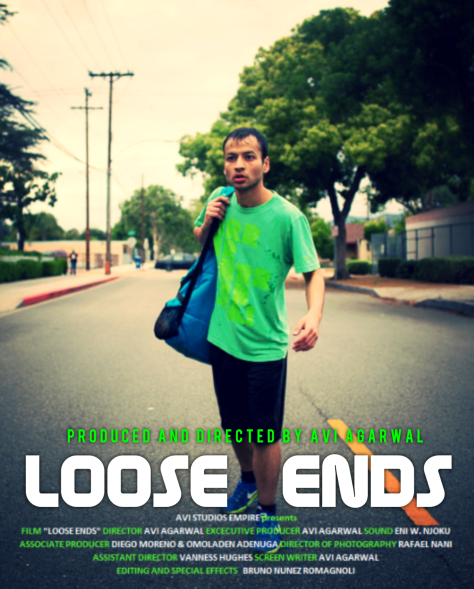
Avi Agarwal has received resounding accolades for his comedic performances in films like “Cowboys” but in “Loose Ends” he delivers a serious performance with gravitas (for which he was awarded the BEST ACTOR MALE at the Hollywood Boulevard Film Festival, CA. September 2016).  “Loose Ends” literally portrays an experience that many of us have likely had inside our own minds. Almost everyone has that “tipping point” in life in which they see that they can either focus on something that will add positively to their life or negatively. It might be a relationship, a career choice, or simply a pattern of behavior that will lead to a peaceful or tumultuous existence. In the film “Loos Ends” Avi Agarwal becomes a proxy for the audience, considering the many decisions available and how they will manifest his future.

LOOSE ENDS 5 png

Agarwal is known for his physicality and intense discipline in approaching roles. The film’s cinematographer Rafael Nani notes, “It’s easy to see the talent of Avi in front and behind the camera. What most people can’t see is his tremendous dedication and passion for his job and his art. A serious hard worker who never gives up before getting the best, Avi is an example to the other professionals around him that greatness requires immense dedication. It was an honor work with him in ‘Loose Ends’ and it’s always a pleasure work to with him. Avi Agarwal is an artist who makes you want to do your best, and who you can always learn from.”

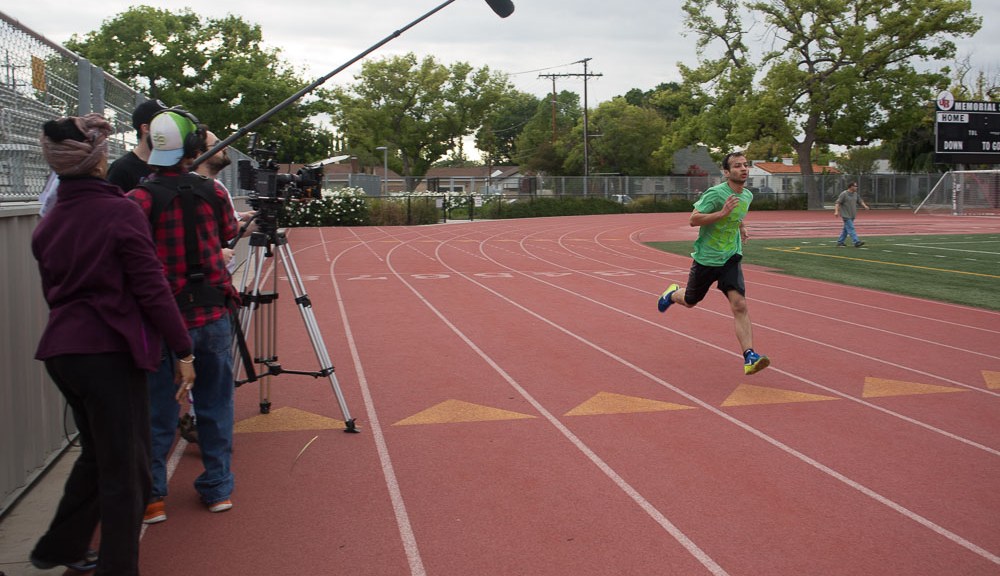
Avi’s physical dedication to the role came long before anyone arrived on set or began filming. In preparation for playing a college student, the actor’s training required a lean and in-shape build. Among his many means of training was an eighteen miles per week running requirement to sculpt the svelte appearance of a man this age. It’s a combination of mental, physical, and artistic purpose that drives Agarwal as he relates, “I show this intensity for every role I take. Sometimes I’m not able to get enough time but I work with whatever time frame I am given to make sure the results are visible.  Every day, I used those voices in my mind of people demoralizing me saying ‘You can’t do it’ on the track to make sure I kept running. I basically used the negativity to my advantage and turned it into a positive. It really motivated me. Although I have nothing against the people who did not believe in me because I know they had the best interest at heart for me but, as an actor I used whatever I could find to become Sid. I take this approach since the change in my appearance definitely changes the way an audience see me in ‘reel’ life compared to me in my real life.”LOOSE ENDS 4

“Loose Ends” was screened in December at the Mumbai Shorts International Film Festival in 2016 where it was recognized with the “SPECIAL FESTIVAL MENTION.” Agarwal appears as the main character, Sid, in the story that is a cautionary tale depicting one man exploring his potential for good and bad. Sid is an affable guy but a habitual partier and slacker. As a college student, he often ditches class due to hangovers or simple laziness. When he does attend, he is ill prepared and mocks those who are serious. His support system of friends enables this behavior and embraces him as their “always ready for a good time friend.” Sid begins to have visions of himself in the future leading the lives of others whom he feels likely lacked the focus and self-discipline that he does. Walking about in his everyday life he sees his own face in that of the alcoholic janitor, as a menacing felon on a wanted poster, and many less desirable life pursuits. In a course of “Rocky” determination, Sid begins applying himself, both figuratively and literally cleaning up his life.LOOSE ENDS 7

The role and the schedule required Avi to access and convey such a wide variety of emotions that it was immensely taxing. So what’s the secret ingredient that allowed him to do all of this so effectively? For this actor it’s a combination of the Meisner and Chekhov techniques. He elucidates, “The role of Sid required different emotions such as, happy, sad, angry, lost, confused, uncomfortable, disturbed, hurt, frustrated, awkward, dismayed, ignorant, concerned and hopeful. There were times when I had to switch from different emotional states instantly in order to deliver the performance. I used the Meisner and Chekhov techniques in order to bounce off from one emotion to another. For example, I had just finished shooting a very emotionally challenging scene and right after that I had to shoot a happy party scene, I used Chekhov and started throwing my hands and legs at different places at fast pace, to loosen the nerves and let the heavy emotion drain from my body. I had discovered in Chekhov how the body movement and image has effect over our emotions. In my opinion, a technique is best implied when you use it but is not shown on screen. People who have studied Meisner sometimes know when on screen the actor has used it to make it look authentic on screen. I use Meisner and then combine it with other techniques such as Chekov to find the character. The difference being Chekov mainly focuses on attaining emotions through physicality of the character. However, Meisner mainly focuses on emotions so to find the characters posture I use Chekov. The combination of both has so far really helped me in making my characters more memorable ones.”LOOSE ENDS 6

“Loose Ends” required a great deal from Agarwal and he confirms that he learned just as much from doing it. In what might be one of the most important lessons for this diverse, talented, and educated actor, his experience of intent that fell short revealed a truth to him. During the filming of a scene in which Sid sees himself as a down on his luck homeless man, the makeup artist was nowhere to be found. With the pressure of an extremely tight filming schedule, Avi improvised and grabbed a handful of actual mud from the street, smearing it on his face. To his surprise, his great overture of actual mud was not even visible on screen, yet his frustration shown through as the character. The moral; you never know what truly works until you see it onscreen.

YOU CAN’T TAKE YOUR EYES OFF ALSION ARAYA IN THE UNSEEN

Faust has been the inspiration for countless films about those who make a pact with the devil to get exactly what they want but end up making a great sacrifice for their gains. There’s always a loophole “gotcha” moment. While this has nothing to do with the theme of the movie The Unseen it might be found in the story of one of the film’s stars Alison Araya. If the actress were to design an ideal situation for herself, it would be The Unseen. While Araya has made numerous appearances in blockbuster films like X-Men Origins: Wolverine and Watchmen (and many others), this was her first major role. Alison’s portrayal of the fearless Moll who is involved in a same sex relationship drew great praise from critics. She even got to act opposite one of her adolescent crushes (Aden Young as Bob Langmore) in one of the film’s most climactic and prominent scenes. Everything was perfect except…wait for the twist…The Unseen is an action/sci-fi/horror story and Araya is one of the most squeamish individuals on the planet. A self-described chicken who can’t make it through the horror film trailers at a movie theater, the actress found herself in a perfect environment save the very premise of the film. With no way out of it and too much to lose by passing on The Unseen, Araya bit the bullet and accepted the role as Moll. Alison and the entire audience benefitted from this decision. The film itself was a resounding hit whose recognitions include: two Canadian Screen Awards nominations, eight Leo Awards nominations, selection of the Molins de Rei Horror Film Festival and Vancouver Film Critics Circle, and wins at the Other Worlds Austion SciFi Film Festival, Molins de Rei Horror Film Festival, and others.Screen Shot 2017-07-03 at 3.31.23 PM

While The Unseen is based on the lore of The Invisible Man, it’s a very different and unique take. Writer/director Geoff Redknap didn’t want to update the already familiar story with new actors and VFX; he wanted to create an entirely different focus. The Unseen dissects the idea of how this fantastic situation would affect the family of the person in this very odd circumstance. The inclusion of an ex-spouse, children, extended family members, etc. is similar to looking at a 3-D picture where your eyes cross and present a totally new subject…one which was previously invisible. The character Moll is the partner of Darlene, ex-wife of Bob who has literally disappeared. She is stepmother to Eva, Bob and Darlene’s daughter and has become fiercely protective of her new family, particularly when it comes to Bob. The actress portraying Moll would need to be both fierce and tender. Redknap stipulates, “Alison stood out during the audition process. She was fierce but what captured our attention was the vulnerability she bought to the role. She could have easily played a mere foil to her step-daughter but instead Alison’s multi-layered performance brought a greater depth to her own and the other actors’ performances. Alison was not afraid to go head to head with Aden Young and they created one of the most climactic scenes in the film. We knew we ‘got it’ when the air felt like it was buzzing with the electricity of the performance Aden and Alison had just given.” Producer Katie Weekly confirms, “It was important to find an actress who could carry the gravitas of Moll. We were looking for a dynamic and strong actress who could also play the vulnerability of the character. Alison bought nuance and passion to the role and really made it her own. A different actress might have played Moll as ‘the bad guy’ but Alison brought such life to the character that her transition from the beginning to end of the movie was much more satisfying.”

Moll could have been presented in a variety of ways; it was this fiercely loyal woman who protects her family and her partner that attracted Alison to the role. Moll is deeply in love with Darlene (played by Camille Sullivan) and has completely bonded with and come to love Darlene’s daughter Eva (played by Julia Sarah Stone) from Darlene’s previous relationship with Bob as her own. Being the woman in Darlene’s life, Moll has a chip on her shoulder when it comes to Bob. A drifter and absent father, Moll has seen firsthand the pain Bob has caused and will stop at nothing to protect the family she calls her own. Moll is stunned when she discovers that Bob is back in town and Eva is missing. Suspicious of Bob and the company he keeps, she pursues the truth and the two. When Moll is finally let in on the family secret, she is able to make peace with the relationship Bob and Darlene will always share and relaxes with her place in Darlene’s life knowing there are no secrets. The story is family drama with a very substantial secret ingredient.

Screen Shot 2017-07-03 at 3.34.53 PM

In one of the film’s most intense scenes, Alison was called upon to do something that has been common place for her in numerous productions, exhibit the signs of seeing something that wasn’t there; which is both literal and figurative when you are in a movie about an invisible man. She recalls her process noting, “I remember struggling with that particular moment in the film, when I had to react to seeing something shocking and new to me. I remember trying to figure it out intellectually and I wasn’t getting anywhere. Then I just closed my eyes and visualized what was in front of me. Immediately my body reacted and I understood on a visceral level what was real for me. I love moments like that because we don’t always have it worked out in advance. Some moments stump me and they challenge me to look deeper into my tool belt or think outside of the box. There is no one path to the truth of the moment, there are infinite paths it’s a matter of knowing which one to follow on any given day.” One thing Araya wasn’t confused about was working with her co-star Aden Young. She admits, “Working with Aden was a career highlight for me! I was a huge fan growing up in Australia; Aden has always been on my radar. I had a huge crush on him after watching “Black Robe” and when I saw his name on the cast list, I could hardly believe it. Aden was so generous and really invited me to get inside the ring with him and go for it…and we did! It was exhilarating and scary and live. It was incredibly fulfilling and I hope to have many more moments on set just like that. I held it together and kept it very professional but there was a younger version of me inside that was going crazy with excitement.”

boudoir shoot 2014 014

The Unseen as a film is contradictory; not in the sense that it doesn’t line up in terms of story or production but rather that this movie about the unseen is made so believable by what is seen. It’s not overuse of VFX or trickery that makes it compelling, it’s the performances of Alison and her cast that pull us into believing this very fantastic situation is as real as any discomfort a non-nuclear family experiences. The filmmakers ask us as the audience to buy into quite a bit and it’s the performances onscreen that make it much easier to be at ease with and suspend our view of reality. What is seen in The Unseen looks very good.

SIMULACRUM’S ENIGMATIC SARAH FAY

Sarah Fay has always enjoyed the inner game of acting. This idea that only the actor (and the director) truly know the character, rather than laying everything out for the audience in an easily digestible manner; it’s something that has shaped many of her roles. For someone of artistic temperament, the less obvious choices make for a more engaging experience, on the part of the viewer. This is a premise that Fay has always admired whether she is an audience member or a participant in the story. She notes that her early experience acting in the film Simulacrum (which received the Norman Jewison Filmmaker Award) was instrumental in her appreciation of the subtleties possible in character presentation. A sociological sci-fi tale, Simulacrum presents many of the ways in which technology affects our culture and relationships. Although set in an alternate reality, many of the ideas presented more than fifteen years ago, are coming of age in modern society. While the overall theme questions mankind’s use of biotechnology, Fay’s stand out role gives a glimpse into the complexity that she would bring to following productions.

In a very clever manner, Simulacrum presents the possibilities of our own world, by presenting the events in one, which we feel could not exist. Asking the audience to suspend their sense of reality, immediately disarms them into accepting any possibilities. The story takes place in a pre-apocalyptic Soviet world. Dallas is a young technician who has a clone (common place in this futuristic society) who seeks her assistance. The clone needs her to help with a government test because the two share the same DNA. What unfolds is a story of deceit, governmental constriction/abuse which eventually sees Dallas fleeing for her freedom. At the heart of the story is the question “What is identity? What is self?”, and the answer is not easily defined for the viewer.

Screen Shot 2017-08-01 at 7.36.33 AM

Perhaps the most interesting aspect of the film is that the lines between right and wrong are not presented in a clearly defined manner. The living embodiment of this, in the film, is Sarah’s character who, in congruent fashion, is known only as “Taxi Driver”. This only enhances the mystery and mystique of this pivotal character in Dallas’s search for truth and resolution. Fay so convincingly plays the unknown intentions of the character, who is both taxi driver and either governmental agent or agent of freedom, that viewers of the film differ in their conclusion of her motives. Sarah remarks, “An actor must always make clear, defined choices within themselves. I knew who I was and why, as the Taxi Driver and that was decided with the Director and in my own creative discovery. I don’t see a duplicitous character as undefined. Both types of characters have an alliance to themselves. A good wholesome character has an alliance to themselves and their belief in good, truth, and love. They act with those motivations. An evil character has less honorable motivations but is still true to themselves. They may not have a moral compass but they will defend their actions. A duplicitous character will flow with the wind but still remain true to their own survival and their self- alliance. Both the audience and society like to label. I think part of the joy of acting, for me, is discovering the true gray area of human existence, in different circumstances. The more layers you have as a character, the more real you are, the less you fully fit into a label of completely one way or another. Either way a character must have consistency to be connected to and duplicitous characters have that too.”

Screen Shot 2017-08-01 at 7.36.47 AM

A role like this is intriguing for any actor, but can only be presented as such when the director also sees the potential for the role. Sarah worked extensively with Director Anita Doran to present this character in terms of dialogue and physicality to create the mystery that made her so fascinating. Doran saw a quality in Fay from the very beginning and notes, “I hired Sarah for the film because I saw a lot of stand-out qualities in her audition. She took great care to understand her character with a depth that many others would miss. Sarah was precise and concentrated, revealing a dedication to craft that has only grown since this early state. Once on the set, she was generous with her creativity and a consummate professional. I’ve rarely seen an actor throw themselves so deeply into a role. She had immense commitment and made it her responsibility to add as much as she could to the overall quality of the film, and I think the end product is exponentially better thanks to her presence.” Fay confirms that this is her normal approach. Her intense discipline and dedication has served her well since this early experience. Contrary to being restricting or overwhelming, she finds this intensity frees her in roles and allows for less thinking and more feeling. These days, as an LA resident she finds that this mindset is expected in an entertainment centered city. Sarah states, “I’m pretty obsessive and singular in my focus and strive for success, but it makes me happy. To be in L.A. doing this, I am living my dream. In terms of the others in my life, everyone knows if I have an audition…I’m going to need to cancel with them. That’s part of the thing I love about living in LA. It’s an actor and industry town. People understand and we are all here to succeed, so they get it. All the people in my life get it. In Toronto, I experienced a little more frustration and eye rolling. I’d hear, ‘No really, when are you going to give it up and find something stable?” a lot more. That just doesn’t happen in LA. The key to life is finding a place where you fit in and I feel like I’ve found it here.  I am working on filming ‘CON’, a great film that is also going to be a series, with Oscar nominated producer Joseph Wesley Adams and I just got a couple new roles I am overjoyed about. When you work towards a goal your entire life and people see it as a positive rather than negative, it makes you feel that you finally fit in. Taking chances like I took in Simulacrum were part of the journey that got me here.”