AVI AGARWAL’S COMMITMENT TO LOOSE ENDS

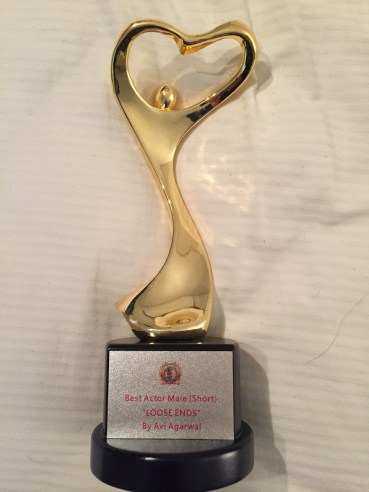
Avi Agarwal has received resounding accolades for his comedic performances in films like “Cowboys” but in “Loose Ends” he delivers a serious performance with gravitas (for which he was awarded the BEST ACTOR MALE at the Hollywood Boulevard Film Festival, CA. September 2016).  “Loose Ends” literally portrays an experience that many of us have likely had inside our own minds. Almost everyone has that “tipping point” in life in which they see that they can either focus on something that will add positively to their life or negatively. It might be a relationship, a career choice, or simply a pattern of behavior that will lead to a peaceful or tumultuous existence. In the film “Loos Ends” Avi Agarwal becomes a proxy for the audience, considering the many decisions available and how they will manifest his future.
LOOSE ENDS 5 png

Agarwal is known for his physicality and intense discipline in approaching roles. The film’s cinematographer Rafael Nani notes, “It’s easy to see the talent of Avi in front and behind the camera. What most people can’t see is his tremendous dedication and passion for his job and his art. A serious hard worker who never gives up before getting the best, Avi is an example to the other professionals around him that greatness requires immense dedication. It was an honor work with him in ‘Loose Ends’ and it’s always a pleasure work to with him. Avi Agarwal is an artist who makes you want to do your best, and who you can always learn from.”

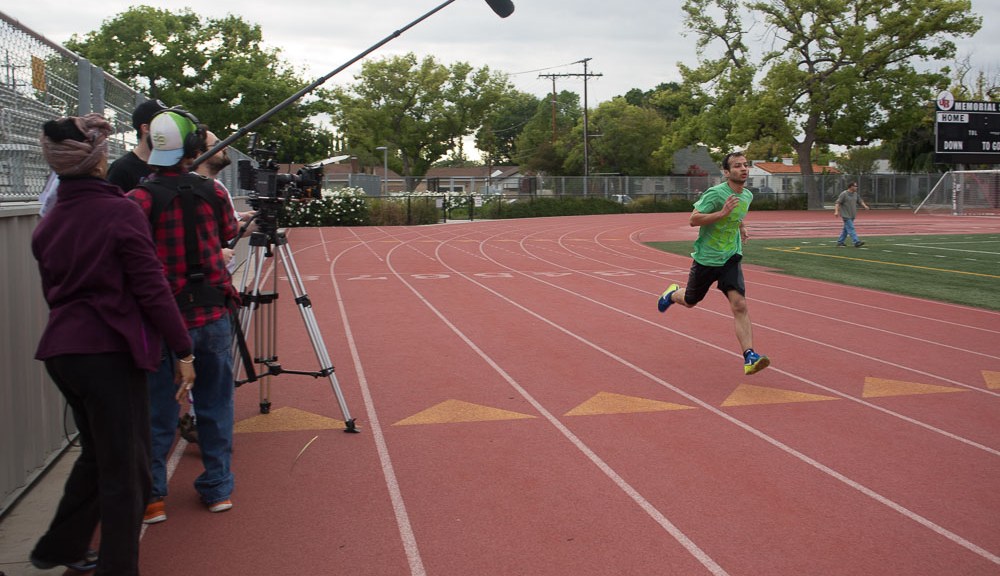
Avi’s physical dedication to the role came long before anyone arrived on set or began filming. In preparation for playing a college student, the actor’s training required a lean and in-shape build. Among his many means of training was an eighteen miles per week running requirement to sculpt the svelte appearance of a man this age. It’s a combination of mental, physical, and artistic purpose that drives Agarwal as he relates, “I show this intensity for every role I take. Sometimes I’m not able to get enough time but I work with whatever time frame I am given to make sure the results are visible.  Every day, I used those voices in my mind of people demoralizing me saying ‘You can’t do it’ on the track to make sure I kept running. I basically used the negativity to my advantage and turned it into a positive. It really motivated me. Although I have nothing against the people who did not believe in me because I know they had the best interest at heart for me but, as an actor I used whatever I could find to become Sid. I take this approach since the change in my appearance definitely changes the way an audience see me in ‘reel’ life compared to me in my real life.”LOOSE ENDS 4

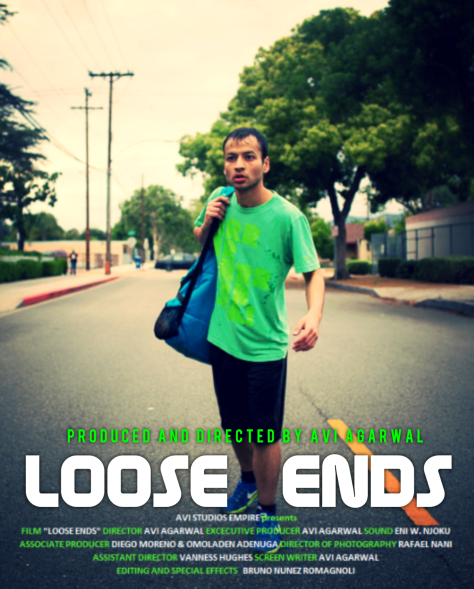
“Loose Ends” was screened in December at the Mumbai Shorts International Film Festival in 2016 where it was recognized with the “SPECIAL FESTIVAL MENTION.” Agarwal appears as the main character, Sid, in the story that is a cautionary tale depicting one man exploring his potential for good and bad. Sid is an affable guy but a habitual partier and slacker. As a college student, he often ditches class due to hangovers or simple laziness. When he does attend, he is ill prepared and mocks those who are serious. His support system of friends enables this behavior and embraces him as their “always ready for a good time friend.” Sid begins to have visions of himself in the future leading the lives of others whom he feels likely lacked the focus and self-discipline that he does. Walking about in his everyday life he sees his own face in that of the alcoholic janitor, as a menacing felon on a wanted poster, and many less desirable life pursuits. In a course of “Rocky” determination, Sid begins applying himself, both figuratively and literally cleaning up his life.LOOSE ENDS 7
The role and the schedule required Avi to access and convey such a wide variety of emotions that it was immensely taxing. So what’s the secret ingredient that allowed him to do all of this so effectively? For this actor it’s a combination of the Meisner and Chekhov techniques. He elucidates, “The role of Sid required different emotions such as, happy, sad, angry, lost, confused, uncomfortable, disturbed, hurt, frustrated, awkward, dismayed, ignorant, concerned and hopeful. There were times when I had to switch from different emotional states instantly in order to deliver the performance. I used the Meisner and Chekhov techniques in order to bounce off from one emotion to another. For example, I had just finished shooting a very emotionally challenging scene and right after that I had to shoot a happy party scene, I used Chekhov and started throwing my hands and legs at different places at fast pace, to loosen the nerves and let the heavy emotion drain from my body. I had discovered in Chekhov how the body movement and image has effect over our emotions. In my opinion, a technique is best implied when you use it but is not shown on screen. People who have studied Meisner sometimes know when on screen the actor has used it to make it look authentic on screen. I use Meisner and then combine it with other techniques such as Chekov to find the character. The difference being Chekov mainly focuses on attaining emotions through physicality of the character. However, Meisner mainly focuses on emotions so to find the characters posture I use Chekov. The combination of both has so far really helped me in making my characters more memorable ones.”LOOSE ENDS 6
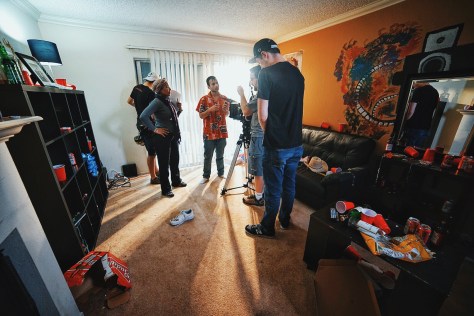
“Loose Ends” required a great deal from Agarwal and he confirms that he learned just as much from doing it. In what might be one of the most important lessons for this diverse, talented, and educated actor, his experience of intent that fell short revealed a truth to him. During the filming of a scene in which Sid sees himself as a down on his luck homeless man, the makeup artist was nowhere to be found. With the pressure of an extremely tight filming schedule, Avi improvised and grabbed a handful of actual mud from the street, smearing it on his face. To his surprise, his great overture of actual mud was not even visible on screen, yet his frustration shown through as the character. The moral; you never know what truly works until you see it onscreen.

XING-MAI DENG VISUALIZES THE FEELINGS OF A NEW WAY OF WAR

Artists often bring up ideas that we may or may not agree with but it is important to see things from differing viewpoints. The artistic mindset is about the freedom to express ideas; they might be truth or they might just be opinion but in a well-balanced society it’s important to have all ideas heard and then weighed out. Whatever your opinion is on any particular subject, there is someone who disagrees with you, and that person should be important to you. By presenting an argument that challenges your belief, you either become more committed or you reassess; either way, this person has done you a favor. Artists of many different mediums have challenged our thinking for eons. Filmmakers like Xing-Mai Deng are simply the newest manifestation of this. As a cinematographer, Deng is the modern day painter with film and digital images as his canvas. The way the visuals appear in the Drama/Thriller “Drone” (2015) affects the viewers’ attitude towards one of the most modern approaches in warfare in an almost imperceptible manner, but achieves the desired emotional impact. It was for this very reason that producer Abi Corbin sought out Xing-Mai and persuaded him to take on the project.

1660814_10152005791207615_847302355_n

“Drone” appears at first to be a film about the military when in fact, it is about humanity. It was his own personal experience with these two factors that actually convinced Deng that he wanted to be a part of this film. He explains, “Before working on the project, I happened to know a few people who were working on developing treatments for veterans with PTSD. Among them, the air force veterans were the majority and most of them were military drone pilots. Through my friends, I learned that even though the drone pilots did not see their enemies and the actual battles, they had a higher chance on incidence of PTSD because of their working schedule and the suppression of sleep. I knew what the pilots were going through. I invited my friends to the screening of the completed film and they all felt that the film was a realistic portrait of a drone pilot’s life.”

“Drone” is a story about a rookie air force drone pilot who finds himself increasingly attached to a target as he watches from halfway around the world. As a newly minted drone pilot, Matt (played by Daniel Sharman) enthusiastically flies his first stalk and kill mission, unconcerned that he knows nothing about the enemy target in his crosshairs. As the hours of surveillance turn into days, then a week, he finds it increasingly difficult to see the target as a mere white dot on the screen. When the strike order finally arrives, Matt must face the very real person behind the pixelated image.

Making any film is not as simple as displaying the actions of the characters onscreen. A story that concentrates so intensely on the emotional inner conflict of the main character requires a great deal of planning and expertise on the part of a DOP to properly convey this emotional turmoil. The subtlest of changes can achieve substantial returns in eliciting the proper response from a viewer. Deng prepared his concept in terms of the tone and the look before meeting with “Drone” writer Tony Rettenmaier to present these two different worlds he had created. Lighting in particular was key for this film as Xing explains, “When Matt is alone, his life is not fulfilling to him. To achieve the lonely feeling for the audience, we made sure the lighting on him is half a stop darker. It appears as if his life is always one shade darker than the rest of the world. And when Matt was doubting his world, we used a lot of close-up shots with a wide-angle lens on Matt to bring out the emotion. We placed the actor very close to the lens so he got distorted by the wide-angle lens, while other actions are happening in the background. After the strike, Matt was crushed by what he did. We placed him further away from the camera, using a longer telephoto lens to compress the background just to show how small he is compared to the world he is doubting.” He continues, “Most of the scenes were in the cockpit. We did research on what a real drone cockpit looked like. It was actually very different from what we imagined. In reality, the pilots were operating the drones flying on the other side of the planet, so they usually work during the night. In order to keep the pilots awake, the cockpit was usually lit with bright fluorescent lights. It is very bright and flat. We wanted the scenes to look interesting so we decided to use minimal lighting fixture to achieve the dark and dramatic look. The production built this on a stage so I had total control of the lighting. Most of the lighting was motivated from the monitors in the rack in front of the two pilots with cold colors. That was a very planned out cinematographic choice.”

1901350_10151906724721010_457869631_n

The manner in which the characters and their surroundings are framed is exceptional in communicating what they are feeling. Whether it be of a claustrophobic nature or the insignificance of being miniscule in an open space, the viewer feels the impact of this perspective. The short, cutty, and lock-off shots of the main character early in the film contrast with later long moving shots to show the internal struggle of the character and the tension of the situation when Matt must decide to pull the trigger during the strike. We immediately understand the tunnel vision and comprehend that time is slowing down for this drone pilot. During the final sequence of the film as Hunter (played by Michael Trucco) tells Matt about his own story, the extreme-wide shot inside the drone hanger with a military drone in the foreground and the rusty roof on top depicts how small they are compared to the world of drone warfare. The metaphor relates that this kind of story happens every day.

IMG_2360

One added benefit for Deng working on this film was an association with the famed Industrial Light and Magic who had allowed the production to use their drone model in conjunction with green screen shots. The investment was obviously well placed as Deng and his crew achieved a nomination for Outstanding Achievement in Cinematography (2015 First Film Festival) as numerous awards from others such as the DisOrient Asian American Film Festival, Phoenix Film Festival and numerous others. While these accolades were appreciated by Xing, he reiterates that his connection to the veterans who have been in these situations and the positive response which he received that “Drone” accurately and honestly portrays the experience of these men and women means that his highest goal was achieved.

YOU CAN’T TAKE YOUR EYES OFF ALSION ARAYA IN THE UNSEEN

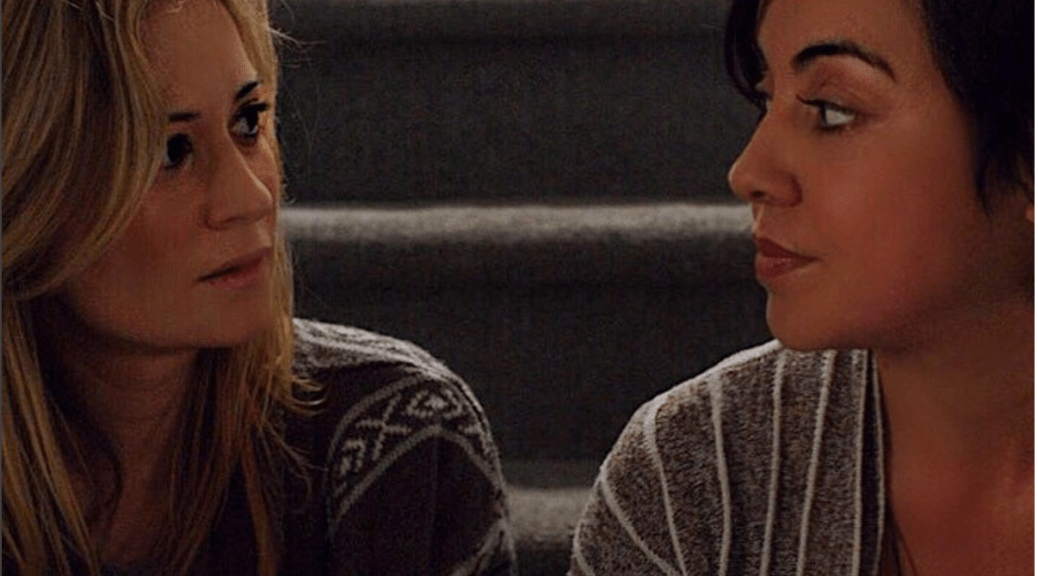
Faust has been the inspiration for countless films about those who make a pact with the devil to get exactly what they want but end up making a great sacrifice for their gains. There’s always a loophole “gotcha” moment. While this has nothing to do with the theme of the movie The Unseen it might be found in the story of one of the film’s stars Alison Araya. If the actress were to design an ideal situation for herself, it would be The Unseen. While Araya has made numerous appearances in blockbuster films like X-Men Origins: Wolverine and Watchmen (and many others), this was her first major role. Alison’s portrayal of the fearless Moll who is involved in a same sex relationship drew great praise from critics. She even got to act opposite one of her adolescent crushes (Aden Young as Bob Langmore) in one of the film’s most climactic and prominent scenes. Everything was perfect except…wait for the twist…The Unseen is an action/sci-fi/horror story and Araya is one of the most squeamish individuals on the planet. A self-described chicken who can’t make it through the horror film trailers at a movie theater, the actress found herself in a perfect environment save the very premise of the film. With no way out of it and too much to lose by passing on The Unseen, Araya bit the bullet and accepted the role as Moll. Alison and the entire audience benefitted from this decision. The film itself was a resounding hit whose recognitions include: two Canadian Screen Awards nominations, eight Leo Awards nominations, selection of the Molins de Rei Horror Film Festival and Vancouver Film Critics Circle, and wins at the Other Worlds Austion SciFi Film Festival, Molins de Rei Horror Film Festival, and others.Screen Shot 2017-07-03 at 3.31.23 PM

While The Unseen is based on the lore of The Invisible Man, it’s a very different and unique take. Writer/director Geoff Redknap didn’t want to update the already familiar story with new actors and VFX; he wanted to create an entirely different focus. The Unseen dissects the idea of how this fantastic situation would affect the family of the person in this very odd circumstance. The inclusion of an ex-spouse, children, extended family members, etc. is similar to looking at a 3-D picture where your eyes cross and present a totally new subject…one which was previously invisible. The character Moll is the partner of Darlene, ex-wife of Bob who has literally disappeared. She is stepmother to Eva, Bob and Darlene’s daughter and has become fiercely protective of her new family, particularly when it comes to Bob. The actress portraying Moll would need to be both fierce and tender. Redknap stipulates, “Alison stood out during the audition process. She was fierce but what captured our attention was the vulnerability she bought to the role. She could have easily played a mere foil to her step-daughter but instead Alison’s multi-layered performance brought a greater depth to her own and the other actors’ performances. Alison was not afraid to go head to head with Aden Young and they created one of the most climactic scenes in the film. We knew we ‘got it’ when the air felt like it was buzzing with the electricity of the performance Aden and Alison had just given.” Producer Katie Weekly confirms, “It was important to find an actress who could carry the gravitas of Moll. We were looking for a dynamic and strong actress who could also play the vulnerability of the character. Alison bought nuance and passion to the role and really made it her own. A different actress might have played Moll as ‘the bad guy’ but Alison brought such life to the character that her transition from the beginning to end of the movie was much more satisfying.”

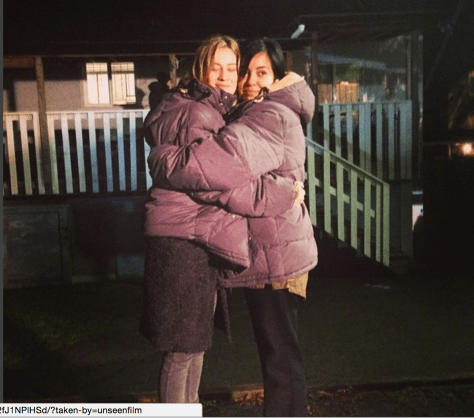
Moll could have been presented in a variety of ways; it was this fiercely loyal woman who protects her family and her partner that attracted Alison to the role. Moll is deeply in love with Darlene (played by Camille Sullivan) and has completely bonded with and come to love Darlene’s daughter Eva (played by Julia Sarah Stone) from Darlene’s previous relationship with Bob as her own. Being the woman in Darlene’s life, Moll has a chip on her shoulder when it comes to Bob. A drifter and absent father, Moll has seen firsthand the pain Bob has caused and will stop at nothing to protect the family she calls her own. Moll is stunned when she discovers that Bob is back in town and Eva is missing. Suspicious of Bob and the company he keeps, she pursues the truth and the two. When Moll is finally let in on the family secret, she is able to make peace with the relationship Bob and Darlene will always share and relaxes with her place in Darlene’s life knowing there are no secrets. The story is family drama with a very substantial secret ingredient.

Screen Shot 2017-07-03 at 3.34.53 PM

In one of the film’s most intense scenes, Alison was called upon to do something that has been common place for her in numerous productions, exhibit the signs of seeing something that wasn’t there; which is both literal and figurative when you are in a movie about an invisible man. She recalls her process noting, “I remember struggling with that particular moment in the film, when I had to react to seeing something shocking and new to me. I remember trying to figure it out intellectually and I wasn’t getting anywhere. Then I just closed my eyes and visualized what was in front of me. Immediately my body reacted and I understood on a visceral level what was real for me. I love moments like that because we don’t always have it worked out in advance. Some moments stump me and they challenge me to look deeper into my tool belt or think outside of the box. There is no one path to the truth of the moment, there are infinite paths it’s a matter of knowing which one to follow on any given day.” One thing Araya wasn’t confused about was working with her co-star Aden Young. She admits, “Working with Aden was a career highlight for me! I was a huge fan growing up in Australia; Aden has always been on my radar. I had a huge crush on him after watching “Black Robe” and when I saw his name on the cast list, I could hardly believe it. Aden was so generous and really invited me to get inside the ring with him and go for it…and we did! It was exhilarating and scary and live. It was incredibly fulfilling and I hope to have many more moments on set just like that. I held it together and kept it very professional but there was a younger version of me inside that was going crazy with excitement.”

boudoir shoot 2014 014

The Unseen as a film is contradictory; not in the sense that it doesn’t line up in terms of story or production but rather that this movie about the unseen is made so believable by what is seen. It’s not overuse of VFX or trickery that makes it compelling, it’s the performances of Alison and her cast that pull us into believing this very fantastic situation is as real as any discomfort a non-nuclear family experiences. The filmmakers ask us as the audience to buy into quite a bit and it’s the performances onscreen that make it much easier to be at ease with and suspend our view of reality. What is seen in The Unseen looks very good.

SIMULACRUM’S ENIGMATIC SARAH FAY

Sarah Fay has always enjoyed the inner game of acting. This idea that only the actor (and the director) truly know the character, rather than laying everything out for the audience in an easily digestible manner; it’s something that has shaped many of her roles. For someone of artistic temperament, the less obvious choices make for a more engaging experience, on the part of the viewer. This is a premise that Fay has always admired whether she is an audience member or a participant in the story. She notes that her early experience acting in the film Simulacrum (which received the Norman Jewison Filmmaker Award) was instrumental in her appreciation of the subtleties possible in character presentation. A sociological sci-fi tale, Simulacrum presents many of the ways in which technology affects our culture and relationships. Although set in an alternate reality, many of the ideas presented more than fifteen years ago, are coming of age in modern society. While the overall theme questions mankind’s use of biotechnology, Fay’s stand out role gives a glimpse into the complexity that she would bring to following productions.

In a very clever manner, Simulacrum presents the possibilities of our own world, by presenting the events in one, which we feel could not exist. Asking the audience to suspend their sense of reality, immediately disarms them into accepting any possibilities. The story takes place in a pre-apocalyptic Soviet world. Dallas is a young technician who has a clone (common place in this futuristic society) who seeks her assistance. The clone needs her to help with a government test because the two share the same DNA. What unfolds is a story of deceit, governmental constriction/abuse which eventually sees Dallas fleeing for her freedom. At the heart of the story is the question “What is identity? What is self?”, and the answer is not easily defined for the viewer.

Screen Shot 2017-08-01 at 7.36.33 AM

Perhaps the most interesting aspect of the film is that the lines between right and wrong are not presented in a clearly defined manner. The living embodiment of this, in the film, is Sarah’s character who, in congruent fashion, is known only as “Taxi Driver”. This only enhances the mystery and mystique of this pivotal character in Dallas’s search for truth and resolution. Fay so convincingly plays the unknown intentions of the character, who is both taxi driver and either governmental agent or agent of freedom, that viewers of the film differ in their conclusion of her motives. Sarah remarks, “An actor must always make clear, defined choices within themselves. I knew who I was and why, as the Taxi Driver and that was decided with the Director and in my own creative discovery. I don’t see a duplicitous character as undefined. Both types of characters have an alliance to themselves. A good wholesome character has an alliance to themselves and their belief in good, truth, and love. They act with those motivations. An evil character has less honorable motivations but is still true to themselves. They may not have a moral compass but they will defend their actions. A duplicitous character will flow with the wind but still remain true to their own survival and their self- alliance. Both the audience and society like to label. I think part of the joy of acting, for me, is discovering the true gray area of human existence, in different circumstances. The more layers you have as a character, the more real you are, the less you fully fit into a label of completely one way or another. Either way a character must have consistency to be connected to and duplicitous characters have that too.”

Screen Shot 2017-08-01 at 7.36.47 AM

A role like this is intriguing for any actor, but can only be presented as such when the director also sees the potential for the role. Sarah worked extensively with Director Anita Doran to present this character in terms of dialogue and physicality to create the mystery that made her so fascinating. Doran saw a quality in Fay from the very beginning and notes, “I hired Sarah for the film because I saw a lot of stand-out qualities in her audition. She took great care to understand her character with a depth that many others would miss. Sarah was precise and concentrated, revealing a dedication to craft that has only grown since this early state. Once on the set, she was generous with her creativity and a consummate professional. I’ve rarely seen an actor throw themselves so deeply into a role. She had immense commitment and made it her responsibility to add as much as she could to the overall quality of the film, and I think the end product is exponentially better thanks to her presence.” Fay confirms that this is her normal approach. Her intense discipline and dedication has served her well since this early experience. Contrary to being restricting or overwhelming, she finds this intensity frees her in roles and allows for less thinking and more feeling. These days, as an LA resident she finds that this mindset is expected in an entertainment centered city. Sarah states, “I’m pretty obsessive and singular in my focus and strive for success, but it makes me happy. To be in L.A. doing this, I am living my dream. In terms of the others in my life, everyone knows if I have an audition…I’m going to need to cancel with them. That’s part of the thing I love about living in LA. It’s an actor and industry town. People understand and we are all here to succeed, so they get it. All the people in my life get it. In Toronto, I experienced a little more frustration and eye rolling. I’d hear, ‘No really, when are you going to give it up and find something stable?” a lot more. That just doesn’t happen in LA. The key to life is finding a place where you fit in and I feel like I’ve found it here.  I am working on filming ‘CON’, a great film that is also going to be a series, with Oscar nominated producer Joseph Wesley Adams and I just got a couple new roles I am overjoyed about. When you work towards a goal your entire life and people see it as a positive rather than negative, it makes you feel that you finally fit in. Taking chances like I took in Simulacrum were part of the journey that got me here.”