
Category Archives: Behind the Scenes

THE CREATIVE CONSCIENCE OF VISHNU PERUMAL

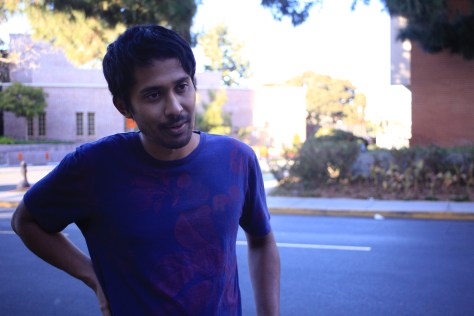
Storytelling has long been about taking one’s personal voyage and relating it in a way that almost everyone can connect to it. While Hollywood has been accused of homogenizing the film industry, some artists who convey these stories are attempting to give the public a glimpse into the lives of others who differ from the majority. It’s ironic that people are often apprehensive to accept differences in their own lives but are attracted to films which display those who possess this trait. Editor Vishnu Perumal learned to be comfortable with differences early in his life. This fact combined with his fascination of film laid out his path from childhood. He has pursued his vocation with fervor for as long as he can remember; the fruits of this labor have been numerous award-winning films and the respect of the Hollywood community. This is perhaps so apparent because Perumal is an artist who seeks out projects which he connects to emotionally and believes in passionately. It’s easy to chase fame or a fat paycheck but pursuing projects which make a clear and resonant statement about society’s potential to aid or hinder is often more challenging and unsettling. For someone like Vishnu, it is also a requirement.

Vishnu relates to being different. He grew up in a situation where it was expected that both himself and others would not have the same exact background and experience. This allowed him to have a perspective different from many people. Regardless of their point of origin, most people are comfortable and content being insulated from those who are different. Contemplating the motivations and life experiences of people who have had it worse than you or who have faced greater adversity is unsettling. For Vishnu, it has been a call to action; one which he has used his most important resource to empower…the role of editor.

Differing perspectives and diversity is an inherent part of this editor’s makeup. The son of an Indian father and an Indonesian mother, Perumal experienced different cultures in his own home and in his surroundings from an early age. He explains, “I moved a lot when I was growing up due to my father’s work. I was born in a small beach town in Malaysia called Kuantan. Later, our family moved to Jakarta, Indonesia. Jakarta is a really vibrant energetic city with a lot of culture. It’s big, bold, noisy, and colorful with great food and very friendly people. Growing up there, I remember it being slightly chaotic, especially the traffic. It was a large developing city that was growing rapidly and changing every year. From there, I moved to Singapore where I spent much of my Primary to early secondary school years. Singapore was the total opposite of Jakarta because it was extremely orderly, clean, and organized. I was astounded by how clean Singapore was and I remember trying to wrap my mind around the fact that it doesn’t have traffic jams. Like Jakarta however, Singapore was a vibrant city with a whole lot of mixing of cultures. Both places were located close to the beach so I would spend most of my weekends there. It was natural to me to witness different types of people enjoying the same activities; I never questioned it.”

Watching his father edit his own family movies on a Sony editing deck interested Vishnu in the process, soon to be followed by his interest in the work of Walter Murch (the editor of such films like Apocalypse Now and The Godfather). Murch inspired an approach to the possibilities of editing for Vishnu who recalls, “I was lucky enough to sit in on a guest lecture of his where he talked about the philosophy of transitions and editing. What I really loved about his lecture was that he wasn’t focused on any technical aspect, formula, or technique but rather he talked about the philosophy behind editing concepts and how they relate to the world. It was a lecture that sometimes delved into the spiritual and metaphysical and it made me look at editing in a whole new light.”

Carrying the torch of this idea for his generation, Perumal’s many award-winning productions give evidence that this editor is focused on making a statement with film. As with many of the most respected filmmakers, Vishnu’s work often displays the more unpleasant sides of humanity in hopes that the public will contemplate the plight of those who suffer. “Violet Hour” is the story of Tom Freed, a young black man who is at odds with what he feels is natural in terms of his own sexuality and what society deems acceptable. The film is a powerful statement about the psychological effects of what others use to subjugate those who differ from their own beliefs, opinions, and actions. Freed goes so far as to undergo conversion therapy in an attempt to conform but in the end takes action with a dire resolution. At the heart of the film is the question “What freedoms does our society truly offer?”; a sobering query. Perumal worked with director Mark Allen to create the conflict that the main character feels in his heart and communicate this in the timing and actions onscreen. Allen declares, “Working alongside Vishnu throughout the duration of the project was a wonderful experience. It is rare to find an editor with as much thoughtfulness, support, and passion. What he demonstrated for the project was evident in the final product and success of the film. Vishnu’s emphasis on storytelling provided the film with a powerful tone and ending. It was really pleasant to discover how easy it is to work with him. Because the story and the style of the film according to my vision was so specific and different, I was afraid that it would have taken considerable effort and time just to explain and push for the vision I intended. Fortunately, Vishnu understood and supported my vision 100% and fought to preserve that vision. He not only was able to maintain my vision for the film, but he was also able to incorporate his own creative ideas into the product, helping to brand the film as a creation of his own.” “Violet Hour” received a nomination at The San Francisco Black Film Festival for Best Film as well as an award for Best Narrative Short at the Princeton Film Festival.

Exploring the unsettling and frightening crime of sex trafficking, Vishnu edited the film “Only Light.” An increasingly widespread occurrence across many parts of the world, including the US, sex trafficking is something that often goes unnoticed and unrecognized in many communities, which is exactly the message communicated in “Only Light.” The two lead characters in the film are young women of the same age. Zora is a rebellious teen living in California who has a crush on her older male neighbor. Zora’s parents are wary of this, as well they should be. This neighbor has a girl named Laeticia locked up as a sex slave in his basement. Laeticia was kidnapped from her village in the Congo and transported to California where she moves in and out of lucidity in the basement. When she is ultimately freed by Zora at the end we sadly realize that this event is only a wishful dream that Laeticia has created in her own mind as she is still a prisoner. The film is highly disturbing and unfortunately somewhat based in reality. Perumal was eager to work on this film as he felt it was a story that needed to be displayed to viewers. “Only Light” was recognized at the One Lens Film Festival, Blackstar Film Festival, and L.A. Indie Film Festival. Zachary Skipp (Producer of “Only Light”) remarks, “Only Light was a film with many technical aspects (shooting in different mediums, various effects, etc.) that an average editor would find daunting to work with. Fortunately, we had an editor who was able to integrate himself into the many creative aspects of the post-production process, making him adaptable in almost any project he undertakes. I hired Vishnu as an Editor for ‘Only Light’ after seeing what he had done on previous films. His ability to understand and work with abstract and experimental forms of storytelling and mold them into a cohesive story is one of the many reasons why I brought him onto the project. Vishnu was deeply involved and began working early on in the project, starting in pre-production. For example: there were some effects and stylistic transitions that we wanted to accomplish, and Vishnu was very helpful in helping us figure out how to achieve the desired result, before heading into production.”

It seems contradictory that followers and leaders of religions become upset when religious leaders who are highly flawed are depicted or revealed for their baleful nature. One would think that these “believers” would want those who are not true to their teaching to be “cast into the light.” This seems the most benevolent thing to do in the parameters of their faith. Vishnu used his editing talents on a fictionalized tale that used actual footage and inspiration from the Reverend Jim Jones entitled “Devil I Know.” The disturbing life and events of Jones are well documented but “Devil I Know” creates a storyline inspired by what we know of his behavior to give a firsthand feeling of what it may have been like to be around him. Known for the People’s Temple mass suicide (in Jonestown, Guyana), his infidelities, and other abuses of power, the film takes an almost documentary style approach to portraying this complex and tragic figure. A vital contribution of Vishnu’s on this film was to edit and present the story out of chronological order; a method used to confuse the audience as well as affirm the idea that things are not always as they seem.
_MG_8622 (1)

The common thread of all these films is that they reveal to the audience that we should not be so assured that we understand the full truth. Well-known figures or private individuals may be dealing with many factors that we are unaware of. They may act in nefarious ways or society as a group may be overlooking the struggles they deal with. There is no way for anyone to truly know but artists and filmmakers like Vishnu Perumal keep us questioning the intent and the plight of others who are different from us. In doing this, they provide a service that few can…a conscience.

ZHENG HUANG PRODUCES AN AWARD-WINNING FILM FROM THE HEART OF HIS FAMILY

Of all the qualities that make up an artist, the most essential is heart. While knowledge, vision, and technical expertise are beneficial, passion is not to be underestimated when it comes to the tenacious mindset that drives an artist of almost any medium. Producer Zheng Huang’s connection to the location and story of the film “Lost” was deeply embedded in his heart. While he wore a multitude of hats for “Lost” (including writer and director) it was the role of producer which proved most taxing. It was Huang’s excellence as a producer that also led this film to such immense praise and eventually a spot at the world famous Cannes Film Festival. The film is epic, adventurous, and gripping for many reasons. Zheng was driven to create the film as a tribute and connection to his family’s homeland and to expose its beauty to the world. The lush grasslands, the exotic characters, and the endearing portrayal by the cast all appear to originate from the story which this producer was inspired to write, and was the only person capable of manifesting onscreen. “Lost” truly is a piece of Zheng Huang personified for all to see.

psb (1)


“Lost” was Zheng’s first high budget film to produce and he definitely felt the responsibility. Whether it was fear or passion, the fuel that pushed him towards excellence was the appropriate one. After the completion of the script, he flew to China and did location scouting in Inner Mongolia. It was an intensely emotional moment for him. Huang’s grandfather had died on the grasslands of Inner Mongolia and it was this which inspired the story. Zheng wanted to be in the grasslands; to feel them and to expose this feeling to the rest of the world in film. For two years he had seen the terrain, the people, and the story in his mind; a mixture of Chinese and American culture and individuals…and now he was seeing the nebulous form start to solidify in front of his eyes. While the story of “Lost” is not derived from his family, Huang understood that the feeling of the location and people who carry the spirit of both his grandfather’s life and his own. The film tells of an American boy named Michael who has lost his mother in Inner Mongolia. Mr. Wu, a native Mongolian, saved Michael and decides to adopt him. Mr. Wu teaches him Chinese and Mongolia culture. Michael’s real mom (Mary) searches for him for quite some time. Michael knows the truth that Mr. Wu hides this from him and Mary. Michael is angry but struggles with the decision to return to his birth family or not. While many films give a clear and imposed decision about situations like this, “Lost” accurately depicts the conflict that can be a part of real life when considering to whom have we bonded most strongly. Just as importantly, the story and the stunning visuals of this film portray the people and the culture of Inner Mongolia not as “others” but as those who share precisely the same emotions, virtues, and faults as those of any group of people on the planet, meaning that Zheng perfectly achieved the goal of his film. The process of creating this onscreen was earned.

E8162276-2944-4592-A15D-6F80DBF33E92

Every producer knows the challenging points for their project. Successfully and positively utilizing these is a badge of honor as well as an accomplishment for any professional in the field. For “Lost” the can easily be defined as: kids, animals, and nature. Due to the nature of the people in this part of the world, the actors needed to be able to ride horses. This is not exactly a skill that the majority of individuals possess these days. While some actors take quickly and easily to it, it only takes one intimidated thespian to derail the schedule. A dutiful producer, Huang prepared a week of riding lessons in advance to the shoot. A couple of actors were never quite at ease with the situation (or the animals) which necessitated a restructuring of the shot list and even some “cheat” shots.

Zheng admits that this film was his first time working with a child actor. The final performance by this youth in the film is exceptional but the producer concedes that it wasn’t exactly the same as dealing with most actors in his experience. He recalls, “He was great and is a very talented actor. I think it’s wrong to expect a young actor to have the same perspective as an adult. It was actually kind of miserable for part of the shoot, it was hot and he was being asked to do things that were difficult…I can completely understand his state of mind. Having been a young boy myself once I knew that there’s not much that pizza and some toys can’t fix when it comes to attitude. Regardless of the actor I’m working with, I find that if I can put myself in their shoes I can quickly find the proper motivation for them.”

One of the most striking traits of “Lost” is the visual component of the film. The beauty of the Inner Mongolian grasslands is as epic as any classic western from Hollywood’s heyday. A shrewd producer who is always cognizant of a film’s budget, Huang had his location manager contact his best friend (a herdsman named A De) about using his private 8,000-acre meadow. A De was so interested in the film being made that he offered the location up free of charge. As a thank you, Zheng gave him a supporting role in the film. In an effort to keep production value high and cost low, he also hired a crew from nearby Beijing (four hours away from the filming location). Casting locals rounded out this international production and provided the authenticity that Huang had envisioned. Since his early vision, it was these very people that he wanted to be seen in the film.

DT8A1862

“Lost” was much more than a film to Zheng. It was an Odyssey that connected him with the previous generations of his family. Through his talent, he was able to communicate to the rest of the world, via film, what it feels like to feel both afraid and comforted in a part of the world that few Westerners will ever see. It’s by seeing these types of stories that we realize how similar all people are at their core. The literal deluge of awards that “Lost” has received in addition to being an Official Selection of the Cannes Film Festival (2017 American Film Award, Award of Merit at the 2017 Best Shorts Competition, Official Selection of the Hollywood International Moving Pictures Film Festival, Multiple Platinum Awards at the International Independent Film Awards, and numerous others) is an assurance that the beauty of this film has touched many people in many different lands. While producer is only one of the roles which Zheng Huang performed for this film, it is likely the most applicable to his deep investment in it.

psb

TUNA’S INTERNATIONAL COOPERATION

Producer Tuna Erturk’s films and commercial work is widely recognized with awards and their prevalence in the industry. If you don’t know of him that’s likely because you don’t live in Turkey. Fame and recognition does not typically transfer internationally unless you are an actor with a marquee name. This doesn’t bother Tuna as he has always preferred creating behind the scenes. Still…he has been a part of some productions in the US which means it’s likely that you’ll start hearing his name more often, at least if you are in the industry. As the world’s communication becomes more immediate, our interest in different cultures and the stories we share cross international boundaries. Established and creative professionals like Erturk are increasingly becoming sought after to lend their skills and sensibilities to an entertainment thirsting public.

Erturk served as a producer on Dervis Zaim’s Fish which won a Crystal Apricot Award, a SIYAD Award, and was an official selection of the Istanbul International Film Festival. The film is an excellent example of the rich storytelling that is found outside of the US. Fish follows the story of a poor fisherman who, desperate to cure his daughter’s muteness, tries to catch a fabled magic fish. As the film’s producer, Tuna played a huge role in the creation and ultimately ensured their fantastic degrees of critical and commercial success. The film was shot in Golyazi/Bursa, Turkey (a peninsula) where the spectacular views and natural beauty complement the mythical hopes of the main character. Tuna concedes that coordinating a location shoot there was more than worth the effort. Having done only one feature project prior to Fish, Erturk was overwhelmed by Zaim’s insistence that he come aboard the project. He notes, “I was so busy with shooting T.V. commercials at the time. Dervis Zaim came to office one day to meet and asked me to work on Fish. I said that I really wanted to and then he replied to me with this Turkish idiom ‘There is no wedding without the orchestra. You must be there!’ He was stating that I was the orchestra in the wedding. With that kind of confidence, I found a way to make my schedule work and I’m glad I did.” As proof of the positive working relationship and Erturk’s work, Fish won multiple awards at the Malaysia International Film Festival and was nominated for Best Film at Nuremberg Film Festival.

Commercial Shooting 1

Tuna was already in LA amongst the Hollywood industry and experiencing it firsthand when he was hired as producer for the film Uzun bir Gun or “A Long Day.” This film is about a sick father who is accompanied by his son to find the patriarch’s childhood home was filmed in Turkey. Having served as producer in both the US and Turkey, the difference in the two industries was redefined for Erturk. He states, “There is a very close connection between the film industry and school in LA. It’s not just directing or production, technically that is the way it is. Active people working in the sector give lectures on light, sound, visual effects, and many other topics. They share with you all their experiences on set. This makes it possible to educate qualified personnel in every way. There are university graduate set workers and assistants, production assistants, sound assistants in LA. Everyone is very professional and educated in their work. There is great support for students. You can rent the finest cameras, the best equipment, and the most amazing team almost for free. The working rules here are much stricter than in Turkey. For instance, the health and rest time of the team working on the set is very important. In the simplest case, you can call at least 12 hours after the last worker who left the set. I can count many other rules for protecting the workers like this. I think these rules make things work better quality. It was with great pride that I applied my experience here in Hollywood to producing in Turkish films.” “A Long Day” received awards from First Run Film Festival – Wasserman Award, Golden Orange Film Festival, and Tehran International Short Film Festival.

Most recently, Tuna was enlisted as the producer for Noah Tree. Set to be shot in Bursa (Turkey), it tells the story of a man named Omer who goes to his dying father’s childhood village to fulfill his last wish: to bury him under the Noah Tree which his father claims to have planted long ago. But the villagers believe the tree to be the first tree Noah planted after the Great Flood and they will do anything to stop Omer from debasing their sacred tree. The production has already received a Cannes Film Festival Residence invitation.

Choosing to focus on films these days, Erturk has a long history in producing with various formats. Every producer and director gets their start in commercials and Tuna is no exception. He has no disdain for them, in fact…he quite liked the work. What’s not to like when you’re working with international stars like Megan Fox and for massive brands like Coca Cola and Doritos? It does however not come without it’s challenges as he notes, “We shot the Doritos commercial with Megan Fox in Istanbul. When she arrived at the Istanbul International Airport all the paparazzi were waiting there for her. She was very famous in Turkey like the rest of the world. The commercial was about a celebration of new product of Doritos “Fritos Shots”. There was an academy in commercial that brings together the young bright brains. So one of the teachers was Megan Fox. We shot the commercials for 3 days in one studio. The most challenging part of the commercial was Megan’s fame. She was so famous and it was hard keep paparazzi and media attention away.” Erturk adds, “My tasks during these productions were: making budgets, hiring crew, and keep it running smoothly. I was reporting every process to the executive producer Emre Oskay. We were finding solutions together if we had a problem. He was a friend more than a boss. That positive working relationship grew into twenty-three commercials together and film work.” Oskay adds, “In addition to our commercial work together, I have also worked with Tuna on a pair of feature films, both of which he produced. These films, 2014’s Fish and 2013’s Cycle, have each accrued a fantastic degree of commercial success and have drawn the acclaim of audiences and critics. Neither film would have garnered such a significant degree of international acclaim if not for Tuna and his fantastic gifts as a producer. Tuna Erturk stands among the top tiers of Turkey’s film producers.”

IMG_9826

MASSIMILIANO LOMBARDO ON THE SWEET & SALTY SCORE OF NOCTURNALLY YOURS

Storytelling has been with mankind for as long as we can remember; yes…that’s humorous. Whether it began as a means of oral history or entertainment (it was likely both) it has captivated people. The means have changed over time, what was spoken by a single orator or actor in front of the cave’s fire is now a vision manifested by the most skilled artists and advanced software. Filmmakers have returned to the keystone of imagination and its limitless possibilities. Whether it be rocks and a drum aiding Cro-Magnon man or current day symphonies and music software with composers, the relationship between music and stories is one of the longest enduring marriage in the arts. 2017’s Karma is a CGI animated film of a cautionary tale. This recent release has already been nominated in over 30 film festivals all over the world and has won 8 awards, including Best Original Score: Honorable Mention at the Asians on Film Festival (US, 2017) for its composer Massimiliano Lombardo. Director Peter Zhou directly reached out to Lombardo (also known as Max) after seeing bits and samples of other animated movies he had previously scored. Because Karma contains very little sound FX and no dialogue at all in the movie, the music would become a main character. The film also has a wall to wall score, meaning that the music is present from the opening scene through to the final credits. Keeping the music interesting and effective all the time without being able to hide behind sound fx or dialogue required an inventive and assertive composer like Max. Zhou requested a score that would engage the audience but not pull their attention away.

A film composer’s task is to write music to picture in order to enhance the emotional impact of the movie and help tell the story. Karma is a traditional 3D animated movie (like Pixar’s movies). After meeting and discussing the music with director Peter Zhou and animator Franklin Okike, Max decided to write a classical full orchestral score with memorable melodies and motifs. The first step was to write a theme for the main character, from which the whole score would be developed. Lombardo recalls, “I watched the picture twice and then shutdown the computer and focused on music for an entire day. Once I had a theme I started composing the actual score to picture, adapting the theme to it. During this process I wrote entirely on the piano in something called sketches.” Sketches are reductions of what will be the actual full score. They contain the main ideas, the rhythm, and the harmony but without orchestration. From there Max began the orchestration, choosing the right orchestral colors and arranging for an ensemble. Given the size of an orchestra, writing for it without a sketch can get a bit dispersive. Max used this method to focus on one thing at the time: rhythm and dramatic impact of the music first, then orchestral embellishments, textures, and finally colors.

Lombardo had an immediate affinity for this film and its message, which greatly aided his role as composer. He confirms, “It really makes a big difference when you fall in love with the movie you are scoring. With Karma it was love at first sight for me. First of all, the movie is incredibly well designed and animated. Characters and landscapes are incredibly detailed and evocative. Furthermore, the movie is very well structured and has a built in rhythm to it. All these elements together are the perfect backbone to a score. The characters would suggest the themes, the colors and textures would inspire orchestral colors and arrangements, while the structure would dictate the rhythm of the score.” Karma tells the story of a boy who meets a fish in a mysterious forest. The boy starts feeding the fish and the fish grows exponentially. He gets carried away and feeds the fish everything he has with him regardless of whether this is good for the little creature. The fish keeps growing until he eventually turns into a monster and eats the boy. The movie is a metaphor for the way we are treating our planet and the animals in it. Actions without conscience lead to disaster for us and all who inhabit Earth.

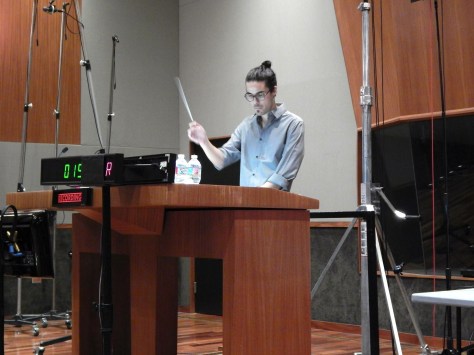
conducting

Upon viewing, the music in Karma seems so perfectly matched and obvious…yet, prior to Max’s compositions there were a myriad of possible ways that the score could emotionally affect the audience. Carefully taking this into consideration so that he might deliver the intended impact of the action, Lombardo delicately crafted the music for Karma. He explains how his work colored scenes stating, “There are two scenes in which I think the music really added a layer to the movie. One is when we first realize the fish is getting bigger. In this moment the score gets majestic and magical taking the point of view of the boy, but then goes into a darker tone as we start sensing that something is wrong. Here the music really anticipates and creates suspense before the big reveal when the fish turns into a monster. The other moment is at the very end when the fish eats the boy. Here I didn’t want to make it too dramatic as the movie had to be playful overall. I decided to build a dark orchestral piece that ends with a silly resolution that almost sounds like a Tom & Jerry cartoon, leaving a smile on people’s face when the end credits come in.

Contemplating Lombardo’s score for Karma, Peter Zhou relates, “We were really trying to go to some new places with this film. We straddled a line to deliver a message while making it entertaining and not heavy handed. I’m sure that it is frightening for a composer to play their new creation to someone for the first time; it’s a very delicate moment. As soon as I watched the film with Max’s score, I couldn’t stop smiling. It was perfect! He perfectly captured the message and the mood of the movie, adding an extra layer to it that made it complete. I think he really captured the essence of the movie.” Whether he is working with the finest LA musicians, the London Symphony Orchestra, or digital music software, Max Lombardo continually brings a fresh and creative approach to modern film composition and orchestration.

Headshot2

AWARD-WINNING EDITOR JUN XIA’S “INSIDE LINDA VISTA HOSPITAL”

Jun Xia is passionate about his work. As an editor, he is passionate about filmmaking in general but he makes no qualms about his love of Horror films. To be clear, it’s the difficulty of it that calls to him and is so attractive. Jun contends that for an editor, horror films are more difficult and require more of him than any other genre. There are multiple reasons for his opinion but it’s clear that the affinity between this editor and the genre is mutual. His work on the film “Inside Linda Vista Hospital” is evidence that Xia feels called to dig deep and bring brilliance, and the accolades which the film has received have vetted him as one of the premier professionals of the day. In addition to numerous awards, Jun was named winner of Best Editing at the United International Film Festival 2017 and received the prestigious honor of this film being named an Official Selection of the Festival De Cannes Short Film Corner 2017. It’s hard to fathom the concept that a factor which led to such international notoriety was conducted in a small editing room. This is the role and life of an editor however and Xia seems more than comfortable with it. When speaking about his work on “Inside Linda Vista Hospital” it is obvious that his ideas and the images on the screen transport him to another place, just as they do for the audience and even the characters on screen.

Jun is boisterous in his proclamation that editing Horror films is an art form, perhaps even a calling for him. One thing is for sure, when a professional feels as inspired and assured as this, you are certain to get an incredible film. “Inside Linda Vista Hospital” is a pseudo-documentary horror film. The script and fictional elements are used to tell the story but are presented in a style that mirrors the documentary format, giving an implied sense of reality to it. The story is about three explorers of the supernatural who go to investigate an abandoned hospital. They get lost in the hospital and one member of the trio becomes separated from the group. While the other two try to connect and find him, they encounter a variety of horrible things in the hospital. John (the missing member) is lost in the basement as the other two characters encounter patients who had been tortured in the hospital and eventually died. Several surprise twists and turns in the story line deliver the shocks and startles that viewers of this genre love. While it all seems so natural and intuitive when viewing the movie, the film’s editor reveals that it is quite the opposite.

While many people operate under the presumption that an editor simply connects and dissects different scenes, the role is actually one of the most vital in creating a film’s story. Working closely with the director, Jun commonly finds himself in deep discussion about what tone to take in placing the scenes together. As with any creative endeavor, if you aren’t noticing the difficulty that it takes to create the work…it means that a highly skilled artist has manifested it. Xia explains, “Once filming is wrapped, there is still so much work to do before the film takes shape. The story is given to the film editor. The editor should discuss with the director to understand the director’s interpretation and ideas of the script. The editor should also understand the director’s style because every director has a unique voice which will naturally lead to different film styles. After the synthesis of these, the editor will successively present the story’s narrative methods using editing software. It’s paramount to understand the role and temperaments of all these professionals in order to be an effective film editor (the ability to understanding what the writer, director, and actors are doing). When it is most creative and enjoyable is during the post-production, the director and the film editor will communicate and discuss at great length. The film editor needs to understand the style and the ideal effect of the director before starting the cutting.  The director will also give the film editor a large creative space in order to maximize the effect that presented by the film.”

Every editor has a process and Xia’s is very specific when it comes to Horror films like “Inside Linda Vista Hospital.” Obviously, he does an initial check of the footage to find the subjective perspectives and intersperse them into the cinematic look of the film; for example, using the POV shots to present the sense of what the character sees while walking. In this way, the audience will feel like they are moving in the film scene while watching the movie. “Inside Linda Vista Hospital” had a large number of handheld camera shots which can be useful but problematic for an editor. Jun describes, “There are a lot of handheld shots in this film. I needed to edit these shots to move fast, so the audience will feel that it’s real and scary. There is a shot in which the character runs into an abandoned red room; I wanted them to run very fast and then fall down on the ground. To achieve this, when I edited this scene, I removed some frames when they run and fall. This is a good idea when editing moving shots. It adds a jolt and surprise element.” Xia adds, “It’s true that editing with a moving or hand-held shot is more difficult than with a fixed shot. A moving shot is constantly changing and often represents the state and psychology of the characters, such as running, walking, or moving with the visual changes of the characters. The editing of these shots should be very reasonable and the convergence of the character movements should be smooth. When editing this, you need to find the splicing points of the screen and then chose the best joint to link the senses of different contents and form a complete action or concept. In addition, based on the characters’ physical movements on the scenes, it’s best to select the beginning or the end of the action as the editing point. In contrast to this, a fixed shot is relatively static and visually has no obvious dynamic shot.

The challenge for Jun when editing a horror film comes not only from the technical aspect of what he is doing but the content which he is given. The footage for a horror film has such a diverse number of factors that affect its delivery. VFX, Dolly shots, fighting or chasing scenes, and other methods are essentially requirements of the genre. While many types of films include some of these, only the rarest contained what is almost always contained in a Horror film. Of course, no scary movie is complete without those unexpected frights which elicit screams and then laughter. This is yet another reason that Jun Xia loves this type of work; it allows him to use the very best he can muster to draw such a wide range of emotional responses from audiences across the planet.

Linda V 1

“LIKE COTTON TWINES” EDITOR TING YU CRAFTS AN EMOTIONAL AND AWARD-WINNING TALE

Like Cotton Twines is one of those rare films that breaks your heart and inspires you at the same time. In the form of cinema, it achieves what no other informative vehicle can; it gives the audience an inside view of a very real situation in another culture. A story such as this touches not only the viewer but also those who create it. Ting Yu served as the editor for this production, carefully crafting its presentation with writer/director/producer Leila Djansi. This film’s content directly speaks to both women as it relates to the plight of women in this particular part of the world. Ting also notes that there are facets of the story which resonate with her due to her country of origin. As a lauded and respected member of the film industry, Yu proved her value to the film and the emotional impact it has made. Now available for streaming on Netflix, Like Cotton Twines is receiving a great deal of accolades, as it did in Ghana (the location of the film’s story) where it was nominated for thirteen awards (at the Ghana Movie Awards, the biggest national movie awards in Ghana) and won 6 awards, including the best film editing award for Ting.

The film focuses on the traditional culture in Ghana. Told from the perspective of an American teaching volunteer, it focuses on his attempts to save one of his students, a fourteen-year-old girl, from religious slavery. Djansi contacted Ting based on her reel and declares, “There is a rhythm to Ting’s editing that is on par with some of the greatest editors. Whether it’s on the micro or macro level, she excels with every edit. She combines shots in a way that perfectly conveys the message of the scene and overall tone of the film. It’s inconceivable to think that Like Cotton Twines would have received the attention and praise that it has without Ting’s talent. When I approached Ting it was because I knew that I had to have an editor of exceptional ability to help me realize my vision.” Conflicting opinions are healthy in film and often lead to better art. Yu’s perspective and ideas are what led Leila to bring Ting aboard the film. For the scene in which Allison (the teacher) did not find Tuigi (the student) on the bus, Leila wanted to use a long take from the beginning to the end, because of the production value. At Yu’s urging, she agreed that this take was beautiful but too long. Ting created a cut half the length of the original; one which allowed the audience to still feel the same emotional content but make the story move faster and more entertaining. She found that her personality and opinions were very strong as an editor but she had no problem listening to the director to help achieve her vision of the film. These are the traits that endeared her to Leila Djansi. These two professionals worked at a feverish pace to complete Like Cotton Twines on a very tight schedule. Yu recalls, “We had several cuts before we locked the picture. Each time we made a cut, Leila and I would sit down and watch the whole film together; both of us giving each other notes. Leila is very open-minded. She is always willing to listen to my opinion, especially when we think we need to cut something out of the film. It was an ideal situation. We would challenge each other…in a very positive way. I feel that this is one of the ways you achieve such a good end result; when everyone seeks the very best and refuses to take anything less than that. One of my favorite memories is of Leila’s cooking. She is such a good cook and would cook for me, because we were working such long hours to finish on schedule. I’d be making cuts based on our notes and also guessing what she would be making me for lunch. That’s not the kind of experience and positive work environment I think most editors get. Add to that the fact that Like Cotton Twines won so many awards; I’m a little spoiled by it all.”

Perhaps one of the unseen facets of Ting’s approach and excellence as an editor is because she started out pursuing the path of director. Her history with secondary choices has proven quite fortuitous. When Yu didn’t get accepted into her chosen University as a medicine major, she switched to TV and Film production. She found that she had a lot of natural talent and it excited her. She felt a strong connection to American films, in particular the work of Steven Spielberg. It became apparent to her that an editor has a different means by which to structure and shape the message and tone of a film and she found it more intuitive for her personally.

Ting notes that one of the reasons she was interested in the role of editor of Like Cotton Twines was the story of females in a culture which does not see them as equal to men. Because of these aspects of her own country of origin (Yu is from China) she believed that the commonly held view that men are seen as somehow superior to women gave her great empathy for the characters and storyline of the film. She communicates, “It’s silly to feel this way when I know that everyone is equal but, coming from a society where women are not seen as important as men…it is difficult to shake this idea from your own thoughts. Leila and this film do an amazing job communicating these ideas and I am proud to have been a part of it.”

The attention and accolades which Ting Yu received for her work in Like Cotton Twines led directly to more work. Enjoying a wide variety of productions such as editing an African documentary about wildlife, Kickboxer: Retaliation (once again starring Jean-Claude Van Damme), and a trio of live action films based on comics and toys in China, Ting Yu has become one of those editors who is in demand across the planet. It’s written in the stars that those directors whom she has admired will be watching her work and likely remembering her name for future projects.

13339629_10154814089580828_8216972789816935442_n

PETER CHRAPKA HELPS SET HISTORY STRAIGHT

History can tell us volumes. The main shortcoming is that it is sometimes selective in what it wants to tell us. A half-truth is still akin to a lie. Anyone who presents themselves without fault is likely someone who has a major one. This is particularly applicable to countries. To deny fallacy or shortcomings is to admit that you have them to the world. When truth is omitted it is up to artists and journalists to bring these occurrences into the light. Ryan Boyko, Diana Cofini, & Editor Peter Chrapka performed the patriotic task of revealing the truth about the internment camps of World War I in Canada. The love of their country compelled them to create a 32-episode documentary series about this period. This documentary series would inspire a feature documentary to expound on the tale. Only in facing the events of the past can Canada hope to understand and avoid them in the future, a lesson that is applicable to every place on Earth…no matter where you live or your ideology.

The Camps Poster5 large format

“The Camps” is a documentary series depicting the period between 1914 and 1920 when over 8,500 people were wrongfully imprisoned in Canada. Almost forgotten, “The Camps” honors the memory of these men, women, and children by telling the story of their affliction. This production was recognized with an Award of Recognition by Hollywood International Moving Pictures Film and an Award of Merit (Special Mention) at the IndieFest Film Awards. Director/writer/producer Ryan Boyko approached Peter about the project. Chrapka openly admits that the content was as instrumental as the process for him, stating, “After meeting Ryan, the director, I learned of the internment camps for the first time and was shocked as I’d never heard about it before. Ryan saw my previous work and hired me to set up the project and sync all the audio. Ryan noticed the great attention to detail I had in handling the footage and setting up the project properly as well as my past awards and recognitions for work in the documentary genre so he offered me the position of video editor for the ‘The Camps.’ I felt like this was an important project for all of us. There is a responsibility that comes with a career in which you have a line of communication with the public.”

“The Camps” received so much attention and praise that its creators decided to fashion a feature documentary entitled That Never Happened: Canada’s First National Internment Operations. The expanded production team focused on the story of the 8,500 people who were wrongfully imprisoned in concentration camps across Canada, not for anything they had done but because of where they came from, as well as the fact that in 1954 the public records were destroyed. In the 1980s, a few brave men and women began working to reclaim this chapter in history to ensure future generations would know about it. Chrapka and his fellow filmmakers became the next generation in this lineage determined to reveal and discuss the true events while learning from them. Delivering a story such as this is never easy, Peter concedes, “I commend Ryan on his pursuits to tell this story in Canada’s history that has been erased from the history books. He wants this information to reach as many Canadians as possible. This web series has been viewed by thousands of people from around the world and I think the feature documentary will greatly help in reaching thousands more.”

17159330_10155022643096894_4368818621155072033_o

It quickly became apparent to Chrapka that his task would be monumental working on the feature documentary. It involved locating and researching archived clips of the time period. Luckily, the Canadian National Film Board has a fairly large collection of footage from this era which the production was able to license. Of course, most of the records about the internment camps had been destroyed, meaning that no footage specific to the camps was available. Working with a combination of black and white footage from the 1920s as well as footage acquired from private citizens’ camcorders at special events in the 1990s up to the 2000s gave Peter some video but there was a distortion in the resolution as the quality of some of the old footage was not great quality. In documentaries, it is expected that archive clips are of lower quality. These archived clips became an integral part of telling the story and allowed the audience to visualize what the interviewees were referring to. This footage, combined with numerous interviews, gave a strong emotional component to the documentary.

The primary force behind both productions, Ryan Boyko, declares, “Peter’s incredibly important tasks included splicing stories together from the hours of interview footage we shot (which gave him creative control over what conversations made it into the finalized episodes), choosing the music for each episode from a stock cue library, splicing in our 4K drone footage (drone footage was a relatively new concept at the time, and required skill and grace to effectively edit into each episode), and overseeing the work of our color corrector, sound mixer, and other post-production personnel. All this adds up to Peter being an essential member of our crew, and a lead factor in The Camps & That Never Happened: Canada’s First National Internment Operations receiving the incredible critical and commercial success that it has. The web-series has garnered awards from the IndieFEST Film Awards (where the series won an Award of Merit for Best Documentary Short) and Hollywood International Moving Pictures Film Festival (where the film won an Award of Recognition for Best Webisode/New Media). Peter was such a vital component and essential part of the voice with which we delivered this story, I knew that he must be included in the feature documentary when we decided to move forward with it. He is inseparable from the tone we achieved in That Never Happened.”

20151223_125954

It’s easy to tell the kind of story which everyone wants to hear; communicating painful self-implicating ones requires bravery and introspection. It’s only by recognizing one’s own flaws that they may be overcome. Peter admits, “As a proud Canadian, I am glad I got to help in getting this story out to the world and sharing a part of Canada’s past that most Canadians have never heard of. I have learned a lot about this event in Canada’s history and have mentioned it to many of my friends and colleagues. They were as surprised as I was when I told them about this part in Canada’s history because it was never mentioned in any of our history classes growing up. I also learned a lot about storytelling and the importance of keeping the audience engaged and interested as a result of working both of these projects. I’m incredibly proud of these productions because I believe that all art is best when it is honest.”


WALTON CREATES A MODERN ROMANCE BY FLIPPING THE GENDER ROLES IN “THE DATING RING”

Boxers are tough. They are visceral creatures who are quick to physical action and known for few words (with the possible exception of Muhammad Ali) and disconnected from their emotions. The antithesis of this type of person is the calm, well learned, and eagerly helpful librarian. Those who find themselves in this profession are soft spoken professionals who appreciate a good razor for their beard. Wait…were you thinking of a female librarian and possibly a male boxer? Sarah Walton was likely hoping you would make this mistake when she wrote the screenplay for the film The Dating Ring. This film flips the gender roles that we have come to expect. Exploring the dynamic of a relationship between a female boxer and a male librarian, Sarah wanted to challenge both herself and the audience to see these characters as unique and not just another gender assumption. The Dating Ring won worldwide acclaim and was an Official Selection for the Lumiere Film Festival, Italy (2015). Romantic Italians loved the idea which Walton presented that every female/male relationship should be considered at face value; a lesson we’d all be better off learning. Sarah has a pedigree which includes many romantic comedies but The Dating Ring presents its action with a goal of making the viewer ponder just as much as being entertained. The ultimate question asked by this film is, “What is strength?”

When Sarah went through a bad break-up and experienced a betrayal, she did what all artists do…she created. She saw her own dating experience as combative and took the pugilist metaphor to a literal place in her screenplay. To make a clean break from her normal romantic comedy method, she wrote the initial draft without dialogue to challenge herself. This approach gave her a radically different tone for the film and exhibited a fresh approach for Walton. The gender role switch of the two main characters might sound odd on paper but works amazingly well on screen, no doubt due to the incredible performances of Emily Goddard (Shayne) and Nick Farnell (Benji). Shayne is a thirty-three-year-old female boxer, bred by her retired boxing champion mother to be a fighter but it was never Shayne’s passion. She has a maternal mother inside her dying to get out, but her tough exterior and mannerisms belie her true desire for intimacy. Benji is a gentle and compassionate man in his mid 30’s, raised by his strong single mother and two older sisters who taught him the importance of strength and compassion after they escaped from his con artist father. His Achilles heel is being lied to because he watched his mother cry herself to sleep night after night as a result of his father’s lies. He wants true love, not a ruse. Walton states, “In society, the pressure for males and females to focus predominantly on their masculine or feminine traits can be psychologically unhealthy for us as individuals, our self-expression, and the way we interact with one another. Gender role reversal in film challenges this division and promotes equality for the sexes. Within a melodramatic film it’s difficult to stray from the traditional expression and repression of female characters in stereotypical feminine behavior, in which non-diegetic music plays a role. A way of solving that problem is gender role reversal. Steering away from the historical portrayal of masculine and feminine in film will allow us to challenge stereotypes and potentially ease the pressure for men and women to feel limited by their genders in society.”

Donna Hensler (Supervising Producer on The Dating Ring) Recognized the magic in Sarah’s script immediately. She recalls, “As soon as I picked up the script for The Dating Ring I was captured by the voice of the lead character Shayne; a female boxer struggling with the trials and tribulations of love. Sarah’s writing, though commercial and mainstream, is extremely honest and original. She thinks outside the box and isn’t afraid to take a risk. Sarah is a passionate story teller and her stories reflect her unique view of the world and positive view of humanity which is perfectly suited to the romantic comedy genre.”

The Dating Ring still copy

The core of The Dating Ring is designed around fighting. The reveal of the plot is that what you think you are fighting for may not be what you really should be fighting for. With 10 years out of the dating game, Shayne gets back in the ring. She’s training for a big fight and she’s losing her game, so focus is imperative. Her boxing coach mother lets her in on the family secret to winning championships…sex the night before the fight, because it will help her loosen up and focus on the game. Shane meets a male librarian named Benji to whom she is surprisingly attracted. The fact that he’s a male librarian and has a child (she thinks children are the devil) intimidates her, causing her insecurities to flair. She struggles to break the ice with him and finds herself acting out and screaming obscenities like a Tourette’s syndrome victim. Before she knows it she has a fist full of lies to cover up and she’s in too deep. Her fighting increasingly suffers culminating in a choice between the sport she’s loved her whole life and the man of her dreams. When they kiss for the first time Shayne reveals her true self. Benji, hurt that she lied, breaks into tears. She does what any woman in her position would do…she runs off to the boxing ring for the big game. Shayne finds herself in the ring and set up for the wining punch but she can’t do it anymore. Her love for Benji has changed her and she feels compassion for the first time in a long time. She throws in her boxing gloves right then and there with the realization that gentleness is strength.

Just as profound as the role reversal for this story is the idea presented that we cannot judge ourselves by the way that others see us. For Shayne, it is her judgmental and pushy mother who envisions an idea of what her daughter’s life should be. Discovering your sense of self is a thread that runs through much of Walton’s writing. Consider this piece that she penned about other well-known romantic comedy characters of present times; Sarah wrote, “Bridget Jones perfected the art of imperfection.  We love watching her and characters like Carrie Bradshaw, Nina Proudman, or Ted Mosby take chances, put themselves out there and fall down (often literally) because when they make mistakes it makes us feel better about our failures.  It reassures us that it’s okay to be flawed. Mistakes and failures are merely learning curves and opportunities for growth.  Bridget and her fellow imperfectionists show us how making mistakes can lead to happiness because they always succeed in the end.  But what if happiness isn’t at the end of the film or T.V. series.  What if happiness is right now?  Not when we get that dream job, lose weight, finish a degree, earn more money, find a partner, have a baby or move house… but right now. If success is happiness and we can only achieve true happiness through mistakes and failures, then surely we should be welcoming and celebrating failure rather than trying to avoid it?  I know I’ve made a million mistakes and I’ll make a million more.  And I wouldn’t change a single one because they are part of what has gotten me here… And here is pretty great.”

The Dating Ring IMG_3997 (2)

There is a deluge of romantic comedies to choose from if you want to be entertained and feel good. If you want all of the former as well as to be challenged to consider who we are as individuals rather than easily categorized tropes, watch a film that was written by Sarah Walton.

VISHNU PERUMAL: EXPERIMENTING WITH EDITING

Vishnu Perumal loves editing. In fact, he loves it so much that he is constantly challenging himself. Yes, he challenges himself to do better and better work on each project but it goes much further than this. He is constantly seeking out new ways of using editing in a production. He is vigilant is this approach. Sometimes a unique idea comes from pondering and sometimes simply by coincidence. You have to keep your eyes open in order to spot your opportunity and Perumal has his eyes wide open. The old adage “Luck is what happens when preparation meets opportunity” aptly applies to Perumal as he is constantly in search of differing ways to force himself to think outside the norm and how both he and the community view the role of an editor. Because of this, he often uses his work on smaller film productions to create an approach that he can access for larger ones. For this professional who has numerous award-winning productions vetting his abilities, complacency is a dirty word.

Something as mundane as listening to a friend describe a time when she accidentally hit the no tip button on her phone after getting a Lyft ride home sparked an idea for Vishnu. The discussion evolved into a debate on the virtues of tipping. Recognizing a universally relatable experience, Perumal decided to approach some of his fellow filmmakers and use it as a challenge to create a one-minute short. Vishnu would take a short story and condense it to a two act structure like that of a joke: setup and punchline. This was presented to a number of festivals that had a category for one minute films (like the Miami Short Film Festival). The film, titled Tipping Point, was a hit and proved that sometimes smaller is better.

The action of Tipping Point starts at a restaurant with a man and a woman in mid-conversation about the virtues of tipping. The man explains that he rarely tips, to which the woman begins to lecture him on the importance of tipping. The man begins to throw out scenarios on which no tipping may be fair, and mentions an outlandish one involving a horrible Lyft ride. Unbeknownst   to him, she had experienced that exact same scenario and in the end reveals to have accidentally pressed the no tip button after sneezing. Comedy, conflict, and a surprise reveal at the end…all within one minute! The impact of the performances cannot be communicated (a trait it shares with full length feature films) by a simple description; yet, what stands out here is the idea that Perumal is on a staunch search for ways to hone his craft.

Vishnu confirms that even in a film this, being succinct is a virtue. He states, “Brevity is a useful tool in editing short films, especially comedic ones. As in “Sexcapades” [the award-winning series on which Vishnu served as editor], brevity was used in this film to cut out all unimportant aspects, lines, moments, etc. When a film is stripped clean of all the fat and the spine of the narrative is laid bare, it becomes easier to add on moments and embellishments. Unlike “Sexcapades,” this film did not have the luxury of adding awkward moments. It was solely focused on getting the joke out as cleanly and efficiently as possible.” In a revealing statement about his constant quest for improvement, Perumal mentions, “If the story and concept of a film is simple and straightforward enough, you will be able to cut that down to however short you want it to be. Thinking back now, I may have been able to trim this one-minute cut to an even shorter 30 second cut.  This film was a really positive experience in my editing techniques and ability to focus on brevity. It has helped me identify how to trim the fat when editing pieces that seem too long winded or excessive.”

In a much darker subject matter, Vishnu utilized his talent on The Devil I Know. Inspired by a Jim Jones video (the infamous cult leader how led his followers of the People’s Temple to a mass suicide in Jonestown, Guyana) the film saw Perumal using his editing skills to present the life of Jones in an anachronous order. In an approach similar to “found footage” the whole aspect and style of editing was instrumental in underlining the plot of this film. The result was a visually challenging story with an engaging narrative, leaving audiences mesmerized.

The film begins with the preacher amongst his congregation in the beginning of his sermon. As the sermon ramps up we witness cuts to a later point in his life where he meets up with a woman from the street. The two leave to an undisclosed location and make love. It is revealed (when the action returns to the original setting) that the woman is actually one of his congregation members. When the woman attempts to leave, the preacher won’t let her. As she fights back, the preacher becomes violent and strangles her to death. As the preacher stands over her body, the words from his sermon play in the background.

Vishnu comments, “The intention was to juxtapose the preacher’s private life with his public life, creating an initial sense of confusion for the audience. I wanted the audience to look through this initial sense of confusion and come to realize and identify what it is they are watching. By presenting the events out of chronological order, I also wanted to emulate the message that things aren’t always what they seem as well as the main character’s duplicity. Having the film told out of order also enabled a significant reveal of the female character as one of the congregation members.”

For those who wish to excel and succeed, constant self-assessment is a requirement. The professionals who are very good are challenged by the industry; those who are great challenge themselves and the industry. It is apparent which side of this Vishnu Perumal resides on.

A THOUSAND CRANES: SCORING GENERATIONS OF LOVE WITH EIKO JIN

Eiko Jin-4

Music is the connective tissue of people throughout distance and time. When you hear music you will likely immediately have an image of people and places based on its character. Whether it is a person wearing a white wig conducting a symphony in Vienna in the 1700’s, indigenous tribe members in a drum circle of the 1800’s, or a punk rocker of the past 30 years, the sounds we hear imply a great deal. It tells us about the people but it can also tell us about the state of their heart, as it does in the short film “A Thousand Cranes.” This film about love and reincarnation had some very specific musical requirements which led the filmmakers to composer Eiko Jin. The composer’s lauded work on such productions as “The Last Page”, “My Sweet Prince”, “Humor Me”, have garnered acclaim for her but it was her cultural expertise which sealed the deal for her as the provider of the musical character and accent of this film. Key to the film is the ability of this sonic backdrop to connect the lives of different characters in different periods of time. The two constant threads in “A Thousand Cranes” are enduring love and the compositions of Eiko Jin.

Director Leonard Chan had been searching for a music composer and experiencing great difficulty finding a professional who had the expertise in traditional Chinese instrumentation and culture to give the proper validity to “A Thousand Cranes.” In the same manner that he would cast an actor for a role, he was much more discerning in terms of hiring a composer to create the music for this film because of the different time periods presented in the film. It wasn’t Jin’s work for traditional films which convinced him but rather the music pieces she created for the Silk Road(Dunhuang) International Cultural Expo in 2016. The project focuses on ethnic music pieces which each represented a different city on the silk road. The nucleus of “A Thousand Cranes” is a love story that begins in ancient China. Eiko’s talent, cultural background, and multilingual abilities (she speaks English, Mandarin, and Cantonese) made her the ideal choice for this film. Chan declares, “Eiko Yichen Jin is a great collaborator. Meeting Eiko is a blessing because she aided in the sound effects, dialogue, and music composition for the film. These three categories were a challenge for me because I could not find someone experienced and talented enough to tackle this project. It included the use of playing Chinese instruments such as the guzheng, an instrument with over 2,500 years of history. Finding a music composer who knew how to play such an instrument was not easy. Having already spoken to some other composers, I was so happy and fortunate to have met her. Eiko introduced me to how music can have character and how sound effects create another layer in a film. What captivated me was the diverse and revolutionary way she described music and used sound in her film. What I learned from her added value to my not just my short film but also to my own filmmaking as well.”

The film is a story about enduring love and the ability of reincarnation to sustain it. A Chinese princess falls in love with a common man. Society’s rules forbid them to be together. The young man sacrifices himself protecting the princess but first tells her, “I’ll meet you in the next life and all the coming ones. No matter how my outlook changes, my soul and my heart will not. I will find you.” The second scenario of the couple is in San Francisco finds a wife stricken with Alzheimer’s and losing her memory. Distressed, she states to her husband, “The doctor told me I’ll lose my memory. Aren’t you afraid?” The husband calmly responds, “As long as we are together everything will be okay.” The final part of this series depicts a young boy and girl on a playground. The boy finds paper cranes on the ground and the little girl asks him about them. In both of the prior parts of the story, the cranes are also seen. These artistic presentations of the couple’s timeless connection are the yin to the yang of Eiko’s compositions. The paper cranes bring the couple together just as the music connects the viewer to their timeless story.

The film’s director had provided Jin with reference music to give her an idea of the mood he wanted to create but it was her job to bring an authentic Chinese sound and instrumentation to the actual score of the film. The composer carefully reviewed the film to discern the connective tissue. Even though the film was comprised of three separate stories, she didn’t want it to appear to be three independent stories. Similar to the way Leonard used the paper crane to communicate that all these stories take place between the same two souls, Eiko used the theme melody line to connect them. The composer created a theme similar to a suite with slight variations. Eiko explains her preferences for instrumentation and the ideas it communicates stating, “Usually I will set up different personalities for different instruments. Sometimes even the same instrument will have two different personalities in different pitches/ranges. For example, I always think of harp as an elegant lady. She’s very emotional but also perfect for horror films with a screaming high pitch. Violin/viola are sisters while cello is a mom & bass is a dad. Violin is more positive and vivid. Cello holds the note for harmony, bass plays a not too obvious audible note but it’s the fundamental of the whole story. Piano is usually used for very emotional situations. In this situation, I chose piano as the only instrument for the second story. It’s very sad that this couple who are deeply in love are being separated by disease. Music has the ability to express all the unspoken words, especially when this elderly wife begins to forget her husband. That’s very hopeless and helpless. Without saying anything, I leave all the work to the piano, adjusted and turned the main theme to a piano version.

Eiko Jin-8

Perhaps the most striking and important part of Eiko’s contribution is her expertise in playing and writing for the guzheng. This Chinese style harp which looks like a wooden box with strings is performed with fake nails. Similar in sound to the Japanese koto, its sound is fragile but very powerful and emotional. The guzheng’s cultural character and wide emotional range made it ideal for the film. Jin describes, “It could be powerful with a fast tempo or very light with a glimmering feeling sound with a slower tempo. It’s really good and popular to be used to describe the glimmering lake or water. By pressing on the string it easily gives a bending sound. No matter what kind of words that I use to describe it, each person will have their own feelings about this instrument’s sound. There’s something that speaks to everyone with the guzheng. I know that if someday I write the music for a kung fu film, I’ll definitely use guzheng for a fight scene.” This type of forward and creative thinking is what leads Leonard Chan and numerous other filmmakers to enlist Eiko Jin to augment their stories and propel them to greater heights.